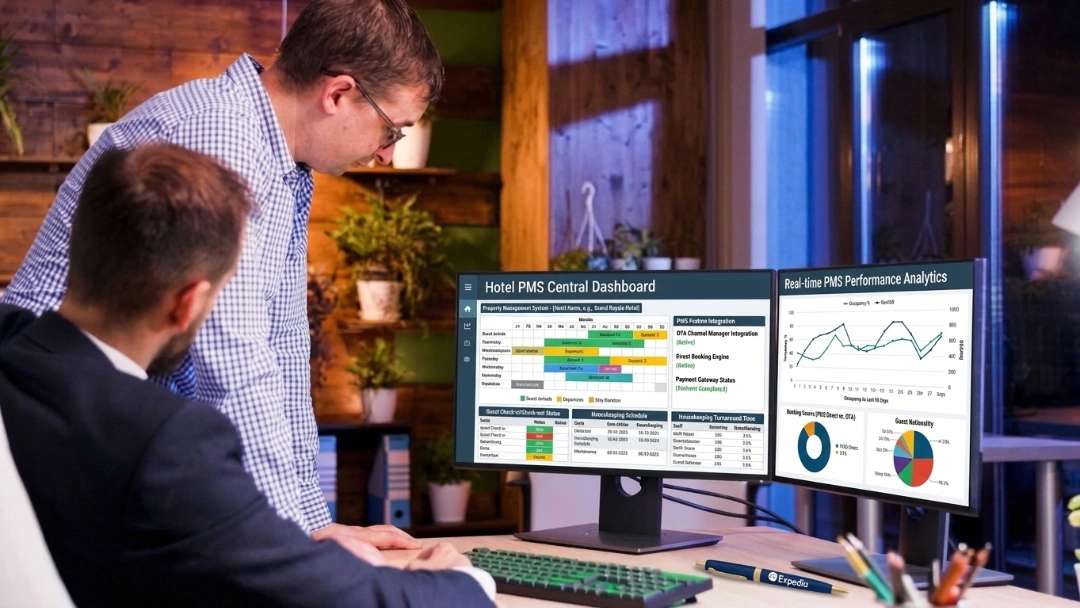
A hotel management system centralizes and automates your daily operations, from bookings and check-in to billing, housekeeping, and distribution. Here is what an HMS is, how it works, and how to choose the right one in 2026.
What it is: all-in-one software that centralizes bookings, front desk, billing, housekeeping, and channel distribution.
HMS vs PMS: the terms are often used interchangeably. PMS classically means the front-desk core, while HMS implies the broader platform around it.
How it works: connected modules share one source of truth, so a booking updates availability, folios, and housekeeping automatically.
Types: cloud-based, on-premise, or hybrid, and all-in-one versus modular best-of-breed setups.
Why it matters: it saves staff time, prevents overbookings, lifts revenue, and improves the guest experience.
What Is a Hotel Management System (HMS)?
A hotel management system is an all-in-one software platform that automates and centralizes a hotel's daily business operations. Instead of juggling separate tools and spreadsheets, you run reservations, front-desk check-ins, billing, housekeeping, and distribution from one connected system.
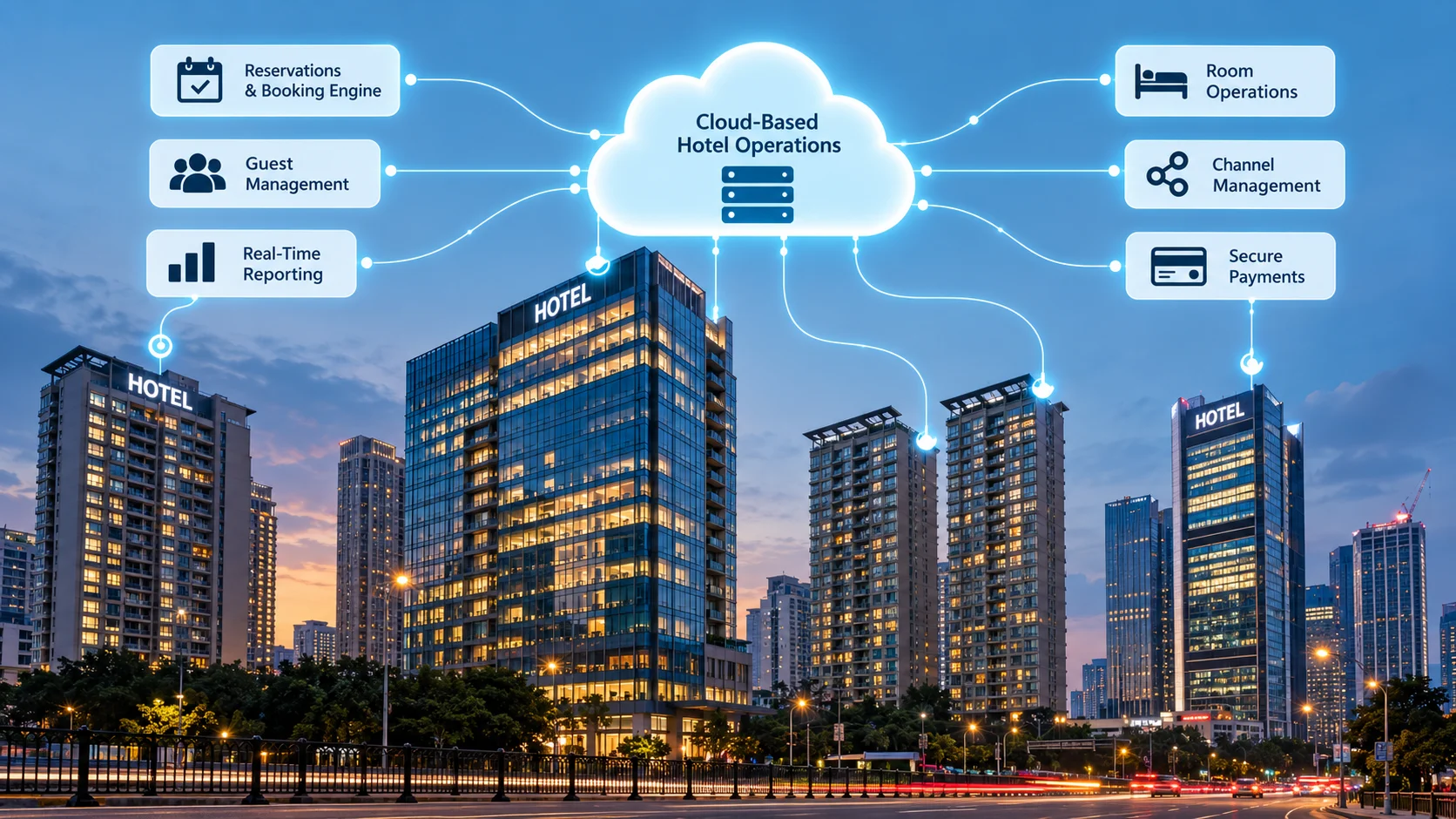
Most modern systems are cloud-based, which means they live online rather than on a server in your building. Staff log in from any device, every department sees the same live data, and updates happen in real time. That makes an HMS the operational core for lodging properties of all sizes, from a single independent hotel to a multi-property group.
HMS vs PMS: What's the Difference?
This is the most common point of confusion, and the honest answer is that the two terms overlap and are frequently used interchangeably.
Property management system (PMS): classically refers to the front-desk core, reservations, check-in and checkout, room assignments, housekeeping, and billing.
Hotel management system (HMS): usually implies the broader platform built around that core, adding distribution, revenue, payments, guest experience, and reporting.
In practice, most cloud platforms marketed today do both, so a modern hotel PMS software and a modern hotel management software (HMS) describe the same thing: one connected system that runs the whole property. What matters is not the label but whether the platform covers the functions your hotel needs.
Core Functions And Components Of A Hotel Management System
A complete hotel management system is not one tool but a set of connected modules working from the same data. The property management system sits at the center, and the other components extend it into distribution, revenue, marketing, and guest experience. Here is what each one does.
1. Property management system (PMS)
The operational core of the platform and the system your team uses every shift. It ties the front desk, housekeeping, and finance together so every department works from the same live data. Everything below is either part of the hotel PMS software or connects directly to it, which is what makes the whole system act as one.
{{pms-one}}
2. Reservations
Manages online bookings, tracks room availability in real time, and prevents double-booking. Every reservation, from any source, lands in one calendar, so you always know what is sold and what is open. Because availability updates the moment a room is booked, you avoid the double-sold rooms that lead to walked guests and bad reviews.
3. Front desk
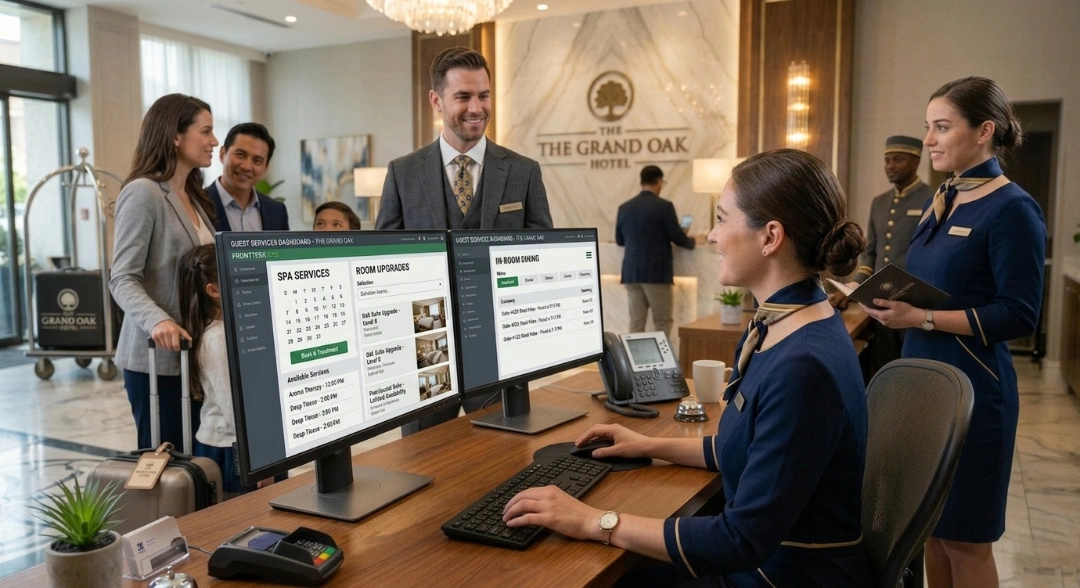
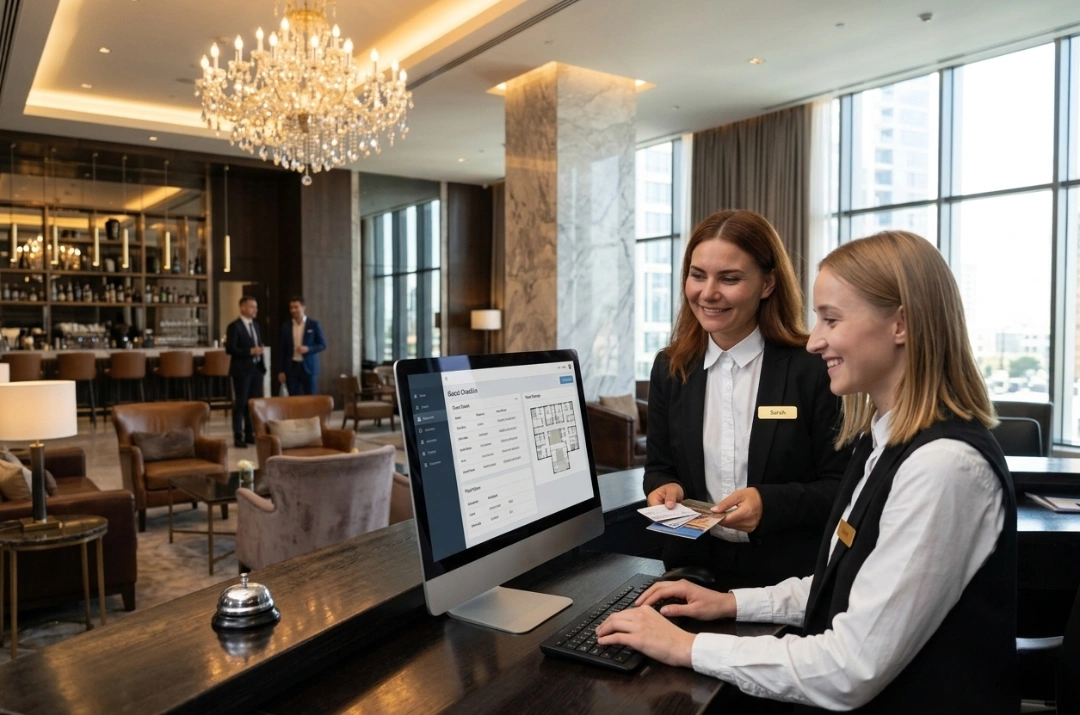
handles guest check-ins, checkouts, and room assignments. It gives staff a single screen to see arrivals, departures, and room status, so the busiest part of the day runs smoothly. Guest details, folios, and preferences are all in one place, which speeds up check-in and removes the scramble of hunting through separate systems.
4. Channel manager
syncs your rates and availability across OTAs like Expedia, Booking.com, and Airbnb to prevent double bookings. Update a rate or close out a date once in the PMS, and the change reflects everywhere automatically, with no logging into each extranet. Bookings from every channel also flow straight back into the system, so inventory stays accurate across your entire distribution.
5. Booking engine
powers direct reservations through your own website with no third-party commission. It turns your site into a real sales channel, capturing guest and payment details straight into the PMS. Every direct booking you win this way is revenue you keep in full instead of paying an OTA commission on it.
{{booking-engine-one}}
6. Hotel Metasearch
A hotel metasearch module places your direct rate on comparison platforms like Google Hotel Ads, Trivago, and Tripadvisor, right beside the OTAs. Because it connects to your live rates and availability, the price travelers see is always accurate, and the click routes straight to your booking engine. That lets you win high-intent shoppers as direct, commission-free bookings instead of handing them to an OTA.
7. Hotel Revenue Management
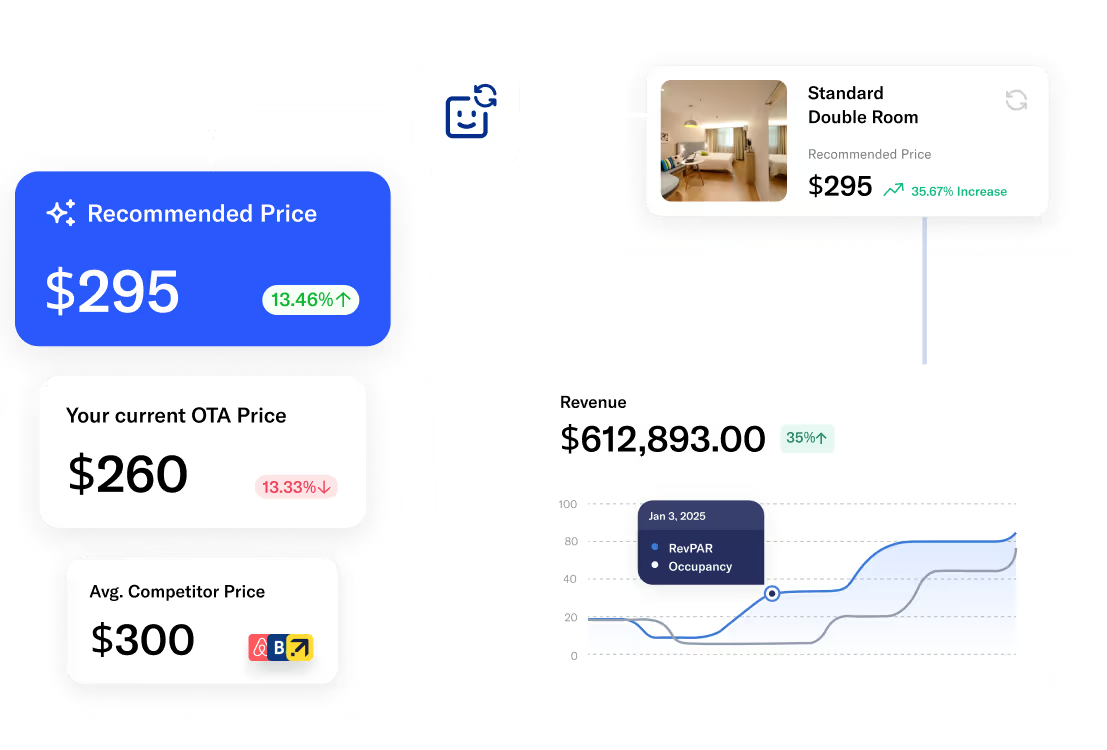
A hotel revenue management module analyzes demand, historical data, and market signals to recommend the right price at the right time, then pushes those rates back to the PMS and every channel automatically. Instead of setting prices by hand or leaving money on the table, you capture more revenue on high-demand dates and fill rooms on slow ones. It gives independent hotels the kind of pricing intelligence that large brands rely on.
8. Hotel Website Builder
A hotel website builder lets you create a fast, mobile-friendly hotel website that connects directly to your booking engine, so browsing turns into booking without friction. Because the site and the PMS share the same rates and availability, guests always see accurate pricing, and every direct reservation flows straight into the system. A branded, conversion-focused website is the foundation for reducing OTA dependence and growing direct revenue.
9. Guest Management
A hotel guest management or CRM module unifies data from every reservation and stay into a single guest profile. That gives you one clear view of preferences, history, and contact details, which you can use to personalize service, run loyalty and marketing campaigns, and turn first-time bookers into repeat, direct guests. Instead of scattered records, every department works from the same guest picture.
10. AI Concierge
A hotel AI concierge handles guest questions and requests automatically, around the clock, across channels like chat and messaging. It draws on reservation and profile data to answer accurately, take simple requests, and free your front desk from repetitive queries, while escalating anything that needs a human. The result is faster responses, smoother stays, and staff who can focus on in-person service.
11. Housekeeping and maintenance
updates staff instantly on which rooms are clean, dirty, or under repair. Room statuses change in real time as guests check out and rooms are serviced, so the front desk always knows what is ready to sell. Maintenance issues can be flagged and tracked in the same place, which keeps out-of-order rooms from being booked by mistake.
12. Billing and payments
processes credit cards, tracks guest folios, and generates financial reports. Charges from the room and connected outlets post to a single folio, so checkout is fast and accurate. Payments, deposits, and refunds are handled in one place, and the numbers feed straight into your financial reporting without manual re-entry.
13. Reporting and analytics
pulls data from every module into one view of occupancy, revenue, and performance. Instead of stitching together spreadsheets from separate tools, you get accurate, real-time reports on metrics like occupancy, ADR, and RevPAR. That single source of truth lets you make pricing and staffing decisions based on real numbers.
{{hotel-website-builder-two}}
How Does A Hotel Management System Work?
An HMS works by connecting its modules so information flows automatically instead of being re-entered by hand. Every module reads from and writes to one shared source of truth, so a change in one place updates everywhere.
Here is a typical flow. A guest books a room, whether on an OTA, through your booking engine, or at the front desk:
The reservation is recorded and room availability drops across every channel at once, so the room cannot be sold twice.
A guest profile and folio are created, ready for charges throughout the stay.
Housekeeping sees the arrival and updates room status as it is cleaned and readied.
At checkout, payments process and post to the folio, and the stay feeds into your reports.
Because the modules talk to each other, your team never opens a second system to keep data aligned. For a deeper look at how these connections are built, see our guide to hotel PMS integration.
Types Of Hotel Management Systems
Hotel management systems differ in two main ways: how they are hosted, and how they are built.
Cloud-based: hosted online by the vendor and accessed through a browser or app. Automatic updates, mobile access, and easier integration make this the standard for most hotels today.
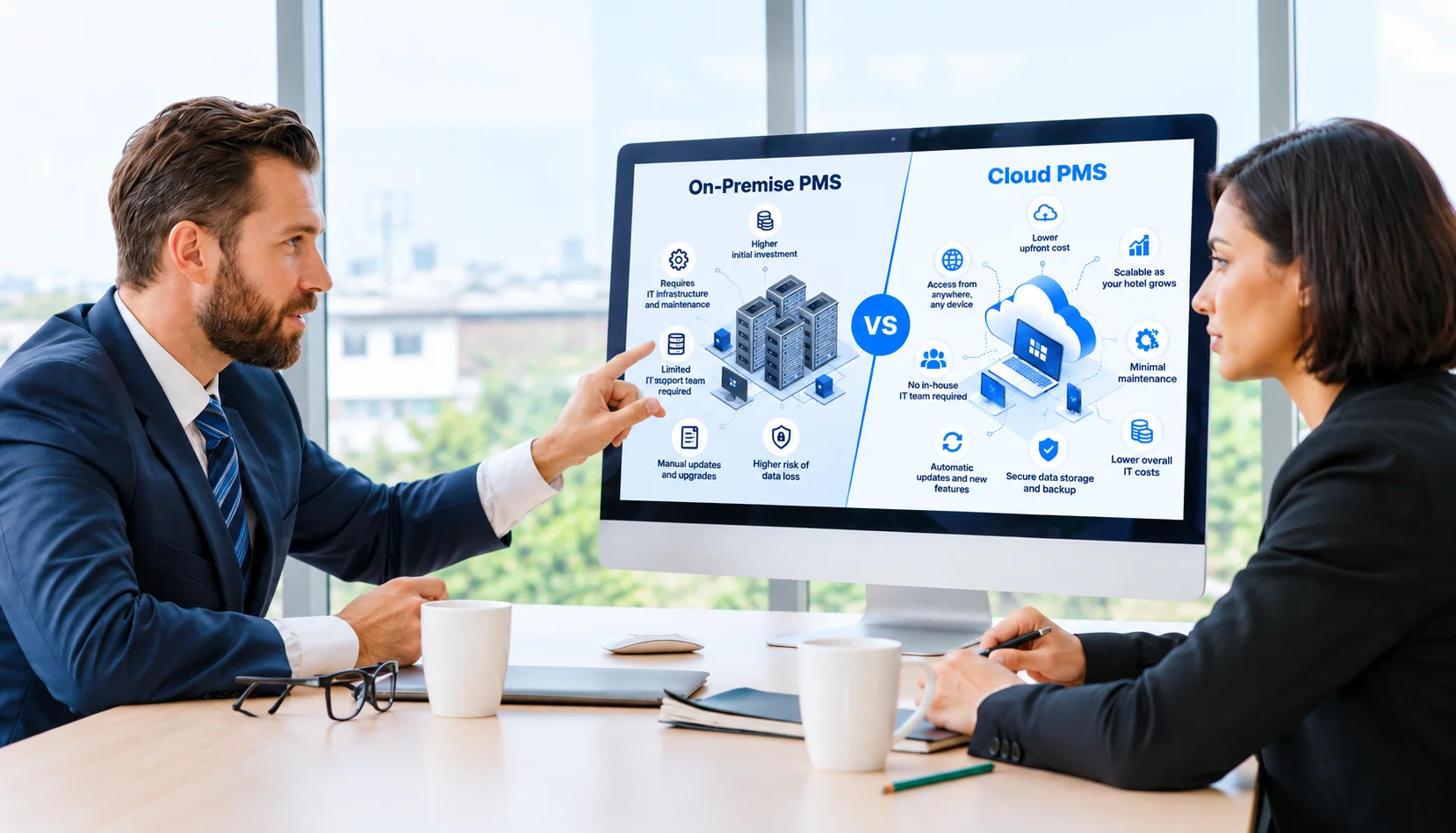
On-premise: installed on servers inside the property, giving full local control but requiring in-house maintenance and manual updates.
Hybrid: a mix, with some functions local and others in the cloud.
By build, you will also choose between an all-in-one platform, where reservations, distribution, payments, and more come from one vendor, and a modular or best-of-breed setup, where you connect specialist tools through integrations. All-in-one is simpler to run, while best-of-breed offers more choice at the cost of more connections to manage.
Cloud-Based Vs On-Premise Hotel Management Systems
For most properties the real decision is cloud versus on-premise. Here is how they compare.
Aspect
Cloud-Based HMS
On-Premise HMS
Access
From any device, anywhere
Only on-site machines
Updates
Automatic, included
Manual, often paid
Upfront cost
Lower, subscription based
Higher, hardware and licenses
Maintenance
Handled by the vendor
Handled by your team
Integrations
Easier through APIs
More limited
Data and backups
Encrypted, backed up in the cloud
Your responsibility
For most independent and mid-size hotels, a cloud-based HMS wins on cost, flexibility, and ease of maintenance. On-premise mainly suits properties with specific control or connectivity requirements.
{{pms-five}}
Key Benefits Of A Hotel Management System
A hotel management system (HMS), often called a property management system (PMS), is an all-in-one software platform that centralizes and automates a hotel's daily operations, from reservations and front-desk check-in to billing, housekeeping, and distribution across booking channels. Most modern systems are cloud-based, so staff can run the property from any device while every department works from the same real-time data. It is the operational core for lodging businesses of all sizes.
Saves time: automates routine admin so staff spend less time on paperwork and more with guests.
Fewer errors: centralizes data so departments like the front desk and housekeeping stay aligned.
Stops overbooking: updates inventory across every channel the moment a room is sold.
Improves pricing and revenue: uses demand data and dynamic pricing to adjust rates, and drives more direct, commission-free bookings.
Better guest experience: faster check-in, smoother payments, and personalized service from unified guest data.
Scales with you: add properties, tools, and services without rebuilding your setup.
Essential Integrations For A Complete HMS Ecosystem
Even an all-in-one HMS gets stronger when it connects to the other tools you use. The most valuable integrations include the channel manager, booking engine, payment gateway, POS, revenue management, and CRM, so data flows across your whole stack instead of sitting in silos. For the full breakdown of each connection and how the data moves, see our guide to hotel PMS integration.
How To Evaluate Hotel Management Software
When comparing systems, weigh them on what actually affects daily operations:
Ease of use: staff should learn it quickly, since a hard-to-use system slows everyone down.
Integration compatibility: it should connect to the tools you already rely on.
Feature fit: it should cover the functions your property type needs, no more, no less.
Support quality: responsive, hospitality-aware support and smooth onboarding.
Scalability: it should grow with you as you add rooms or properties.
Total cost: weigh subscription, setup, and any per-transaction fees against the value delivered.
Run Your Whole Property On One Platform
A hotel management software replaces scattered tools and manual work with one connected platform, so your team spends less time on admin and more on guests. roommaster brings reservations, the booking engine, channel manager, payments, and revenue management into a single cloud platform built for independent and mid-size hotels and groups, with 100+ integrations so the rest of your stack connects cleanly. The result is fewer errors, more direct bookings, and a clear view of your whole operation.
{{cta-strip}}
Frequently Asked Questions
1. What is a hotel management system?
A hotel management system (HMS) is an all-in-one software platform that centralizes and automates a hotel's daily operations, including reservations, front-desk check-in, billing, housekeeping, and distribution across booking channels. Most modern systems are cloud-based, so staff can run the property from any device using one shared source of data.
2. What is the difference between an HMS and a PMS?
The terms overlap and are often used interchangeably. A property management system classically refers to the front-desk core, reservations, check-in, housekeeping, and billing, while a hotel management system implies the broader platform around it, adding distribution, revenue, and guest experience. Most modern cloud platforms do both.
3. What are the main features of a hotel management system?
The core features are reservations, front desk, a channel manager, a booking engine, housekeeping and maintenance, and billing and payments, plus reporting. Larger platforms add metasearch, revenue management, a website builder, a CRM or guest-management layer, and an AI concierge, all sharing the same data.
4. Is a cloud-based hotel management system better than on-premise?
For most hotels, yes. Cloud-based systems cost less upfront, update automatically, are accessible from any device, and integrate more easily. On-premise systems give more local control but require in-house maintenance and manual updates, which mainly suits properties with specific requirements.
5. How much does a hotel management system cost?
Pricing depends on your property size, the modules you need, and the deployment model. Cloud systems typically use a subscription, sometimes with setup and per-transaction fees, while on-premise systems carry higher upfront hardware and license costs. Compare total cost against the time saved and revenue gained.
6. What is the best hotel management system?
The best HMS is the one that fits your property type, covers the features you need, integrates with your existing tools, and scales as you grow. For independent and mid-size hotels and groups that want operations, distribution, payments, and revenue in one connected platform, roommaster is a strong choice.
Mayela Lozano is a content strategist with a passion for hospitality and technology. She collaborates with roommaster on content creation, highlighting how technology can streamline hotel operations and enhance guest satisfaction. When she’s not creating content, Mayela loves to travel and spend time with her two little ones, discovering new adventures and making memories along the way.
Join Thousands of Hotels Thriving with roommaster
The transition to roommaster is straightforward and efficient. Our implementation team handles data migration including reservations, guest profiles, and historical information.
The transition to roommaster is straightforward and efficient. Our implementation team handles data migration including reservations, guest profiles, and historical information.
Hotel Check-In Kiosk: Enhance the Guest Experience
October 5, 2026
Hospitality Technology
Hotel Management
Hospitality Trends
Hotel Self Check-In: How It Works, Types, Benefits And Setup
October 1, 2026
Hotel Management
Hospitality Trends
Hotel Check-In & Check-Out Times Explained
October 1, 2026
Cloud PMS
Cloud PMS vs On-Premise PMS: A Complete Comparison For Hotels
October 1, 2026
Hospitality Trends
Hotel Management
Cloud-Based Property Management System: Hotel PMS
October 1, 2026
General
Cloud PMS
AI
Cloud Computing In The Hospitality Industry: A Complete Guide For Hotels
October 1, 2026
Hospitality Trends
Hotel PMS
Cloud PMS
Hotel PMS Integration: How It Works for Hotels
September 23, 2026
Hospitality Trends
Hospitality Technology
Hotel PMS
Hotel Management
Cloud PMS
How Hotel PMS Software Transforms Hospitality Management
September 23, 2026
Hotel Management
Marketing
Pet-Friendly Hotel Amenities & Package Ideas That Drive Revenue
September 22, 2026
Hotel Management
Hotel PMS
Hotel Food And Beverage (F&B): The Complete Guide
September 22, 2026
Join Thousands of Hotels Thriving with roommaster
See how roommaster's unified platform can work for your property. Our team will walk you through features tailored to your specific needs and operations.




.png)
.png)
.png)