10 Best Hotel Management Software 2026: Hotelier's Choice
Hotel management software (HMS) maximizes revenue, enhances guest experiences, and streamlines daily hotel operations, such as front desk tasks, guest check-ins/outs, bookings, channel distribution, housekeeping, and payment processing, syncing real-time rates and availability across booking channels and OTAs.
Best 10 hotel management platforms hotels actually use in 2026, ordered by property size: 1. roommaster, 2. Cloudbeds, 3. WebRezPro, 4. Seekda, 5. Oracle OPERA Cloud, 6. Mews, 7. Stayntouch, 8. Little Hotelier, 9. RoomRaccoon, and 10. Hotelogix. Selecting the right system depends heavily on your property size and specific operational needs:
Independent Hotels & Mid-Sized Properties (20 to 100 rooms): You need robust, scalable hotel PMS systems with dynamic pricing, channel management, and a built-in booking engine, all in one platform that grows with you. Look at roommaster, Cloudbeds, WebRezPro, and Seekda.
Large Hotels & Enterprise Groups (100+ rooms or multi-property): Focus shifts to multi-property consolidation, deep configurability, standardized reporting, and guest-experience customization. Look at Oracle OPERA Cloud, Mews for cloud-native management and self-service kiosks, and Stayntouch.
Small Properties & B&Bs (under 20 rooms): Prioritize simplicity and ease of use, with an integrated channel manager that prevents double bookings without overwhelming a small team. Look at Little Hotelier, RoomRaccoon, and Hotelogix.
What Is Hotel Management Software?
Hotel management software (HMS) is a cloud-based platform that helps hoteliers run front-desk operations, manage room inventory, and handle reservations, billing, housekeeping, and payments from anywhere. By unifying the PMS, channel manager, and booking engine in one dashboard, it syncs rates and availability across OTAs like Expedia, Booking.com, and Airbnb in real time.
{{pms-one}}
How We Chose The Right Software For Every Property Type and Size
The right HMS depends on the size of your property and how your team actually works. Below, each segment is broken down by the roles that own operations, the KPIs they are judged on, the features that move those numbers, and the software that fits.
Independent Hotels & Mid-Sized Properties (20 to 100 rooms)
Role
Goals and KPIs
Features that deliver those goals
Hotel Owner (Independent or Small Group)
Run the property on one system instead of five, reduce OTA commission dependence, keep software that scales when they add rooms or a second property, and see clear ROI, all measured in RevPAR, GOPPAR, direct-versus-OTA mix, and cost of acquisition.
All-in-One PMS + Booking Engine + Channel Manager, Integrated Payments, Multi-Property Support for small groups, Reporting & Analytics, Revenue Management.
General Manager
One clear picture of rate, occupancy, and operations, less daily manual work, fast onboarding, and results they can defend to ownership, all measured in RevPAR, ADR, Occupancy, and staff hours saved.
Front Desk Operations, Housekeeping Management, Demand-Based Pricing, Dashboards & Reporting, Ease of Use & Onboarding Speed.
Front Desk / Reservations Manager
Bookings and rates flowing between the PMS and every channel with no re-keying, no overbookings, clean rate parity, fast check-in, and more business shifting to direct, all measured in check-in time, sync reliability, overbooking rate, and direct-booking share.
Two-Way PMS Sync, Channel Manager & OTA Distribution, Commission-Free Booking Engine, Group Booking & Folio Management, Guest Communication.
Which software is suitable:roommaster, Cloudbeds, WebRezPro, and Seekda.
{{pms-two}}
Large Hotels & Enterprise Groups (100+ rooms or multi-property)
Role
Goals and KPIs
Features that deliver those goals
Multi-Property Owner / Management Company
Consolidate performance across every property, standardize operations and brand standards across sites, reduce total software cost, and see portfolio results remotely, all measured in Portfolio RevPAR, GOPPAR, TRevPAR, and cost per occupied room.
Run a secure, reliable, cloud-native system with minimal on-site hardware, control access across sites, integrate with the existing stack (POS, door locks, accounting, CRS), and hit uptime and compliance targets, all measured in uptime, PCI DSS compliance, integration reliability, and IT tickets.
Cloud Infrastructure & Uptime SLA, Open API & Deep Integrations, PCI DSS-Compliant Payments, Two-Way PMS Sync, Enterprise Security & Access Controls.
General Manager
Hold consistent service and pricing standards across the portfolio, cut training time on new sites, and reduce firefighting from overbookings and rate mismatches, all measured in RevPAR, ADR, Occupancy, and guest satisfaction scores.
Self-Service Kiosks & Mobile Check-In, Housekeeping Automation, Guest CRM & Profiles, Reporting Dashboards, Ease of Use & Onboarding Speed.
Which software is suitable: Oracle OPERA Cloud, Mews, and Stayntouch.
Small Properties & B&Bs (under 20 rooms)
Role
Goals and KPIs
Features that deliver those goals
Owner-Operator
Manage bookings, guests, and payments without a big team or a steep setup, avoid double bookings across OTAs, and keep the tech affordable, all measured in Occupancy, ADR, and time spent on admin.
Simple Front Desk & Calendar, Integrated Channel Manager, Direct Booking Engine, Integrated Payments, Fast Setup & Ease of Use.
Front Desk Manager / Lead
Rooms, rates, and guest details that stay in sync automatically, and pricing and status that stay out of the way at the desk, all measured in sync reliability, overbooking rate, and check-in speed.
Two-Way OTA Sync, Drag-and-Drop Calendar, Housekeeping Status Updates, Guest Profiles & Messaging.
Which software is suitable: Little Hotelier, RoomRaccoon, and Hotelogix.
Best Hotel Management Software: At a Glance
Below we compare the best hotel management software (HMS) side by side (key features, what it solves and for whom, best-fit property type, and ratings) so you can shortlist the two or three worth a demo.
Run the whole property on one platform, cut admin and training time, reduce OTA commissions, and scale from one property to a group with no re-platforming.
All-in-one PMS, native channel manager & booking engine, AI insights
Unify operations and distribution in one native system for independents that want everything in one place.
Independent & mid-sized, all-in-one
Capterra 4.3 / G2 4.3
WebRezPro
Full-featured cloud PMS, deep reporting, OTA connectivity
Run robust front-desk and back-office operations with strong reporting at independent and mid-sized properties.
Independent & mid-sized hotels
Capterra 4.5 / Software Advice 4.6
Seekda
Booking engine, channel manager, website & distribution tools
Grow direct bookings and manage distribution for independent European hotels.
Small, Independent & mid-sized hotels
Seekda cites a 40% market share among hotels in Austria and 4,000+ hotels served globally as its primary trust signal.
Oracle OPERA Cloud
Enterprise PMS, deep configurability, global standardization, broad integrations
Standardize operations across a large portfolio and run complex multi-property and franchise setups.
Large chains & enterprise portfolios
Capterra 4.2 / G2 4.0
Mews
Cloud-native PMS, self-service kiosks, open API, automated operations
Modernize the front desk, automate check-in and payments, and connect a large app marketplace.
Cloud-native mid-market to enterprise
Capterra 4.4 / G2 4.3
Stayntouch
Mobile-first guest journey, mobile check-in/out, guest-facing kiosks
Deliver a contactless, guest-centric front desk and lighten desk load at high-volume properties.
Guest-experience-led hotels & groups
Capterra 4.7 / G2 4.6
Little Hotelier
Small-property PMS, integrated channel manager, direct booking page
Manage a small property and stop double bookings without a heavy system or a big team.
B&Bs, motels & small hotels
Capterra 4.0 / G2 4.1
RoomRaccoon
All-in-one PMS for small hotels, channel manager, booking engine, payments
Automate the front desk and distribution for a lean team with a modern, easy interface.
Small & boutique hotels
Capterra 4.4 / G2 4.5
Hotelogix
Cloud PMS with reliable offline mode, channel manager, POS
Run affordable, dependable operations, including where the internet is unstable.
Budget-conscious & connectivity-limited
Capterra 4.3 / G2 4.2
Top Hotel Management Software (HMS) Providers
Here are the best hotel management software platforms in 2026, grouped by the property type they serve best. Each entry covers what it does, the problem it solves, who it fits, pricing, and reviews, so you can shortlist the two or three worth a demo.
Independent Hotels & Mid-Sized Properties (20 to 100 rooms)
1. roommaster: Best for small, independent hotels & groups that want one platform for the whole property
Independent and mid-sized hotels often lose time and revenue running the front desk, distribution, payments, and reporting in separate tools that do not talk to each other. roommaster was built to close that gap. It is a cloud-based hotel management software platform that unifies the PMS, booking engine, channel manager, payments, revenue management, and guest app in one system, so bookings, rates, and guest data share a single source of truth and updates flow to every channel and back to the PMS with no re-keying. Built by hoteliers with 30+ years in the industry, it scales from a boutique property to a small group without re-platforming.
Key features: Front-desk operations and reservations, integrated channel manager (hundreds of OTAs and GDS), commission-free booking engine, roommaster Payments, revenue management, housekeeping, guest communication, and hundreds of built-in reports, all in one cloud platform.
What it solves: Run the whole property on one system instead of stitching five together, reduce OTA commissions with direct bookings, cut admin and training time, and keep software that scales as you grow. Owners see it in RevPAR, GOPPAR, direct-booking share, and cost of acquisition.
Best for: Small hotels, independent hotels, and mid-sized properties, including boutique hotels, motels, inns, B&Bs, resorts, and hotel groups.
Pricing: Custom quote based on room count; available as one unified platform or by product.
Reviews: G2 4.5, Capterra 4.3, and Software Advice 4.3, backed by 30+ years in hospitality, a 97% client retention rate, and 99.95% uptime. Hotels report 50% faster check-in, 40% fewer admin tasks, and 50% reduced training time.
"We’ve trusted roommaster for over 25 years. It keeps our entire hotel group running smoothly with everything we need in one easy-to-use system" - Jorge Venegas, General Manager, NUVO Suites
{{pms-five}}
2. Cloudbeds: Best for independents that want everything native in one system
Cloudbeds is an all-in-one hotel property management software platform with a PMS, channel manager, and booking engine built natively together. Because operations and distribution share one system, there is no separate integration to maintain, which suits independent and mid-sized properties that want everything under one roof. Its AI-driven insights help forecast demand and guide pricing, and a large partner marketplace extends it to POS, payments, and guest apps.
Key features: Native PMS, channel manager, and booking engine, AI insights, marketplace integrations, unified reporting, integrated payments.
What it solves: Unify front desk and distribution in one native system and cut the double handling of managing two platforms. For a GM who wants operations and channels in one place, it keeps focus on RevPAR, ADR, Occupancy, and TRevPAR without extra admin.
Best for: Independent and mid-sized properties that want operations and distribution unified natively.
Pricing: Custom quote; strongest value bundled as the full platform.
Reviews: Capterra 4.3 and G2 4.3 from a large review base, one of the bigger verified samples here.
Looking for a Cloudbeds alternative? See how roommaster stacks up on finance-grade reporting, group billing, and hospitality-trained support in our full Cloudbeds alternatives guide.
3. WebRezPro: Best for robust operations with deep reporting
WebRezPro is a full-featured cloud-based property management software known for operational depth and strong reporting. It handles the front desk, back office, and OTA connectivity for independent and mid-sized properties that want a dependable workhorse hotel PMS software rather than a stripped-down tool. Reviewers consistently point to its reporting depth and reliable OTA sync.
Key features: Cloud PMS, front-desk and back-office operations, deep reporting, OTA and channel connectivity, integrated payments, group booking management.
What it solves: Run robust day-to-day operations with reporting a GM can defend to ownership. For properties that have outgrown a basic tool, it supports Occupancy, ADR, and staff efficiency with detailed back-office control and clean audits.
Best for: Independent and mid-sized hotels that want operational and reporting depth.
Pricing: Custom quote based on property size.
Reviews: Strong ratings on Capterra and Software Advice; verify current scores before publishing.
Looking for a WebRezPro alternative? See how roommaster stacks up on finance-grade reporting, group billing, and hospitality-trained support in our full WebRezPro alternatives guide.
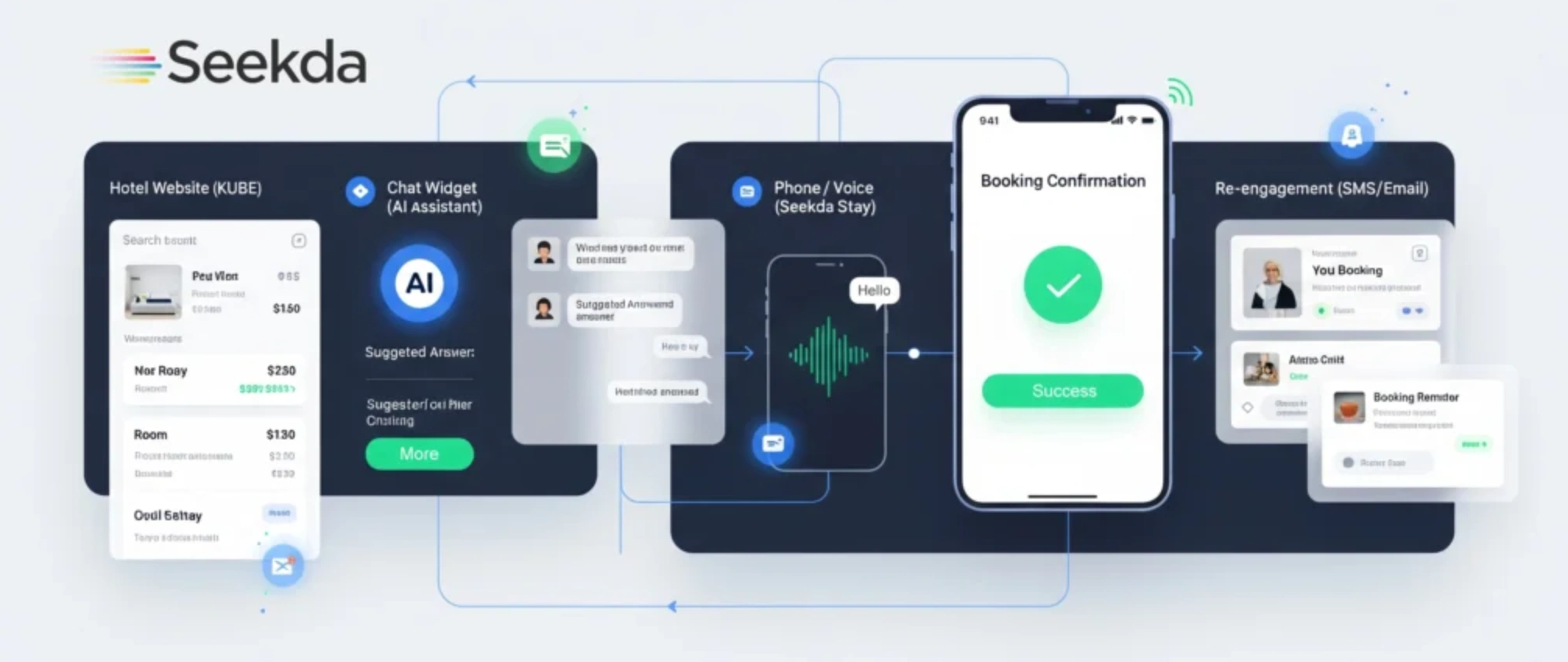
4. Seekda: Best for European independents focused on direct bookings
Seekda is a European hotel software provider focused on distribution and direct bookings, with a booking engine, channel manager, and website and metasearch tools for independent hotels. Its footprint is strongest in the DACH region, and it appeals to independents that want to grow direct revenue and manage channels from one provider rather than assembling several tools.
Key features: Booking engine, channel manager, website solutions, metasearch and Google connectivity, distribution management.
What it solves: Grow direct bookings and control distribution across OTAs and metasearch for independent European properties, reducing reliance on high-commission channels. It supports direct-booking share, ADR, and Occupancy.
Best for: Small, Independent & mid-sized hotels
Pricing: Custom quote based on property size and modules.
Reviews: Seekda cites a 40% market share among hotels in Austria and 4,000+ hotels served globally as its primary trust signal.
{{pms-four}}
Large Hotels & Enterprise Groups (100+ rooms or multi-property)
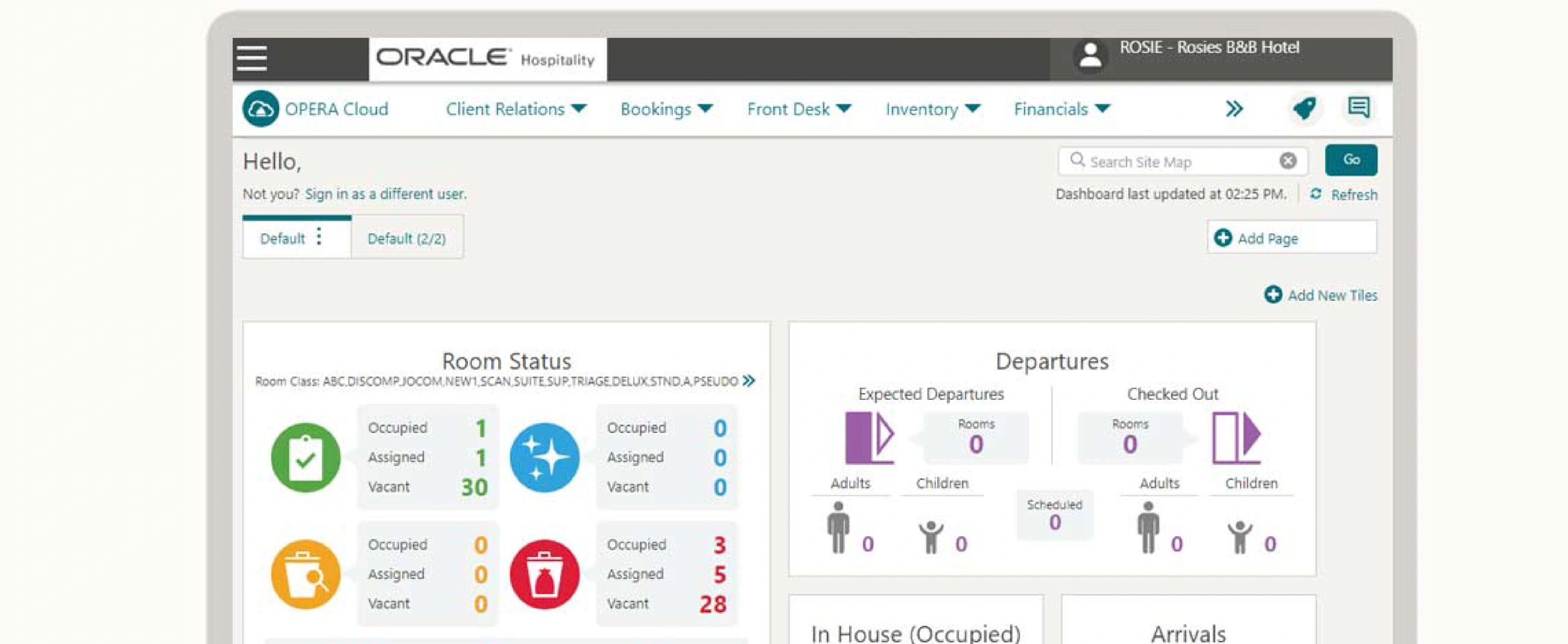
1. Oracle OPERA Cloud: Best for large chains & enterprise portfolios
Oracle OPERA Cloud is the long-standing enterprise standard among hotel PMS systems, built for the hardest operational problems: large room counts, complex franchise and brand-standard requirements, multiple revenue centers, and deep integration across an enterprise stack. Major chains and management companies rely on it to standardize operations and reporting across many properties from one system.
Key features: Enterprise cloud PMS, multi-property and franchise configuration, deep reporting, extensive certified integrations, role-based access.
What it solves: Standardize operations, brand standards, and reporting across a large portfolio, and run complex setups lighter systems cannot. When you operate hundreds of rooms across several sites, corporate IT and ownership need one configurable system of record, so Portfolio RevPAR, GOPPAR, and consolidated reporting all sit in one place.
Best for:Large hotels, resorts, and multi-property enterprise groups.
Pricing: Custom, enterprise-level quote based on portfolio size and modules.
Reviews: Widely adopted at enterprise scale; confirm current directory ratings, since general-directory coverage is lighter than its market footprint.
Looking for an Oracle OPERA alternative? See how roommaster stacks up on finance-grade reporting, group billing, and hospitality-trained support in our full Oracle OPERA alternatives guide.
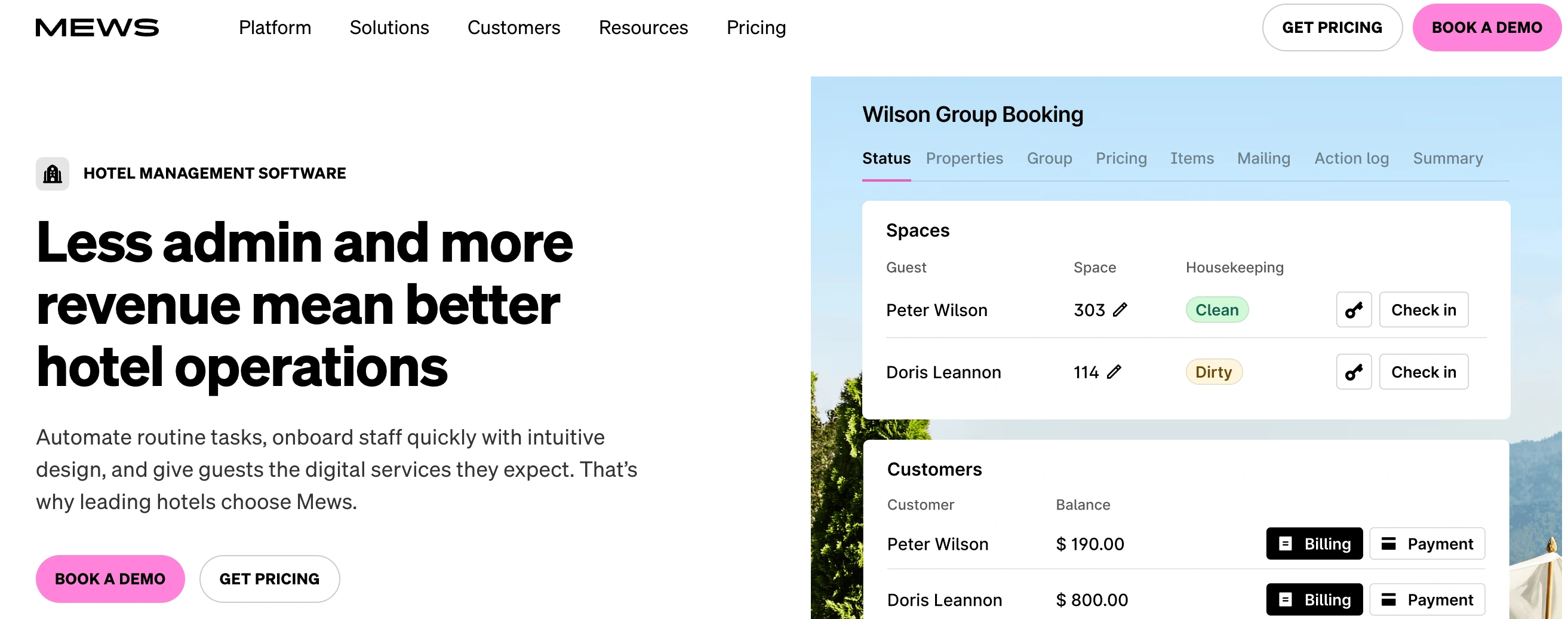
2. Mews: Best for cloud-native operations & self-service
Mews is a cloud-native hotel management system built to modernize and automate the front desk. Its strengths are self-service kiosks, automated check-in and payments, and an open API with a large app marketplace, which appeals to operators who want to reduce manual desk work and assemble their own tech stack. It scales from ambitious independents up to multi-property groups.
Key features: Cloud-native PMS, self-service kiosks and mobile check-in, open API and app marketplace, automated payments, multi-property support.
What it solves: Modernize and automate operations, cut repetitive desk tasks, and connect a wide ecosystem of apps. For GMs and corporate ops lifting throughput without adding headcount, it keeps RevPAR, ADR, Occupancy, and check-in time moving in the right direction.
Best for: Cloud-first hotels and groups that want automation and an open ecosystem.
Pricing: Custom quote based on property size and modules.
Reviews: Strong ratings on general directories; verify current scores before publishing.
Looking for a Mews alternative? See how roommaster stacks up on finance-grade reporting, group billing, and hospitality-trained support in our full Mews alternatives guide.
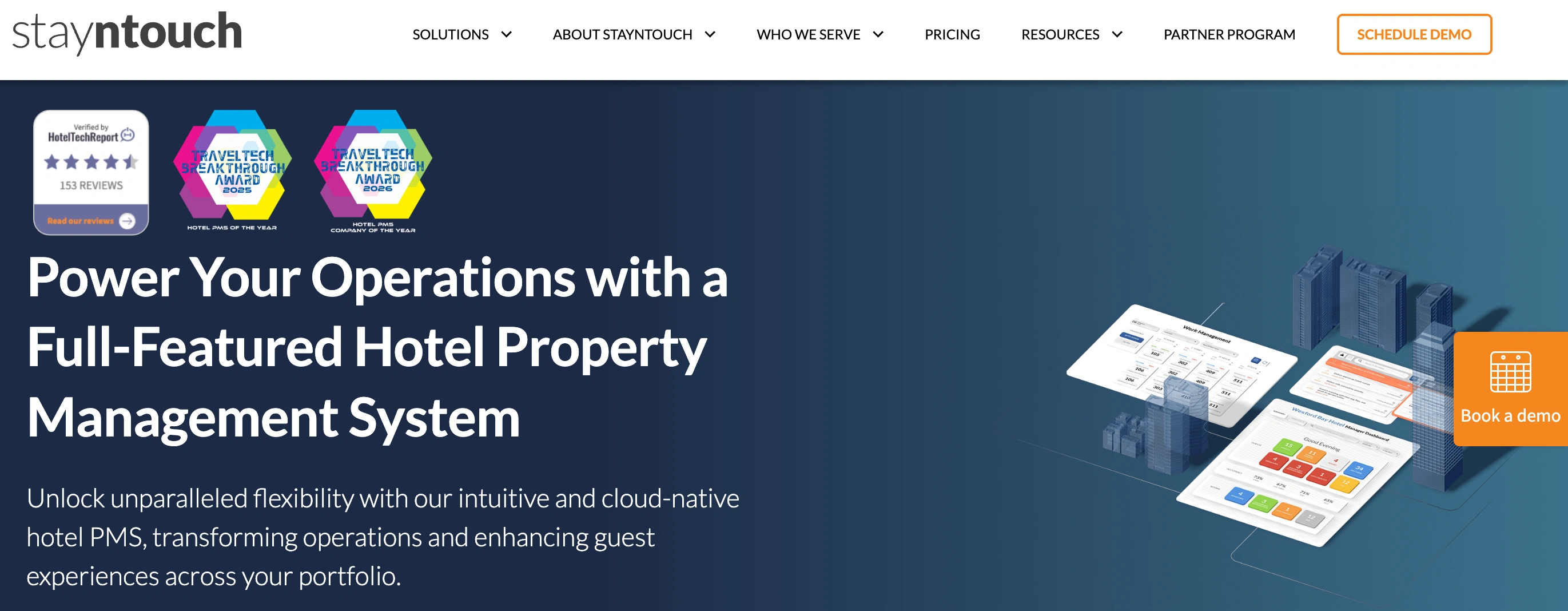
3. Stayntouch: Best for a mobile-first, guest-centric front desk
Stayntouch is a guest-centric hotel property management system built around a mobile-first journey: mobile check-in and checkout, guest-facing kiosks, and a front desk that can operate from a tablet anywhere in the lobby. It suits properties and groups that compete on guest experience and want to lighten desk load at high-volume arrival times.
Key features: Mobile-first PMS, mobile check-in and checkout, self-service kiosks, guest profiles, OTA and integration connectivity.
What it solves: Deliver a contactless, guest-led arrival and free front-desk staff from queues. When the front desk manager's priority is a fast, personal welcome, it moves guest satisfaction scores and check-in time while keeping Occupancy and ADR healthy.
Best for: Guest-experience-led hotels and groups.
Pricing: Custom quote based on property size and modules.
Reviews: Consistently high guest-experience ratings; confirm current directory scores.
Looking for a Stayntouch alternative? See how roommaster stacks up on finance-grade reporting, group billing, and hospitality-trained support in our full Stayntouch alternatives guide.
Small Properties & B&Bs (under 20 rooms)
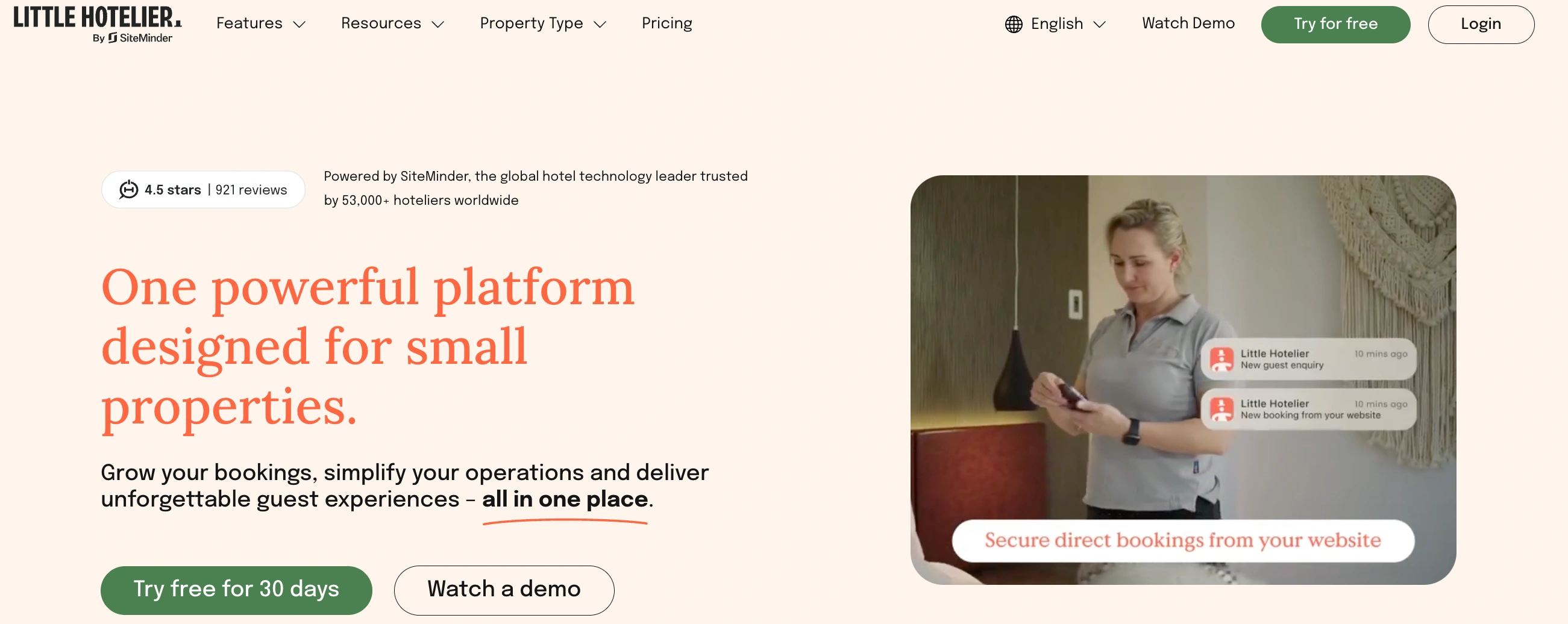
1. Little Hotelier: Best for small hotels, B&Bs & motels
Little Hotelier is purpose-built for small properties and lean teams. It pairs a simple hotel management solution with an integrated channel manager and a direct booking page, so an owner-operator can manage bookings and stop double bookings without a complex system or a dedicated team. Its appeal is speed and simplicity: set up fast and run the day from one screen.
Key features: Small-property PMS, integrated channel manager, direct booking page, simple front-desk calendar, guest messaging.
What it solves: Manage a small property end to end and prevent double bookings across OTAs, without overwhelming a small team. It keeps Occupancy and admin time under control for owners who wear every hat.
Best for: B&Bs, motels, guesthouses, and small hotels.
Pricing: Tiered pricing with an accessible entry level.
Reviews: Popular among small properties; verify current directory scores.
Looking for a Little Hotelier alternative? See how roommaster stacks up on finance-grade reporting, group billing, and hospitality-trained support in our full Little Hotelier alternatives guide.
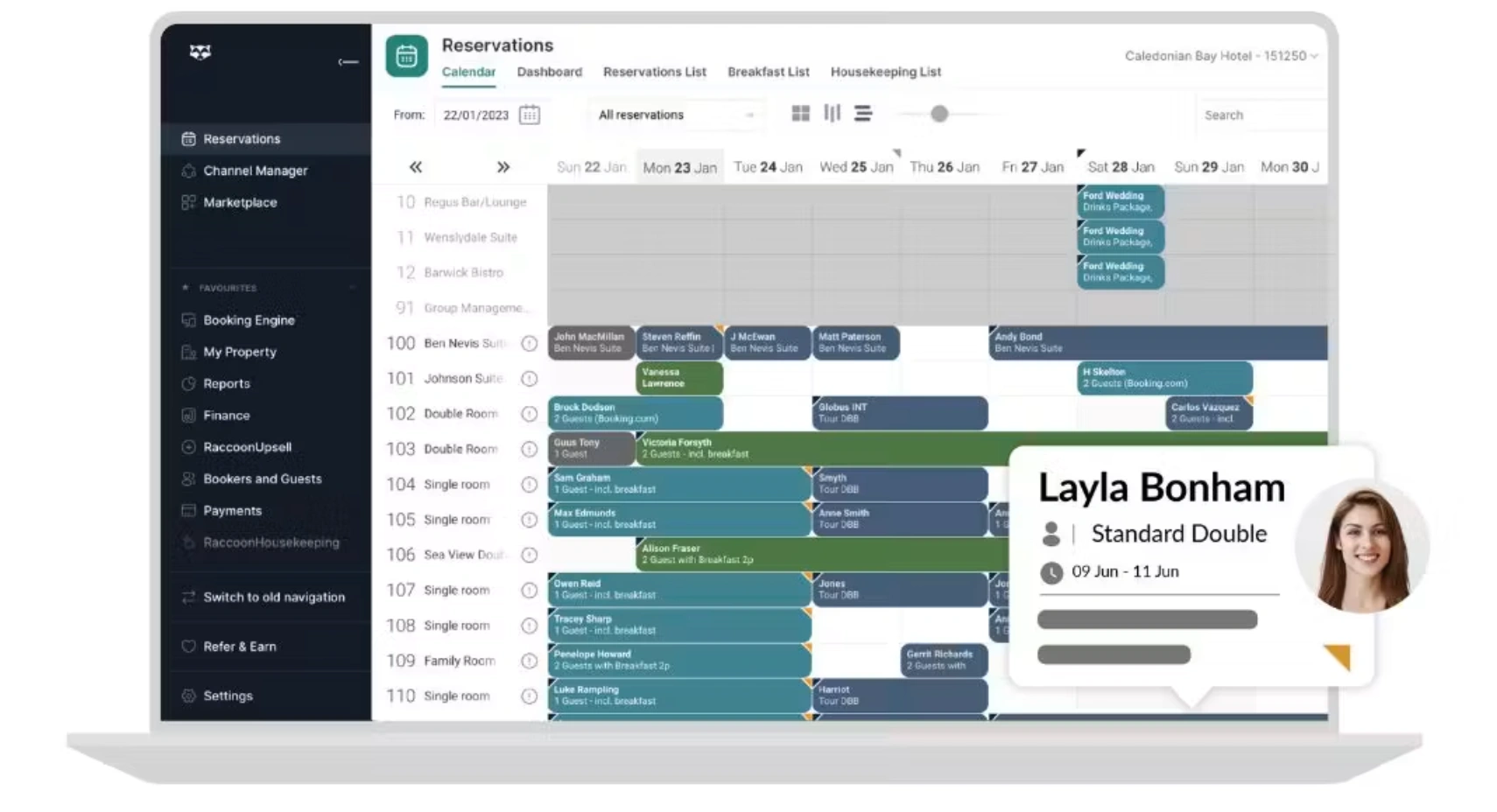
2. RoomRaccoon: Best for small & boutique hotels that want automation
RoomRaccoon is an all-in-one hotel software for small and boutique hotels, combining a PMS, channel manager, booking engine, and payments in a modern, easy interface. It appeals to lean teams that want more automation than a basic tool offers without stepping up to enterprise complexity. Reviewers highlight its clean design and fast onboarding.
Key features: All-in-one PMS, channel manager, booking engine, integrated payments, automation for a small team.
What it solves: Automate the front desk and distribution for a lean team and shift more business to direct. It supports Occupancy, ADR, and direct-booking share while keeping daily admin light.
Best for: Small and boutique hotels that want an easy all-in-one.
Pricing: Tiered, quote-based by property size.
Reviews: Strong ratings for ease of use; confirm current scores.
Looking for a RoomRaccoon alternative? See how roommaster stacks up on finance-grade reporting, group billing, and hospitality-trained support in our full RoomRaccoon alternatives guide.
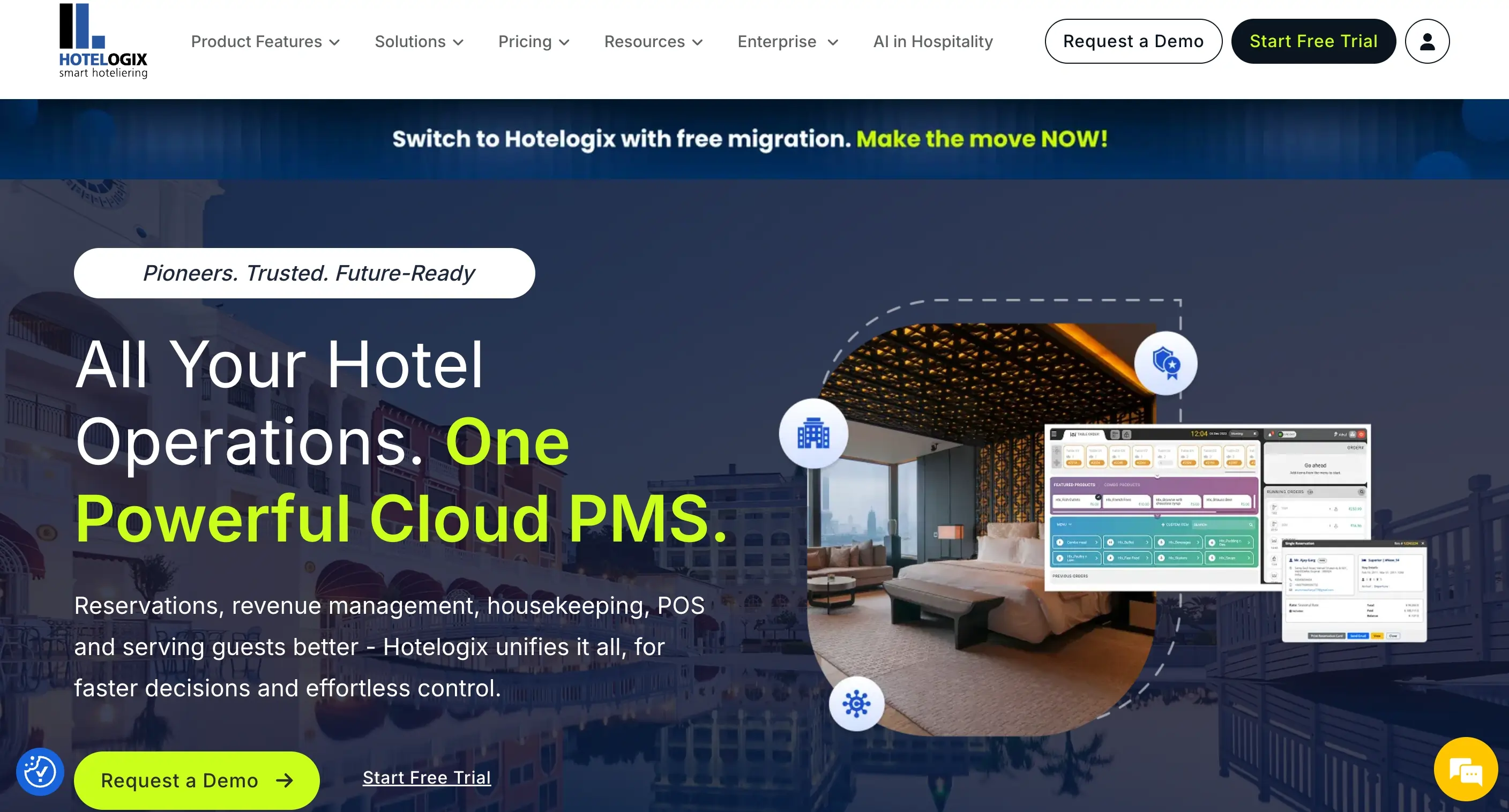
3. Hotelogix: Best for budget-conscious & connectivity-limited properties
Hotelogix is a cost-effective cloud PMS and one of the more accessible hotel industry software options, with a reliable offline mode, a channel manager, and a POS. It suits properties that are price-sensitive or operate where the internet is unstable, so the front desk keeps running even when connectivity drops. That offline capability is its standout differentiator for hotels in remote or emerging markets.
Key features: Cloud PMS with offline mode, channel manager, POS, front-desk operations, OTA connectivity.
What it solves: Run affordable, dependable operations, including in areas with unstable internet, without losing front-desk continuity. It keeps Occupancy and daily operations steady on a lean budget.
Best for: Budget-conscious properties and those in connectivity-limited locations.
Pricing: Accessible, tiered pricing.
Reviews: Solid ratings across directories; verify current scores.
Looking for a Hotelogix alternative? See how roommaster stacks up on finance-grade reporting, group billing, and hospitality-trained support in our full Hotelogix alternatives guide.
{{cta-strip}}
Frequently Asked Questions
1. What is hotel software?
Hotel software, or a hotel management system (HMS), is a cloud-based platform that runs a hotel's daily operations and guest experience. It unifies the front desk, reservations, housekeeping, billing, channel manager, booking engine, and payments in one dashboard, and syncs rates and inventory in real time across OTAs and booking channels.
2. What is hotel management software?
A cloud-based platform that centralizes and automates daily hotel operations, front-desk tasks, reservations, billing, housekeeping, and payments, and syncs rates and availability across booking channels, replacing manual and disconnected tools.
3. What is a hotel management system?
A hotel management system (HMS), also called a property management system (PMS), is the digital platform at the center of a hotel's operations. It unifies reservations, front desk, billing, housekeeping, and channel distribution in one dashboard.
4. What software do most small hotels, independent hotels, and mid-sized properties use?
The right HMS depends on your property size and type. For small hotels, independent hotels, mid-sized properties, and hotel groups, roommaster is a strong choice because it unifies the PMS, booking engine, channel manager, and payments in one platform that scales as you grow.
5. What software do most hotels use?
Most hotels run on a property management system (PMS), the central operational software that handles bookings, check-ins, billing, and housekeeping. The specific platform depends heavily on the hotel's size and whether it is an independent property or a global chain.
6. What is the difference between a PMS and hotel management software?
In practice the terms are used interchangeably. A property management system (PMS) is the core of hotel management software; a full HMS usually adds a channel manager, booking engine, payments, and reporting around that PMS core.
7. What are the core features to look for in hotel management software?
A property management system, a channel manager, a direct booking engine, integrated payments, a guest CRM, housekeeping and maintenance tools, and reporting and analytics. Verify two-way PMS and channel sync first.
8. What is cloud-based property management software?
A hotel PMS hosted in the cloud that lets you run the front desk, manage room inventory, and take payments online from anywhere, with automatic updates, no on-site servers, and instant sync across booking channels.
9. What are the common types of PMS?
The two most common are Hotel & Resort PMS, built to manage on-site room inventory, event spaces, food and beverage charges, and front-desk check-ins, and Vacation Rental PMS, which focuses on properties managed for homeowners, with trust accounting, unified messaging inboxes, and smart lock integrations.
11. What are the core KPIs for hotel management software?
RevPAR, ADR, and Occupancy are primary. Operators also track TRevPAR, GOPPAR, direct-versus-OTA booking mix, check-in time, overbooking rate, staff hours saved, and guest satisfaction scores.
12. Does hotel management software integrate with OTAs?
Yes. A built-in channel manager syncs availability and rates in real time across OTAs like Expedia, Booking.com, and Airbnb, so inventory updates everywhere the moment a room is sold, which prevents overbooking.
Mayela Lozano is a content strategist with a passion for hospitality and technology. She collaborates with roommaster on content creation, highlighting how technology can streamline hotel operations and enhance guest satisfaction. When she’s not creating content, Mayela loves to travel and spend time with her two little ones, discovering new adventures and making memories along the way.
Join Thousands of Hotels Thriving with roommaster
The transition to roommaster is straightforward and efficient. Our implementation team handles data migration including reservations, guest profiles, and historical information.
The transition to roommaster is straightforward and efficient. Our implementation team handles data migration including reservations, guest profiles, and historical information.
Hotel Check-In Kiosk: Enhance the Guest Experience
October 5, 2026
Hospitality Technology
Hotel Management
Hospitality Trends
Hotel Self Check-In: How It Works, Types, Benefits And Setup
October 1, 2026
Hotel Management
Hospitality Trends
Hotel Check-In & Check-Out Times Explained
October 1, 2026
Hospitality Trends
Hotel Management
Cloud-Based Property Management System: Hotel PMS
October 1, 2026
Hotel Management
Cloud PMS
Hotel Management System (HMS): A Complete Guide
September 23, 2026
Hospitality Trends
Hospitality Technology
Hotel PMS
Hotel Management
Cloud PMS
How Hotel PMS Software Transforms Hospitality Management
September 23, 2026
Hotel Management
Marketing
Pet-Friendly Hotel Amenities & Package Ideas That Drive Revenue
September 22, 2026
Hotel Management
Hotel PMS
Hotel Food And Beverage (F&B): The Complete Guide
September 22, 2026
Hotel Management
Marketing
Hotel Pet Fees: How Much Should You Charge?
September 22, 2026
Hotel Management
Hotel PMS
Best Hotel Food and Beverage (F&B) Management Software In 2026
September 22, 2026
Join Thousands of Hotels Thriving with roommaster
See how roommaster's unified platform can work for your property. Our team will walk you through features tailored to your specific needs and operations.


.png)
.png)
.png)