The main advantages of hotel management software are that it centralizes daily operations, syncs rates and availability across booking channels in real time, grows direct bookings, and turns scattered data into reports you can act on. For an independent or boutique hotel, that means fewer manual tasks at the front desk, fewer overbookings, and a clearer picture of where revenue comes from.
{{revenue-management-one}}
What are the advantages of hotel management software?
The advantages of hotel management software fall into three buckets: it saves staff time, it protects and grows revenue, and it improves the guest experience. Below is a quick reference tying each advantage to what it does and why it matters to a working property.
| Advantage |
What it does |
Why it matters |
| Automated daily operations |
Handles reservations, room assignment, and billing |
Frees staff for guest-facing work |
| Real-time channel sync |
Updates rates and availability across OTAs at once |
Prevents overbookings and rate mismatches |
| Higher direct bookings |
Takes reservations through your own booking engine |
Cuts commission paid to OTAs |
| Revenue management |
Guides rates by demand, season, and occupancy |
Protects ADR and RevPAR |
| Guest personalization |
Stores preferences, history, and requests |
Builds loyalty and repeat stays |
| Housekeeping coordination |
Flags checkouts and room status live |
Turns rooms faster, fewer errors |
| Reporting and analytics |
Compiles occupancy, ADR, and revenue reports |
Faster, better decisions |
| Payment security |
Processes and stores payment data to standard |
Reduces compliance and fraud risk |
| Faster onboarding |
Standardizes workflows for new staff |
Shorter training time |
| Scalability |
Adds rooms or properties on one system |
Grows with the business |
{{pms-one}}
How does hotel management software improve daily operations?
It improves operations by putting front desk, reservations, housekeeping, and accounting on one connected system, so information moves between departments without re-keying. When a guest checks out early, housekeeping sees the room status change immediately and can prepare it for the next arrival.
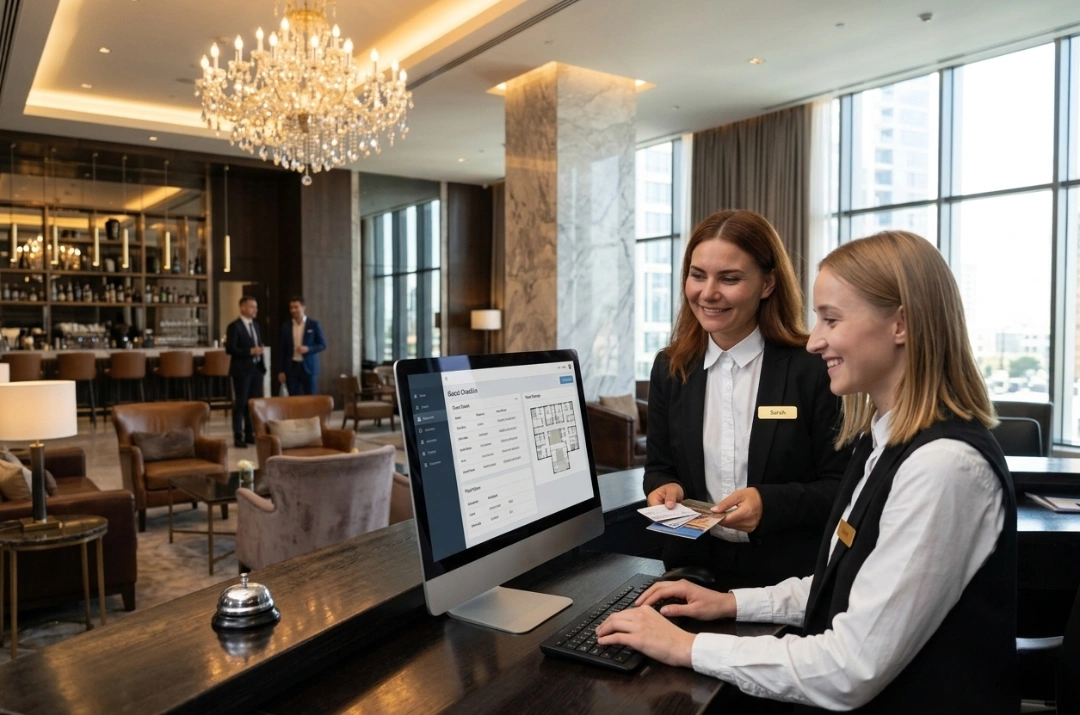
A modern property management system automates the repetitive front desk work that used to eat the morning: confirmation emails, room assignments, folio postings, and the night audit. Staff spend less time on data entry and more time with guests, which is where a smaller property competes.
Housekeeping is a clear example. Instead of a printed sheet that goes stale by mid-morning, housekeeping software shows live room status to the front desk and cleaners at the same time. That shared view cuts the phone calls between departments and the guesswork over which rooms are ready.
There is a labor-cost angle too. When one system covers reservations, billing, and reporting, a lean team can run a full property without adding headcount as occupancy climbs. The saving is in hours reclaimed, not in cutting the people guests actually meet.
{{pms-two}}
How does hotel management software increase revenue and direct bookings?
It increases revenue two ways: it moves bookings to lower-cost channels and it helps you price rooms to demand. Both add margin without adding rooms.
Start with distribution. A channel manager pushes one rate and availability update to every connected OTA at once. That single source of truth prevents the double-bookings and rate-parity slips that happen when someone updates each site by hand.
Direct bookings are the bigger prize. Every stay booked through your own booking engine skips OTA commission. Take a $180 room and an OTA charging 15%: that is $27 handed over per night. Move even a handful of those stays to your own site each week and the difference funds real improvements.
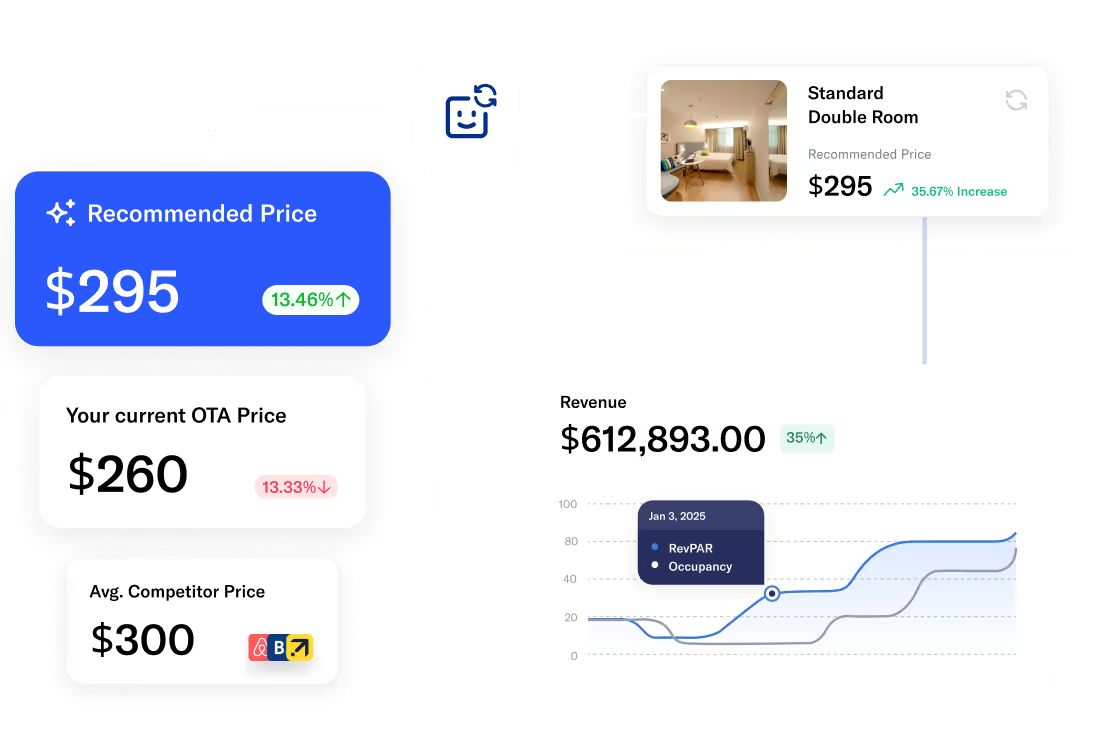
On price, built-in revenue management supports rate decisions using occupancy, season, and booking pace, so you are not leaving money on the table during a busy weekend or scaring off demand in a slow week. The goal is a defensible ADR, not a race to the bottom.
{{channel-manager-one}}
How does hotel management software improve the guest experience?
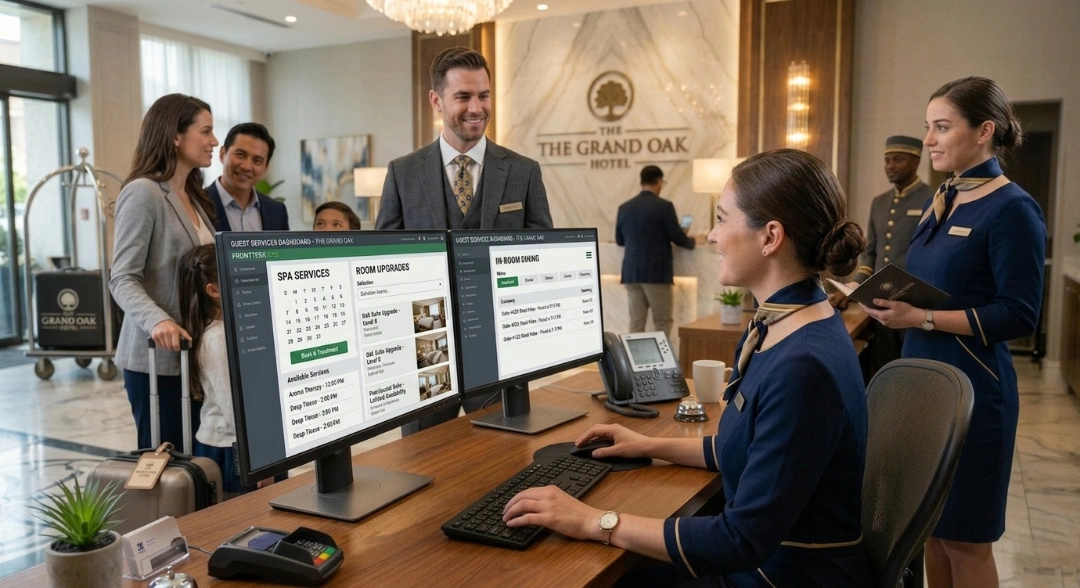
It improves the guest experience by making service faster and more personal. Reservation details, past stays, and special requests sit in one profile, so check-in takes under a minute and staff can greet a returning guest by preference rather than starting from scratch.
A guest-facing guest app extends that beyond the desk: guests can handle check-in, requests, and messaging from their phone, which suits boutique properties that run a light front-of-house team. The payoff is fewer queues at peak arrival times and more repeat stays from guests who felt recognized.
What features should hotel management software include?
Good hotel management software should include a property management core, a channel manager, a booking engine, revenue tools, payments, and reporting, plus the integrations to connect them. The features to weigh:
- Reservations and front desk: the daily operating hub for bookings, check-in, and folios.
- Channel manager and booking engine: distribution and commission-free direct sales.
- Revenue and rate tools: demand-based pricing support.
- Payments and billing: secure processing that meets card-data standards.
- Reporting and analytics: the numbers behind decisions.
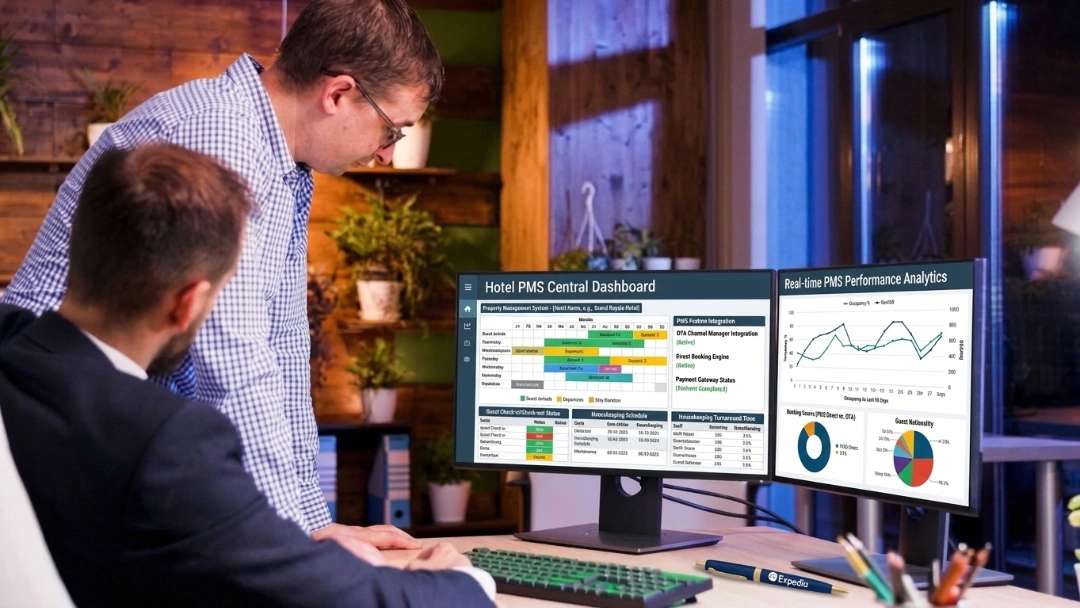
On that last point, strong reporting software compiles occupancy, ADR, RevPAR, and pickup automatically, so you review performance instead of building it in a spreadsheet. Just as important, check the integrations on offer: your PMS should connect to the accounting, payment, and guest tools you already run, because a closed system creates the manual work it was meant to remove.
Cloud vs on-premise hotel management software: which suits a hotel?
The core difference is where the software lives and how you reach it. On-premise runs on servers inside the hotel; cloud-based runs online and opens from any device with a login. For most independent properties, cloud has become the practical default.
| Factor |
Cloud-based |
On-premise |
| Access |
Any device, anywhere |
On-site only |
| Upfront cost |
Lower, subscription |
Higher, hardware |
| Updates |
Automatic |
Manual, scheduled |
| IT burden |
Vendor-managed |
In-house |
| Best fit |
Lean, multi-location teams |
Properties needing full local control |
Cloud lowered the barrier for smaller hotels to run the same tools large brands use. If you want the full trade-off, see this breakdown of cloud vs on-premise hospitality systems before you commit.
Is hotel management software worth it for small and independent hotels?
Yes, and the case is often stronger for small properties because they have the least slack in staff time and the most to lose on OTA commission. Consider a 40-room boutique hotel running at 72% occupancy with a $180 ADR.
That property sells roughly 864 room-nights a month. If OTAs handle 60% of them at a 15% commission, the hotel pays about $14,000 a month in commission. Shifting even a fifth of those stays to a direct PMS for independent hotels booking engine keeps a meaningful share of that back, which for many properties covers the software cost several times over. Add the hours reclaimed from manual admin, and the return shows up in both the ledger and the roster.
Ready to see how this maps to your property? Book a demo and walk through your own numbers with the team.
What are the disadvantages of hotel management software?
The honest trade-offs are worth naming. There is a learning curve during setup, a subscription cost to budget for, and a dependence on stable internet for cloud systems. Migrating data from an old system takes planning, and staff need time to adjust to new workflows.
None of these are reasons to stay on spreadsheets. They are reasons to choose a vendor with real onboarding support, clear pricing, and reliable uptime, and to plan the switch during a slower season rather than at peak.
How do you choose the right hotel management software?
Choose by matching the software to how your property actually runs, not to the longest feature list. Weigh these:
- Property fit: built for your size and type, whether that is a boutique hotel, motel, or group.
- Distribution: a channel manager and booking engine you will actually use.
- Integrations: connects to your accounting, payment, and guest tools.
- Support and onboarding: real help during migration and after.
- Pricing clarity: a model you can forecast, without surprise add-ons.
Shortlist two or three systems, run each against your own workflows, and involve the people who will use it daily. To see how roommaster handles the front desk, distribution, and reporting for an independent property.
{{cta-strip}}
Frequently asked questions
1. What is hotel management software?
It is a system that runs a hotel's daily operations, including reservations, front desk, housekeeping, billing, and reporting, usually with a booking engine and channel manager attached.
2. What is the difference between hotel management software and a PMS?
A property management system is the operational core. Hotel management software often describes the wider suite around it, including distribution, revenue, and guest tools.
3. How does hotel management software prevent overbookings?
A connected channel manager updates availability across every OTA in real time, so a room booked on one channel is removed from the others at once.
4. How long does it take to implement?
It varies by property size and data to migrate. Many small hotels are live within a few weeks when onboarding support and clean data are in place.
5. Is hotel management software suitable for independent hotels?
Yes. Cloud systems give smaller properties the same distribution, revenue, and reporting tools larger brands use, on a subscription that scales with rooms.
6. Does it work for multi-property groups?
Yes. Scalable systems manage several properties from one login, with shared reporting and per-property controls.
7. How does it help increase direct bookings?
A commission-free booking engine on your own site captures reservations without OTA fees, keeping more revenue per stay.


.png)
.png)
.png)