Hotel Operating Costs: Complete Guide for Hoteliers 2026
Hotel operating expenses typically consume about 60% to 63% of revenue, leaving a gross operating profit (GOP) of 37% to 40%. Labor (30% to 35%) and food & beverage are the largest cost categories.
Hotel operating costs are rarely a flat number. They are tracked as a percentage of revenue and on a per-occupied-room basis.
A well-run full-service hotel holds a gross operating profit (GOP) margin of 37% to 40%, meaning operating expenses eat roughly 60% to 63% of revenue.
Labor is almost always the single largest line, at 30% to 35% of revenue. Food & beverage is the next heaviest for full-service properties.
Fixed costs (taxes, insurance, permanent salaries, leases) stay put no matter your occupancy. Variable costs (utilities, housekeeping, supplies, OTA commissions) rise and fall with it.
The costs that sink new owners are the ones they never budgeted for: Property Improvement Plans, FF&E reserves, and commercial insurance.
The fastest way to protect margin without cutting service is to reduce admin labor, win back direct bookings, and price with real-time data. That is where the right technology pays for itself.
While many hoteliers look for quick cuts in operating costs, not every measure truly supports the property's long-term financial health. A highly strategic move to reduce hotel operating costs involves adopting a cloud-based system like a modern roommaster hotel property management system (PMS) software.
According to Gartner research, 73% of hospitality organisations increased their technology budgets in 2024, indicating that ready investment in smart systems helps reduce overall operating costs for hotels.In this article, we will explore how a cloud PMS helps independent hoteliers reduce operating costs while maintaining service quality and improving hotel profitability.
What's the Difference Between Fixed and Variable Hotel Operating Costs?
Every hotel, from a family-run inn to a luxury resort, deals with expenses that fluctuate throughout the year. Understanding the difference between fixed and variable costs is one of the most critical steps in effectively managing hotel operating costs. These two cost categories shape how hotel managers plan budgets, track spending, and maintain steady profits even when occupancy levels change.
Let’s break them down clearly so they’re easier to relate to in a hotel setting.
- Variable costs
Variable costs are expenses that change with the property's level of activity. When occupancy rates rise during peak seasons, a hotel naturally spends more on operational areas. These costs are directly tied to guest activity and day-to-day hotel operations.
Some of the common examples of variable costs include:
Labor costs, especially overtime pay for additional staff members during busy periods
Food and beverage costs that increase when restaurants or bars serve more guests
Utility costs, such as water and electricity, rise when more rooms are occupied
Housekeeping supplies and guest amenities used in each occupied room
When guest numbers drop, these expenses decline as well, allowing hotels to reduce unnecessary spending. To understand this better, imagine a 100-room property where each occupied room costs $25 in operating supplies and utilities. If 60 rooms are sold, the variable costs reach $1,500. When occupancy rises to 90 rooms, those costs climb to $2,250. The change directly reflects the level of business activity.
- Fixed costs
Fixed costs, however, remain steady regardless of how many rooms are sold. They are the backbone of hotel operations because they must be paid every month, regardless of occupancy.
Typical examples of fixed costs include:
Rent or lease payments for the hotel property
Property taxes and liability insurance fees
Equipment depreciation and monthly maintenance costs
Regular insurance premiums and administrative salaries
For instance, if the same hotel pays $12,000 each month to lease its building and $2,000 in insurance premiums, that total stays the same whether only five rooms or the entire property is booked. Since fixed expenses don’t change, they can heavily influence a hotel’s long-term financial health and profit margins.
When managers understand both cost types in detail, they gain better control over operating expenses, protect hotel profitability, and plan for sustainable success in every season.
What Percentage of Revenue Should Hotel Operating Costs Be?
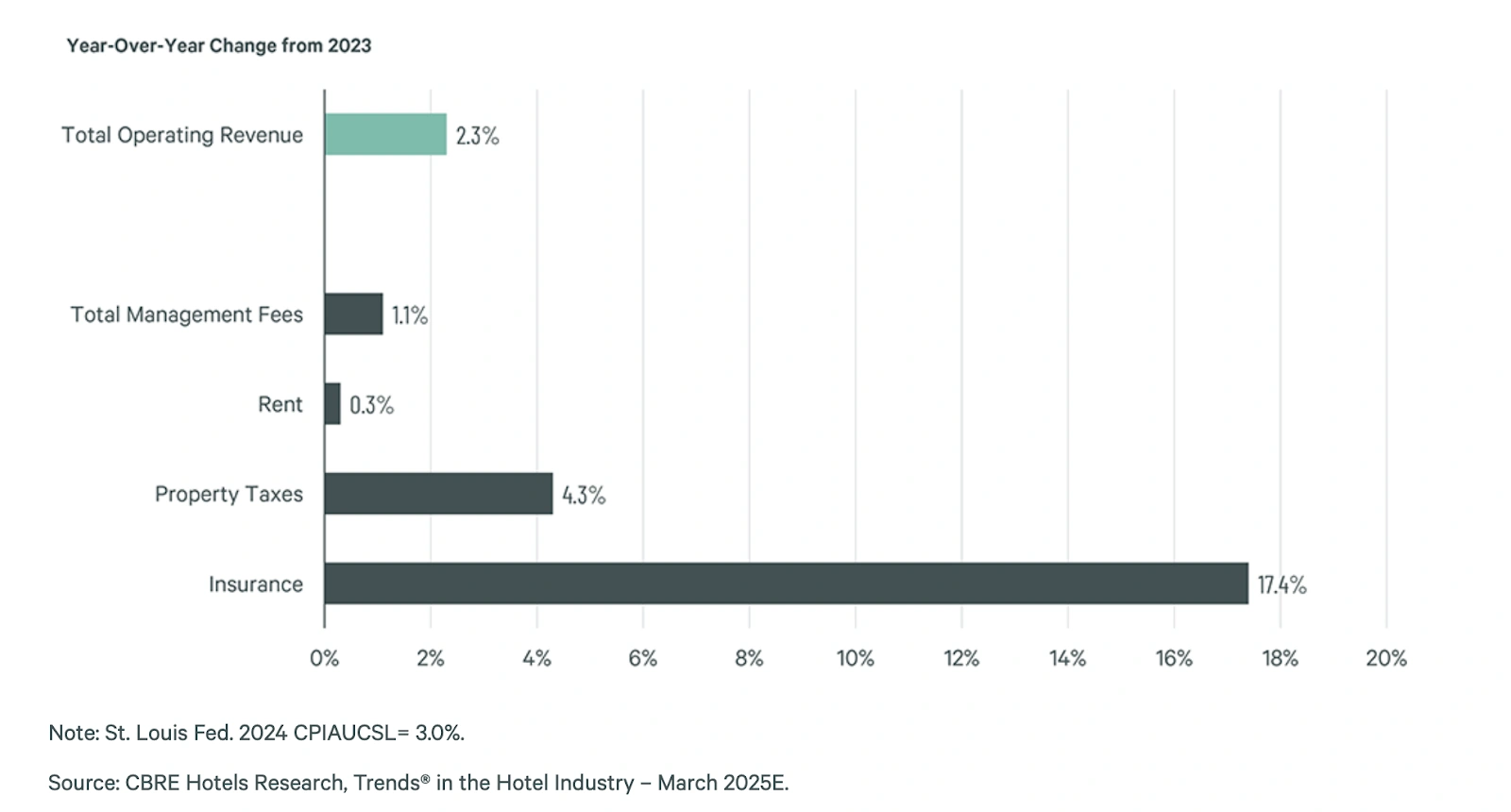
Even when revenue appears to be growing, rising hotel operating costs can quietly erode profits for any property in the hotel industry. Across many U.S. properties, total revenue rose by only about 2.3% in 2024, while operating expenses grew faster, narrowing margins.For example, one survey found that non-operating costs such as insurance premiums jumped by 17.4% even as revenue increases remained modest.
These rising financial pressures are clear in a recent breakdown of year-over-year expense changes, which shows how certain operational and non-operational costs have far outpaced modest revenue growth:
When you calculate the percentage of revenue that goes to costs, many hoteliers aim to keep total operating costs within a range that supports a healthy gross operating profit margin. Industry data suggest a gross operating profit (GOP) margin of about 25% to 35% is substantial for full-service hotels, while more limited-service properties may aim higher.If your total operating costs consume, say 65% to 75% of total hotel revenue, you may still be functional. Still, the ability to reinvest in guest experience or capture growth becomes harder when operating costs keep rising faster than revenue.
Effective cost management means looking at all items, from labor and utility costs to food and beverage and maintenance costs, to protect your property’s financial health. When cost growth outpaces revenue growth, then operational efficiency suffers, and your profit margins shrink, no matter how strong your occupancy or revenue growth looks.
What KPIs Should Hotels Track to Monitor Operating Costs?
To gauge how your hotel is tracking its operating costs and operational efficiency, you’ll want to monitor key performance indicators (KPIs) across your property and team:
Cost per Available Room (CPAR): This metric provides a full‑inventory view of cost exposure and helps identify how empty rooms continue to impact your expense base.
Formula: CPAR = Total Operating Costs ÷ Total Available Rooms
Revenue Per Available Room (RevPAR): This measures your room-revenue generation relative to available rooms. While it does not factor in expense-side metrics such as labor or utility costs, it remains a critical gauge of demand and pricing for the hotel industry.
Formula: RevPAR = Total Room Revenue ÷ Total Available Rooms OR RevPAR = Average Daily Rate × Occupancy Rate
Gross Operating Profit per Available Room (GOPPAR): This KPI builds on both revenue and expense data to reveal how well your property turns rooms into actual profit after all costs. It provides insight into whether your management team is balancing revenue growth with cost management to achieve solid hotel profitability.
Formula: GOPPAR = Gross Operating Profit ÷ Total Available Rooms
Cost per Occupied Room (CPOR): This KPI helps compare how much your team spends on every room sold and spot inefficiencies that may be eroding profit margins.
Formula: CPOR = Total Operating Costs ÷ Number of Occupied Rooms
Guest Acquisition Cost (GAC): The cost you incur for sales, marketing, and distribution to bring one guest into the hotel. It links to operating expenses such as vendor contracts, OTA commissions, and extensive marketing programs conducted by hotel operators. A rising GAC can reduce net revenue and erode profit margins.
Formula: GAC = Total Marketing & Distribution Costs ÷ Number of Guests Acquired
Additionally, you should monitor supporting metrics, such as labor costs per available room, utility costs per room, food and beverage cost ratios, maintenance costs per room, and distribution expenses, as these all feed into your hotel’s financial health. For instance, industry data show that combined salary and benefit expenses increased by 4.8 % in 2024 for U.S. hotels while total revenue rose by only 2.3 %.
Once you track these KPIs, taking action to improve profitability becomes easier with a unified hotel PMS system like roommaster PMS. This modern, cloud-native PMS combines the Operations Suite, Revenue & Finance Suite, and Marketing & Distribution Suite into a single seamless system, letting your team manage reservations, housekeeping, pricing, and guest communication from a single dashboard. Hotels using roommaster Revenue Optimization can implement automated rate adjustments based on occupancy, demand, and market trends, helping to increase RevPAR by 15–20 % in the first year.
{{pms-one}}
Meanwhile, integrated reporting and analytics reduce manual work, letting managers make faster, smarter decisions that directly impact operating costs and profit margins. With over 30 years of hospitality experience, roommaster supports independent properties and group hotels in turning KPI insights into tangible operational and financial improvements.
What are the Biggest Hotel Operating Cost Categories?
Every hotel needs to recognise the key cost buckets that drive its operating expenses so that the team can manage labor, utilities, and other costs with clarity. Below are some of the biggest operating cost categories hotels incur:
Labor and staff: This includes salaries, benefits, payroll taxes and compensation for all staff members, and it often represents the largest line item among hotel expenses.
Food & beverage and guest amenities: This covers everything from raw materials and beverage costs to kitchen labor, guest amenities, and service quality for restaurants or bars in the hotel. Many full‑service properties treat these costs as a significant part of their operations, and they directly affect guest satisfaction and repeat business.
Utility and energy: Expenses for electricity, water, sewer, heating, cooling, and other services make up the utility costs line, which can escalate quickly as guest occupancy rises or when older equipment remains in use. For instance, utility outlay increased by around 2.0 % in 2024 even as revenues grew by about 2.8 %.
Maintenance, repairs and property tax: This includes preventive upkeep, room upgrades, maintenance costs, property taxes, and insurance premiums. Because many of these fall into the hotel’s fixed costs, they have a steady impact on hotel operating regardless of occupancy.
Marketing, distribution, and guest acquisition: This covers spending on promotions, OTA commissions, vendor contracts, distribution channels, and the cost to attract each guest, also known as the guest acquisition cost. As occupancy rates and revenue growth shift, these costs can harm profitability if they rise faster than income.
Administrative and overhead costs: These include general management salaries, IT, direct booking systems, depreciation and amortisation, and insurance premiums. Many of these are under the broader umbrella of operating expenses that don’t directly tie to the number of guests but still contribute to the total burden.
If you track each of these categories carefully and benchmark them against revenue, you’ll gain a clearer view of how your hotel property is coping with cost management and whether your hotel’s financial health is headed toward sustainable growth.
How Can Hotels Reduce Operating Costs Without Sacrificing Quality?
Making small operational changes can produce significant savings and increase profits without disrupting service. These cost-cutting strategies can save time, money, and energy while keeping guests satisfied:
1. Choose a property management system that connects everything
Your property management system should tie together all departments, reduce unnecessary staff work, and keep guest information in one place. A modern, cloud-native PMS like roommaster allows hotels to integrate POS systems, accounting platforms, and guest apps, giving staff instant visibility across operations and preventing duplicate work.
Hotels that adopt a fully connected PMS can cut administrative workload by up to 30% and reallocate time to improving guest experiences, creating both efficiency and satisfaction.
2. Make mobile access a core part of operations
Letting your team use mobile devices to update room status, manage service requests, and communicate instantly can save countless hours. roommaster supports mobile workflows for housekeeping, front desk, and maintenance teams, allowing real-time updates that prevent delays and mistakes.
Hotels that use mobile systems together with a connected PMS can trim labor costs by up to 15% while ensuring staff spend more time on high-priority tasks that directly impact guest satisfaction.
3. Adjust staff schedules around real-time needs
Rigid work schedules can leave your hotel overstaffed during slow periods and understaffed during peak periods, unnecessarily increasing labor costs. With roommaster, you can access live data on occupancy and guest requests, helping managers schedule employees efficiently without compromising service.
Flexible scheduling informed by these insights can reduce overtime expenses and let your team focus on the critical areas during high-traffic hours, creating both cost savings and happier guests.
4. Track housekeeping and room priorities clearly
Not all rooms are equal, and not all cleaning tasks require the same effort. By defining clear expectations and using data to prioritize what needs complete prep vs. minimal touch, you boost productivity without adding pressure.
roommaster tracks occupancy patterns and guest needs, showing staff which rooms require complete preparation and which need minimal attention. This system prevents wasted effort and allows employees to complete more tasks in less time. Optimizing room care based on actual usage keeps labor costs lower and maintains a consistent, high-quality experience for every guest.
5. Use direct booking and guest apps to protect revenue
Relying on OTAs can cost 15-25% of potential revenue, so encouraging direct bookings is crucial. The roommaster Hotel Guest App lets guests reserve rooms, request services, and receive upgrades directly from their smartphones, keeping revenue in-house and reducing front desk workload.
The app also provides personalized offers, service requests, and mobile keys, making stays smoother for guests and boosting profitability without adding marketing costs or unnecessary staffing hours.
{{guest-app}}
How Does Technology Help Reduce Hotel Operating Costs?
Reducing technology gaps makes a big difference when you are trying to cut your hotel operating costs without lowering service quality. If your hotel property runs on an integrated cloud-native digital platform such as roommaster PMS, you set yourself up to save time, money, and keep guest satisfaction strong:
1. Streamline financial operations
Your payment processing should connect directly with your core system so accounting, reconciliation, and billing don’t create extra admin work. With roommaster hotel payment gateway, hotels eliminate manual folio entries and reconcile all channels from a single dashboard, so your team spends fewer hours chasing invoices.
When you reduce multiple systems and vendor fees, you lower your operating expenses and help protect your hotel’s financial health. Automated payment processing also reduces the risk of errors, helping prevent hidden cost leaks that erode profit margins.
2. Use revenue optimization with AI‑driven pricing
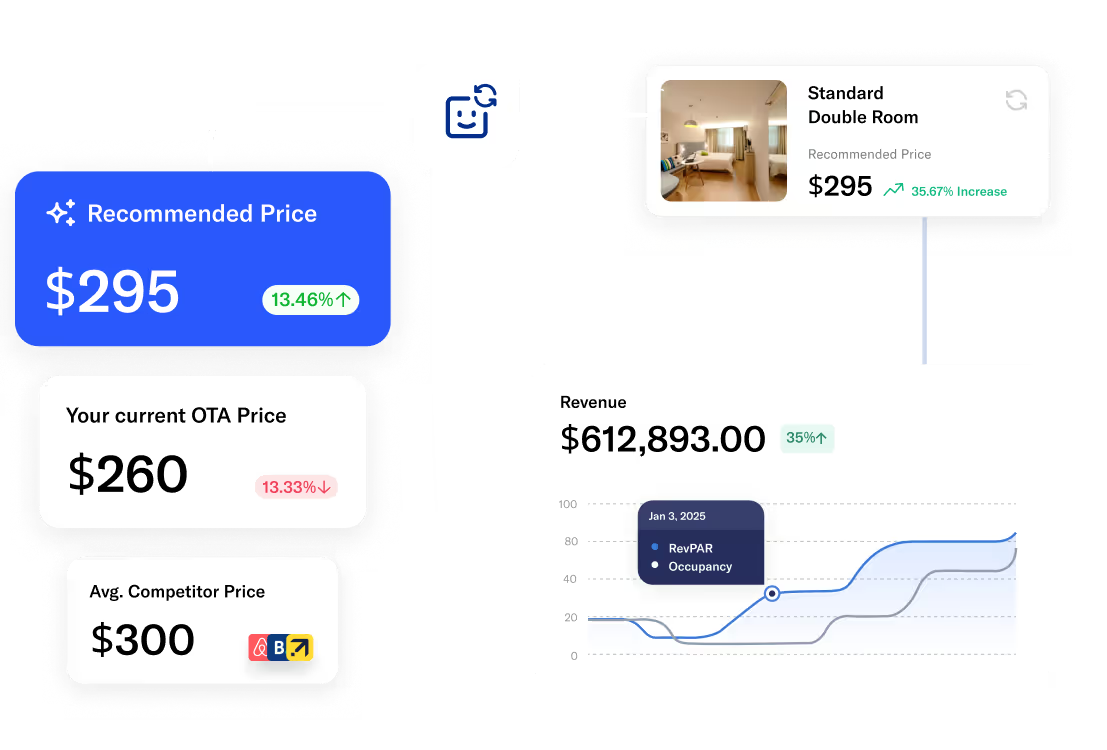
Smart pricing makes a concrete impact on your hotel's operating performance and revenue generation. The roommaster Revenue & Finance Suite integrates AI‑powered rate management and ampliphi RMS to adjust pricing based on demand, lead time, and competitive data, helping you capture more high‑value bookings.
When you combine that with control of labor costs and cost‑to‑serve data, you strengthen your hotel's profitability by hitting better rates with fewer wasted nights.
3. Expand distribution control
Managing your inventory across multiple channels while keeping costs in check matters a lot in the hospitality industry. roommaster Hotel Channel Manager links your property to hundreds of global OTAs and major GDS systems, automatically syncing rates and rooms so you avoid over‑bookings and reduce manual labor.
This platform lets you view channel‑specific performance and vendor contracts from one place, making cost management simpler and your operating costs more transparent. As your team spends less time reconciling channels, you also reduce unnecessary staffing hours and keep your cost base lower.
4. Drive more direct bookings
The best way to protect your margins and reduce cost‑to‑serve is to push guests into direct reservation paths. With roommaster Hotel Booking Engine, you get a mobile‑first booking flow, an interactive rate calendar, and upsell options that drive higher transaction values without increasing vendor fees.
When you convert more guests directly, you shrink your reliance on high‑commission channels, which is one of the largest hidden cost drivers in hotel operations. Over time, this supports above-average profit margins because you control distribution, guest experience and cost base.
5. Combine data insights and cost control
Technology alone does little unless you link it to actionable insight on your total operating costs and day‑to‑day workflows. roommaster delivers unified data from bookings to guest services, payments to housekeeping, enabling your management team to react faster and spot cost pressure earlier.
And when you pair analytics with your guest app, direct booking engine, and channel manager, you build a cost‑aware ecosystem that supports sustainable growth.
How Do You Balance Cost Reduction with Guest Experience?
Balancing cost reduction with a great guest experience requires careful planning and technology choices. Using roommaster PMS, hotels can reduce operating costs while keeping guests happy, and these strategies show how to make it work:
Reduce labor costs without sacrificing service quality: Hotels that use digital tools like roommaster PMS to streamline routine tasks can cut labor costs. This reduction frees up budget for front-line staff to focus on guest experience improvements, including personalized greetings and faster check-ins. Staff no longer spend hours on repetitive tasks, which improves morale and allows them to dedicate energy to creating memorable stays.
Capture more revenue: Every direct booking keeps 15-25% of the revenue within the hotel, rather than giving it to third-party platforms. roommaster Booking Engine helps you optimize your website for direct bookings, creating higher net profit while maintaining competitive pricing.
Save energy and lower utility bills: Implementing energy-saving technologies with roommaster PMS integrations can reduce utility bills by up to 30%. Each kilowatt saved contributes directly to the hotel’s financial health, while automated climate and lighting controls maintain guest comfort. Your guests experience consistent room conditions while you control costs without impacting service.
Integrate payments: roommaster Payments reduces transaction friction, allowing your team to process payments quickly and accurately. This saves time and reduces errors, lowering operating expenses and improving profit margins. Guests notice smooth check-out experiences, which keeps satisfaction high and encourage repeat visits.
Use data to make cost-saving decisions: Analytics provides insights into labor, energy, and revenue performance. Hotels can identify opportunities to cut costs while investing in services guests value most. Understanding the numbers helps your team make decisions that protect hotel profitability without reducing the quality of guest interactions.
What are the Most Common Mistakes in Managing Hotel Operating Costs?
Mistakes in managing hotel operating costs happen often, and they can quietly affect your hotel’s financial health. Let’s highlight some key errors that may be hiding in plain sight:
One common error is combining all labor costs without assessing whether each shift or role actually serves current guest demand. That can lead to staff spending even when occupancy is low.
Another mistake relies on static assumptions about utility costs and doesn’t track usage per occupied room, which means when guest numbers drop, the cost base remains too high.
Many hotels invest heavily in guest‑focused operations but overlook contract terms and vendor fees, turning operating expenses into a leaky bucket from which money drains unnoticed.
A frequent oversight treats fixed costs such as rent, insurance premiums, and property taxes as second‑priority items, even though they continue to accumulate regardless of occupancy fluctuations.
Each of these mistakes may seem small when taken alone, but they accumulate fast and undermine your profitability. Recognising where you might be falling into these traps gives your management team the chance to act early and protect both service quality and financial outcomes.
Maximizing Profit and Guest Satisfaction with roommaster
Upgrading from local servers and outdated systems to a cloud‑based platform changes how your team works and how you control your hotel operating costs. With a modern, cloud-native system such as roommaster PMS, you bring together all your systems into one interface that drives operational efficiency, enhances guest satisfaction, and boosts your profit margins:
Unified cloud PMS that connects your front desk, housekeeping, revenue tools, guest apps, and payments in one dashboard.
A mobile guest app that gives travellers check-in access, service requests, mobile keys, and upsell options from their own device.
Revenue & channel suite that integrates rate management, channel control, a direct booking engine, and a payment gateway, so you keep more revenue in‑house rather than paying costly commissions.
Hotel operating costs are the everyday expenses required to run a property, including staff salaries, utilities, maintenance, supplies, and guest services. Using a system like roommaster PMS can help track these costs efficiently while maintaining a great guest experience.
What is the biggest operating expense for hotels?
Labor costs typically represent the largest operating expense for hotels, often accounting for 30-50% of total costs. Paying staff, including housekeeping, front desk, and management, consumes a significant portion of the budget while directly affecting guest satisfaction.
How do you calculate Cost Per Occupied Room (CPOR)?
To calculate CPOR, divide total departmental and operating expenses by the number of rooms sold. This metric shows the operating costs for each occupied room and helps hotels identify opportunities to optimize costs.
{{cta-strip}}
revenue-management-one
Put Your Hotel Pricing Optimization on Autopilot with AI
Mayela Lozano is a content strategist with a passion for hospitality and technology. She collaborates with roommaster on content creation, highlighting how technology can streamline hotel operations and enhance guest satisfaction. When she’s not creating content, Mayela loves to travel and spend time with her two little ones, discovering new adventures and making memories along the way.
Join Thousands of Hotels Thriving with roommaster
The transition to roommaster is straightforward and efficient. Our implementation team handles data migration including reservations, guest profiles, and historical information.
The transition to roommaster is straightforward and efficient. Our implementation team handles data migration including reservations, guest profiles, and historical information.
How Hotel PMS Software Transforms Hospitality Management
September 23, 2026
Hotel Management
Marketing
Pet-Friendly Hotel Amenities & Package Ideas That Drive Revenue
September 22, 2026
Hotel Management
Hotel PMS
Hotel Food And Beverage (F&B): The Complete Guide
September 22, 2026
Hotel Management
Marketing
Hotel Pet Fees: How Much Should You Charge?
September 22, 2026
Hotel Management
Hotel PMS
Best Hotel Food and Beverage (F&B) Management Software In 2026
September 22, 2026
Hotel Management
Marketing
Pet-Friendly Hotel Guide: Policy, Fees & Amenities
September 22, 2026
Hotel Management
Payment Processing
Best Practices For Hotels To Avoid Chargebacks Disputes
September 21, 2026
General
Hotel Management
Preventing Credit Card Fraud In Hotel Operations
September 21, 2026
Hotel Management
Hotel Guest WiFi: The Complete Guide for Hoteliers 2026
September 19, 2026
Join Thousands of Hotels Thriving with roommaster
See how roommaster's unified platform can work for your property. Our team will walk you through features tailored to your specific needs and operations.






.png)
.png)
.png)