"roommaster makes running Nuvo Suites so much easier, everything’s in one place, from bookings to housekeeping. It’s extremely customisable – they customised everything according to our needs."
Small hotels juggle bookings, check-ins, housekeeping, payments, and guest messages. Often with a team of two or three.
The right hotel management software puts all of that in one place. Less manual work. Fewer mistakes. More revenue.
This guide compares 10 options built for small independent hotels in 2026.
We cover features, pricing, and what each platform does well.
roommaster is the best choice. One platform covering everything from front desk to revenue management.
Built by hoteliers with over 30 years of industry experience. Designed around how small hotels actually operate.
By the end of this guide, you will know exactly which software fits your property.
Comparing the top small hotel management software in 2026: roommaster, Seekda, RoomRaccoon, Protel, Check-Inn, Frontdesk Master, ResNexus, HotelRunner, RMS Cloud, and Little Hotelier.
Small independent hotels face a challenge that big chains never deal with. You have limited staff and tighter margins. But guests still expect instant booking confirmations, fast check-ins, and clean rooms. That gap is where the right software makes a real difference.
This guide breaks down the 10 best hotel management software options built for small hotels in 2026.
Top 10 Small Hotel Management Software in 2026
A quick overview before the detailed breakdown.
roommaster - Best all-in-one platform for independent hotels
Seekda - Best for expanding OTA visibility
RoomRaccoon - Best for direct booking focus
Protel - Best for hotels with complex multi-department operations
Check-Inn - Best for flexible cloud or on-premise deployment
Frontdesk Master - Best for lean teams on a tight budget
ResNexus - Best for clean, simple reservation management
HotelRunner - Best for online distribution reach
RMS Cloud - Best for properties planning multi-site growth
Little Hotelier - Best for quick setup at entry-level pricing
10 Best Small Hotel Management Software: At a Glance
Let’s start with a quick side-by-side comparison to review first.
RMS Pay, Google Hotel Ads, PMS, Marketplace, booking engine
Custom pricing
Little Hotelier
Quick setup and mobile-friendly control
All-in-one calendar, channel manager, direct booking engine, mobile app
Flex: From $29/month, Pro: From $109/month
Now that you’ve seen a quick overview of these hotel property management systems for small hotels, let’s look closer at each one to see what it includes.
What Is Small Hotel Management Software?
Small hotel management software is a platform that runs your day-to-day hotel operations from one place.
It covers reservations, front desk check-ins and check-outs, room management, housekeeping coordination, guest communication, and payment processing. Instead of spreading these tasks across separate tools and spreadsheets, everything connects in one system.
For a small hotel, this matters more than it sounds. A 15-room property with two or three staff members cannot absorb errors. A missed reservation, a double-booking, or a payment that doesn't post correctly costs you real revenue and real guest trust.
Good software removes those risks. It keeps your room inventory in sync across every booking channel in real time. It sends guest confirmations automatically. It gives your team one dashboard instead of five logins.
The best small hotel software does this without unnecessary complexity. You should not need an IT team or two weeks of training to get it working.
How We Evaluate Hotel Management Software for Small Hotels
We reviewed each platform against criteria that specifically matter to small independent hotels. Not enterprise chains.
1. Ease of use: Small hotel teams don't have time for complicated workflows. We looked at setup speed and daily usability for non-technical staff.
2. Core features: Reservations, front desk management, a booking engine, channel distribution, and payment handling. These are the baseline for any serious platform.
3. Real-time channel sync: The software must update rates and availability across OTAs instantly. Manual updates create overbooking risk.
4. Guest communication tools: Automated confirmations, pre-arrival messages, and post-stay review requests save staff time and lift guest scores.
5. Transparent pricing: Small hotels operate on tighter margins. We assessed value at the price point each platform targets.
6. Support quality: When something breaks at 11pm on a Friday night, you need real support from people who understand hotel operations. Not a chatbot.
7. Scalability: If you add rooms or a second property, can the software grow with you?
Top 10 Hotel Management Software for Small Hotels
1. roommaster (Best All-In-One Hotel Management Software)
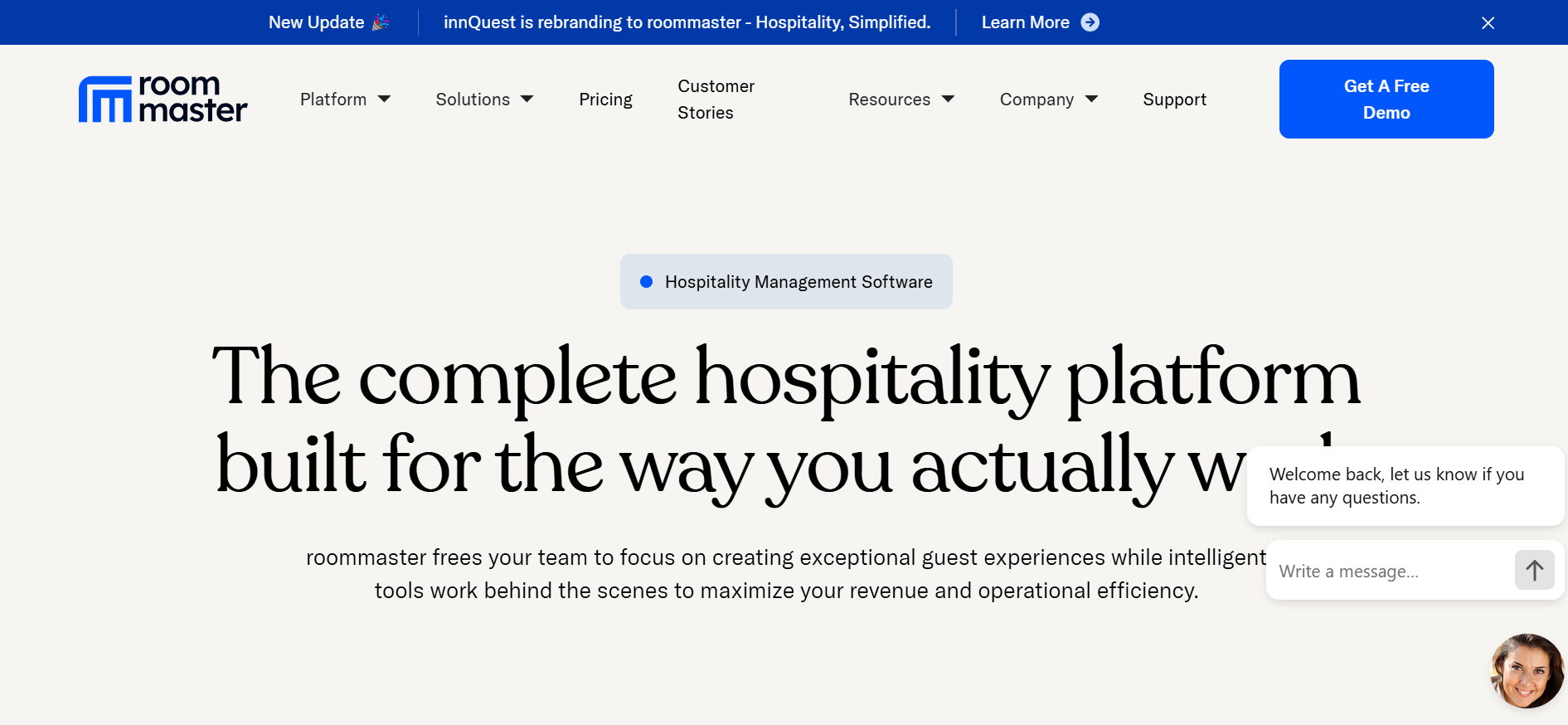
roommaster is an all-in-one hospitality platform built by people who have worked in hotels. The team behind it carries over 125 years of combined hands-on hotel management experience. The platform itself has over 30 years in the hospitality technology industry.
It handles reservations, front desk operations, housekeeping, payments, direct booking, channel distribution, guest communication, and revenue management. All in one platform. No patchwork of third-party integrations.
For small hotels, the impact is immediate. roommaster reduces training time by 50%. Front desk staff manage check-ins, folios, and housekeeping status from two core screens. No system hopping. No duplicated data entry.
{{pms-one}}
roommaster PMS
The roommaster PMS is the operational backbone of the platform. It manages reservations, front desk workflows, housekeeping, accounting, billing, and guest communication from one screen. Staff complete check-ins in minutes, manage rate plans, process payments, and update housekeeping status in real time without logging into separate systems.
roommaster Booking Engine
The roommaster Booking Engine drives commission-free direct bookings from your own website. Hotels using it see up to 40% more direct bookings and a 35% higher conversion rate. Every direct booking is revenue that would otherwise go to OTA commission.
roommaster Channel Manager
The roommaster Channel Manager syncs availability and rates across hundreds of OTAs and global distribution channels automatically. That cuts distribution management time by 85%.
roommaster Concierge
roommaster AI Concierge is a voice agent that recovers lost revenue from missed calls. It handles guest inquiries and captures bookings 24 hours a day, 7 days a week. For a small hotel where one person covers the front desk, this is a genuine revenue recovery tool.
roommaster AI Revenue Management
roommaster AI Revenue Management tracks competitor rates and market demand, then adjusts your pricing automatically. Hotels using it have seen RevPAR increase by up to 35%.
roommaster carries a 97% client retention rate. That number says more than any feature list.
Best for: Independent small hotels that want one platform covering everything from reservations to revenue management.
Pricing: Custom. Book a demo to get a quote for your property size.
{{pms-three}}
2. Seekda
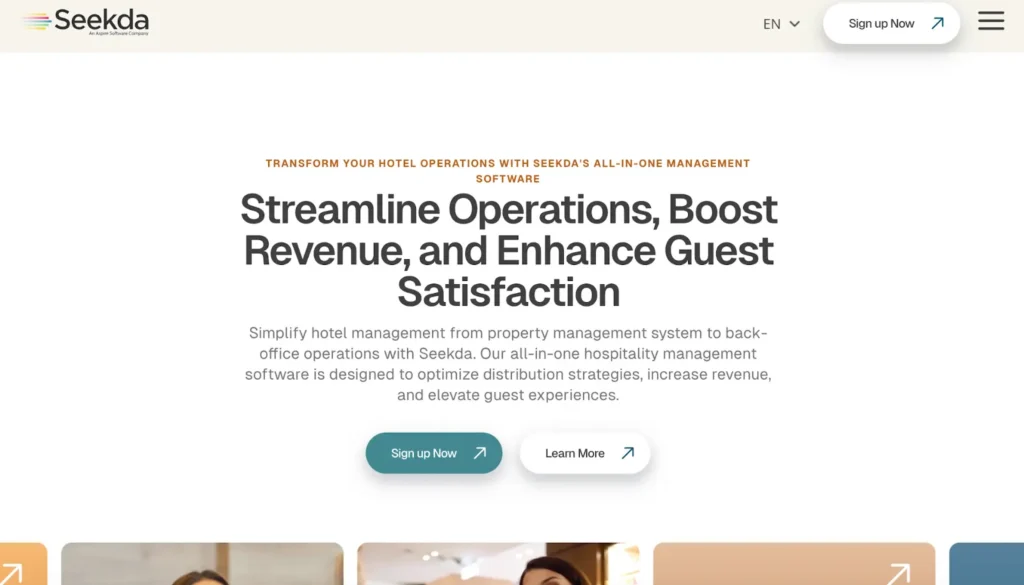
Seekda focuses on online distribution and booking visibility. It helps small hotels manage OTA connections and increase online booking volume.
Pricing runs from €67 to €125 per month depending on the tier. It's a more focused platform compared to full management suites.
It can work well alongside a full management platform if your primary focus is expanding your OTA footprint.
Best for: Hotels focused primarily on growing their OTA presence.
Starting price: From €67/month.
3. RoomRaccoon
RoomRaccoon is an all-in-one platform with a strong focus on direct booking performance. It combines front desk management, a booking engine, channel manager, and revenue tools.
The interface is modern. Setup is faster than older enterprise systems. Pricing ranges from $236 to $620 per month depending on property size and the features selected.
It performs well for direct booking conversion. Finance reporting, group billing, and multi-folio workflows are less developed than platforms built for deeper operational needs.
Best for: Small independent hotels that prioritize direct booking growth and want a modern interface.
Starting price: From $236/month.
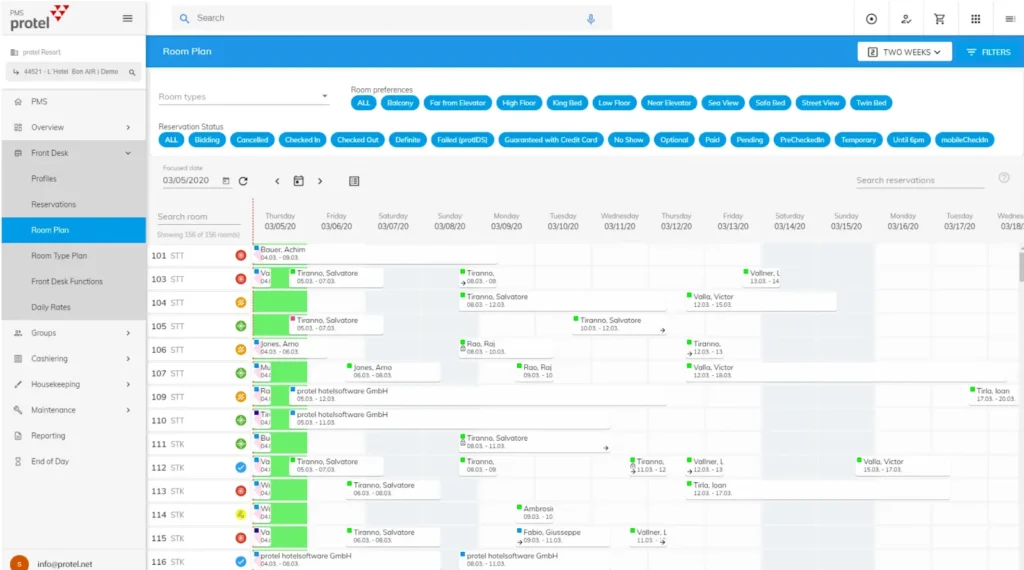
4. Protel
Protel is built for hotels with more complex departmental structures. It handles multi-department operations including food and beverage, events, and group billing.
It's a strong platform for hotels where rooms are one part of a larger operation. For a 12 to 20-room property focused on rooms only, it is more system than you need.
Best for: Small hotels with complex multi-department operations.
Starting price: Custom.
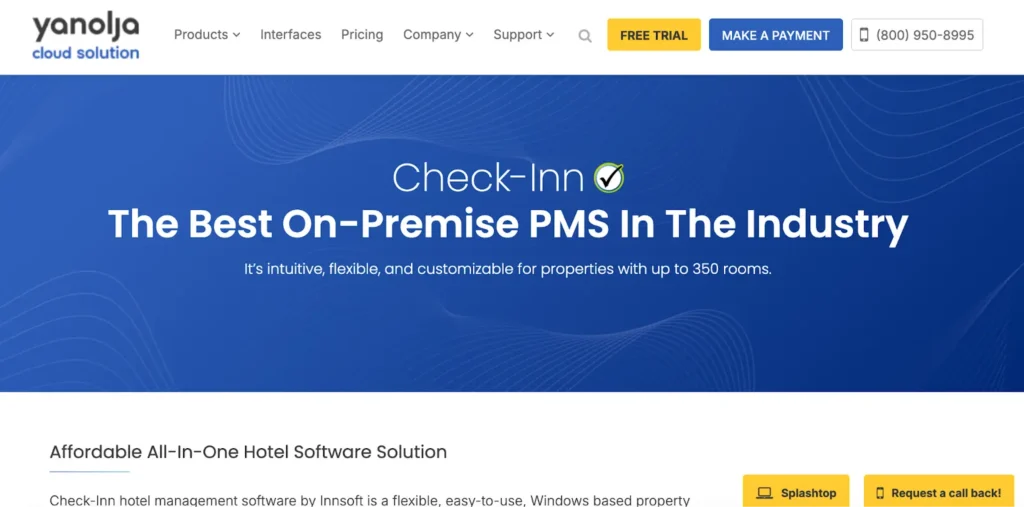
5. Check-Inn PMS
Check-Inn has served small and mid-sized hotels for many years. It offers both cloud and on-premise deployment options. That flexibility matters for properties with specific IT infrastructure preferences.
The cloud version starts from $40 per month. It covers reservations, front desk management, and basic daily reporting.
It's a reliable daily management tool. The interface reflects its age compared to newer platforms.
Best for: Small hotels that want a flexible option with both cloud and on-premise deployment.
Starting price: From $40/month (cloud).
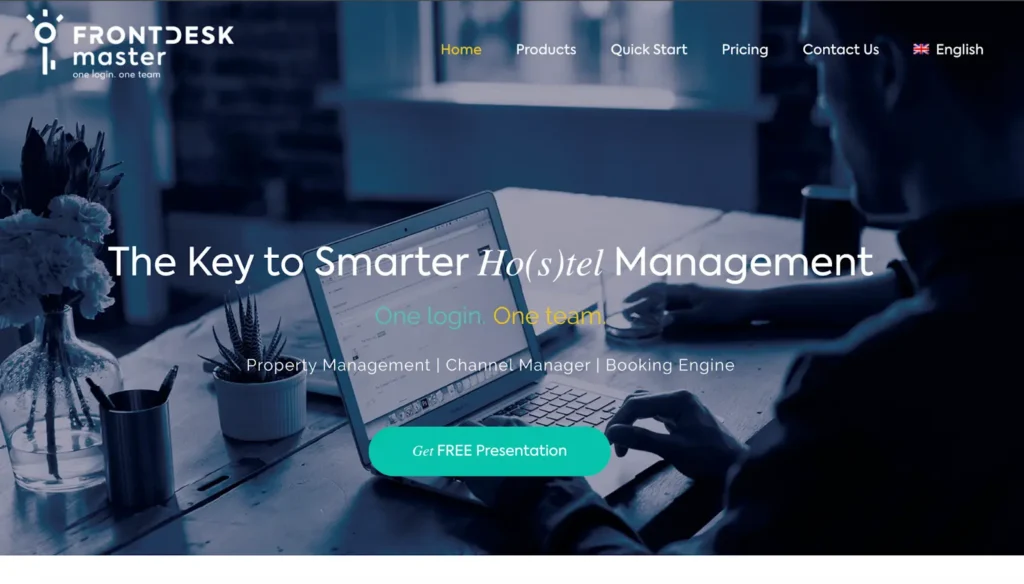
6. Frontdesk Master
Frontdesk Master is a cloud platform built for smaller independent properties. It combines reservations, channel management connections, and a booking engine.
Pricing starts from $25 per month. It's one of the more affordable full-platform options in the market.
It covers the core requirements. Reporting depth and advanced features are limited for properties that need more than daily management basics.
Best for: Small hotels and boutique properties with lean teams and essential management needs.
Starting price: From $25/month.
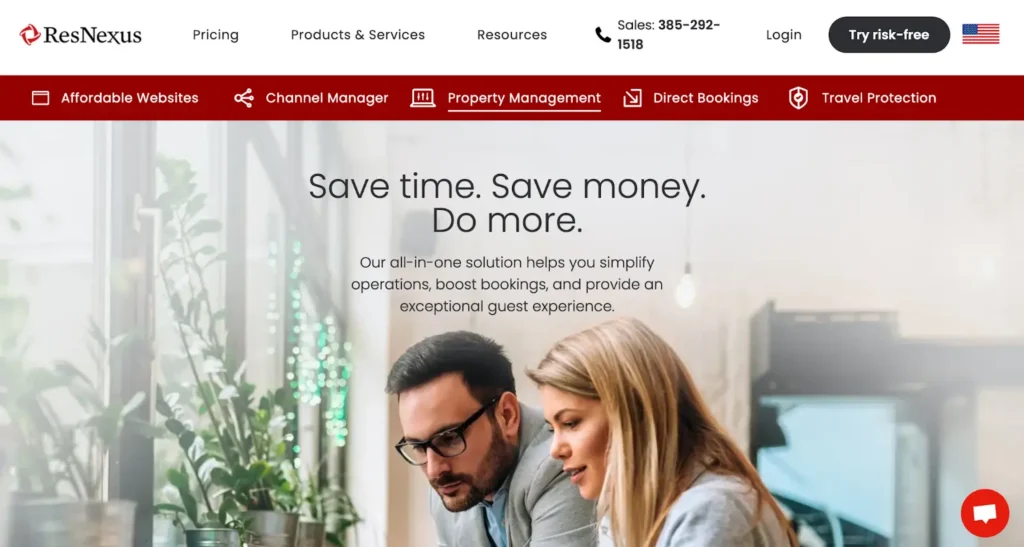
7. ResNexus
ResNexus is a booking and reservation platform for small to mid-sized independent properties. It covers reservations, a booking engine, channel connections, and guest communication tools.
Pricing is transparent and accessible, starting from $35 per month. The platform is straightforward for small teams to learn quickly.
Core reservation workflows are clean. Advanced revenue management and multi-property tools are more limited.
Best for: Small hotels that need clean, simple reservation management without complexity.
Starting price: From $35/month.
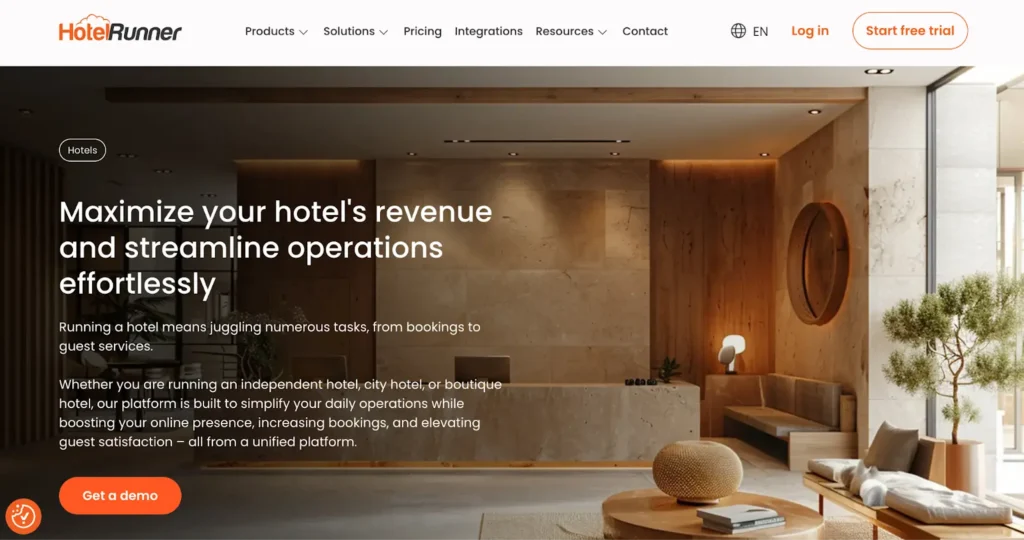
8. HotelRunner
HotelRunner focuses on online distribution. It connects small hotels to a wide range of OTAs and provides tools for managing online presence and direct bookings.
Entry-level pricing starts at $19.95 per month. Core front desk management functionality is lighter than platforms like roommaster or RoomRaccoon.
It works well as a channel distribution tool. As a full hotel management platform covering operations, guest communication, and revenue, it covers the basics without much depth.
Best for: Hotels prioritizing OTA reach and online booking volume over operational depth.
Starting price: From $19.95/month.
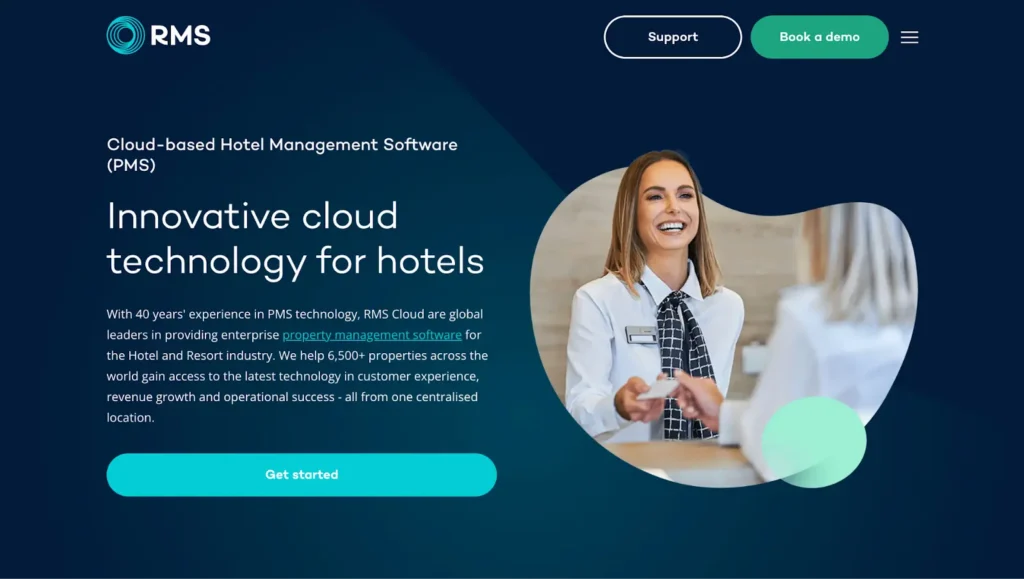
9. RMS Cloud
RMS Cloud is a scalable cloud platform that serves everything from small properties to large multi-site hotel groups. It handles reservations, channel management, revenue tools, and reporting.
For small hotels, the depth of the platform is both its strength and its challenge. There is a lot available. But the setup and learning curve are steeper than platforms built specifically for smaller operations.
It's a strong choice if you plan to grow and want one platform that scales with you without switching later.
Best for: Small hotels with multi-property growth plans.
Starting price: Custom.
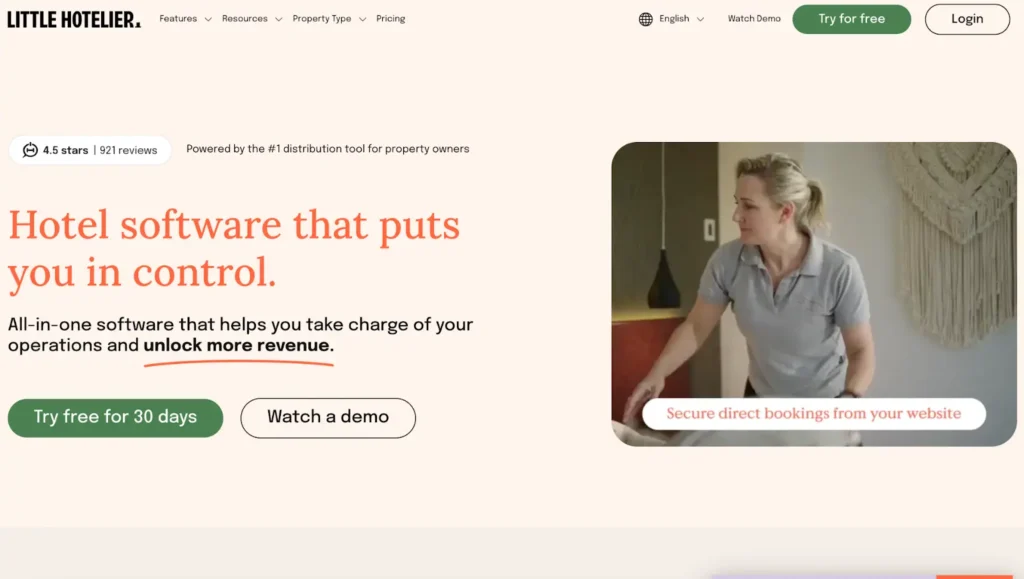
10. Little Hotelier
Little Hotelier is designed for properties under 30 rooms. Setup is fast and the interface is simple for non-technical staff.
It covers reservations, a direct booking engine, channel manager connections, and basic front desk tools. Entry pricing starts at $29 per month, making it accessible for properties just moving off manual systems or spreadsheets.
It's a solid starting point. Reporting depth, revenue management, and billing workflows are limited. Properties that grow beyond basic operations often find they need more than it offers.
Best for: Very small hotels, guesthouses, or B&Bs getting started with hotel software for the first time.
Starting price: From $29/month.
{{pms-five}}
10 Key Features of Small Hotel Management Software
1. Reservation management: All bookings, from online channels, phone, and walk-in, in one calendar. No double-bookings. No missed reservations.
2. Front desk tools: Fast check-in and check-out, room assignment, and folio management from a single screen.
3. Direct booking engine: A commission-free booking option on your own website. Every direct booking cuts OTA fees and keeps more revenue with you.
4. Channel manager: Real-time sync of rates and availability to OTAs and global distribution systems. Eliminates manual extranets and overbooking risk.
5. Payment processing: Integrated card payments, deposit collection, and chargeback handling built into the platform.
6. Guest communication: Automated booking confirmations, pre-arrival messages, and post-stay review requests. Runs without staff involvement.
7. Housekeeping management: Room status tracking and task assignment. Front desk always knows what's clean, what's not, and when rooms are ready.
8. Reporting and analytics: Daily, weekly, and monthly reports on occupancy, revenue by source, and booking channel performance.
9. Mobile access: Full platform access from a phone or tablet. Essential for owner-operators who are not always at the desk.
10. Revenue management: Dynamic rate tools that adjust pricing based on demand, season, and market rates. Moves you beyond fixed seasonal pricing.
Benefits of Small Hotel Management Software
1. Save hours every week: Automated guest messages, real-time availability sync, and single-screen workflows cut hours of manual work. Staff at roommaster properties save 4 to 6 hours per week on admin tasks alone.
2. Eliminate costly mistakes: Manual reservation management creates overbooking and payment errors. Software keeps your inventory accurate in real time across every channel.
3. Get more direct bookings: A booking engine on your website captures guests before they book through an OTA. Hotels using the roommaster Booking Engine see up to 40% more direct bookings. That commission stays with you.
4. Improve how guests feel about their stay: Automated pre-arrival communication, faster check-ins, and post-checkout follow-up messages build loyalty. Hotels that automate guest communication see up to 30% more repeat bookings.
5. Grow revenue without growing your team: AI driven rate management adjusts your pricing in real time based on market demand. Even small improvements in occupancy or average rate compound across a full season.
6. See your whole property at a glance: One dashboard for bookings, revenue, housekeeping, and guest history. No spreadsheets. No checking three different systems to answer one question.
How to Choose the Right Small Hotel Management Software for Your Property
1. Start with your team size and workflow: A 10-room inn run by two people needs different software than a 25-room boutique with a dedicated front desk team. The right platform should match your actual operations, not your aspirational ones.
2. Add up the real cost: Some platforms charge separately for a booking engine, channel manager, or payment tools. Others include everything. Always compare total cost, not just the base subscription price.
3. Identify your biggest pain point right now: If you are losing bookings to OTAs, a strong direct booking engine is the priority. If your team spends hours on manual availability updates, channel management is the gap to close first.
4. Test the support before you sign: Ask specifically how support works after hours and on weekends. A hotel that cannot reach support during a busy Friday check-in has a real problem.
5. Check the retention rate: Star ratings tell you what people say in the first few months. A 97% client retention rate tells you what happens after two years.
6. Confirm it can grow with you: If you plan to add rooms or open a second property, verify the software handles that without forcing a platform change later.
Getting Started With Hotel Management Software for Small Hotels
Switching to a new system feels like a big decision. In practice, it's more straightforward than most hotel owners expect.
Step 1: Map what you are currently using:
List every tool, spreadsheet, OTA extranet login, and manual process you rely on today. Knowing what you are replacing makes it easier to evaluate what the new system needs to cover.
Step 2: Book live demos with your top two or three options:
Do not just watch a recorded video. Ask to walk through a live reservation, a check-in, and a rate update in real time. See it working before you commit.
Step 3: Ask about the migration plan:
Find out exactly how your existing reservations and guest data transfer across. A good platform has a clear migration process and does not leave you to figure it out alone.
Step 4: Plan go-live around a low-demand period:
A quiet midweek stretch is the right time to switch. Not the Friday before a long weekend.
Step 5: Train your team before go-live day:
Most platforms offer onboarding support. Use it fully. Proper training is the difference between a smooth launch and a frustrating first week.
Step 6: Set up your automation and reports on day one:
Pre-arrival emails, post-stay review requests, and daily occupancy reports take minutes to configure. The time they save starts immediately.
Making the Right Choice for Your Property's Future
Small hotels compete every day against larger chains with bigger marketing budgets and larger teams. The right software levels the playing field.
It gives your staff time back. It captures bookings your competitors miss. It keeps guests returning.
roommaster has been built alongside independent hoteliers for over 30 years. It's not generic business software adapted for hotels. It's a platform shaped by people who understand how your front desk actually works. What a GM worries about at midnight. What drives real revenue for an independent property.
Thousands of hotels worldwide rely on it, with a 97% client retention rate to show for it.
Book a personalized demo today and discover how roommaster can simplify your operations, grow your direct bookings, and give your team back the hours spent on manual work.
{{cta-strip}}
FAQs
What is small hotel management software?
It's a platform that manages your hotel's reservations, front desk, housekeeping, payments, and guest communication in one system. It replaces manual processes and disconnected tools with a single dashboard built around your daily workflow.
What features does small hotel management software need?
The essentials are reservation management, a direct booking engine, a channel manager for OTA sync, payment processing, guest communication automation, and basic reporting. Revenue management tools become important as you grow.
How much does hotel management software cost for small hotels?
Entry-level platforms start from around $20 to $40 per month. Full-featured platforms like roommaster are custom-priced based on your property size and which products you use. Always compare total cost including add-ons, not just the base subscription.
Can I switch software mid-season?
Yes. Most platforms have a migration process to carry over your reservations and guest data. Timing matters. Plan the switch during a quieter period to keep disruption minimal.
Is cloud-based hotel software better for small hotels?
For most small hotels, yes. Cloud software requires no on-site servers, receives automatic updates, and works from any device. It's lower cost and lower maintenance than on-premise systems.
How long does setup take?
It varies by platform. Simple tools can live in days. Full-featured platforms like roommaster include structured onboarding. Most properties are fully operational within two to four weeks.
Will hotel management software help me get more direct bookings?
Yes. A booking engine on your website captures guests directly before they go to an OTA. Hotels using the roommaster Booking Engine see up to 40% more direct bookings. Every direct booking carries no commission, which means more revenue per reservation stays with you.
Mayela Lozano is a content strategist with a passion for hospitality and technology. She collaborates with roommaster on content creation, highlighting how technology can streamline hotel operations and enhance guest satisfaction. When she’s not creating content, Mayela loves to travel and spend time with her two little ones, discovering new adventures and making memories along the way.
Join Thousands of Hotels Thriving with roommaster
The transition to roommaster is straightforward and efficient. Our implementation team handles data migration including reservations, guest profiles, and historical information.
The transition to roommaster is straightforward and efficient. Our implementation team handles data migration including reservations, guest profiles, and historical information.
Best Hotel Management Software in 2026: 10 Top-Rated Tools Compared
October 15, 2026
Hospitality Technology
Hospitality Technology 2027
October 14, 2026
Hotel Management
Hospitality Trends
Hotel Check-In Kiosk: Enhance the Guest Experience
October 5, 2026
Hospitality Technology
Hotel Management
Hospitality Trends
Hotel Self Check-In: How It Works, Types, Benefits And Setup
October 1, 2026
Hotel Management
Hospitality Trends
Hotel Check-In & Check-Out Times Explained
October 1, 2026
Hospitality Trends
Hotel Management
Cloud-Based Property Management System: Hotel PMS
October 1, 2026
Hotel Management
Cloud PMS
Hotel Management System (HMS): A Complete Guide
September 23, 2026
Hospitality Trends
Hotel PMS
Cloud PMS
Hotel PMS Integration: How It Works for Hotels
September 23, 2026
Hospitality Trends
Hospitality Technology
Hotel PMS
Hotel Management
Cloud PMS
How Hotel PMS Software Transforms Hospitality Management
September 23, 2026
Hotel Management
Marketing
Pet-Friendly Hotel Amenities & Package Ideas That Drive Revenue
September 22, 2026
Join Thousands of Hotels Thriving with roommaster
See how roommaster's unified platform can work for your property. Our team will walk you through features tailored to your specific needs and operations.




.png)
.png)
.png)