10 Best Hotel Revenue Management Software (RMS) 2026
Hotel revenue management software (RMS) manages inventory and automatically adjusts room prices using dynamic pricing, demand forecasting, and competitor rate shopping to grow RevPAR, ADR, and Occupancy Rate, streamlining operations without a full-time revenue manager.
This guide compares 10 hotel revenue management platforms used by real hotels in 2026, ordered by property size and type: 1. roommaster 2. Duetto, 3.IDeas, 4. Lighthouse, 5. Atomize, 6. Cloudbeds, 7. Pricepoint, 8. RoomPriceGenie, 9. happyhotel, and 10. PriceLabs.
Independent Hotels & Small Groups (about 30 to 150 rooms): You need real pricing intelligence and tight PMS integration that scales as you grow. Look at roommaster (Revenue Management), Cloudbeds, and Atomize, which bring enterprise-grade yield in an accessible, automated format.
Large Hotels, Chains & Enterprise (200+ rooms or multi-property): You need enterprise depth: complex group pricing, multiple channels, high-volume demand, and predictive analytics. IDeaS and Duetto lead here, with Lighthouse layered in for market intelligence and rate shopping.
Small & Boutique Hotels (under about 30 rooms): Prioritize simplicity, fast setup, and set-and-forget automation that a lean team can trust. Look at RoomPriceGenie, happyhotel, and Pricepoint, all rated highly for being easy to use without a dedicated revenue manager.
Short-Term & Vacation Rentals (and small STR portfolios): Prioritize dynamic pricing built for the STR market and OTA distribution. Look at PriceLabs and Beyond, both of which specialize in demand-driven pricing for vacation rentals and property managers.
What Is Hotel Revenue Management Software?
Hotel revenue management software (RMS) is a tool that automatically forecasts demand and adjusts room rates in real time based on competitor pricing, market data, and booking trends. It applies intelligent pricing strategies to optimize inventory, streamline operations, and maximize profitability.
How We Chose The Right Hotel Revenue Management Software For Every Property Type and Size
Every hotel revenue management software (RMS) handles the same core jobs, demand forecasting, dynamic pricing, competitor rate shopping, performance reporting, and inventory optimization with real-time market data, but the right one depends on your property size and operational needs. Below, each segment is broken down by the roles that own revenue, the KPIs they are judged on, the features that move those numbers, and the software that fits.
Independent Hotels & Small Groups (about 30 to 150 rooms)
Role
Goals and KPIs
Features that deliver those goals
Hotel Owner (Independent or Hotel Groups)
Lift revenue without hiring a full-time revenue manager, reduce OTA commission dependence, keep pricing that scales when they add rooms or a second property, and see clear ROI, all measured in RevPAR, GOPPAR, and cost of acquisition.
Dynamic Pricing (Automated BAR Management), Automation with Manual Override, PMS Integration / Two-Way Sync, Reporting & Analytics Dashboards, Multi-Property Support for small groups.
General Manager
One clear picture of rate, occupancy, and pace, less daily manual work, fast onboarding, and results they can defend to ownership, all measured in RevPAR, ADR, and Occupancy.
Demand Forecasting, Dynamic Pricing, Competitor Rate Shopping, Reporting & Analytics Dashboards, Ease of Use & Onboarding Speed.
Front Desk / Reservations Manager
Optimized rates flowing to the PMS with no re-keying, no overbookings, clean rate parity, and more business shifting to direct, all measured in sync reliability, overbooking rate, and direct-versus-OTA mix.
PMS Integration / Two-Way Sync, Channel Manager & OTA Distribution, LOS & Rate Restrictions.
Enterprise & Large Hotels (200+ rooms or multi-property)
Role
Goals and KPIs
Features that deliver those goals
Hotel Owner (or Ownership Group)
Maximise revenue across the portfolio, reduce dependence on high-commission OTAs, run the property without a full-time IT or revenue function, and check performance remotely on their own time, all measured in RevPAR, GOPPAR, and cost of acquisition.
Multi-Property Support (consolidated portfolio view), Total Revenue Optimization and Reporting Dashboards, Channel Manager & OTA Distribution, Automation with Manual Override.
General Manager
Improve RevPAR without adding headcount, cut staff training time, hold consistent pricing standards across every property, and spend less time firefighting system problems and rate mismatches, all measured in RevPAR, ADR, Occupancy, and TRevPAR.
Automation with Manual Override, PMS Integration / Two-Way Sync, Multi-Property Support, Ease of Use & Onboarding Speed.
Revenue Manager (Dedicated manager or full commercial team)
Automate dynamic pricing without daily manual work, monitor competitor rates continuously, protect RevPAR through shoulder seasons, eliminate the spreadsheet rate grid, and capture demand spikes from local events first, all measured in RevPAR, RGI, MPI, ARI, booking pace, and LOS.
Demand Forecasting (90 to 365 days out), Dynamic Pricing (Automated BAR Management), Competitor Rate Shopping, Market Segmentation, LOS & Rate Restrictions, Group & Displacement Analysis.
Which software is suitable: IDeaS, Duetto, and Lighthouse.
Small & Boutique Hotels (under about 30 rooms)
Role
Goals and KPIs
Features that deliver those goals
Owner-Operator
Automated daily rates that respond to demand, affordable and quick setup, and reliable pricing with only a few minutes of oversight, all measured in RevPAR, Occupancy, and ADR.
Dynamic Pricing (automated daily rates), Automation with Manual Override, Event and Demand Triggers, Ease of Use & Onboarding Speed.
Front Desk Manager / Lead
Rates that sync straight to the PMS and pricing that stays out of the way at the desk, all measured in sync reliability and overbooking rate.
PMS Integration / Two-Way Sync, Channel Manager & OTA Distribution.
Which software is suitable: RoomPriceGenie, happyhotel, and Pricepoint.
Short-Term & Vacation Rentals (and small STR portfolios)
Role
Goals and KPIs
Features that deliver those goals
Rental Owner / Host
Stop pricing every listing by hand across seasons, set minimum-stay rules that protect the calendar, and stay competitive without watching the market all day, all measured in Occupancy, ADR, and revenue per unit.
Dynamic Pricing, Minimum-Stay and LOS Controls, Customizable Automation Rules, Market Data.
Property Manager (portfolio)
Price many units consistently at scale, automate across owners, and report cleanly per property, all measured in portfolio occupancy, ADR, and revenue per unit.
Portfolio and Multi-Property Management, Dynamic Pricing, Automation Rules, Channel and OTA Distribution, Reporting & Analytics.
Which software is suitable: PriceLabs and Beyond.
{{revenue-management-one}}
Best Hotel Revenue Management Software: At a Glance
Below we compare the best hotel revenue management software side by side (key features, what it solves and for whom, best-fit property type, and verified ratings) so you can shortlist the two or three worth a demo.
Monitor competitor rates continuously, read market demand, protect RevPAR in shoulder seasons, stop pricing blind to the market.
Market intelligence & rate shopping
Capterra 5.0 (4 reviews)
IDeaS
Advanced forecasting, room-class pricing, 365-day forecast, group & transient optimization
Maximise revenue across the portfolio, reduce OTA commissions, hold consistent pricing standards across properties, run without a full-time revenue function.
Below is a closer look at each hotel revenue management software, comparing how it handles demand forecasting, dynamic pricing, competitor rates, performance reporting, and inventory, all driven by real-time market data, so you can match the engine to your property.
Independent Hotels & Small Groups (about 30 to 150 rooms)
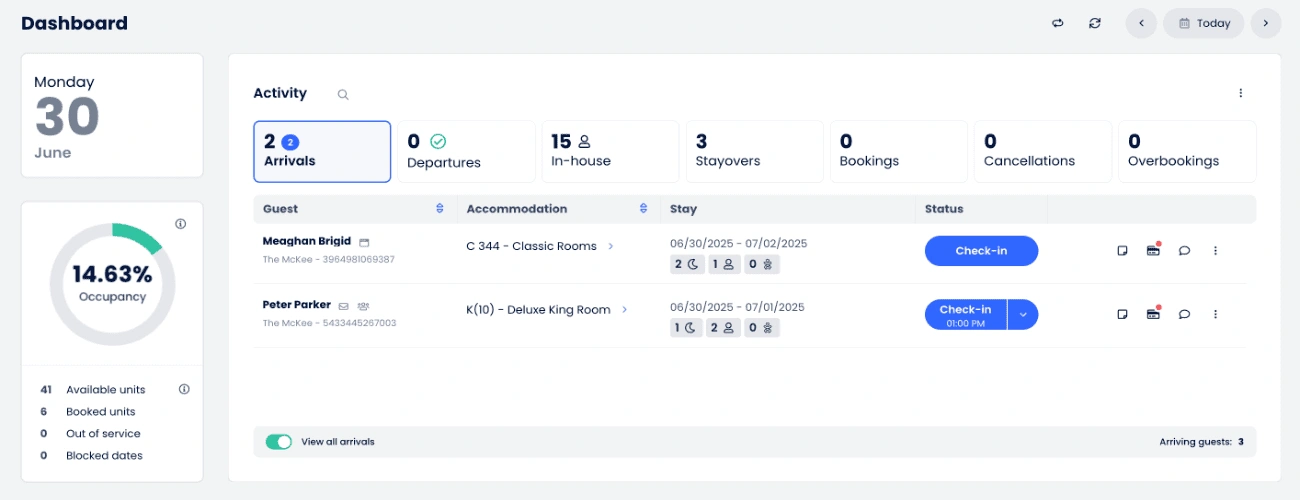
1. roommaster (Revenue Management): Best for independent hotels & groups that want enterprise yield without a dedicated revenue manager
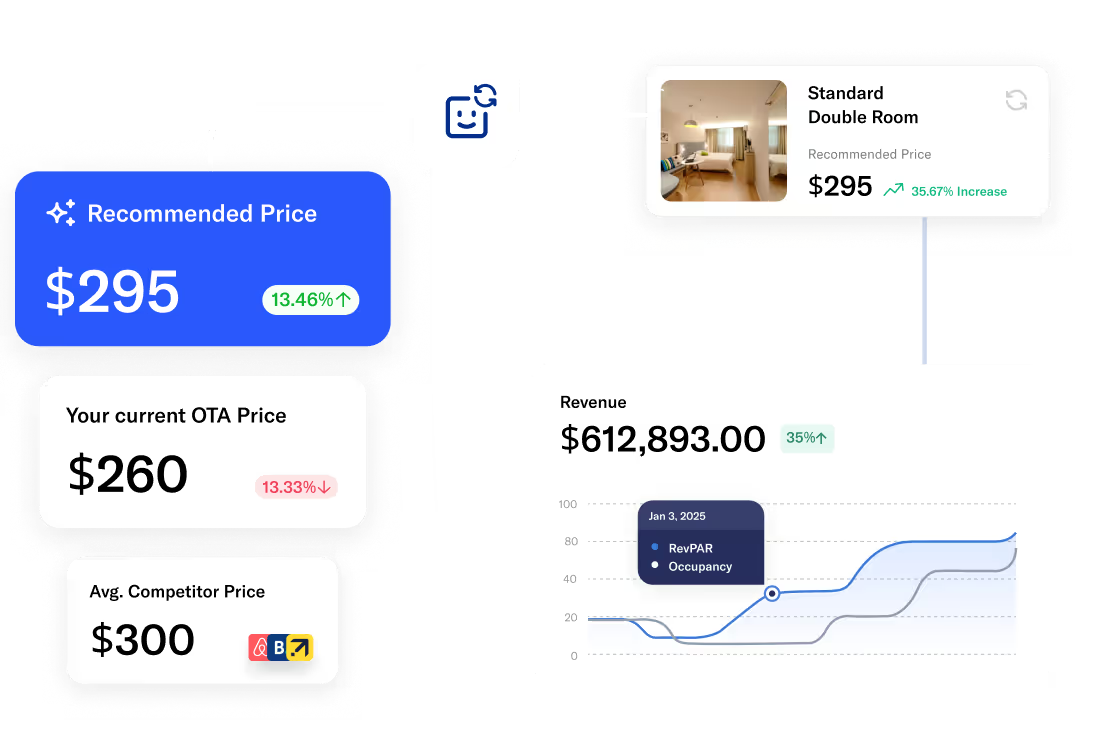
Independent hotels often leave money on the table with static pricing, because they do not have a full-time revenue manager or the budget for an enterprise system. roommaster was built to close that gap. roommaster Revenue Management is an AI pricing engine, built into the roommaster platform, that reads live market data and updates your rates in real time, while you keep full control of the strategy, limits, and goals. Because it lives alongside your hotel PMS software, hotel booking engine, and hotel channel manager, pricing and operations share one source of truth, so optimized rates flow straight to every channel with no re-keying.
Key features: roommaster Revenue Management is a software tool that helps hotels manage dynamic pricing, competitor price tracking, demand forecasting, inventory optimization, and performance reporting, synced in real time with your PMS.
What it solves: roommaster Revenue Management is a software tool that helps hotels manage dynamic pricing, competitor price tracking, demand forecasting, inventory optimization, and performance reporting, all synced in real time with your PMS. That matters because independents lose revenue to rates that sit still, with no one on payroll to move them. roommaster reads the market and prices for you while you keep control of the strategy, so you lift revenue without a dedicated revenue manager, reduce OTA commissions, and keep pricing that scales as you grow, with rates syncing across every channel and back to the PMS with no re-keying. Owners see it in the numbers they're judged on: RevPAR, GOPPAR, and cost of acquisition.
Best for: Independent hotels and small-to-mid hotel groups, including boutique hotels, motels, inns, B&Bs, resorts, and parks.
Pricing: Custom quote based on room count; available as part of the wider roommaster platform.
Reviews: G2 4.5, Capterra 4.3, and Software Advice 4.3, backed by 30+ years in hospitality and a 97% client retention rate. Hotels report up to a 35% RevPAR increase.
{{payments-cta}}
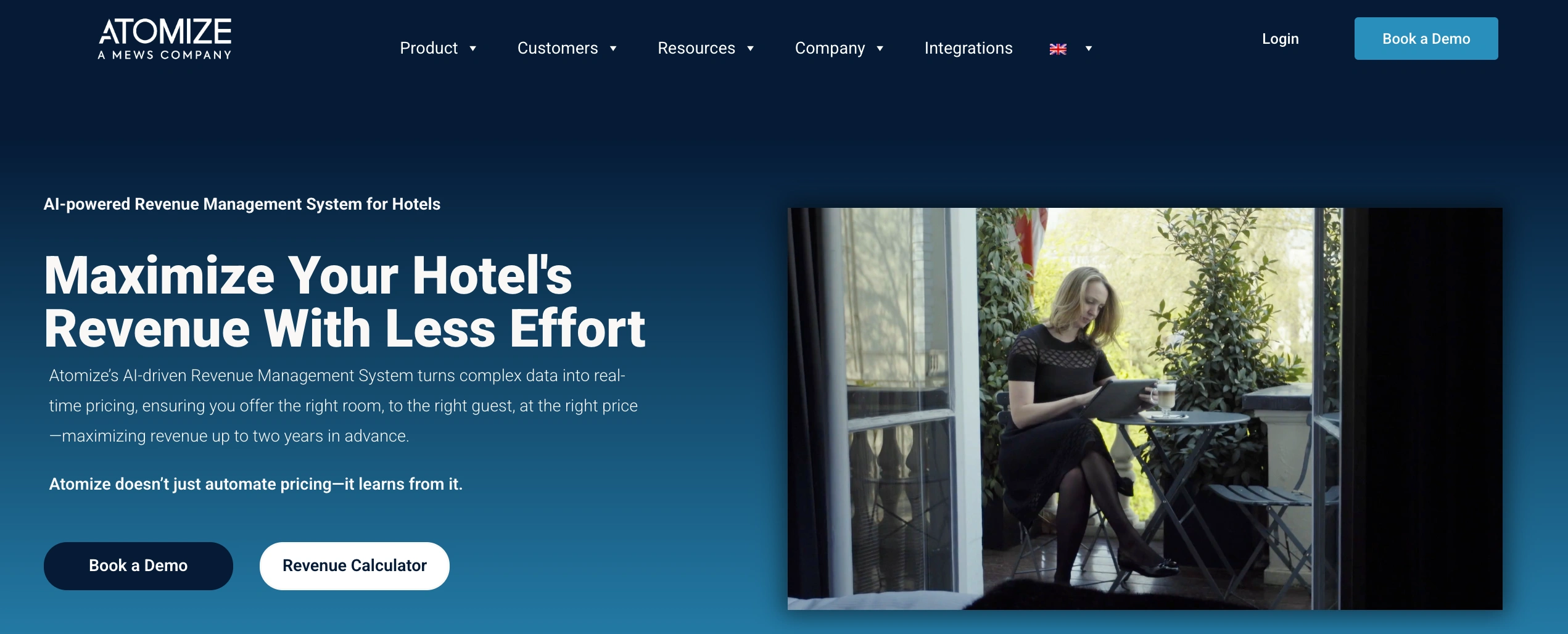
2. Atomize: Best for real-time, hands-off automation
Atomize is a fully automated RMS that updates room pricing in real time with minimal manual input. It uses AI to process large volumes of market data and continuously recalibrate rates to current demand, which makes it a strong fit for independent and mid-scale hotels that want intelligent pricing without a heavy configuration project. Reviewers call out its group pricing function, recommendation accuracy, and strong support.
Key features: 24/7 autopilot pricing, real-time rate optimization, AI demand processing, quick setup, group pricing.
What it solves: Automate daily rates hands-off, reprice to demand in real time, and get going with minimal setup. Plenty of GMs own revenue on top of everything else and don't have an hour a day for it. Atomize takes rate management off your plate while still moving RevPAR, ADR, and Occupancy in the right direction.
Best for: Independent and mid-scale hotels that want automation without configuration overhead.
Pricing: Custom quote based on room count.
Reviews: Capterra 5.0 out of 5 from 13 reviews, with more than 90% of customers recommending it.
3. Cloudbeds Revenue Intelligence: Best for all-in-one, PMS-native revenue management
Cloudbeds Revenue Intelligence is built natively inside the Cloudbeds platform and powered by a causal AI engine designed for hospitality. Because pricing, forecasting, and the PMS share one system, there is no separate integration to maintain, and the data driving your rates is the same data running your front desk. Forecasts reach 90 days out at up to 95% accuracy. It suits operators already on Cloudbeds who want revenue management to come along without adding a tool.
Key features: Causal AI pricing, 90-day forecast at up to 95% accuracy, native PMS integration, market benchmarking.
What it solves: Price and forecast inside the PMS, cut daily manual work, and keep one set of data with no double handling. If you're already on Cloudbeds, a bolted-on pricing tool means syncing two systems and second-guessing which numbers are right. Doing it natively keeps a GM focused on RevPAR, ADR, Occupancy, and TRevPAR without the extra admin.
Best for: Properties that want revenue management and PMS unified in one system.
Pricing: Custom quote; strongest value bundled with the Cloudbeds platform.
Reviews: Capterra 4.3 out of 5 from 343 reviews, one of the larger verified review bases here.
Enterprise & Large Hotels (200+ rooms or multi-property)
1. Duetto: Best for hotel groups, casinos & enterprise open pricing
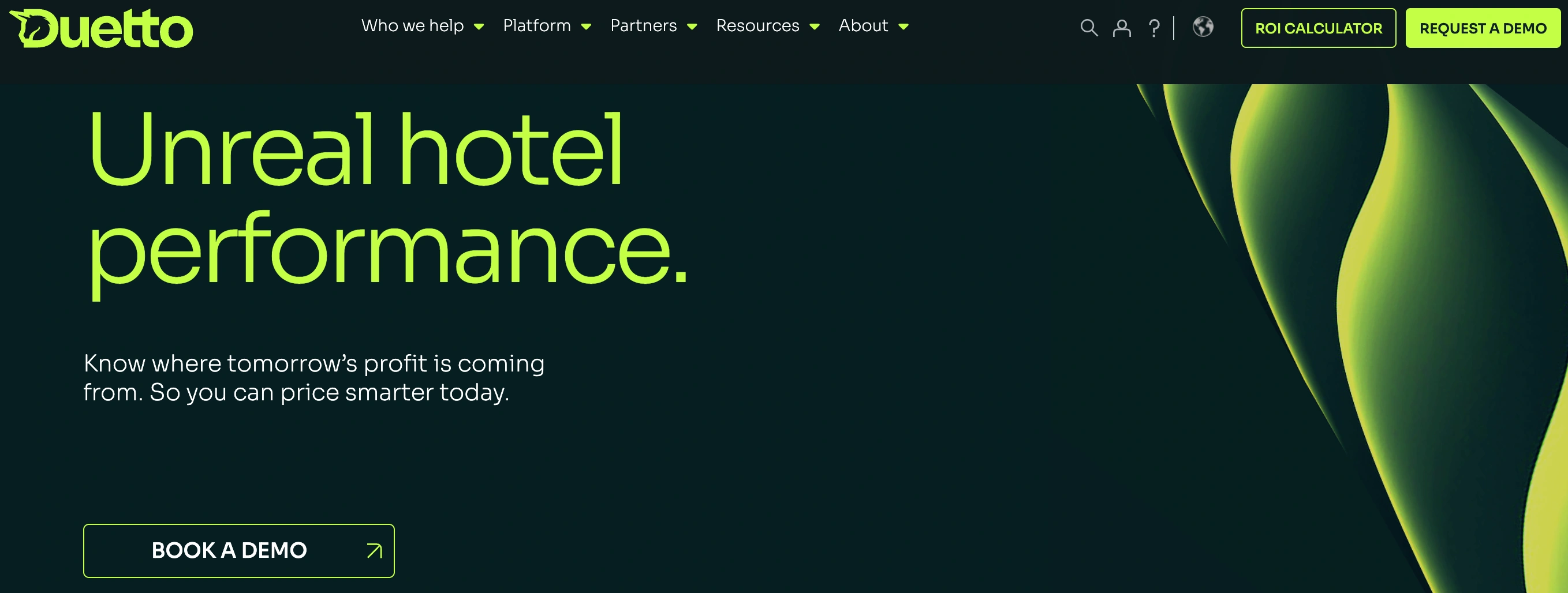
Duetto is a cloud-based revenue platform built for enterprise hotels, groups, and casinos. Its Open Pricing model lets you set and move rates independently across segments, room types, and channels at the same time, rather than shifting everything off one BAR. That removes the rate fencing that caps revenue, which is why large brands with sophisticated commercial teams choose it. Its GameChanger application is the day-to-day tool revenue managers use to build and deploy those strategies fast.
Key features: Open Pricing, GameChanger rate management, demand and competitor data, group displacement analysis, casino and gaming tools.
What it solves: Automate dynamic pricing and move rates independently by segment, room type, and channel instead of shifting everything off one BAR. Backed by live competitor and demand data and group displacement analysis, it stops rate fencing from underselling the segments willing to pay more, and moves the numbers a revenue manager owns: RevPAR, RGI, MPI, ARI, booking pace, and LOS.
Best for: Hotel groups, casinos, and enterprise brands that want granular pricing control.
Pricing: Custom, enterprise-level quote.
Reviews: GameChanger by Duetto holds Capterra 5.0 out of 5 from 5 reviews; widely adopted by leading hotel and casino groups.
2. Lighthouse (formerly OTA Insight): Best for market intelligence & rate shopping
Lighthouse is the leading commercial intelligence platform for hospitality, used by tens of thousands of hotels to turn a noisy market into clear decisions. Its strength is data: live rate shopping across channels, parity monitoring, market demand signals, and competitive-set benchmarking. Many revenue teams run it alongside an automated RMS, using it as the eyes on the market that inform pricing rather than the engine that pushes every rate.
Key features: Live rate shopping, rate parity monitoring, market demand data, benchmarking, business intelligence dashboards.
What it solves: Monitor competitor rates, read market demand, and check parity so your team never prices blind. It benchmarks you against the comp set and flags shifts early, which protects the numbers reservations and revenue teams watch: ARI, RGI, channel cost, and booking pace.
Best for: Revenue teams that want the sharpest view of the market and competitive set.
Pricing: Custom, typically tiered by product (rate shopping, parity, business intelligence).
Reviews: Capterra 5.0 out of 5 from 4 reviews, consistently praised for data quality and ease of use.
3. IDeaS Revenue Solutions: Best for large hotels & enterprise portfolios
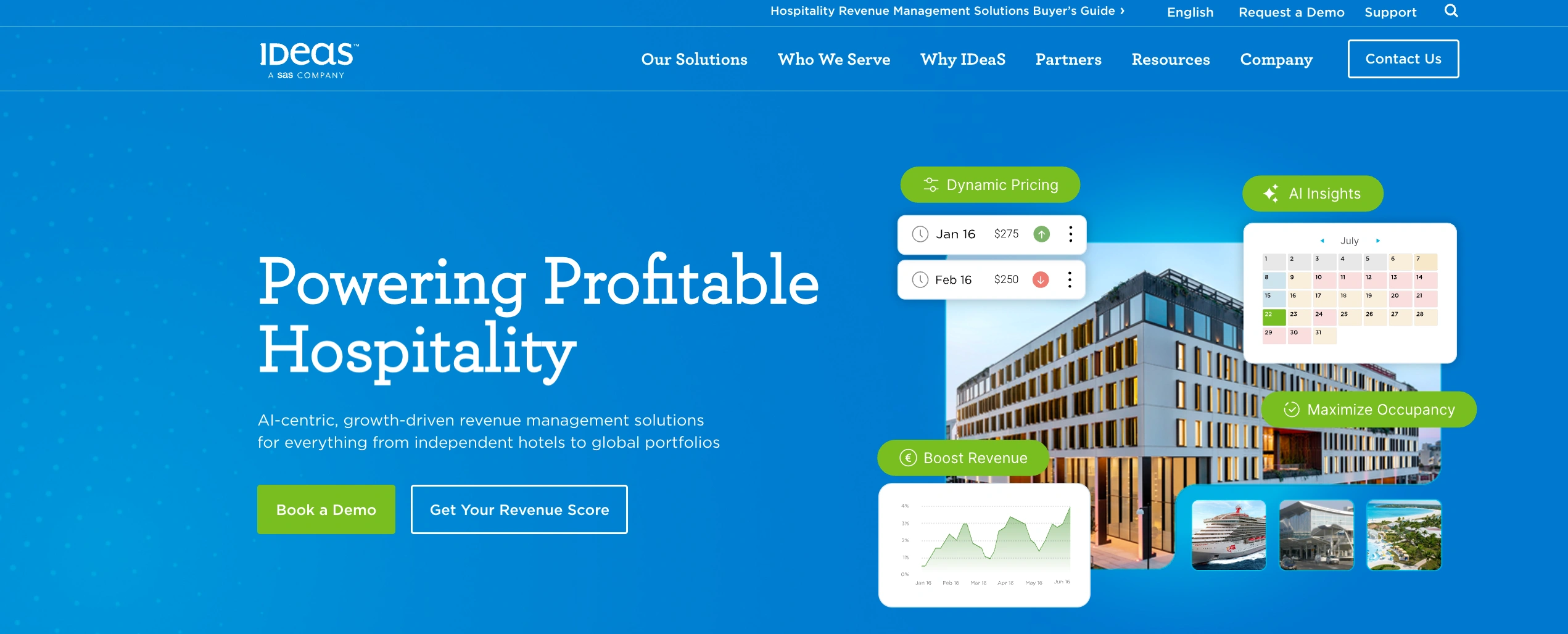
IDeaS is the long-standing enterprise standard, combining decades of pricing science with advanced analytics and AI. It is built for the hardest revenue problems: complex group-versus-transient trade-offs, multiple channels, mixed room classes, and high-volume demand across large or multi-property portfolios. Major chains, management companies, and luxury groups rely on it to price at scale with limited manual intervention.
Key features: Advanced demand forecasting, room-class and 365-day forecasting, group and transient optimization, automated rate recommendations, deep PMS and CRS integrations.
What it solves: Maximise portfolio revenue, forecast group-versus-transient demand at scale, and hold one pricing strategy across every property with limited manual work. When you're running hundreds of rooms across several sites, no one can hand-build a forecast that keeps up with group blocks, transient pickup, and shifting demand at once. IDeaS does the forecasting and prices of every room class for you, so ownership sees the numbers it lives by in one place: Portfolio RevPAR, RGI, GOPPAR, and consolidated reporting.
Best for: Large hotels, luxury properties, casinos, and multi-property enterprise groups.
Pricing: Custom, enterprise-level quote based on portfolio size and modules.
Reviews: Capterra 3.5 out of 5 from 2 reviews and G2 4.8 out of 5 from 3 reviews, which reflects light coverage on general directories rather than its enterprise reputation.
Small & Boutique Hotels (under about 30 rooms)
1. RoomPriceGenie: Best for small & boutique hotels
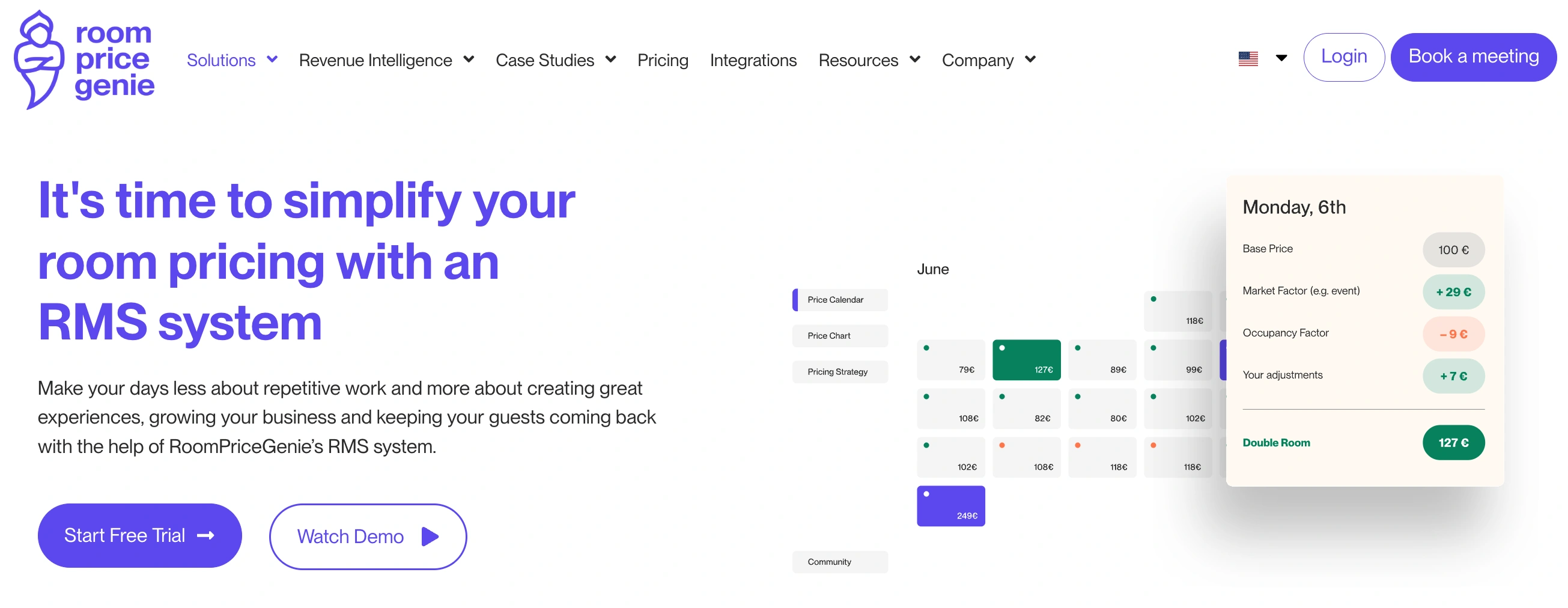
RoomPriceGenie is purpose-built for the independent hotelier and is the easiest tool here to adopt. It is fast to implement, intuitive, and simple to understand, which is exactly what a small property without a revenue manager needs. It sets and updates daily rates automatically based on demand, events, and booking pace, so a lean team can price like a much larger operation with a few minutes of oversight.
Key features: Automated daily rates, event and demand triggers, fast onboarding, simple dashboards.
What it solves: Automate daily rates, react to events and booking pace, onboard fast, and run it in minutes a day. At a small property, rates go untouched for weeks because there's always something more urgent at the desk. RoomPriceGenie updates them automatically so a lean team can price like a bigger operation and lift RevPAR, ADR, and Occupancy with a few minutes of oversight.
Best for: Small and boutique properties that want reliable pricing with minimal effort.
Pricing: Transparent, tiered pricing with an accessible entry level.
Reviews: Capterra 5.0 and Software Advice 5.0 from 13 reviews, with near-perfect ease-of-use and support scores.
2. happyhotel: Best for small properties wanting autopilot pricing
happyhotel is a cloud-based revenue and yield management system with a deliberately simple dashboard, aimed at small and medium hotels that want more revenue without deep technical knowledge. It uses booking-pace and demand signals to keep rates optimized on autopilot, and its low entry price makes automated pricing realistic for properties that would never buy an enterprise tool. Its footprint is strongest in Europe.
What it solves: Run autopilot pricing on booking-pace and demand triggers, kept affordable for a lean team. Automated pricing has always felt out of reach for the smallest properties on tight budgets. happyhotel keeps rates moving on autopilot, with a price low enough that automation finally makes sense, and it shows up in steadier RevPAR and Occupancy.
Best for: Small hotels and boutiques that want automation over manual control.
Pricing: Among the most affordable here, with entry pricing starting around $5 per room per month.
Reviews: Not yet rated on G2, Capterra, or Software Advice, so rely on a demo and direct references.
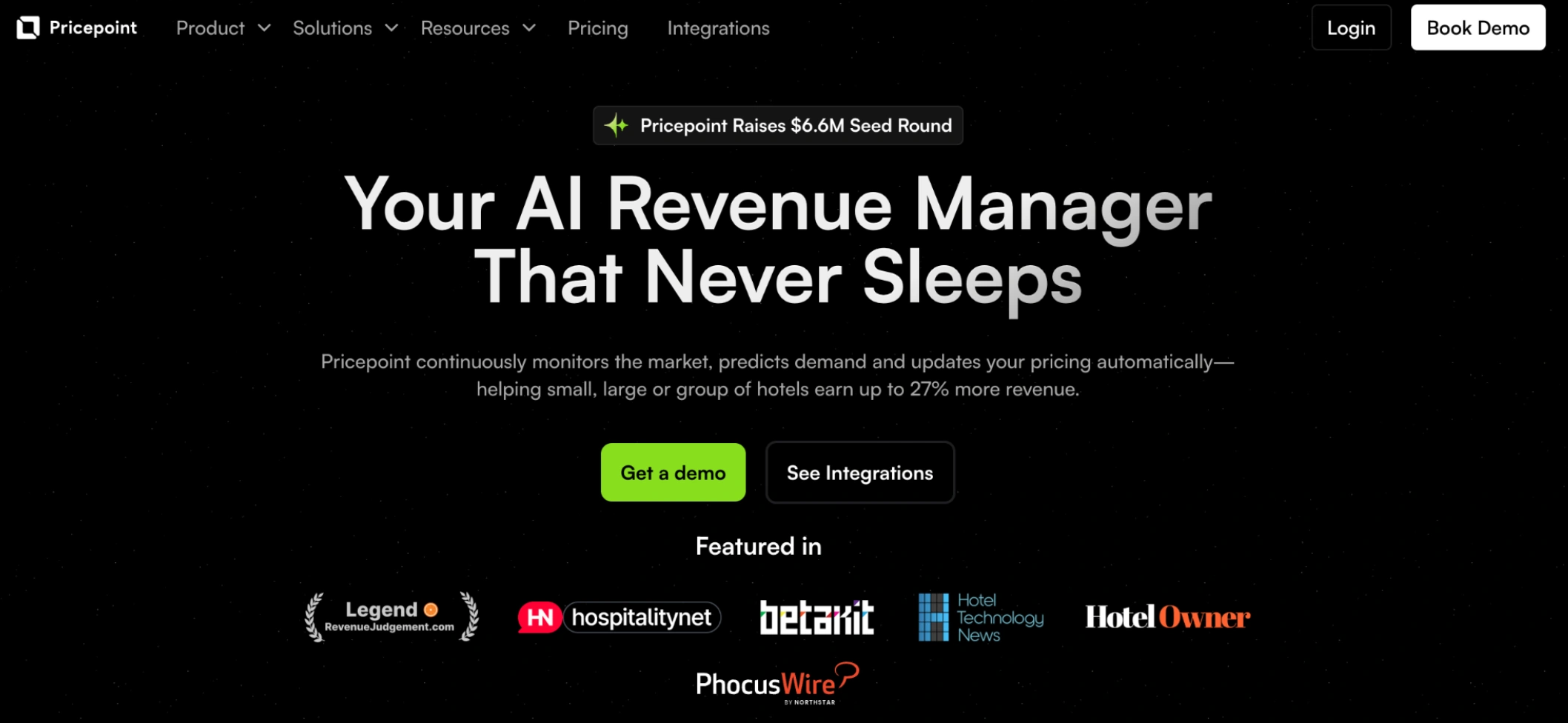
3. Pricepoint: Best for independent hotels wanting simple, affordable automation
Pricepoint is a real-time price optimization engine that analyzes the market and updates rates throughout the day, built to be genuinely set-and-forget. Rather than mirroring the competitive set, it builds pricing around forecasting, pickup analysis, and demand signals to lift ADR and occupancy without triggering price wars. Its appeal is accessibility: simple to run and affordable for smaller independents.
What it solves: Run set-and-forget daily automation that builds rates from forecasting, pickup, and demand rather than just mirroring competitors. It lifts ADR and Occupancy without triggering price wars, and without the cost or complexity of an enterprise system.
Best for: Independent hotels that want dependable automation without complexity.
Pricing: Affordable, quote-based; positioned for smaller independents.
Reviews: Capterra 5.0 out of 5, though from a single review, so weigh the sample size.
Short-Term & Vacation Rentals (and small STR portfolios)
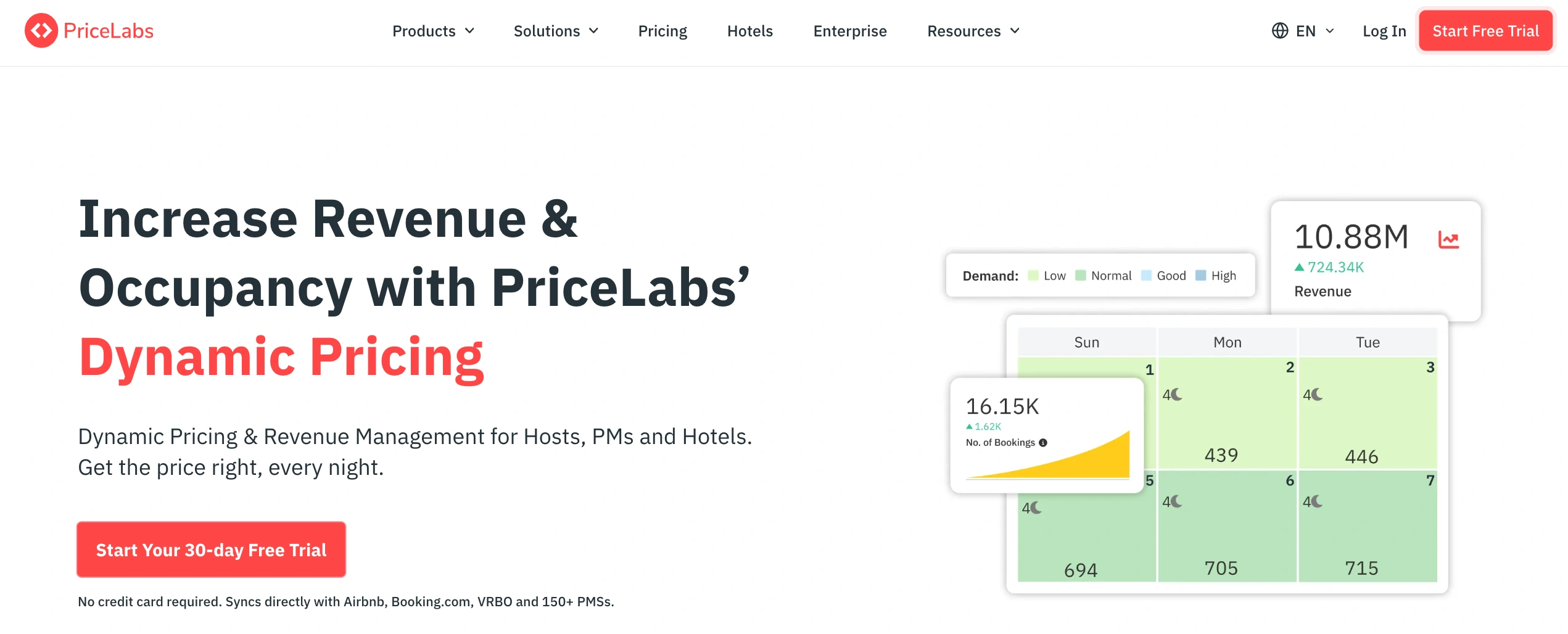
1. PriceLabs: Best for short-term & vacation rentals
PriceLabs blends automation, market data, and human control, and is one of the most widely used tools among vacation-rental managers. It handles dynamic pricing and minimum-stay rules across large portfolios, with deep customization for operators who want to shape the rules themselves. It works for hotels too, but its heart is the short-term rental market, where its data and flexible rules are hard to beat.
What it solves: Stop pricing every listing by hand, apply dynamic pricing and minimum-stay rules across the whole portfolio, and keep rules you control. Once you're past a handful of units, hand-pricing across seasons, weekends, and events is impossible. PriceLabs handles it with deep market data, lifting Occupancy, ADR, and revenue per unit across every listing.
Best for: Short-term and vacation rental managers, and mixed hotel and rental portfolios.
Pricing: Published per-listing pricing for short-term rentals; custom quotes for hotels and larger portfolios.
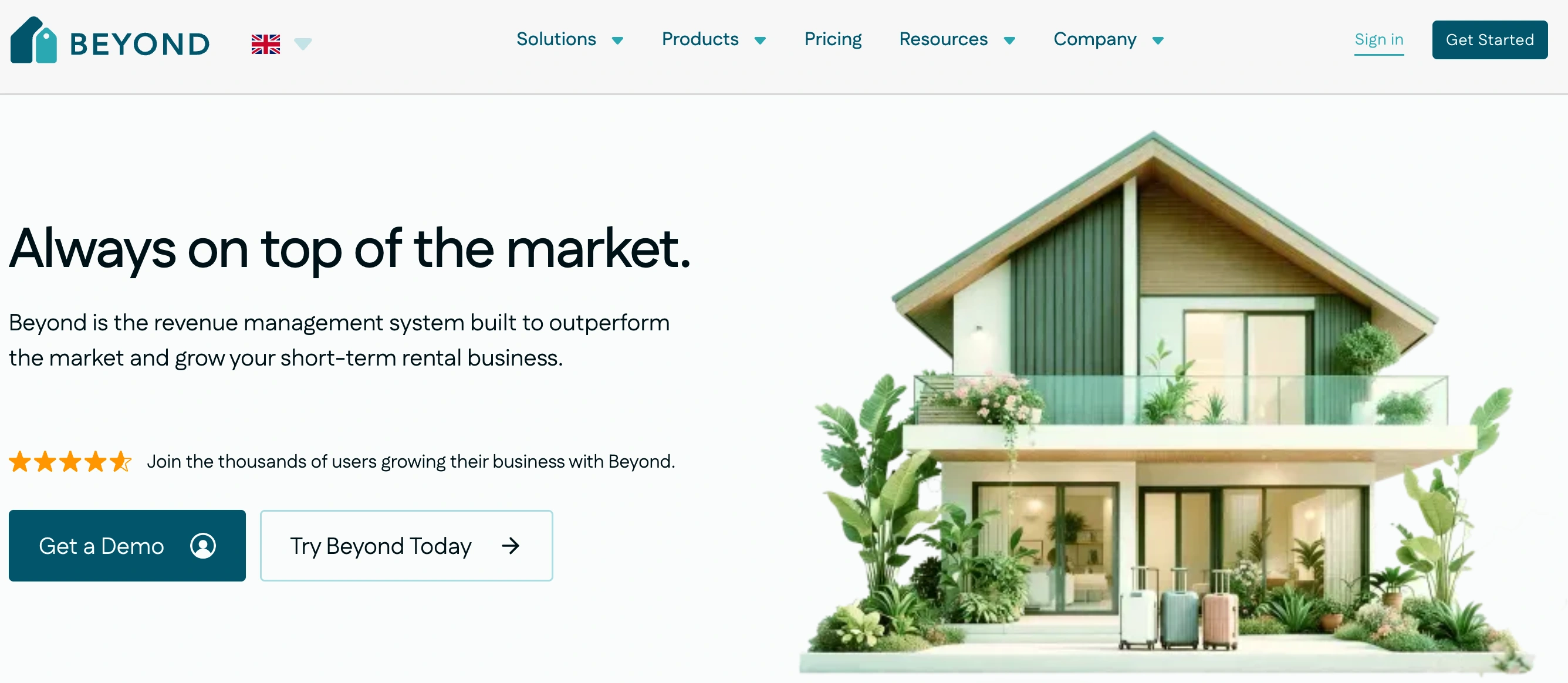
2. Beyond: Best for demand-driven vacation rental pricing
Beyond is a dynamic pricing and revenue management platform built specifically for short-term rentals. It combines demand-driven pricing with market data and distribution tools, helping hosts and property managers lift occupancy and ADR across seasons and events without changing rates by hand. It is a common alternative to PriceLabs for owners and managers who want pricing purpose-built for the rental market.
Key features: Demand-driven dynamic pricing, market data and insights, distribution tools, portfolio pricing for managers.
What it solves: Price to real demand and replace flat rates across a highly seasonal, event-driven calendar. Flat nightly rates leave money on the table when the market swings with the season and the local calendar. Beyond prices to demand and pairs it with market data and distribution tools to lift Occupancy and ADR across the whole portfolio.
Best for: Vacation rental hosts and property managers.
Pricing: Published pricing for short-term rentals; custom quotes for larger portfolios.
Reviews: Widely used in the STR market; check current directory listings for verified ratings.
{{cta-strip}}
Frequently Asked Questions
1. What is the role of revenue management in hotel?
To sell the right room to the right guest at the right time for the right price, so pricing, inventory, and distribution align with real-time demand to maximize RevPAR and profit.
2. What are the core features to evaluate in hotel revenue management software?
Dynamic pricing, demand forecasting, competitor rate shopping, two-way PMS integration, channel management, segmentation, LOS controls, automation with override, and reporting. Verify PMS integration first.
3. What is hotel revenue management software?
Hotel revenue management software is a digital tool that helps properties sell the right room, at the right price, to the right guest, at the right time. Using data and analytics, it predicts demand, tracks the market, and adjusts rates automatically to boost bookings and profit.
4. What is the best hotel revenue management software for independent hotels?
roommaster Revenue Management is a strong fit, delivering enterprise-grade AI pricing inside one platform with the PMS, booking engine, and channel manager, no revenue manager required. RoomPriceGenie and Atomize are also popular for small properties.
5. What is revenue management in the hospitality industry?
The data-driven practice of optimizing pricing, inventory, and distribution across all revenue streams to maximize profitability, using forecasting, segmentation, and dynamic pricing.
6. What are the 5 pillars of revenue management?
Data and analytics, demand forecasting, pricing strategy, inventory and distribution management, and market segmentation.
7. What are the core KPIs for revenue management software?
RevPAR, ADR, and Occupancy Rate are primary. Mature teams also track TRevPAR, GOPPAR, booking pace, and the MPI, ARI, and RGI benchmarking indices.
revenue-management-one
Put Your Hotel Pricing Optimization on Autopilot with AI
Mayela Lozano is a content strategist with a passion for hospitality and technology. She collaborates with roommaster on content creation, highlighting how technology can streamline hotel operations and enhance guest satisfaction. When she’s not creating content, Mayela loves to travel and spend time with her two little ones, discovering new adventures and making memories along the way.
Join Thousands of Hotels Thriving with roommaster
The transition to roommaster is straightforward and efficient. Our implementation team handles data migration including reservations, guest profiles, and historical information.
The transition to roommaster is straightforward and efficient. Our implementation team handles data migration including reservations, guest profiles, and historical information.
Hotel Self Check-In: How It Works, Types, Benefits And Setup
October 1, 2026
Hotel Management
Hospitality Trends
Hotel Check-In & Check-Out Times Explained
October 1, 2026
Hospitality Trends
Hotel Management
Cloud-Based Property Management System: Hotel PMS
October 1, 2026
General
Cloud PMS
AI
Cloud Computing In The Hospitality Industry: A Complete Guide For Hotels
October 1, 2026
Hotel Management
Cloud PMS
Hotel Management System (HMS): A Complete Guide
September 23, 2026
Hospitality Trends
Hospitality Technology
Hotel PMS
Hotel Management
Cloud PMS
How Hotel PMS Software Transforms Hospitality Management
September 23, 2026
Hotel Management
Marketing
Pet-Friendly Hotel Amenities & Package Ideas That Drive Revenue
September 22, 2026
Hotel Management
Hotel PMS
Hotel Food And Beverage (F&B): The Complete Guide
September 22, 2026
Hotel Management
Marketing
Hotel Pet Fees: How Much Should You Charge?
September 22, 2026
Hotel Management
Hotel PMS
Best Hotel Food and Beverage (F&B) Management Software In 2026
September 22, 2026
Join Thousands of Hotels Thriving with roommaster
See how roommaster's unified platform can work for your property. Our team will walk you through features tailored to your specific needs and operations.





.png)
.png)
.png)