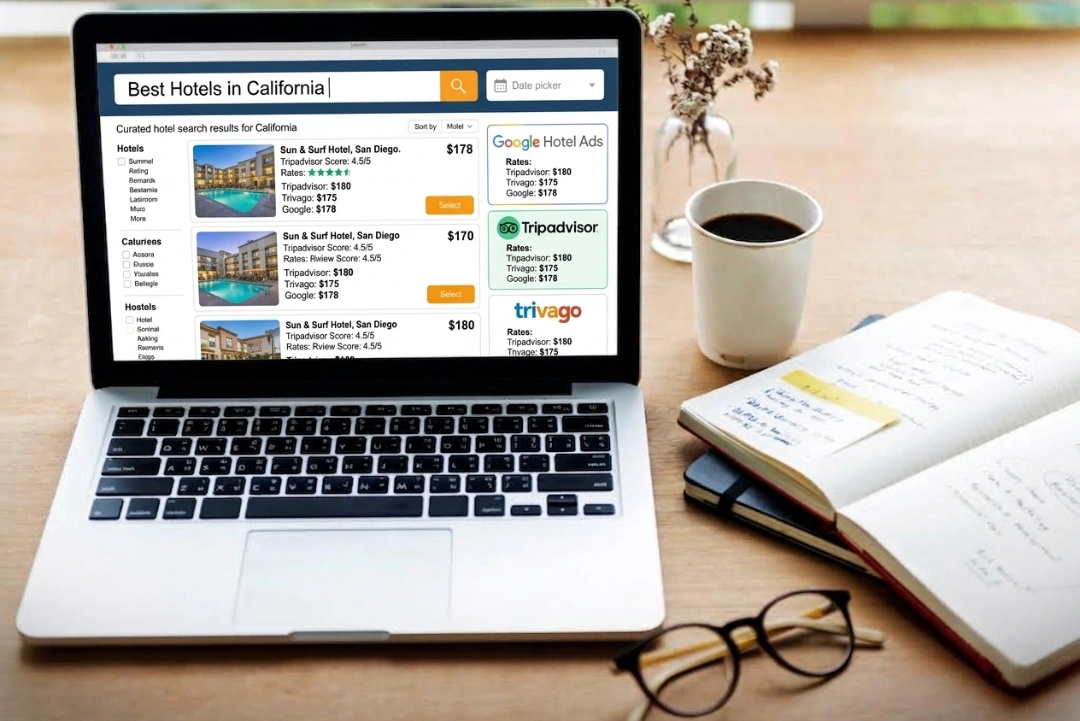
Google hotel ads are a metasearch product that displays live rates in Google search results, Google Maps, and Google Travel.
Hotels compete directly with OTAs for price visibility in the Google Hotel Booking module.
You can pay on a cost-per-click, commission, or hybrid basis, depending on your commission model.
Independent properties can control ad spend through smart bidding and a structured Google Hotel Ads campaign.
Strong integration between your booking engine, channel manager, and connectivity partner via roommaster PMS keeps real-time rates and availability accurate.
Hotels that optimize properly can increase direct bookings, reduce OTA dependency, and strengthen long-term guest relationship value.
Experienced travelers know that finding the right hotel begins long before they pack their bags. Today, the journey often starts with a simple search, on Google Search or Google Maps, where hotel search results can make or break first impressions.
This is where Google Hotel Ads (GHA) can help. Google Hotel Ads enables hotels to be seen at the precise moment when potential customers are searching, driving direct bookings while allowing hotels to control their ad spend.
However, it is not enough to simply appear. A good Google Ads hotel strategy will ensure that your hotel is the one that stands out from the rest, reaches the right customers, and turns clicks into customers. In this guide, we’ll explore everything from setup to costs and key benefits, giving you the tools to maximize visibility and bookings.
What is Google Hotel Ads?
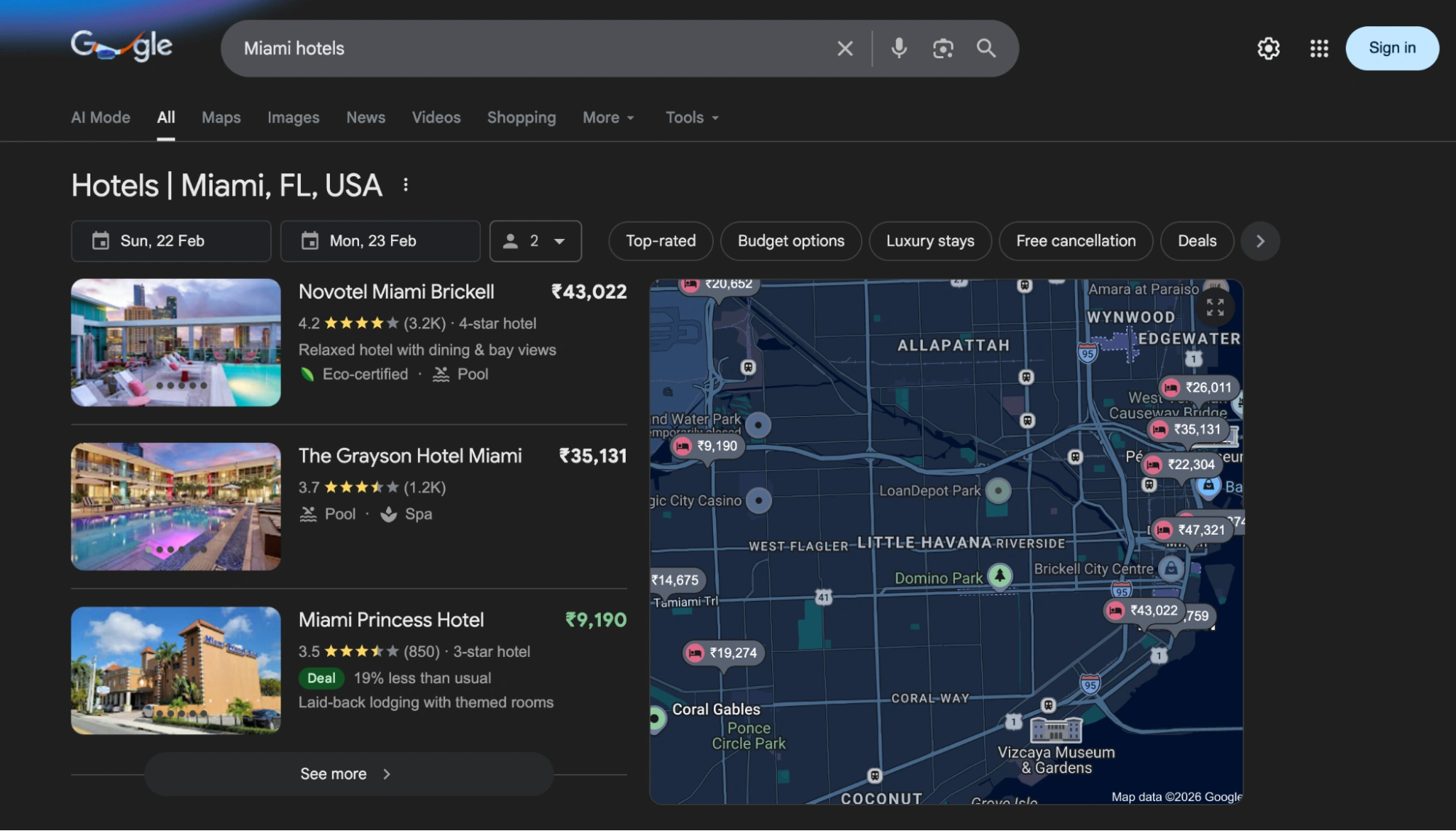
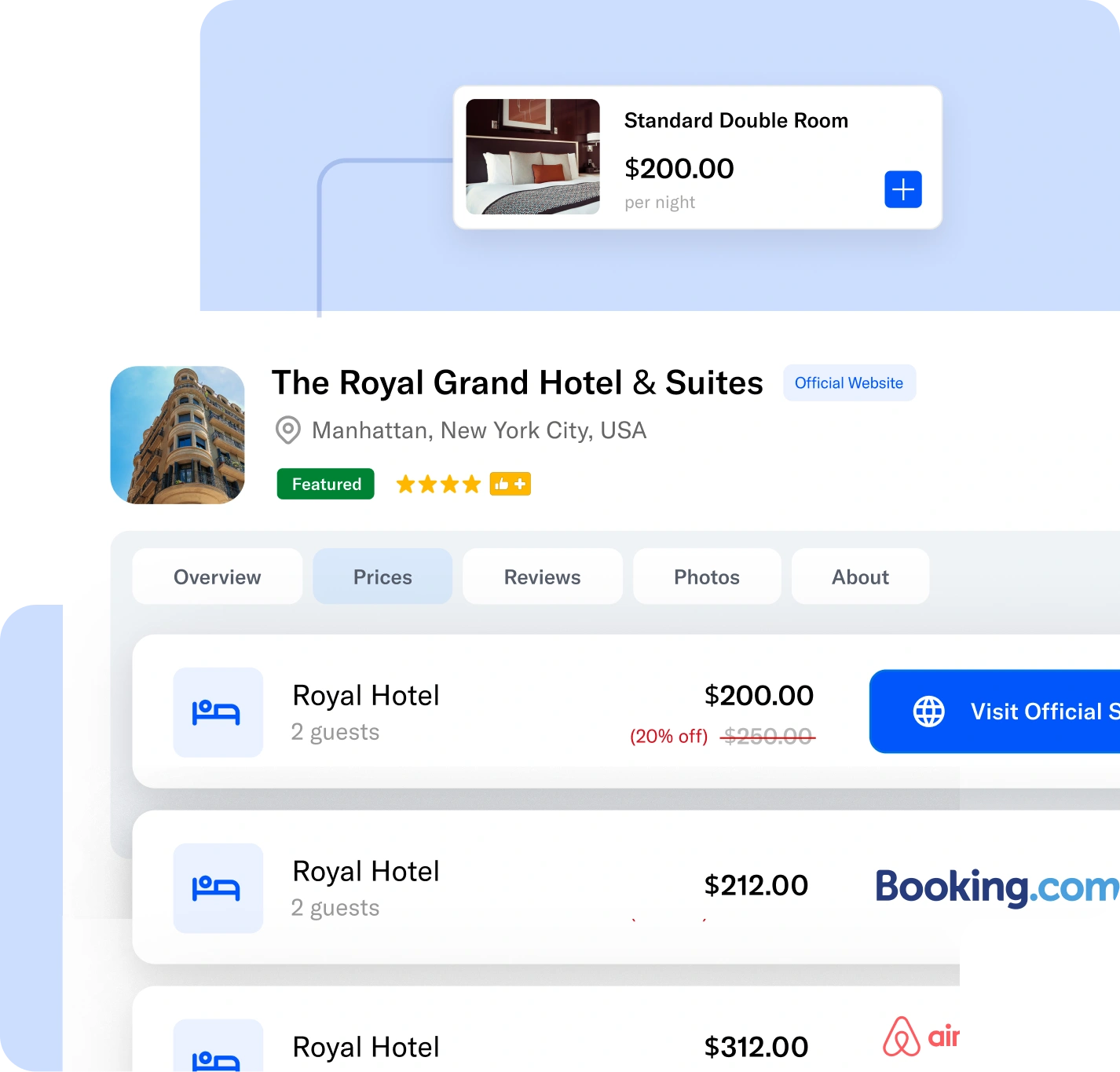
Google Hotel Ads is a metasearch advertising product built specifically for the hospitality industry. The platform displays live hotel rates, room prices, photos, policies, and booking options directly within search results when a traveler searches for accommodation in a particular area.
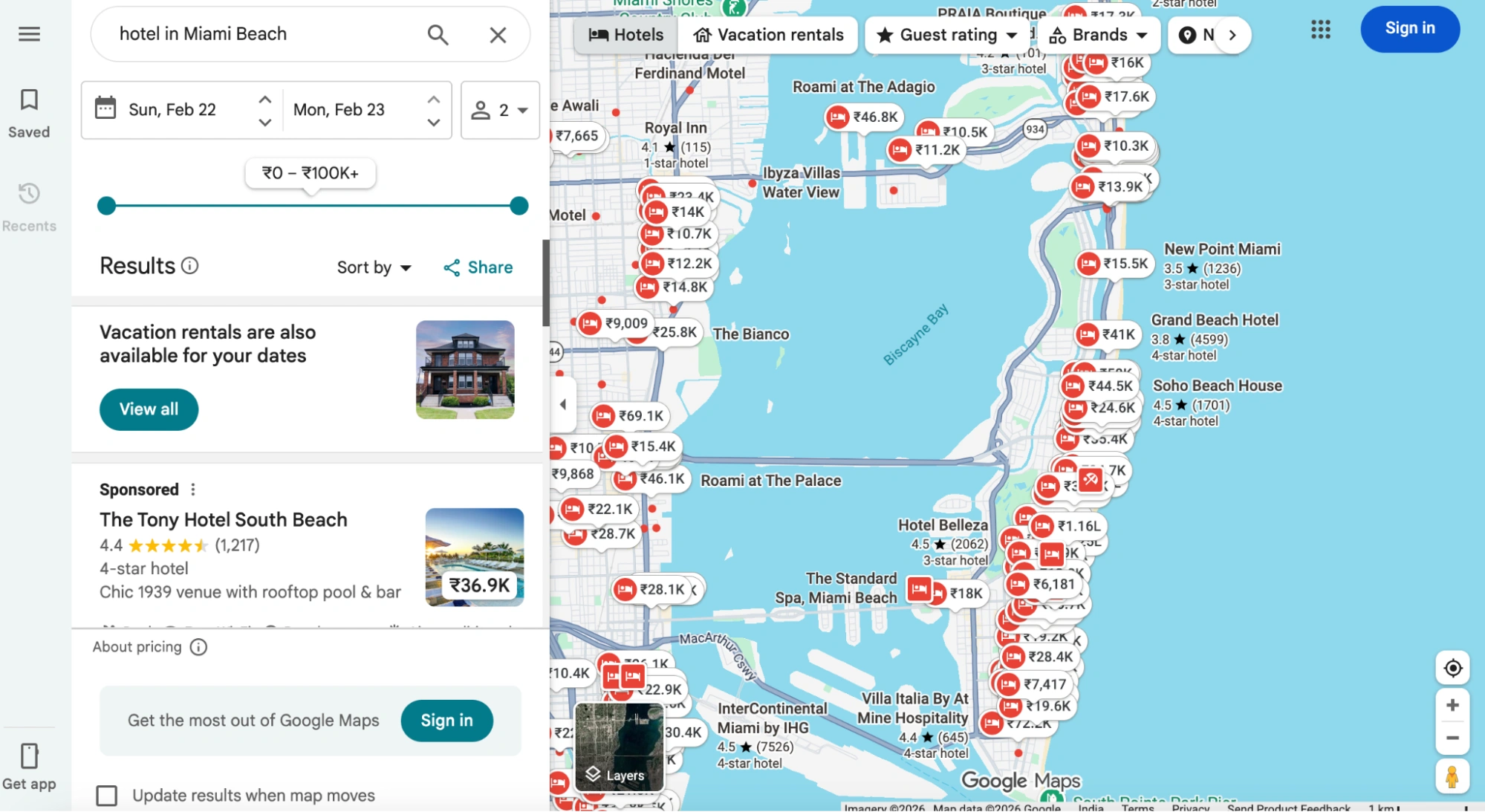
When a user types a search term such as “hotel in Miami Beach,” Google search generates a hotel module. Inside that module, your property appears alongside OTAs and other accommodation providers. Travelers compare rates instantly. If they click your rate, Google sends them to your website or to your booking engine via one of your approved booking links.
Unlike standard paid ads on the search network, this format focuses on real-time pricing rather than text headlines. It functions as a tool designed for hotel campaigns that center on live inventory and demand signals.
Why Should You Use Google Hotel Ads?
Every traveler begins their journey with a search, and hotels that meet them there capture attention, interest, and bookings before competitors even register. Here’s why you should use GHA:
If your hotel doesn’t show up at the top of the results when users query relevant terms, you lose that demand to others. With Google Hotel Ads campaign visibility, you show rates, photos, and booking links right in the place where searchers are actively comparing options.
The instant visibility gives travelers confidence, highlights your unique offerings, and puts your hotel first in their minds, long before they scroll past your competitors.
That means if your direct channel appears as prominently as OTA pricing within the hotel search results, you capture a greater share of direct revenue while bypassing third-party commissions.
By being front and center in the search results, your property becomes the easy, trusted choice. Travelers see your rates and availability alongside competitors, which nudges them to book directly, increasing revenue and strengthening your relationship with guests.
GHA displays instantly on mobile devices during a search and gives travelers on the go immediate access to your rates, images, and booking links. Mobile users often make last-minute, high-intent decisions, and appearing at that moment turns interest into action.
When your hotel shows up first on a phone screen, you capture bookings that might have gone to competitors who aren’t as mobile-ready.
{{hotel-website-builder}}
How Do Google Hotel Ads Work?
When a traveler searches for hotels in a destination on Google, a hotel search box appears right below Google Ads. They can click a listing, scroll down to hit the “View all hotels” or “See more” button, or adjust dates and filters to refine their search.
Clicking on a hotel listing takes the traveler to the hotel’s Google My Business page. There, they see details about the property or vacation rental, along with a list of booking sources and available rates, starting with Google Hotel Ads and then unpaid listings.
If someone searches a hotel’s name directly, the hotel’s knowledge panel appears on the right side of the screen, or below Google Ads on mobile, showing booking sources and rates.
When travelers click the GHA link, they land on the hotel’s website booking engine. Hotels pay Google a fee for each click, whether a booking happens or not. This is the cost-per-click model, also called a metasearch engine, and it lets hotels control their ad spend while reaching guests at the exact moment they’re ready to book.
Google Hotel Ads vs Google Ads
Google Hotel Ads are built specifically for hotels, while Google Ads (formerly AdWords) are designed for hotels and other hospitality businesses. Google Ads appear at the top and bottom of search results and are labeled “Ad.”
To show up there, hoteliers create a Google Ads account, set campaigns, choose keywords, define a daily budget, write ad copy, and adjust other settings.
Compared to Google Hotel Ads, these campaigns rely on keyword searches and are not linked to hotel availability or rates, which makes GHAs a more precise tool for driving bookings.
Your property can appear in Google search results in several ways, each with its own purpose and impact:
Free Booking Links
Google My Business
Google Hotel Ads
Google Ads
Google Hotel Ads vs Booking.com Ads
It’s tempting to think OTAs and metasearch ads are interchangeable, but they are not.
Booking.com ads promote your property inside Booking.com’s ecosystem, while Google hotel ads place your property in front of travelers across Google properties.
Here’s how they differ:
You control guest data with Google hotel ads, while OTAs often own the customer relationship.
OTA commissions cut into profitability, while GHA lets you capture a proportionally higher room booking value when done right.
Direct bookings build loyalty and lifetime guest value, unlike OTA bookings, where guest data stays with intermediaries.
When you choose a robust Google hotel ads management strategy, it helps you reduce OTA dependency without eliminating OTA partnerships entirely.
How Much Does Google Hotel Ads Cost for a Small Accommodation Provider?
Cost structures for Google hotel ads have evolved, and small properties feel the impact every day.
In early 2025, Google phased out traditional commission-based bidding in favor of CPC-centric and value-based bidding models. These models let you control ad spend, reach the right travelers, and turn clicks into direct bookings.
Here’s how the models work:
Cost Per Click (CPC): You pay each time a user clicks on your ad.
Commission per stay: Previously popular but being phased out in favor of more predictable bid strategies.
Hybrid/Target return on ad spend (ROAS): Google optimizes for value rather than clicks.
Ad costs in metasearch have increased significantly, with some hoteliers reporting year-over-year ad spend increases of 20–40% due to heightened competition and complexity.
This means:
It’s essential to maintain competitive hotel rates
You must control your ad spend carefully
Your bidding strategy needs to align with occupancy patterns and peak periods
Despite rising costs, AI-enabled campaigns delivered performance gains, with up to 4× more bookings and revenue than traditional approaches.
Best Bidding Strategies for Hotel Ads
A strong bidding strategy decides how often your hotel appears and which travelers see your rates. Every click represents a chance to earn a direct booking, so you want your campaigns to work as efficiently as possible.
Below are some of the best bidding strategies for hotel ads:
Start with CPC bidding if you want tight control over ad spend. CPC lets you set maximum bids for each click, ensuring you reach travelers without overspending. Small hotels often combine CPC with careful rate management to make every click count.
For properties focused on revenue, target ROAS helps Google prioritize high-value bookings. The system automatically adjusts bids to maximize revenue from each campaign, turning traveler intent into profitable reservations.
Some hotels use hybrid bidding, combining CPC control with value-based optimization. It balances visibility, cost, and revenue, giving hotels flexibility as competition shifts or demand spikes.
The key is to continuously monitor performance, adjust bids for peak periods, and let data guide decisions. With the right strategy, Google Hotel Ads drive bookings, increase revenue, and strengthen your direct channel.
How to Set Up Google Hotel Ads Step by Step
Before you launch Google Hotel Ads, claim your hotel’s profile on Google. The process is simple and well-documented on Google’s support pages.
Once claimed, check every detail on your listing, especially links. A beautiful profile cannot generate direct bookings if the link to your website doesn’t work. By checking accuracy upfront, you also optimize how your hotel appears in the free “All Options” section, giving travelers the best first impression even before ads start running.
With your profile and content ready, take the next steps to create your first ad:
Connect your inventory and rates to Google via an API or a third party, such as a channel manager
Verify that your hotel meets Google’s listing requirements and data quality specifications
If you use a channel manager, work with your integration partner to launch your first ad. If not, you can use Google’s platform to manage ads directly alongside your systems
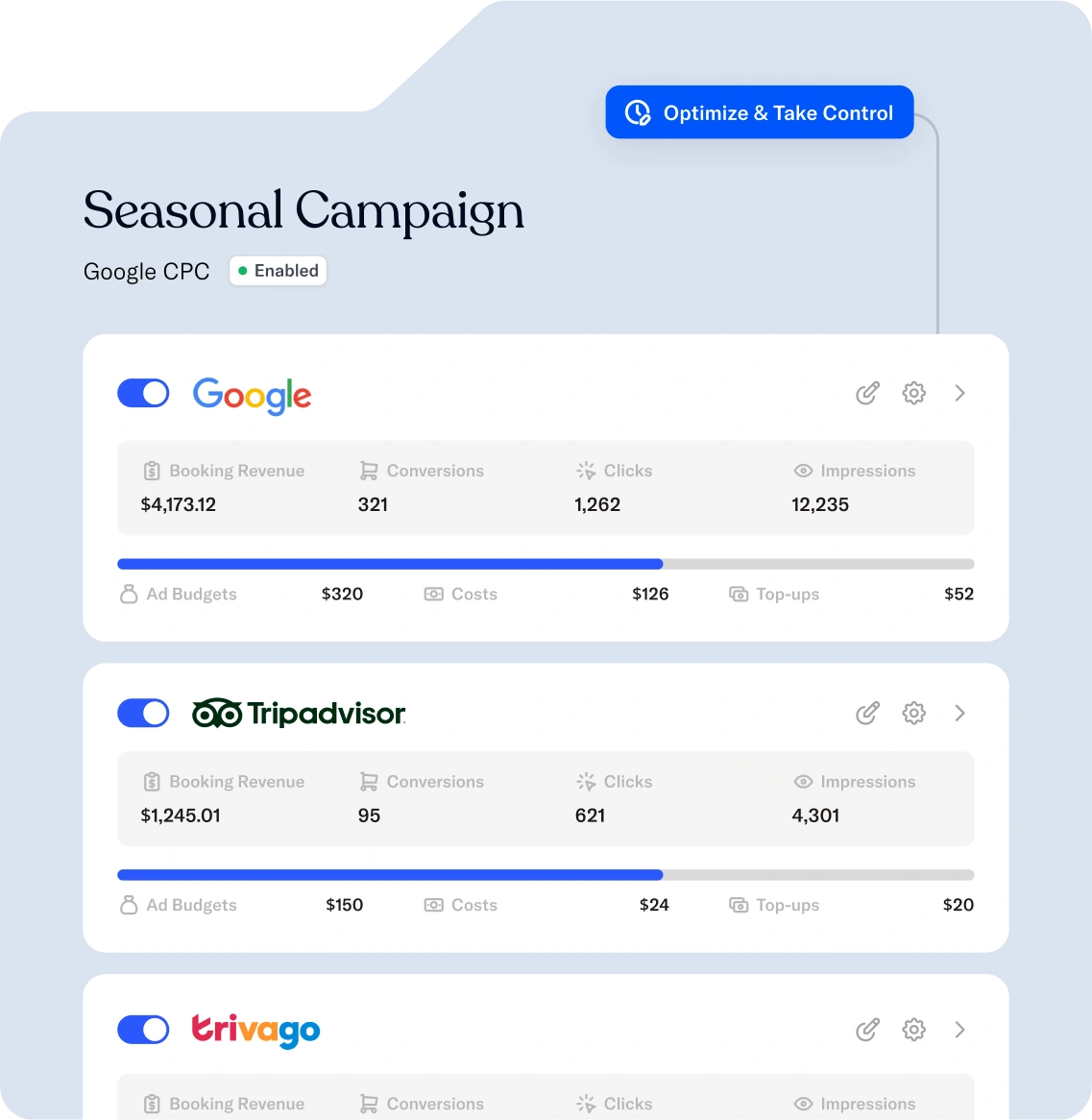
Many hoteliers use roommaster Metasearch to drive direct bookings across platforms like Google, Trivago, and TripAdvisor. As a result, it increases bookings, reduces administrative work, and gives complete control over distribution. Simultaneously, it reaches travelers actively searching for their next stay.
How to Integrate Your Booking Engine with Google Hotel Ads
To make Google Hotel Ads work for your hotel, you must connect your booking engine so Google can pull real‑time rates and availability. Google uses this live connection to show travelers accurate pricing, which helps you capture direct bookings instead of losing them to OTAs.
1. Verify your hotel and prepare your profile
First, make sure your hotel meets Google’s requirements and has a complete, accurate Google Business Profile. Then, connect your booking engine so it feeds rates and availability directly into Google’s system.
Most hotels do this through a channel manager, PMS, or authorized integration partner that links their booking engine to the Google Hotel Ads feed. For example, roommaster Metasearch connects your booking engine to platforms like Google Hotel Ads, TripAdvisor, and Trivago, allowing travelers to see real-time rates and book directly with your property. Instead of managing multiple feeds and bidding tools separately, hoteliers centralize control in one dashboard.
2. Sync inventory and rates across Google platforms
Once connected, Google pulls room types, rates, and availability from your booking engine and displays them across Google Search, Google Maps, and hotel search results.
This seamless flow ensures travelers see accurate information and land on your booking engine, ready to convert, every time they click your ad.
3. Customize and optimize your integration
Different platforms have slightly different steps. For example, some systems let you choose your bid strategy, enter your booking‑engine URL, and save the connection in their dashboard so Google sends traffic directly to your booking page.
With roommaster, hotels gain:
Broad metasearch reach across Google, TripAdvisor, and Trivago
Real-time rate and availability display pulled directly from the booking engine
Automated CPC and CPA bidding optimization
Budget controls with daily, weekly, or monthly caps
Conversion analytics that track the full journey from impression to booking
“Official Site” designation that builds immediate trust
Hoteliers who adopt this approach often report greater visibility, stronger direct bookings, and reduced reliance on OTA commissions.
Do You Need an Integration Partner?
You don’t always need an integration partner, but having one makes it easy to set up Google Hotel Ads. Integration partners, like channel managers or PMS providers such as roommaster PMS, automatically sync your room types, rates, and availability with Google, eliminating errors and saving hours of manual updates.
If your hotel is small or you have limited technical resources, a partner helps your feed stay accurate and keeps your campaigns running smoothly.
Without a partner, you can still connect your booking engine directly through Google’s platform. However, you’ll need to manage updates, bid strategies, and data syncing yourself.
{{pms-one}}
Tips to Optimize Google Hotel Ads Performance
Here’s how you can make the most out of GHA performance:
Monitor clicks and conversions daily: Check which searches, dates, and room types drive the most traffic. Adjust your bid strategy, rates, or listing details to capture high-value travelers.
Use smart bidding to respond to demand: Use target ROAS or enhanced CPC to let Google automatically adjust bids based on traveler behavior. This keeps your hotel competitive in real time, especially during peak periods or sudden spikes in demand.
Optimize your hotel profile: Keep photos, descriptions, and amenities up to date. Travelers scan quickly, and clear, engaging content helps your hotel stand out in hotel search results. For example, you can use phrases like “Book Now” or “Get Exclusive Discounts” to encourage users to click.
Adjust for seasonality and booking windows: Shift bids for last-minute bookings or high-demand dates. For example, increase bids for “tonight” rooms that rarely cancel or reduce bids for distant bookings that may be less likely to convert.
Track device and location performance: Travelers on mobile often book differently than desktop users. Review device and location trends and apply bid adjustments to focus on the most profitable audiences.
Test and refine continuously: No campaign performs perfectly from day one. Experiment with bidding strategies, rate presentation, and listing enhancements. Review performance metrics regularly and adapt campaigns based on what drives the most bookings.
How to Measure Success
In 2025, the average click-through rate (CTR) in Google Ads was 6.66%, showing that travelers actively notice and interact with paid hotel listings. This highlights how important it is to monitor the right metrics to make your campaigns perform at their best:
CTR: Measures how many travelers click your ad after seeing it. It shows whether your listing grabs attention.
Conversion rate: Tracks how many clicks turn into bookings. It shows whether travelers take action.
Cost per click (CPC): Shows how much you pay for each click. It helps control ad spend.
Cost per acquisition (CPA): Measures how much you spend for each confirmed booking. It links cost directly to revenue.
Return on ad spend (ROAS): Calculates revenue per dollar spent. It shows which campaigns deliver the best value.
Impressions: Counts how often your ad appears. It reveals how many travelers see your property.
Booking window metrics: Tracks how far in advance travelers book. It guides bid adjustments for high-value dates.
Device & location performance: Shows which devices and regions drive bookings. It helps you optimize targeting and bids.
How Google Hotel Ads Helps You Compete with OTAs
OTAs dominate visibility with deep pockets, but Google hotel ads gives you your own place in the spotlight. With price parity and good bidding, many independent hotels can:
Capture travelers earlier in the funnel
Reduce dependency on ads partners
Strengthen guest relationship value
Since OTAs take 15–30% per booking and direct channels cost much less, prioritizing direct bookings via GHA improves profitability significantly.
Common Mistakes (And Quick Fixes)
You’ve set your Google Hotel Ads, spent hours tweaking your budget, but you’re still not getting enough traffic. Many hoteliers struggle with it, but the good news is, it’s fixable.
Here’s where hoteliers go wrong and how they can undo it:
Running campaigns without conversion tracking: Some hotels activate campaigns but never track completed bookings. Without booking data, it becommes difficult to optimize bidding strategies. You can drive stronger results when you track every confirmed reservation and feed that data back into your campaign.
Choosing a bid strategy that doesn’t match your goal: Hotels often select a strategy without defining what success looks like. An aggressive Target ROAS can limit reach. Conservative CPC bids can restrict growth. You can unlock better performance when you align your bidding approach with occupancy goals, seasonality, and revenue targets.
Ignoring the mobile booking experience: Travelers search, compare, and book on their phones every day. A slow site or complicated checkout interrupts intent. You capture more conversions when you simplify forms, improve speed, and streamline the booking journey.
Get Started With Google Hotel Ads Easily
Hotels don’t have to sit back while OTAs dominate search results. With the right partner, you can show up where travelers are searching and convert more direct bookings.
Many hoteliers choose roommaster Metasearch to simplify the process. roommaster connects your booking engine to Google Hotel Ads, TripAdvisor, and Trivago, syncs real-time rates and availability, manages CPC and CPA bidding models, and centralizes budget control in one dashboard. As a result, you increase visibility across metasearch platforms, reduce administrative workload, and turn search demand into profitable direct revenue.
Book a demo today and see how roommaster can amplify your direct booking strategy.
{{cta-strip}}
FAQs
What are Google Hotel Ads?
Google Hotel Ads is a metasearch advertising solution that displays live rates and booking links within Google Search and Google Maps interface, helping hotels compete for visibility against OTAs.
Where can I advertise my hotel?
You can advertise your hotel on Google Search, Google Maps, and Google Travel using free profiles, free booking links, and paid Google Hotel Ads campaigns. These placements help your hotel show up where travelers actively look for accommodations.
How do I claim $500 Google Ads?
To claim a $500 Google Ads credit, you need to sign up for a new Google Ads account, complete billing setup, and meet the offer’s spend requirement (usually spend $500 within the offer period) before Google applies the promotional credit to your account.
hotel-website-builder
Build professional hotel websites that drive direct bookings
Mayela Lozano is a content strategist with a passion for hospitality and technology. She collaborates with roommaster on content creation, highlighting how technology can streamline hotel operations and enhance guest satisfaction. When she’s not creating content, Mayela loves to travel and spend time with her two little ones, discovering new adventures and making memories along the way.
Join Thousands of Hotels Thriving with roommaster
The transition to roommaster is straightforward and efficient. Our implementation team handles data migration including reservations, guest profiles, and historical information.
The transition to roommaster is straightforward and efficient. Our implementation team handles data migration including reservations, guest profiles, and historical information.
Hotel Check-In Kiosk: Enhance the Guest Experience
October 5, 2026
Hospitality Technology
Hotel Management
Hospitality Trends
Hotel Self Check-In: How It Works, Types, Benefits And Setup
October 1, 2026
Hotel Management
Hospitality Trends
Hotel Check-In & Check-Out Times Explained
October 1, 2026
Hospitality Trends
Hotel Management
Cloud-Based Property Management System: Hotel PMS
October 1, 2026
Hotel Management
Cloud PMS
Hotel Management System (HMS): A Complete Guide
September 23, 2026
Hospitality Trends
Hospitality Technology
Hotel PMS
Hotel Management
Cloud PMS
How Hotel PMS Software Transforms Hospitality Management
September 23, 2026
Marketing
Online Bookings
Hotel Metasearch Strategy: 8 Tactics That Drive Direct Bookings
September 22, 2026
Hotel Management
Marketing
Pet-Friendly Hotel Amenities & Package Ideas That Drive Revenue
September 22, 2026
Hotel Management
Hotel PMS
Hotel Food And Beverage (F&B): The Complete Guide
September 22, 2026
Hotel Management
Marketing
Hotel Pet Fees: How Much Should You Charge?
September 22, 2026
Join Thousands of Hotels Thriving with roommaster
See how roommaster's unified platform can work for your property. Our team will walk you through features tailored to your specific needs and operations.



.png)
.png)
.png)