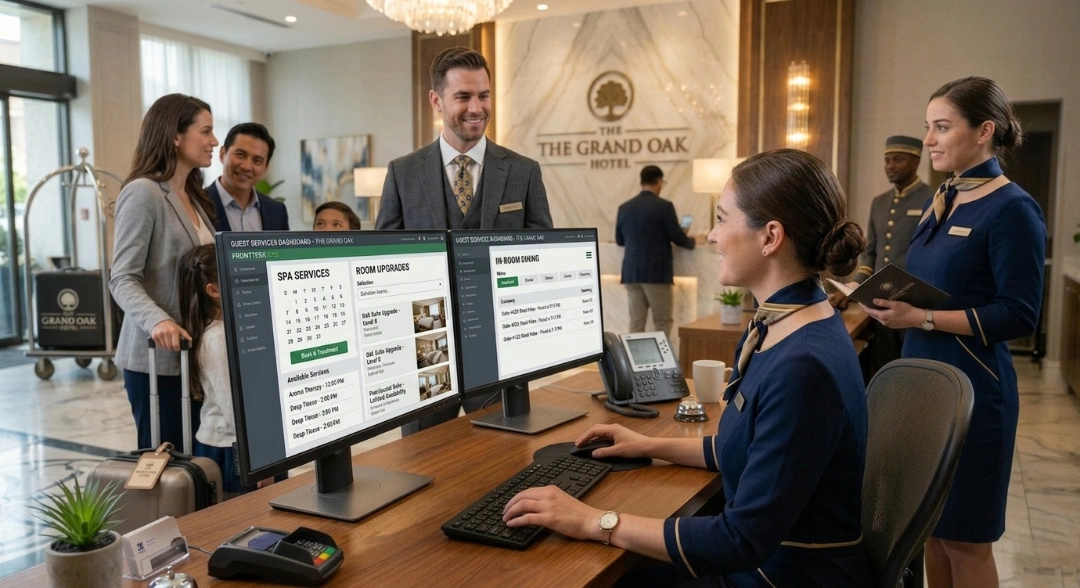
A hotel folio is a live, itemized record of all charges during a guest’s stay, including rooms, dining, spa, and incidentals.
Folios keep billing transparent, and disputes are rare, making check-out smooth and boosting guest satisfaction.
Modern PMS solutions like roommaster PMS automate folio updates, track transactions in real time, and manage guest groups with master folios.
Guests love convenience, with 71% preferring hotels with mobile check-in and messaging, which lets them view and manage folios instantly.
Analyzing folio data helps hotels optimize revenue, personalize offers, and streamline operations, turning billing into a tool for better service.
Whenever you stay at a hotel, you rarely need your wallet. The hotel “bills everything to your room.” But what does it mean?
On the final morning before you check out, you get a neat sheet of paper under your door that lists your room rates, restaurant bills, room service, spa services, and every one of your guests’ financial transactions. Hotel folios make the whole thing feel ridiculously simple.
A well-managed folio reduces confusion and improves guest satisfaction. Modern property management systems (PMS) automate folio updates so hotel staff don’t have to enter charges manually and can focus on delivering great service.
In this guide, you’ll learn the hotel folio meaning, see a hotel folio example, and compare a hotel folio vs receipt vs invoice. You’ll also discover the best practices for hotel folio management.
What is a Hotel Folio?
A hotel folio, also referred to as a guest folio in hotel or master folio, is a dynamic, itemized record of all charges and payments made by a guest during their stay. It tracks every transaction from check-in to check-out and keeps everything in one place so the front desk and accounting teams can monitor charges as they occur.
Think of a folio as a running tab that gets updated whenever a guest:
Books a room
Orders room service
Uses spa treatments
Adds minibar usage
Pays for hotel services like laundry or dining
This running record becomes the basis for the final folio that guests settle when they depart.
In fact, industry trends show that contactless payments move about 10x faster than other payment methods. This speed updates the folio in real time, making every room rate, restaurant bill, room service charge, and spa service appear instantly and reducing errors. As a result, hotels reduce wait times, shorten customer lines, improve the customer experience and guest satisfaction, and free up staff for other tasks, while keeping the folio accurate and complete.
Why are Hotel Folios Important?
Smooth billing makes stays better for everyone. After all, guests hate surprises on their final bill, and nothing frustrates them more than mistakes at check-out.
Hotel folios keep everything clear and simple. Here’s what they do:
Track room rates, restaurant bills, room service, spa services, and all guest financial transactions as they happen
Make check-out faster by keeping everything itemized and ready
Prevent disputes by showing every charge clearly
Build trust and improve guest satisfaction by eliminating surprises
They also make life easier for hotel teams. Accounting teams, front desk managers, and the F&B department all work from the same record, reducing errors and back-office headaches.
Hotel Folio Example: What it Looks Like
A hotel folio shows all the charges a guest incurs during their stay. For example, a typical hotel folio might look like this:
Date
Description
Amount
2026-01-10
Room Charge (Room 205)
$200
2026-01-10
In-Room Dining (Dinner)
$45
2026-01-11
Spa Services (Massage)
$80
2026-01-11
Minibar Usage
$15
2026-01-12
Taxes and Service Fees
$40
Total Owed
$380
This simple example shows how hotels log and track every charge. In a modern property management system (PMS), the folio updates automatically as guests use services, keeping the record accurate and ready for check-out.
{{pms-two}}
Hotel Folio vs Receipt vs Invoice
Hotels deal with multiple financial documents, but a folio isn’t the same as a receipt or an invoice:
A hotel folio is a real-time, running record of charges and payments during a guest’s stay.
A receipt shows proof of payment for a specific transaction or service.
An invoice is a final, formal billing document issued at checkout that includes tax details and payment terms.
In simple terms, a folio shows what happened during a stay, a receipt shows what was paid at a given time, and an invoice is the official final bill issued when the stay concludes.
Types of Hotel Folios
Hotels use several types of hotel folios to handle different billing situations. These include:
Guest folio: This is the standard folio opened when an individual checks in. It tracks all charges incurred by a guest during their stay.
Master folio in hotel: A master folio consolidates charges for groups or multiple guests under one account. For example, meeting planners, corporate clients, or event organizers may want a single bill for rooms, group meals, and other shared charges.
Non-guest folio: Used for transactions not tied to an overnight guest. Examples include purchases by visitors at the hotel restaurant or event space when no guest is staying overnight.
City ledger folio: This folio type is commonly used for corporate billing when payment is arranged after the guest has departed. It lets the hotel bill the company directly.
Split folio: Some hotels allow splitting charges across multiple folios, such as when a group wants room charges on one account and spa services on another.
Employee folio: Used to record charges incurred by employees or staff for official or personal use of hotel services.
Each of these folio types in hotel operations helps tailor the billing structure to the specific needs of guests and clients.
Master Folio in Hotel Explained In-Depth
A master folio brings together all charges for a group or multiple rooms into a single record. Instead of each individual guest having a single folio, a master folio captures all room rates, restaurant bills, room service charges, spa services, and other guest financial transactions for the entire group in one place.
Hotels use master folios when they manage groups, events, or business accounts. For example:
Group bookings: When a group books several rooms for the same event or company, the hotel links all those rooms to one master folio. The hotel tracks every charge under that account, so the organizer can see everything together.
Corporate accounts: When a company sends employees to stay, the hotel creates a master folio tied to that company. The hotel logs room charges, meals, meeting space fees, and transportation or other services to the corporate master folio so the company can settle everything in one payment.
Events and weddings: For weddings, conferences, and large events, hotels often put catering, room blocks, audiovisual charges, and service fees into a master folio. The event planner or host receives a single final bill instead of dozens of small ones.
A master folio keeps billing transparent and efficient. It lets hotels apply negotiated rates, split charges as needed, and give clients a single view of spending. It also reduces confusion at check‑out, speeds billing processes, and improves guest satisfaction by keeping everything organized and easy to reconcile.
💡Case in Point
Hoteles Vista Group operates Puerto Rico’s only all-inclusive hotel portfolio, with nearly 300 rooms across four properties. However, managing all-inclusive resorts presented a unique folio challenge. That is, while guests pay a single bundled package rate, it is still necessary to accurately allocate revenue across rooms, food, beverage, and other departments.
In an all-inclusive model, most charges are packaged into a single rate, but behind the scenes, they must be segmented correctly for accounting, reporting, and owner transparency.
To address this, the team used detailed Night Audit reporting to segment every charge at the folio level. Instead of treating revenue as a single sum, they allocate each component to the correct department, capturing a clear picture of financial activity across all properties.
Asset Manager Rafy Molina explains:
“The Night Audit report comes with all the details, everything posted in the folio, but segmented where we want it. Every charge goes into a certain place: how much to the room, how much to the food, how much to the beverage.”
For Molina, having consolidated, property-level and portfolio-level folio visibility is essential:
“It’s an extraordinary opportunity of information that I get from roommaster. I’m able to get all the information from each property through the report system. That way I have the opportunity to explain to the owners and stockholders how the hotels are performing.”
As a result, Hoteles Vista Group was able to accurately track performance, allocate package revenue appropriately, and make informed strategic decisions.
🎥 For more insights, watch how Hoteles Vista Group simplified hotel operations, increased revenue, and delivered exceptional guest experiences:
Hotels Vista Group Case Study - Puerto Rico | 24 Years with roommaster
How to Understand a Hotel Folio
A hotel folio acts as a detailed record of all charges and payments a guest makes during their stay. It includes guest and stay information such as the guest’s name, room number, room type, and check-in/check-out dates.
The folio lists each transaction as a line item, including:
Room charges
Food and beverage expenses
Minibar usage
Spa treatments
Taxes, such as occupancy or city tax
Associated payment methods
When reviewing a hotel folio, make sure to:
Match the stay dates with the correct room rate
Check for duplicate charges
Verify that the right discounts or special rates are applied
Look for any unauthorized charges
Confirm that the final balance is correct
Understanding the folio helps ensure transparency, prevents disputes, and gives both guests and hotel staff confidence that billing is accurate.
Hotel Folio Template
Curious about what a hotel folio really looks like? Let’s make it clearer with a simple example of a hotel folio below:
1. Hotel information
At the top of the folio, include your property’s core details:
Hotel Name
Full Address
Contact Number
Email Address
This section establishes brand identity and provides guests with a reference point for future communication.
2. Guest information
Clearly list the guest’s personal and contact details:
Guest Name
Contact Number
Email Address
Ensure accuracy here, as this information is often used for billing confirmations and records.
3. Stay details
This section outlines the specifics of the reservation:
Room Number
Check-in Date (MM/DD/YYYY or preferred regional format)
Check-out Date (MM/DD/YYYY)
Invoice Date
Using a consistent date format is essential for accounting clarity and international guests.
4. Itemized charges table
Your folio should include a detailed breakdown of charges in a structured table format with the following columns:
Description
Date
Quantity
Rate
Total
Room Charge
Taxes and Fees
Food & Beverage
Laundry Services
Minibar Usage
Telephone Charges
Other Charges
At the bottom of the table, include:
Subtotal
Total Amount Due
Make sure calculations are automated if using a spreadsheet format to avoid manual errors.
5. Payment information
Provide a summary of how the guest settled the bill:
Method (Credit Card/Cash/Other)
Card Type (Visa/Mastercard/Other)
Last 4 Digits of Card
For privacy and compliance, never display full card numbers.
6. Terms & conditions
This section should clarify:
Cancellation Policy
Additional Charges or Incidental Policies
Clear terms reduce disputes and offer transparency for guests.
7. Closing note
End the folio with a brief appreciation message such as: “Thank you for choosing our hotel. We hope to welcome you again soon.”
How to Manage Hotel Folios Effectively
Creating a hotel folio is only the first step. Now that you understand how to create a hotel folio, managing it effectively can streamline operations, enhance guest experience, and boost revenue.
Here’s how to do it in detail:
1. Choose the right type of folio
Not every guest or booking works the same way. Match the folio type to the situation:
Guest folios for individual stays
Master folios for groups, events, or weddings where multiple rooms or services consolidate under one payer
Split folios when billing needs to be divided between parties
Using the correct folio reduces confusion at check-out, prevents disputes, and supports operational efficiency. The roommaster Operations Suite simplifies this by automatically assigning folio types based on booking details. Its Reservation Management module creates the correct folio from the moment a guest books, while Front Desk Management ensures all charges post correctly.
For group events, Group Blocks Management intelligently allocates rooms, tracks deposits, and organizes shared charges into a single master folio, avoiding manual reconciliation headaches.
2. Automate folio management with your PMS
Manual entry increases errors and slows front desk operations. roommaster’s unified platform synchronizes all charges, payments, and guest activity in real time. For example:
Room rates, restaurant bills, room service, spa services, and minibar usage appear immediately in folios
The Front Desk & Housekeeping modules track charges, room status, and incidentals as they occur
Reporting & Analytics allows management to see a complete picture of revenue and guest transactions across the property or portfolio
Multi-property operations remain in sync, so staff never risk duplicate charges or missed postings
Automation reduces human error, speeds check-out, and frees employees to focus on delivering hospitality.
3. Train your team on folio workflows
Even the best system works only as well as the people using it. Hence, you should provide hotel staff with clear SOPs, train them on folio handling, and show them how to spot discrepancies.
roommaster Operations Suite features an intuitive dashboard and drag-and-drop calendar for reservations and folio management, reducing clicks and training time. Here’s how it helps:
Staff can manage reservations, folios, and housekeeping tasks from a single login
Smart Auto-Fill pre-populates guest information from past stays, ensuring accurate folio entries
Multi-property teams can rotate seamlessly, since workflows remain consistent across locations
4. Communicate folio details to guests
Transparency prevents surprises at check-out. This is why you should let guests know about deposits, incidentals, and charges in advance.
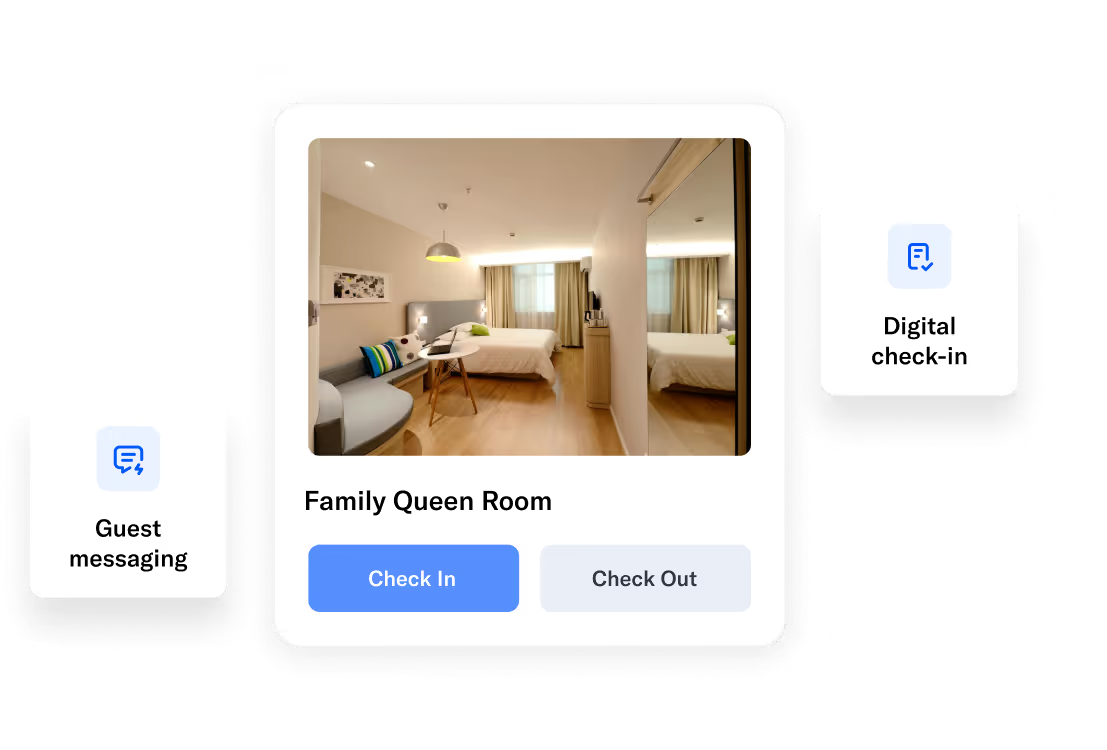
To help you with it, the roommaster Guest Experience Suite and the Hotel Guest App let guests view folio details in real time. With these tools, guests can complete mobile check-in, check-out, and view digital room keys.
{{guest-app}}
Additionally, AI-assisted messaging handles routine inquiries 24/7, answering questions about folio charges or amenities while freeing staff to focus on in-person hospitality. Automated communications integrate with guest preferences stored in roommaster Guest Profiles, enabling personalized messaging for incidentals, spa bookings, or dining charges.
This contactless, real-time communication improves satisfaction, reduces front desk congestion, and supports multilingual guests effortlessly. In fact, hotels that use digital messaging and concierge tools see nearly a 30% increase in guest engagement and communication satisfaction.
5. Analyze folio data to improve operations and guest experience
Hotel folios are more than bills. They provide valuable operational insight.. With roommaster Reporting & Analytics, you can:
Real-time integration, in turn, reflects payments instantly in guest folios and accounting reports. Plus, automated dispute resolution and fraud prevention save 4–6 staff hours weekly and keep every transaction accurate and transparent.
Simplify Folio Management with roommaster PMS
Did you know that 71% of guests prefer hotels with mobile check-in and messaging? These features make it easier for guests to view their folio, track charges, and manage payments in real time.
From a standard guest folio to a master folio for groups, every folio tracks charges and guest spending for rooms, restaurant bills, spa services, and other hotel services. Proper hotel folio management improves guest convenience, enhances satisfaction, and supports transparent billing for both individual guests and corporate clients.
A modern, fully-upgraded, cloud-based, all-in-one PMS like roommaster hotel PMS system streamlines folio management, automates financial transactions, and gives hotel staff real-time insights into room service, room fees, and other charges incurred.
Take control of your folios and elevate the guest experience today! Book a demo to see the platform in action. Or, download our [Free Hotel Folio Template] to standardize billing across your property.
{{cta-strip}}
FAQs
1. What is a folio for a hotel?
A folio for a hotel is an itemized record of the guest’s charges and payments during their stay, tracking every transaction until check-out. Modern systems like roommaster PMS can update folios automatically in real time, maintaining accuracy and transparency.
2. What is the difference between a folio and an invoice?
A folio tracks charges throughout the stay, while an invoice is the final bill issued at check-out, including tax identification and payment details.
3. Why are hotel bills called folios?
Hotel bills are called folios because they serve as a financial ledger, recording every charge a guest incurs during their stay.
4. What is the purpose of a folio?
A folio collects all financial transactions in one place, helping hotel staff manage charges efficiently and provide guests with accurate billing.
5. How does a folio work?
A folio opens at check-in, updates automatically with charges such as room fees, room service, or spa services, and settles when the guest pays at check-out.
6. How to read a hotel folio?
Reading a hotel folio is as simple as reading a book. Just review the guest details, check each itemized charge, confirm payment entries, and verify the final balance to verify the accuracy of all transactions.
7. What are the different types of folios in hotels?
Some of the most common types of folios in hotels include guest folio, master folio, non-guest folio, split folio, and city ledger folio.
8. What does folio payment mean?
Folio payment means settling all charges recorded in the folio at check-out using the guest’s chosen payment method.
pms-two
Hotel Operations Made Simple and Effective with roommaster
Mayela Lozano is a content strategist with a passion for hospitality and technology. She collaborates with roommaster on content creation, highlighting how technology can streamline hotel operations and enhance guest satisfaction. When she’s not creating content, Mayela loves to travel and spend time with her two little ones, discovering new adventures and making memories along the way.
Join Thousands of Hotels Thriving with roommaster
The transition to roommaster is straightforward and efficient. Our implementation team handles data migration including reservations, guest profiles, and historical information.
The transition to roommaster is straightforward and efficient. Our implementation team handles data migration including reservations, guest profiles, and historical information.
Best Hotel Management Software in 2026: 10 Top-Rated Tools Compared
October 15, 2026
Hotel Management
Hospitality Trends
Hotel Check-In Kiosk: Enhance the Guest Experience
October 5, 2026
Hospitality Technology
Hotel Management
Hospitality Trends
Hotel Self Check-In: How It Works, Types, Benefits And Setup
October 1, 2026
Hotel Management
Hospitality Trends
Hotel Check-In & Check-Out Times Explained
October 1, 2026
Hospitality Trends
Hotel Management
Cloud-Based Property Management System: Hotel PMS
October 1, 2026
Hotel Management
Cloud PMS
Hotel Management System (HMS): A Complete Guide
September 23, 2026
Hospitality Trends
Hospitality Technology
Hotel PMS
Hotel Management
Cloud PMS
How Hotel PMS Software Transforms Hospitality Management
September 23, 2026
Hotel Management
Marketing
Pet-Friendly Hotel Amenities & Package Ideas That Drive Revenue
September 22, 2026
Hotel Management
Hotel PMS
Hotel Food And Beverage (F&B): The Complete Guide
September 22, 2026
Hotel Management
Marketing
Hotel Pet Fees: How Much Should You Charge?
September 22, 2026
Join Thousands of Hotels Thriving with roommaster
See how roommaster's unified platform can work for your property. Our team will walk you through features tailored to your specific needs and operations.








.png)
.png)
.png)