Hotel AI dynamic pricing adjusts room rates automatically based on demand, occupancy, and market trends
It helps hotels capture the right price for each booking, maximizing revenue without constant manual work
roommaster, powered by ampliphi, considers historical data, competitor pricing, and guest behavior for pricing recommendations
Dynamic pricing tools respond to events, seasonality, and booking patterns, keeping your hotel competitive
Automated rate updates reduce repetitive tasks and human error
Managers get real-time insights into revenue, occupancy, and pricing performance
Running a profitable hotel business means constantly balancing occupancy and revenue. Set your rates too high, and you risk empty rooms. Go too low, and you leave money on the table.
So how do you strike that sweet balance? Invest in a reliable hotel dynamic pricing software. These tools factor in the current demand, seasonal trends, and competitor pricing and automatically update room pricing across all your channels.
Instead of relying on your gut and hoping for the best, you can set competitive pricing without compromising revenue. Plus, it frees up your time that you would otherwise have spent on changing room rates throughout your booking channels.
In this article, we give you the 11 best dynamic pricing software for hotels and discuss practical strategies to get the best out of them.
What is dynamic pricing software for hotels?
A hotel dynamic pricing software is a tool that helps hotels adjust their room rates automatically instead of sticking to fixed prices. It looks at things like demand, season, local events, competitor data, and booking patterns. Then it updates room prices while keeping your hotel’s rack rate as the baseline.
This way, you can fill more rooms when business is slow and earn more when demand is high. Since the updates are real-time and automatic across all your channels, you don’t have to change them manually.
Benefits of dynamic pricing software for hotels
You need a pricing strategy that adapts to weekday lulls, weekend surges, and sudden changes in demand. Here is how a hotel's dynamic pricing software can help:
Fill more rooms during slow periods: Adjust room pricing to attract guests when demand drops
Save time: Automate rate changes as market trends shift
React quickly to local events: Update rates instantly when concerts, festivals, or conferences drive demand
Reduce human error in pricing: Avoid mistakes of manual changes and maintain consistent pricing to boost brand trust
Key features to look for in dynamic pricing software
Hotel dynamic pricing software helps you keep up with market demand, track customer behavior, and fine-tune your prices with data analysis. And the best part is that you can manage it all with just a few clicks.
However, you must choose the right dynamic pricing platform to get these perks. So, here are the must-have features to look for:
Real-time rate updates: Change room rates instantly based on demand and booking trends
Customer insights: See when and why guests are booking
Smart data analysis: Use data to fine-tune pricing and predict demand
Revenue optimization: Get automated pricing suggestions
Competitor rate tracking: Compare your rates with nearby hotels
Event-based pricing: Adjust prices for concerts, festivals, or conferences
Custom rules and alerts: Set rules for weekdays, weekends, or seasons
Integration with booking systems: Sync rates automatically with OTAs and your booking engine
Multi-property support: Manages room pricing for all your properties from one platform
Best dynamic pricing software compared
Before we get into the details, let’s give you a quick peek at how the best dynamic pricing software for hotels stack up against each other:
Tools
Best for
Key features
roommaster
All-in-one hotel management with dynamic pricing
Real-time price optimization, competitor analytics, event analytics, customizable pricing rules, real-time sync with booking engine and channel manager, analytics, and reporting
Displacement analysis and identifying key demand drivers
Forecasting and displacement analysis, dynamic pricing for rooms and space, communication tools, group booking management
Pricepoint
Running pricing simulations
Pricing simulations, PMS/channel manager integration, mobile management
Top 11 dynamic pricing software for hotels in 2026
Now, you have a basic idea about how dynamic pricing tools work and what features to look for. So, here are detailed overviews of the eleven best dynamic pricing software with real user insights:
1. roommaster with ampliphi (Best for all-in-one hotel management with dynamic pricing)
roommaster, powered by ampliphi, offers automatic and real-time dynamic pricing across all your channels. Whether you manage a small boutique hotel or a property chain, our platform offers unmatched pricing intelligence for consistent rates.
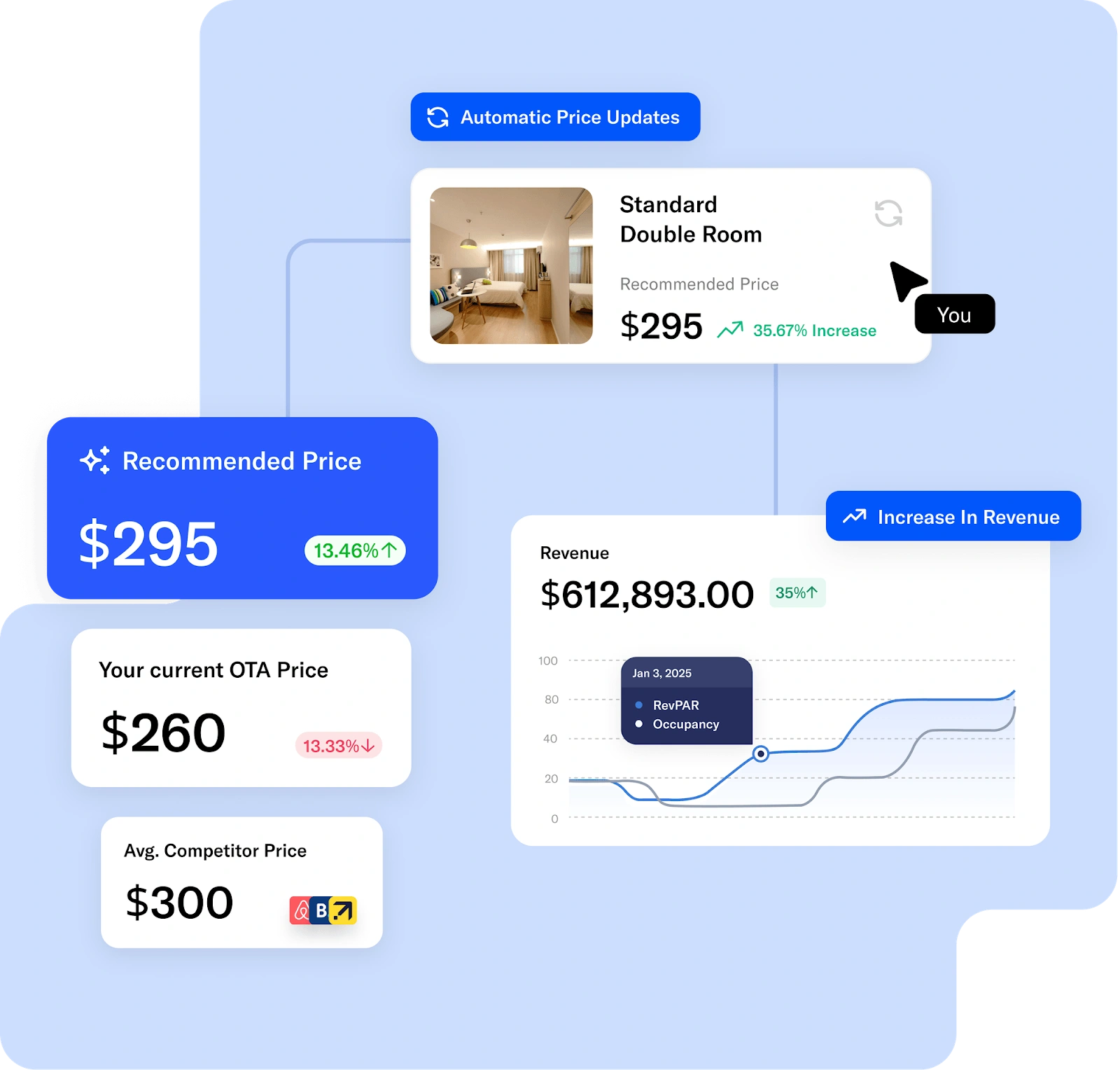
ampliphi connects directly to your roommaster PMS and continuously monitors booking data, historical patterns, forward availability, and even cancellation trends. It analyzes your hotel’s past performance, anticipates future demand, and offers rate recommendations to protect your ADR and RevPAR. That’s why hotels using this system report a 35% surge in RevPAR and 40% higher ADR while boosting the hotel occupancy rate.
What makes it powerful is how it interprets information. The ampliphi integration looks at seasonality, local events, and competitor shifts to understand what’s happening in your market. Every approved and automated update goes straight into your roommaster channel manager, booking engine, and PMS. So, you don’t ever have to worry about duplicate or incorrect data.
{{channel-manager-one}}
roommaster Revenue Management Software also gives you complete control over room rates. You can set custom pricing rules and limits so recommendations always fit your brand standards. Our hotel dynamic pricing software is completely adaptable. Its AI learns continuously from market demand and booking behavior, so the recommendations get more refined over time.
Let’s give you more clarity on how roommaster’s dynamic pricing in hospitality industry works. Our system, powered by ampliphi, continuously gathers data on market demand, competitor rates, and booking patterns. The advanced AI analyzes the data and spots pricing opportunities and demand patterns. Then it considers your pre-set pricing rules and automatically updates rates across your OTAs and website.
And since the whole process is automated, our partner hotel’s revenue managers save 29 hours every month!
Key features
Optimize prices in real time: Adjust rates instantly based on current market demand to capture the right balance of occupancy and revenue. The pricing engine recommends optimal rates that protect profitability and occupancy
Competitor analytics: Monitor competitor pricing across your market with intelligent rate tracking. The system automatically spots changes in competitor positioning so you can respond without delay
Event analytics: Factor in concerts, conferences, and seasonal events that impact booking behavior. roommaster identifies these spikes early and adjusts your pricing recommendations
Customizable pricing rules: Set limits, strategies, and pricing guidelines for the system to follow. This flexibility makes sure that pricing reflects your hotel’s identity
Real-time sync with booking engine: Push every approved and automated rate change directly to your roommaster Booking Engine
Channel manager: Distribute updated rates across all connected OTAs in one step with roommaster Channel Manager. This keeps your pricing consistent without manual work
Analytics and reporting: Get graphical reports to review both past and future performance. These insights inform your strategies with booking behavior and revenue trends
Pros
PMS integration: All pricing updates sync directly to roommaster hotel PMS, booking engine, and channel manager, saving time
Customizable rules: Set pricing limits and strategies that match your brand standards
Demand forecasting: Prepare for seasonal peaks and special events with accurate demand forecasting
Continuously learning AI: The system improves pricing recommendations over time
Easy adaptation: Your team can learn roommaster in hours, not weeks
“The AI handles daily rate changes, but I still control the strategy. It’s like having a revenue manager that works 24/7—only without the burnout”
Nicole Priest, Managing Director and Business Owner, The Last Good Old Fashioned Motel
2. ampliphi (Best for dynamic pricing across multiple properties)
ampliphi’s standout feature is its multi-property support with dynamic pricing. You can manage pricing strategies and set rules from a single dashboard. This keeps rates competitive while also keeping consistent pricing in all your hotels.
Beyond dynamic pricing, ampliphi offers market intelligence with AI-powered event and calendar-driven demand tracking. It monitors pickup velocity and OTA behavior and sends competitor pricing alerts. That way, you know how to prepare promotional offers and restrictions early on. ampliphi also syncs with roommaster, so you can manage all your hotel operations, including dynamic pricing, in one place.
Key features
AI optimization: Learns from your historical data and adjusts room charges according to seasons, booking windows, and guest trends
Competitor analysis: Lets you adjust pricing with continuous monitoring of competitor rates
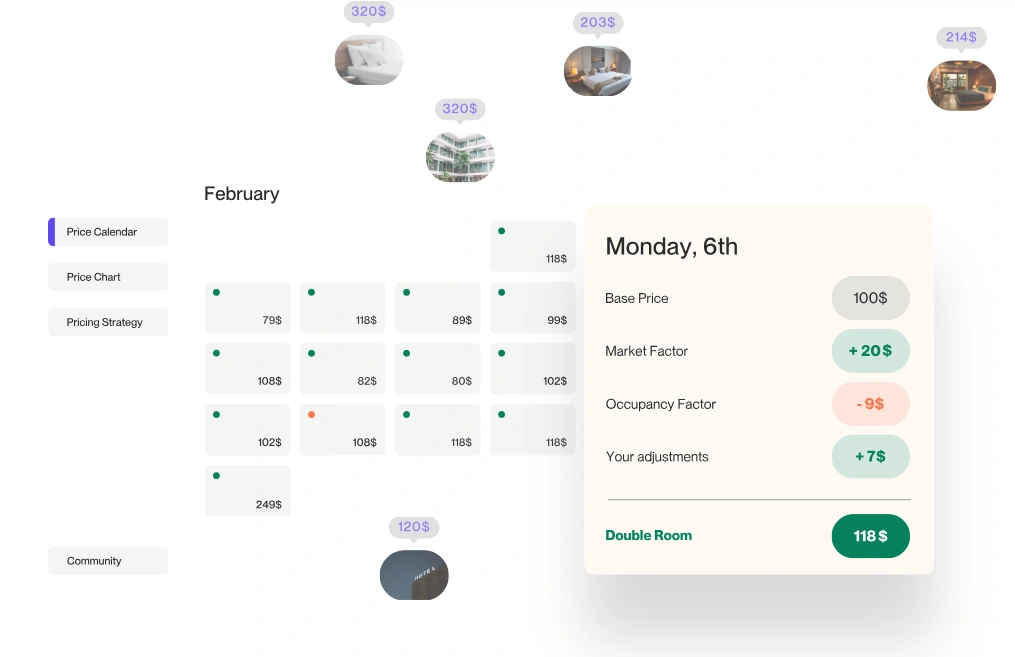
AI-powered rate calendar: Shows daily pricing, performance, and AI-powered recommendations with quick overrides, property comparisons, and date toggles.
Pros
Capacity planning: The market intelligence feature helps with capacity planning through predictive events
Adaptive AI: ampliphi learns your hotel operations and demand patterns over time, showing increasingly accurate pricing across your entire portfolio
Cons
While ampliphi is quite user-friendly, the advanced features may feel a little overwhelming at first
Pricing
Custom pricing
What are real-life users saying about the tool?
No reviews available.
3. Wheelhouse (Best for rental properties)
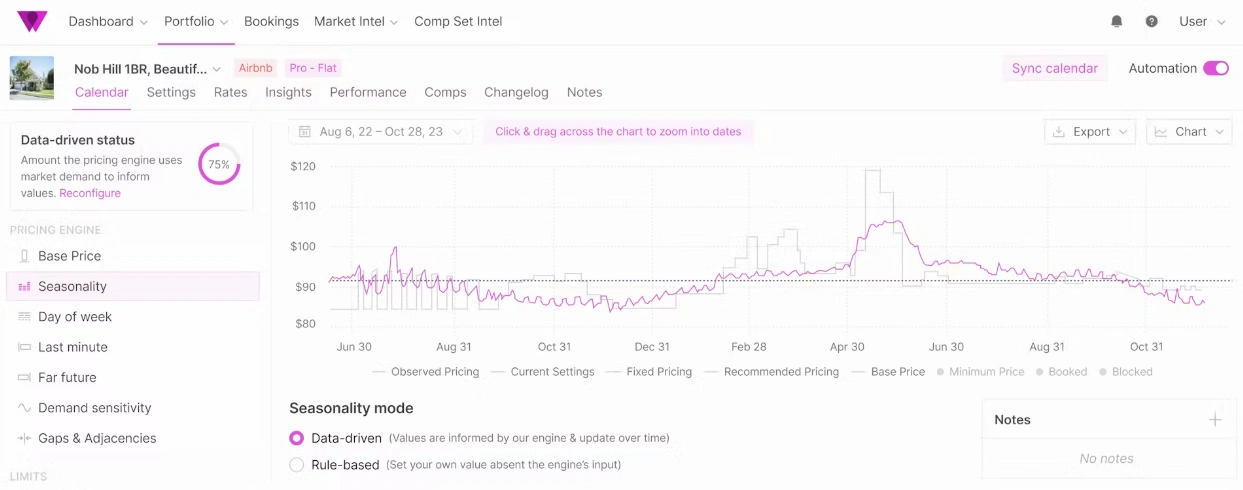
Wheelhouse stands out with its navigator feature for rental properties. It collects market info like how much similar listings in your area are charging and how amenities and location impact earnings. You see the data through charts, maps, and graphs. This helps you set dynamic pricing rules and understand what new amenities you can introduce to get more revenue.
Key features
Dynamic sets: Group local properties according to specific criteria and compare your hotel against them to set pricing for each quality
Navigator: Visualize competitor pricing, occupancy rates, and amenities on a map to understand pricing strategies and scale your operations
Performance analytics: Monitor occupancy trends and run A/B tests to find the right pricing balance
Pros
Flexible filters: Group competitors using customizable filters for clearer pricing insights
Scale amenities: Learn what type of amenities drive more occupancy so you can price rooms better
Cons
While customizable, the dynamic pricing automations aren’t advanced enough
“You want to make sure to set your minimums at a minimum you would truly be happy with otherwise in a low period wheelhouse can adjust the price low to make you competitive. This is easy to remedy but something to be aware of.”
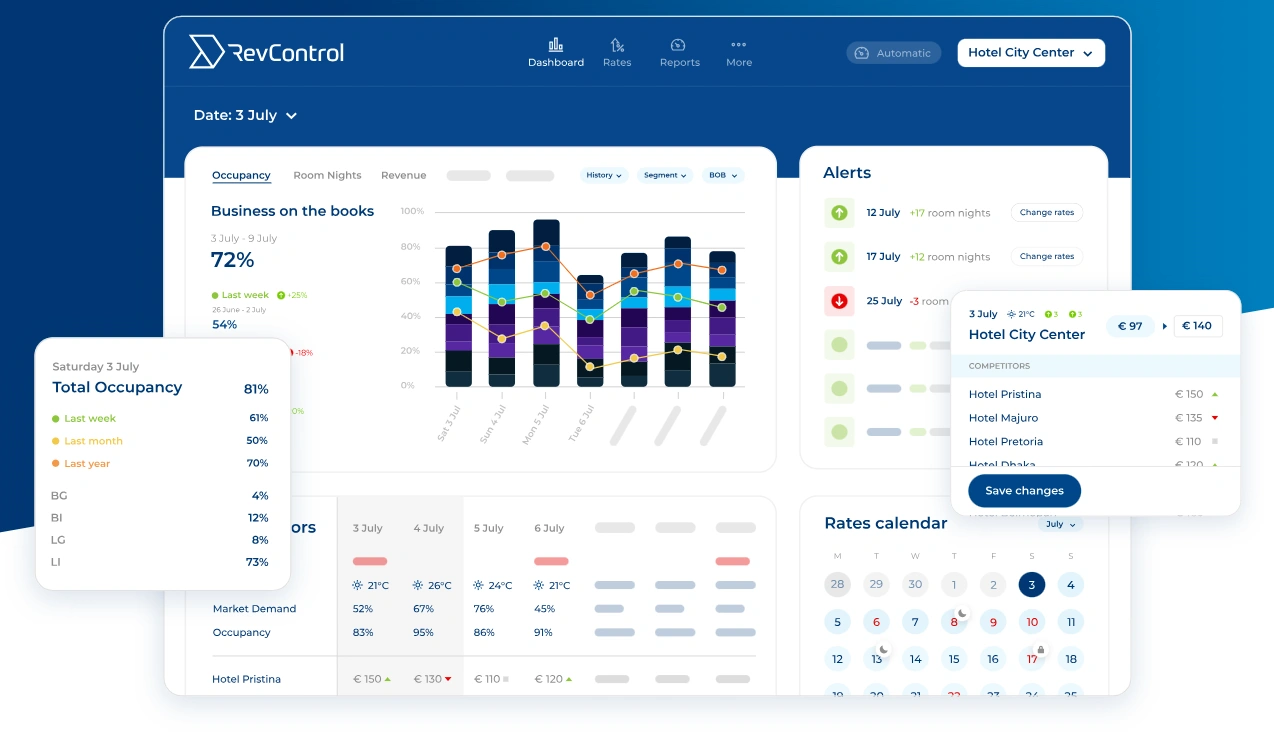
RevControl’s group rate recommendation tool analyzes room availability, group size, and potential revenue impact to set competitive rates for group bookings. Paired with rate buckets, you can define minimum and maximum rates, discounts, and a cap on occupancy for different segments. That way, you can run dynamic pricing with discounts affecting your revenue.
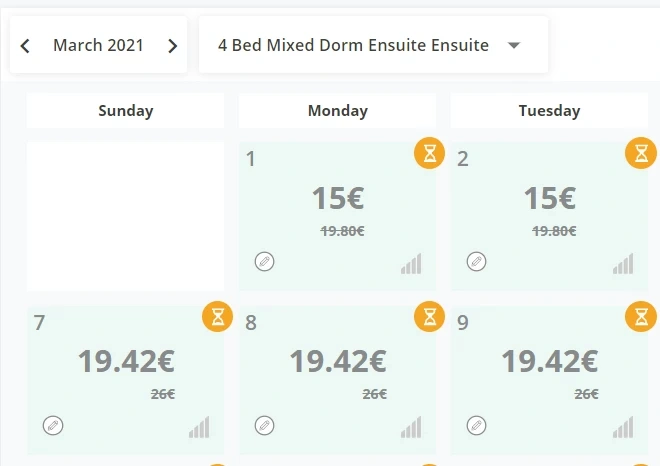
This dynamic pricing platform also offers a rate calendar. Here you can see, verify, and edit the recommended dynamic rates for different dates before auto-publishing.
Key features
Competitor rate shopping: Monitor competitor pricing in one place to improve your market position and adjust your rates accordingly
Rate recommendation: Receive algorithm-based rate suggestions tailored to your hotel's specific needs, helping you stay competitive and maximize revenue
Booking pace analysis: Analyze how quickly rooms are being booked to adjust rates in real time and respond to shifts in demand
Pros
Rate calendar visibility: View upcoming rates across all segments at a glance, making it easier to plan and adjust pricing
Protect revenue: Add discounts for group bookings and set caps on such occupancy to attract guests and protect profits
Cons
You get recommended rates only four times per hour
The dynamic pricing isn’t as useful for single booking charges
Pricing
Custom pricing
What are real-life users saying about the tool?
No reviews available
5. BEONx (Best for double segmentation of dynamic pricing models)
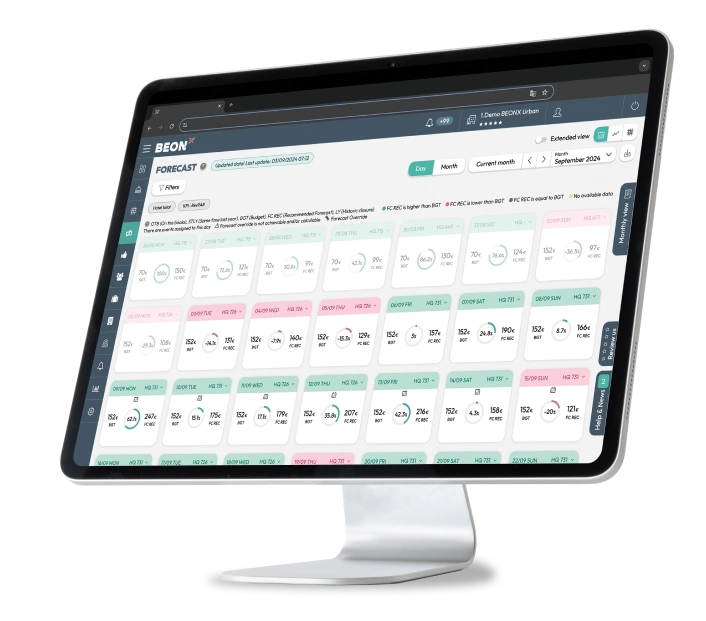
BEONx offers automated double segmentation by channel and market for dynamic pricing in hospitality industry. You can run multiple pricing models at the same time and adjust quickly to changing demand. This approach captures more revenue from every booking while keeping pricing aligned with each of your guest types.
The dynamic pricing platform also offers powerful forecasting tools that predict occupancy and booking trends. Its hotel quality index tracks guest perception and shows how demand changes after dynamic pricing adjustments. The tour operation module manages group booking prices and tour operators.
Key features
Forecasting tools: Predict occupancy, booking trends, and demand shifts with data-driven insights
Hotel quality index: Track guest perception and measure how pricing affects demand
Pros
Flexible pricing models: Deploy different pricing strategies for each segment, channel, or market
Integration: It connects with your PMS, booking engines, and channel managers easily
Cons
The platform has a steep learning curve
The dynamic pricing automation isn’t very feature-rich
Pricing
Custom pricing
What are real-life users saying about the tool?
No reviews available.
6. RoomPriceGenie (Best for real-time surge protection)
RoomPriceGenie is a revenue management software with real-time surge protection. It closely monitors booking activity and automatically adjusts room rates whenever demand spikes. That means if a sudden rush of bookings comes in, your rooms don’t get sold too cheaply. The system reacts instantly, so you drive maximum revenue even during unforeseen surges.
Key features
Forecasting insights: Predict 18 months of future pricing
Group displacement calculator: Compare forecasted revenue from transient bookings with potential group income
Pros
Maximize revenue during demand spikes: Real-time surge protection prevents underpricing
Plan ahead: The 18-month early forecasting lets you plan ahead
Cons
The revenue management system only updates 12 times a day
Smaller properties may find subscription pricing high
Pricing
Custom pricing
What are real-life users saying about the tool?
No reviews available
7. Atomize (Best for dynamic pricing with ancillary revenue)
Atomize stands out with its ancillary revenue management. You can estimate how much each guest spends on extra services, like meals or spa treatments. It also lets you set different base amounts for adults and children, configure values by day of the week, and define a single total for the entire stay.
Plus, seasonal settings let you adjust these estimates for high-demand periods, aligning ancillary revenue with your dynamic pricing. It also offers real-time price optimization, revenue calendar, and
Key features
Multi-property support: Monitor your entire portfolio from one dashboard to spot revenue opportunities
Business intelligence solutions: Use interactive dashboards and reports to monitor performance trends
Restriction management: Apply rules for minimum stays, check-in days, and booking windows to balance occupancy with demand
Pros
Boost total revenue: Ancillary revenue management factors in guest spending on extras to maximize earnings with dynamic pricing
Simplify portfolio management: The multi-property dashboard makes it easy to oversee and compare all our properties
Cons
Configuring ancillary revenue and seasonal settings is complex for first-time users
Seasonal settings can’t overlap, which may limit flexibility for properties with complex demand patterns
Pricing
Custom pricing
What are real-life users saying about the tool?
No reviews available.
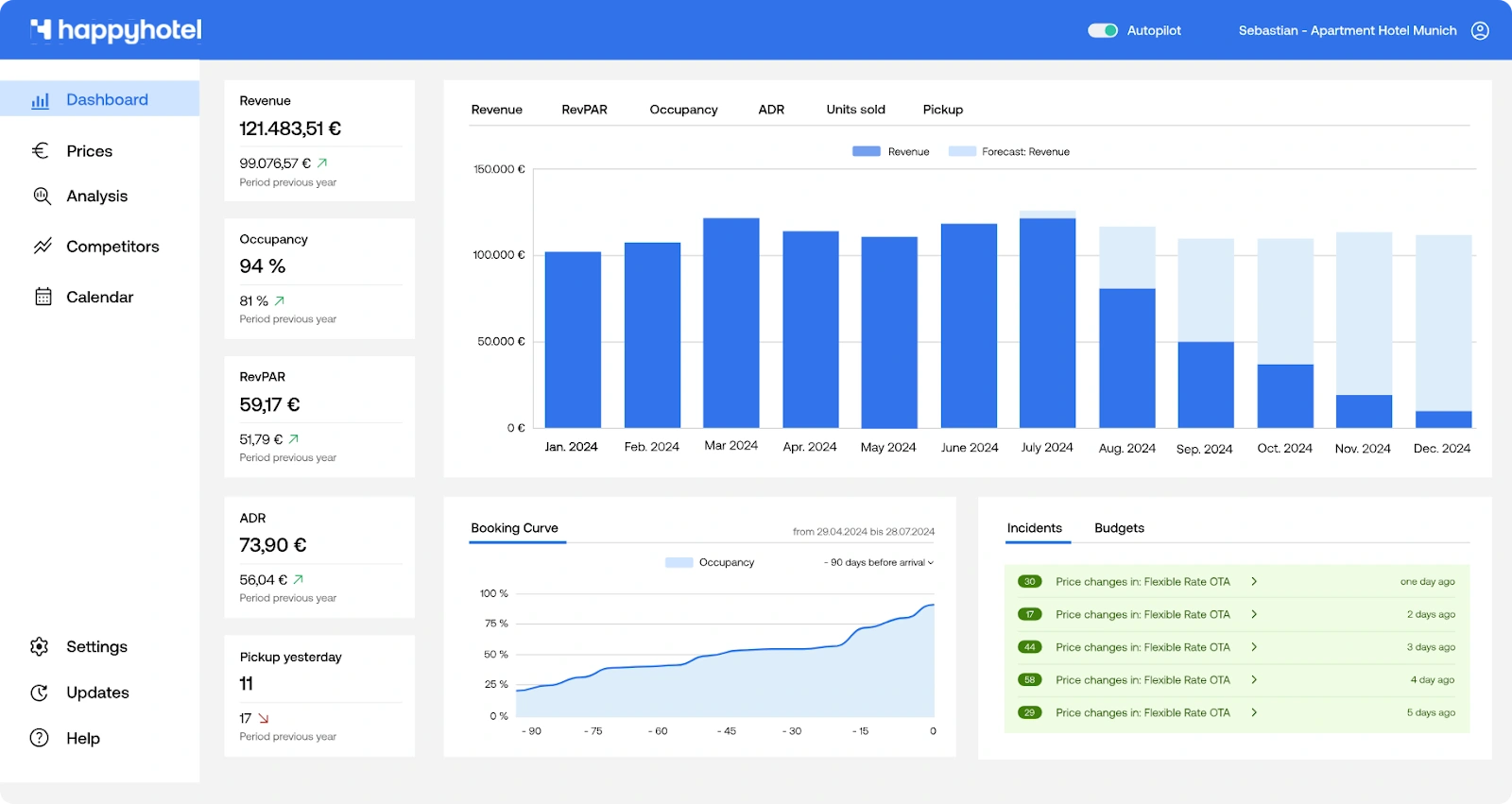
8. HappyHotel (Best for KPI monitoring for independent hotels)
With HappyHotel, independent hotels keep a close eye on KPIs like occupancy, RevPAR, and booking pace to spot when pricing needs to shift. It also offers basic dynamic pricing features to keep your room rates current and competitive.
Beyond that, this dynamic pricing software for hotels offers forecasting tools to show where revenue is heading. And of course, it comes with an autopilot feature that changes rates as per KPIs.
Key features
Competitor tracking: Compare your rates against nearby hotels to stay competitive and capture more bookings
Scenario planning: Test different rate strategies and instantly see how they impact revenue outcomes
Pros
User-friendly: The revenue management system is very beginner-friendly, with an intuitive and simple interface
Mobile access: Manage dynamic pricing and KPIs from anywhere without being tied to a desk
Cons
Hotel chains may find the dynamic pricing features inadequate
The forecasting options feel more basic
Pricing
Custom pricing
What are real-life users saying about the tool?
No reviews available
9. IDeaS Revenue Solutions (Best for properties looking for longer stays)
With IDeaS Revenue Solutions, you can set dynamic prices for multiple stay lengths and all your services individually. Paired with Linked Products, hoteliers can also optimize related rates like advanced purchase and bed-and-breakfast packages without the usual compromises. This is especially beneficial for rentals looking for longer stays.
Beyond this, this dynamic pricing software for hotels offers demand forecasting, competitor data, and stay patterns to recommend pricing that adapts to shifting markets. The platform helps you reduce unnecessary discounting, maintain profitability during low demand, and maximize revenue across room types.
Key features
Linked Products: Adjust connected rates like packages and promotions without losing pricing consistency
Discount optimization: Prevent unnecessary markdowns by tying discounts to demand, season, and booking windows.
Room-type level pricing: Tailor rates to individual room categories for maximum revenue per segment
Pros
Boost revenue from longer stays: Apply dynamic pricing on add-on services to get more long-term stays
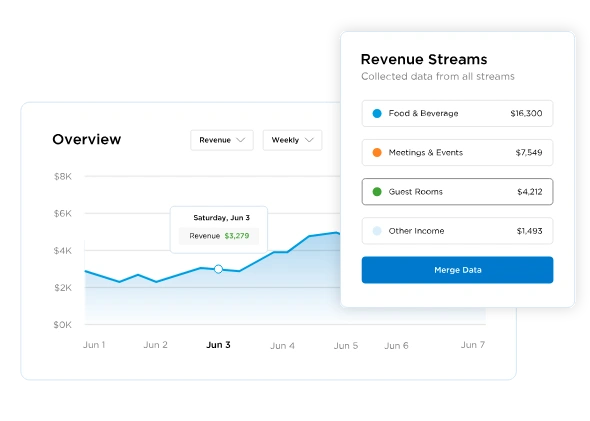
Monitor revenue streams: Check all your revenue streams, including special packages, on the dashboard
Cons
Connecting the system with PMS and channel managers may take time
The system lacks customization
Pricing
Custom pricing
What are real-life users saying about the tool?
No reviews available.
10. Duetto (Best for displacement analysis and identifying key demand drivers)
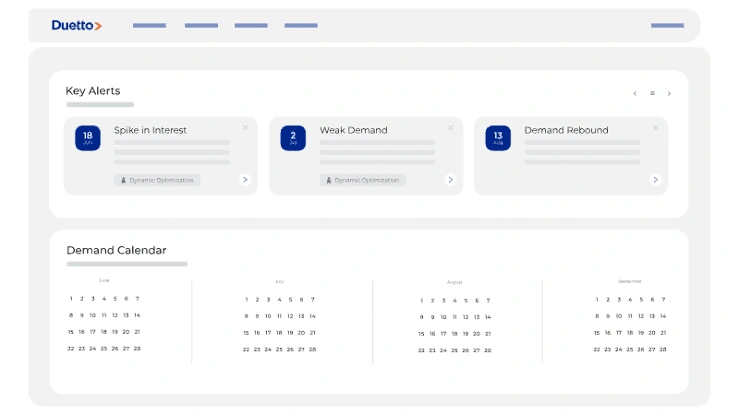
Duetto’s BlockBuster is its displacement analysis and forecasting toolkit, which you can set up by segments. This helps you manage competing business opportunities, like large group bookings versus higher-value transient stays, to maximize overall property profitability.
The ScoreBoard feature generates tailored visual reports for pricing instantly. Plus, you get access to key demand drivers through Amadeus Demand360®, STR historical performance, and PredictHQ to set pricing rules accordingly.
Key features
Demand KPIS: Monitors key insights like pacing anomalies and high-opportunity stay dates
HotStats: Remaps your trail balance data to the latest USALI edition to keep profitability intact even with competitive pricing
Advance: Analyzes your hotel’s demand patterns and spots pacing anomalies and high-opportunity stay dates
Pros
Function space optimization: Helps you drive more revenue from meetings, conferences, and banquets with accurate, demand-driven quotes
Customizable quoting rules: Let hotels set pricing guidelines and approval workflows to stay consistent with brand standards
Cons
The software is more expensive than the alternatives
The interface isn’t very user-friendly
Pricing
Custom pricing
What are real-life users saying about the tool?
No reviews available.
11. Pricepoint (Best for running pricing simulation)
Pricepoint offers simulation-based dynamic pricing in hospitality industry. You can run test simulations to find the perfect pricing for each room and stay type. Besides that, it offers general RMS functions and a mobile app for you to manage your hotel operations.
Key features
Pricing simulations: Run simulations to find the optimal room rates for different dates and stay types
PMS and channel manager integration: Keep rates consistent across all online travel agencies and booking platforms
Mobile management: Monitor pricing and adjust strategies from anywhere with the mobile app
Pros
Flexible management: Mobile access allows managers to respond quickly to market changes
Increase revenue: Real-time adjustments and simulations help capture optimal pricing for every booking
Cons
Larger chains may need more features
The UI is a bit clunky
Pricing
Hotels: $7/room per month
Hostels: $130/room per month
What are real-life users saying about the tool?
No reviews available.
How to choose the right dynamic pricing software
Here are some tips to help you choose the best dynamic pricing software:
Assess your property’s needs: Consider the size of your hotel, types of rooms, and whether you focus on short stays, long stays, or both
Check essential features: Look for real-time rate updates, occupancy-based pricing, competitor tracking, forecasting, and KPI dashboards
Evaluate rate plan flexibility: Check if the system supports multiple rate plans, packages, and group bookings
Integration capabilities: Make sure it works smoothly with your PMS and channel managers to maintain consistent rates
Balance automation and control: Decide if you prefer autopilot pricing or a tool that allows manual adjustments for special events
Support and training: Confirm that the provider offers reliable help and resources for learning the system
Pricing and scalability: Choose software that fits your budget and can grow with your property if you expand rooms and services
Test before committing: Use free trials or demos to see how intuitive the platform is and how it fits your team’s workflow
Implementation best practices for dynamic pricing
Implementing dynamic pricing successfully requires careful planning, monitoring, and team alignment. Following these best practices helps hotels maximize revenue while keeping operations smooth.
Define pricing rules: Set minimum and maximum rates, seasonal adjustments, and responses to occupancy changes to avoid pricing errors and maintain consistency
Start small and test: Apply dynamic pricing to a few room types or segments first, monitor results, and refine your strategy before full-scale rollout
Monitor KPIs continuously: Calculate RevPAR, ADR, and occupancy trends regularly to tweak strategies, adjust rate thresholds, and improve revenue outcomes
Train your team: Ensure front desk staff, revenue managers, and other stakeholders understand the system so everyone aligns on rates and policies
Basic hotel dynamic pricing software vs an all-in-one hotel management software
Basic dynamic pricing tools help you adjust rates based on occupancy or competitor pricing. But they often fall short when it comes to integrating with your PMS, managing multiple rate plans, or tracking KPIs in one place. Using separate tools for these tasks can make pricing more complicated instead of smarter.
All-in-one platforms like roommaster bring everything together. You can manage dynamic pricing, monitor KPIs, adjust rates for different room types, and track revenue streams, all from one dashboard.
Not only that! With integrated competitor tracking, event-based pricing, and automated rate updates, you stay ahead of the market while maximizing revenue.
Book a demo today and see how easy it is to take full control of your hotel pricing with one smart platform!
FAQs
1. What is hotel AI dynamic pricing?
Hotel AI dynamic pricing is a system that automatically adjusts room rates based on real-time data, such as occupancy levels, market demand, competitor pricing, and booking patterns. For example, roommaster’s dynamic pricing tools analyze your hotel’s historical and current data to suggest optimal rates, helping you maximize revenue and respond quickly to changes in demand without relying on manual calculations.
2. What is an example of dynamic pricing?
An example of dynamic pricing is when a hotel increases its room rates during a local festival because demand is high, and lowers rates during slow periods to attract more guests. Airlines, ride-sharing services, and e-commerce sites also use similar strategies to adjust prices based on demand fluctuations.
3. What kind of data is used by hotel pricing intelligence tools?
Hotel pricing intelligence tools use a mix of historical booking data, current occupancy, lead times, competitor rates, local events, seasonality trends, and guest booking behavior. roommaster, powered by ampliphi, also takes these factors into account and recommends rates that optimize revenue for different segments, dates, and stay lengths.
{{cta-strip}}
channel-manager-one
Fill more rooms. Keep more revenue. Hundreds of Channels. One Dashboard.
Mayela Lozano is a content strategist with a passion for hospitality and technology. She collaborates with roommaster on content creation, highlighting how technology can streamline hotel operations and enhance guest satisfaction. When she’s not creating content, Mayela loves to travel and spend time with her two little ones, discovering new adventures and making memories along the way.
Join Thousands of Hotels Thriving with roommaster
The transition to roommaster is straightforward and efficient. Our implementation team handles data migration including reservations, guest profiles, and historical information.
The transition to roommaster is straightforward and efficient. Our implementation team handles data migration including reservations, guest profiles, and historical information.
How Hotel PMS Software Transforms Hospitality Management
September 23, 2026
Hotel Management
Marketing
Pet-Friendly Hotel Amenities & Package Ideas That Drive Revenue
September 22, 2026
Hotel Management
Hotel PMS
Hotel Food And Beverage (F&B): The Complete Guide
September 22, 2026
Hotel Management
Marketing
Hotel Pet Fees: How Much Should You Charge?
September 22, 2026
Hotel Management
Hotel PMS
Best Hotel Food and Beverage (F&B) Management Software In 2026
September 22, 2026
Hotel Management
Marketing
Pet-Friendly Hotel Guide: Policy, Fees & Amenities
September 22, 2026
Payment Processing
Best Hotel Payment Gateway In 2026
September 21, 2026
Hotel Management
Payment Processing
Best Practices For Hotels To Avoid Chargebacks Disputes
September 21, 2026
General
Hotel Management
Preventing Credit Card Fraud In Hotel Operations
September 21, 2026
Join Thousands of Hotels Thriving with roommaster
See how roommaster's unified platform can work for your property. Our team will walk you through features tailored to your specific needs and operations.






.png)
.png)
.png)