Boutique hotels vs regular chain hotels have different operational styles and accommodation bandwidth
The right model for you depends on whether travelers value personalized experiences or predictable convenience, and whether hoteliers prioritise control and character or scale and efficiency
Boutique hotels offer memorable stays but limited scalability; hotel chains have growth but rely heavily on standardisation
roommaster helps independent and boutique hotels manage direct bookings, guest preferences, and daily operations without losing their identity
roommaster also supports hotel groups with centralized control, automation, and visibility across multiple properties
A boutique hotel differs from a regular hotel in property size, what guests expect, and how the system operates.
One model bets on personality and close-knit service. The other depends on consistency, volume, and repeatable systems. While traditional hotels rely more on brand trust, rate parity, and standard processes, boutique hotels prioritize individuality, offering a more niche, personalized guest experience.
In this guide, we will break down the differences between a boutique hotel vs. regular hotel through operational lenses. Our aim is to help travelers find the right option and for hoteliers to position their properties better.
What is a Boutique Hotel?
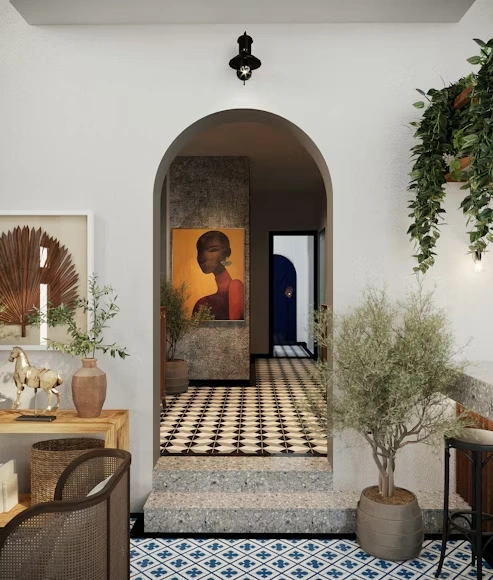
A boutique hotel is a small, independently operated property built around a distinct identity rather than standardized brand rules. These independent hotels focus on personalized guest experience, design-led spaces, and a distinct local charm, offering travellers a culturally immersive stay.
Here are the elements you typically find in boutique properties:
Fewer rooms with a more attentive service
Design and interiors reflecting the local community, culture, theme, and a more intimate environment
Flexible guest policies instead of rigid brand standards
Staff handling multiple roles and guest requests directly
Unique amenities, curated food options, and partnerships with local businesses
Well-known boutique hotels in the US show how this model works in practice. The Historic Hotel Greybull & The Speakeasy in Wyoming blends restored Western architecture with modern interiors, attracting guests who want heritage without sacrificing comfort. El Cosmico, Marfa in Texas offers a non-traditional stay with yurts, trailers, and tents, built around art, desert landscapes, and community-driven experiences. With eco-conscious design, local art, and quiet, design-forward spaces, Hotel Magdalena in Austin appeals to travelers seeking a relaxed yet thoughtful city stay.
What is a Regular Hotel or a Chain Hotel?
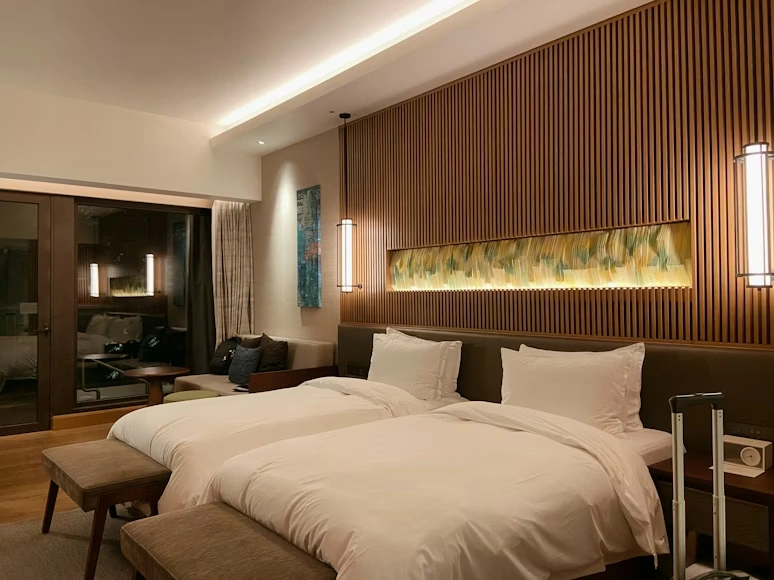
A regular hotel is a standard, full-service, or limited-service property with functional stays and standard amenities instead of a themed or design-led experience. These hotels operate with fixed processes, clear service boundaries, and pricing according to room type, location, and demand.
These hotels offer:
Comfortable rooms for short and repeat stays
Prime locations near business areas, airports, and city centres
More accommodation options across categories and budgets
Defined front desk and housekeeping roles
Standard services for convenience
Popular regular hotels in the US reflect this focus on comfort, location, and consistency. The Evelyn Hotel in New York City caters to business and leisure travelers with well-located rooms, standard amenities, and reliable service close to transit and offices. Broadway Plaza Hotel offers functional stays near shopping and business districts, appealing to short-stay guests prioritizing location and convenience. The Verb Hotel in Boston combines standard hotel operations with a relaxed, retro vibe, giving guests comfort and predictability with a light design touch.
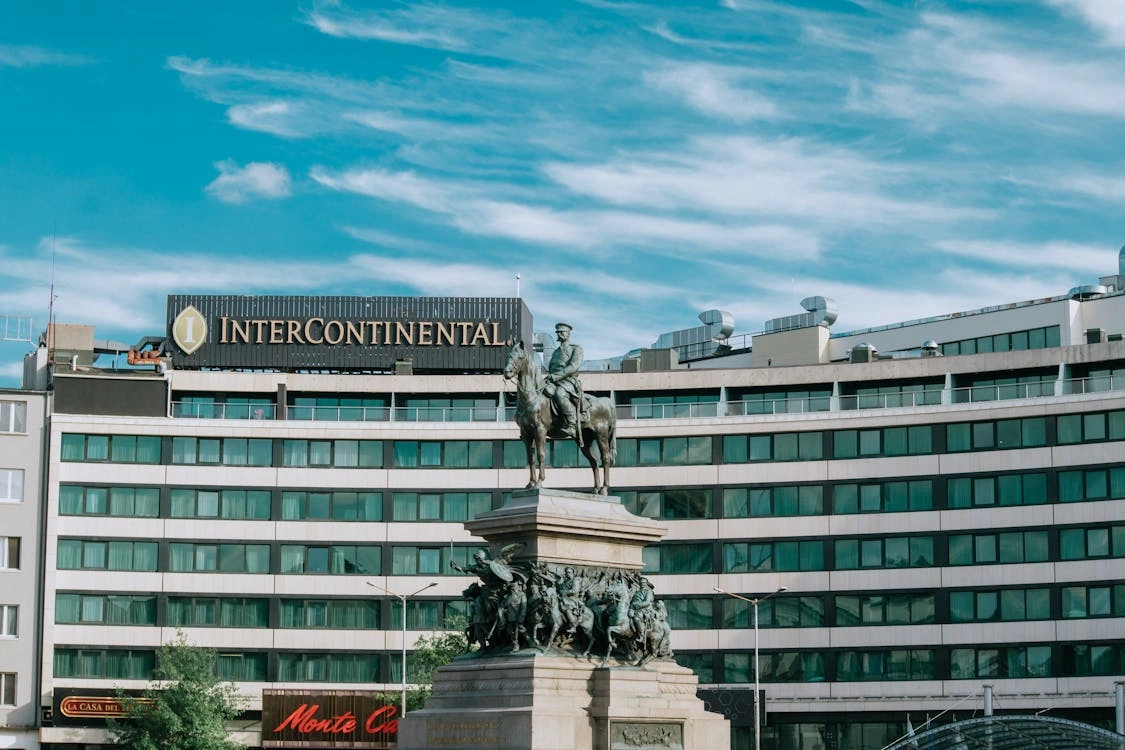
A larger chain hotel belongs to a branded group with multiple properties under the same name. These hotels follow central standards for strong brand identity and shared systems so guests know what to expect wherever they stay.
Chain hotels offer:
Brand consistency across rooms, service, and policies
Concierge services and structured guest support teams
Swimming pools, restaurants, gyms, and other standardized amenities
Centralised pricing, loyalty programs, and distribution
Marriott Hotels focus on brand consistency across locations, offering familiar rooms, loyalty benefits, and full-service amenities for frequent travelers. Hilton Hotels combine centralized pricing, concierge services, and global distribution to support high guest volumes across business and leisure segments. Hyatt Regency properties are known for large footprints, standardized amenities, and operations built to handle conferences, events, and steady occupancy across markets.
Boutique Hotel vs Regular Hotel: Key Differences Compared
Boutique and regular hotels operate on very different priorities, even when they offer similar amenities. Understanding these contrasts helps clarify which model fits your travel needs and business goals.
Connection to local culture: Boutique hotels differ in how closely they tie the stay to local culture and stories. Regular and larger chain hotels keep the experience familiar and consistent across different locations
Guest expectations: Guests stay at boutique hotels for exceptional service, personal attention, and an immersive experience. Traditional hotel guests expect speed and convenience
Room layouts and size: Regular hotels often offer more accommodation options with spacious rooms across categories. Boutique hotels trade uniformity for more character-driven room layouts with an intimate atmosphere
Memorable experiences: Boutique hotels offer more personal interactions, custom recommendations, and local activities. Regular hotels provide guests with comfort and reliability
Operational trade-offs: Personalized service defines boutique properties. Regular hotels depend on structured roles, set processes, and predictable execution to support volume
Boutique vs Regular Hotels: Comfort and Service & Operations Compared
Here is how boutique hotel vs regular hotel differ from each other:
Aspect
Boutique hotel
Regular/chain hotel
Core identity
Built around a distinct personality and theme
Built around standardisation and brand consistency
Connection to local culture
Strong focus on local artisans, charm, and locally-sourced materials
Limited local influence, experience stays similar across locations
Service style
Personalized service with direct guest interaction
Consistent service delivered through defined processes
Guest expectations
Guests expect a personal touch
Guests expect speed, convenience, and predictability
Room design
Unique layouts and themed rooms
Uniform layouts with spacious rooms
Accommodation options
Fewer room types, curated inventory
More accommodation options in different price tiers
Operational structure
Flexible roles and hands-on management
Structured roles and centralised operations
Booking behaviour
Strong focus on direct bookings and storytelling
Heavy reliance on OTAs, loyalty programs, and brand trust
Guest takeaway
One-of-a-kind, memorable stay
Reliable stays that work well for repeat travel
Best fit for
Owners prioritising identity and guest connection
Hoteliers prioritising volume, efficiency, and growth
Benefits of Staying at a Boutique Hotel
Staying at a boutique hotel appeals to travelers who care about how a place feels, not just where they sleep. These properties focus on smaller details that large hotels often cannot prioritise due to the sheer volumes. For guests, it means a stay shaped around attention, character, and intention.
Here are some perks boutique hotels offer:
Direct access to decision-makers: Guests often interact with managers and owners directly, which leads to faster problem resolution and more thoughtful responses
Curated local recommendations: Boutique hotels guide guests toward neighbourhood dining, events, and experiences they would not find through generic travel guides
Flexible guest requests: Special check-in and check-out times, room preferences, and small custom touches are easier to accommodate
Quieter, less crowded spaces: Fewer rooms mean calmer common areas, less noise, and a more relaxed pace throughout the stay in independent boutique hotels
Distinct food and beverage offerings: Menus are often limited but intentional, with locally sourced ingredients and signature items tied to the property’s theme
Higher emotional connection: Guests are more likely to remember the staff, experiences, and moments, increasing repeat bookings and word-of-mouth referrals
Benefits of Staying at a Chain Hotel
Staying at a chain hotel gives travelers predictability and convenience, especially when visiting new cities. These hotels focus on efficiency, scale, and reliable experiences that work for both business and leisure stays. Unlike boutique hotels, guests know what to expect in terms of rooms, amenities, and service, no matter the location.
The advantages of staying in larger chain hotels are:
Consistent experience: Some travelers choose chain hotels for predictable room layouts, amenities, and service standards across locations
Prime locations: Many chain hotels are in city centres, business districts, and near airports, making them convenient for business travelers
More accommodation options: Guests appreciate the wide range of room types and pricing tiers in chain properties
Concierge and guest services: Chain hotels provide structured support, from booking tours to handling luggage, that some travelers rely on.
Loyalty programs: Frequent guests benefit from points, rewards, and perks that encourage repeat stays across multiple properties.
High operational efficiency: Chain hotels handle high guest volumes smoothly, giving some travelers faster check-in, check-out, and service response times.
Brand trust: Some travelers prefer the familiarity and reliability of a larger chain hotel over independent options.
The Downsides of Regular and Boutique Stays
Every business has its drawbacks, so do boutique and regular hotels. Here are some to keep in mind:
Aspect
Boutique hotels
Regular hotels
Scalability
Harder to expand without losing unique character and service quality
Easy to scale, but growth can hamper guest experience if not managed carefully
Operational complexity
Requires flexible, multi-skilled staff and hands-on management
Standard staff roles with less room for service flexibility
Revenue
Higher operational costs per room; harder to achieve volume-based revenue
Dependent on occupancy and standard pricing; may face pressure from competitors
Bookings
Strong dependence on direct bookings and reputation-driven traffic
Heavy reliance on OTAs and brand channels; limited differentiation
Guest expectations
Personalized experiences can raise expectations that are hard to meet consistently
Predictable service may feel impersonal to some guests
Market reach
Smaller marketing reach; harder to attract international travelers without OTAs
Broad marketing reach but less uniqueness; can blend in with competitors
Amenities and services
Limited facilities due to smaller property size
Standard amenities may feel generic; less opportunity for bespoke experiences
Who Should Choose a Boutique Hotel?
Heritage and unique properties in a culturally rich and historic area are a good fit for boutique hotel positioning. You can build guest experiences around local heritage, art, and experiences that larger hotels cannot replicate. This model fits you if you prefer hands-on management, are comfortable with smaller inventories, and want to compete on character and service rather than volume.
If you are a traveller looking for niche experiences like heritage walks, local food trails, farm-to-table dining, neighbourhood art, and staycations, boutique hotels are a good option. Guests who value design, quiet spaces, and direct interaction with staff often feel more at home in such properties.
Who Should Choose a Regular Hotel or a Chain Hotel?
Business travelers, families, and short-stay guests prefer the consistency and reliability chain hotels provide. If you travel to different cities often, loyalty programs in chain hotels come in handy. For those traveling for work, the prime locations of chain properties helps.
If you have a large property or multiple ones in different locations, consider position your brand as a standard or chain hotel. However, make sure you have appropriate funds to manage the upkeep and higher guest volumes.
From Boutique Properties to Chain Hotels: Supporting Smarter Operations With roommaster
One important similarity between boutique hotel vs chain hotel is: a smooth guest experience is the core profit driver for both. And for that, a reliable hotel PMS like roommaster is necessary.
Real-time inventory synchronization to prevent overbookings
Guest history for tracking rooms, activities, and dining preferences so that you can deliver highly-personalized services boutique hotel guests expect
{{booking-engine-one}}
Our platform also comes with a Revenue and Finance Suite, offering roommaster Revenue Management. You can apply dynamic pricing according to demand and process various payment methods easily.
“roommaster let us keep our personality while finally getting modern tools that actually make life easier—from direct bookings to guest communication. It fits the way we work, not the other way around.”
Hotel groups must maintain a standard of service while scaling to other locations. For that, you need unified visibility, centralized control, and consistent operations; and roommaster Hotel Group PMS delivers that.
You get an Operations Suite with roommaster PMS with unified reservation management for all your locations. You can reduce manual tasks by up to 80% with automated reservations, billing, and guest communication, track all your bookings through the channel manager, and boost direct reservations with branded booking pages.
Moreover, we offer a Guest Experience Suite with:
roommaster AI Concierge to answer booking requests and queries, and deliver local recommendations
“roommaster helps us manage multiple properties effortlessly. It’s streamlined our processes, improved internal reporting, and given us the insights we need to make smarter business decisions.”
Alex Moore, President and Chief Executive, Seaboard Hospitality
But beyond features, we bring to the table over 30 years in the hospitality industry and a team with 125+ years of hands-on hotel management experience.
Book a demo today and see how roommaster supports your hotel business, whether it’s a niche boutique property offering experiential stays or a regular hotel or hotel chain delivering convenience.
{{cta-strip}}
FAQs
1. What defines a boutique hotel?
A boutique hotel is a small, independently operated property with a unique identity and hands-on service. It focuses on character, design, and personal guest interactions rather than standardized brand rules or large-scale operations.
2. Are boutique hotels more expensive than chain hotels?
Boutique hotels are not always more expensive than chain hotels. They often charge higher rates for experience and service, but many compete closely with mid-range chain hotels. Pricing depends on location, room count, and the level of service they are offering.
3. Do boutique hotels have loyalty programs?
Most boutique hotels do not run large loyalty programs like chain hotels. Instead, they rely on direct relationships, repeat guests, and personalized offers rather than points-based rewards.
4. What is the difference between a boutique hotel and a luxury hotel?
A boutique hotel focuses on personality and experience, while a luxury hotel focuses on premium amenities and formal service. A boutique hotel can be luxurious, but luxury hotels are not always boutique.
5. Can a chain hotel be boutique?
Yes. Some chains operate boutique-style brands that allow more design freedom and local influence. These properties still follow brand systems while offering a more individual experience.
6. What size qualifies as a boutique hotel?
Most boutique hotels have between 10 and 100 rooms. The focus is less on size and more on personal service, unique design, and close guest interaction.
7. Are boutique hotels better for business travel?
They can be, depending on the traveler. Boutique hotels suit business travelers who value quiet spaces and don’t need to commute to prime locations frequently.
8. What is a lifestyle hotel vs. boutique hotel?
A lifestyle hotel targets a specific audience and mood, often with social spaces and events. A boutique hotel focuses more on intimate scale and personal service, though the two can overlap.
9. Why are boutique hotels becoming more popular?
Boutique hotels are becoming more popular because travelers increasingly value experience, character, and human interaction. Boutique hotels meet this demand by offering unique stays personal touch.
10. How do I find the best boutique hotels?
To find the best boutique hotels, read recent guest reviews and check photos of rooms and common areas. Review the hotel’s direct website to understand its style and service approach. Read up on the local attractions and activities, too.
booking-engine-one
Capture more direct bookings with a fast, reliable booking engine.
Mayela Lozano is a content strategist with a passion for hospitality and technology. She collaborates with roommaster on content creation, highlighting how technology can streamline hotel operations and enhance guest satisfaction. When she’s not creating content, Mayela loves to travel and spend time with her two little ones, discovering new adventures and making memories along the way.
Join Thousands of Hotels Thriving with roommaster
The transition to roommaster is straightforward and efficient. Our implementation team handles data migration including reservations, guest profiles, and historical information.
The transition to roommaster is straightforward and efficient. Our implementation team handles data migration including reservations, guest profiles, and historical information.
How Hotels Can Use AI Assistants In Daily Operations
October 19, 2026
Hotel Management
Connect Your Hotel PMS To AI platforms: ChatGPT, Claude, Copilot & Google Gemini
October 19, 2026
Hotel Management
Best Hotel Management Software in 2027: 10 Top-Rated Tools Compared
October 15, 2026
Hotel Management
Hospitality Trends
Hotel Check-In Kiosk: Enhance the Guest Experience
October 5, 2026
Hospitality Technology
Hotel Management
Hospitality Trends
Hotel Self Check-In: How It Works, Types, Benefits And Setup
October 1, 2026
Hotel Management
Hospitality Trends
Hotel Check-In & Check-Out Times Explained
October 1, 2026
Hospitality Trends
Hotel Management
Cloud-Based Property Management System: Hotel PMS
October 1, 2026
Hotel Management
Cloud PMS
Hotel Management System (HMS): A Complete Guide
September 23, 2026
Hospitality Trends
Hospitality Technology
Hotel PMS
Hotel Management
Cloud PMS
How Hotel PMS Software Transforms Hospitality Management
September 23, 2026
Hotel Management
Marketing
Pet-Friendly Hotel Amenities & Package Ideas That Drive Revenue
September 22, 2026
Join Thousands of Hotels Thriving with roommaster
See how roommaster's unified platform can work for your property. Our team will walk you through features tailored to your specific needs and operations.



.png)
.png)
.png)