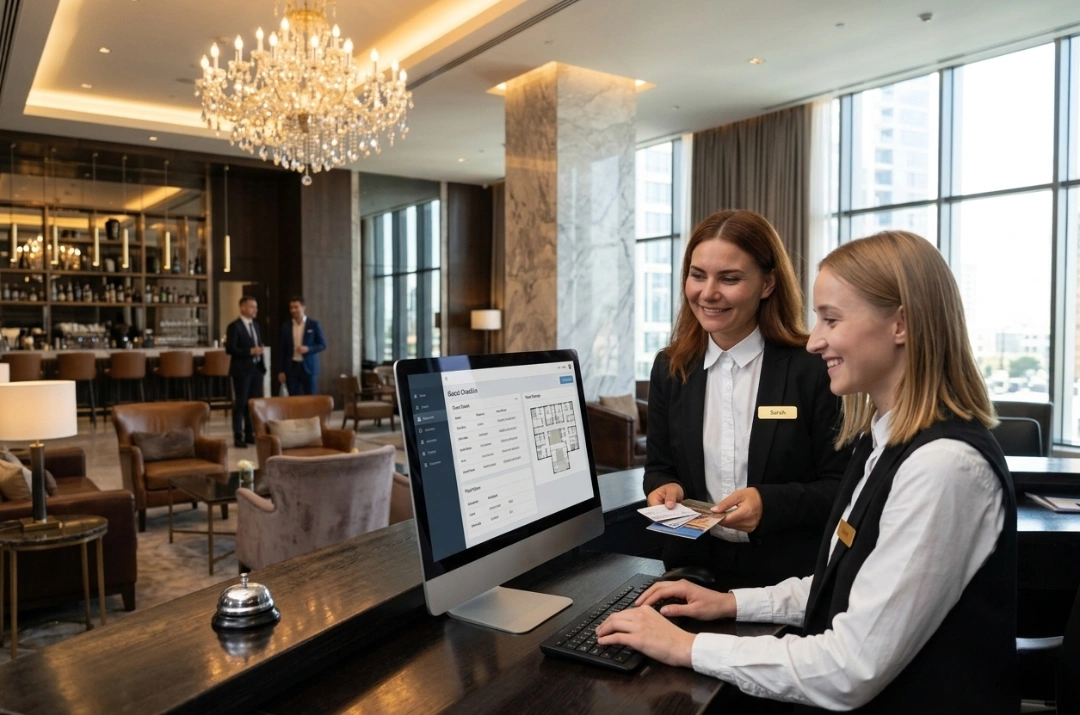
Hotel PMS integration connects your property management system with the third-party tools you rely on every day, so reservations, guest data, and payments flow automatically and in real time.
What it is: a connection that lets your PMS share data automatically with the tools you use every day.
How it works: through APIs, middleware, or direct links, running one-way or two-way. Two-way sync keeps every system current.
Why it matters: it ends double data entry, prevents overbookings, saves staff time, and improves the guest experience.
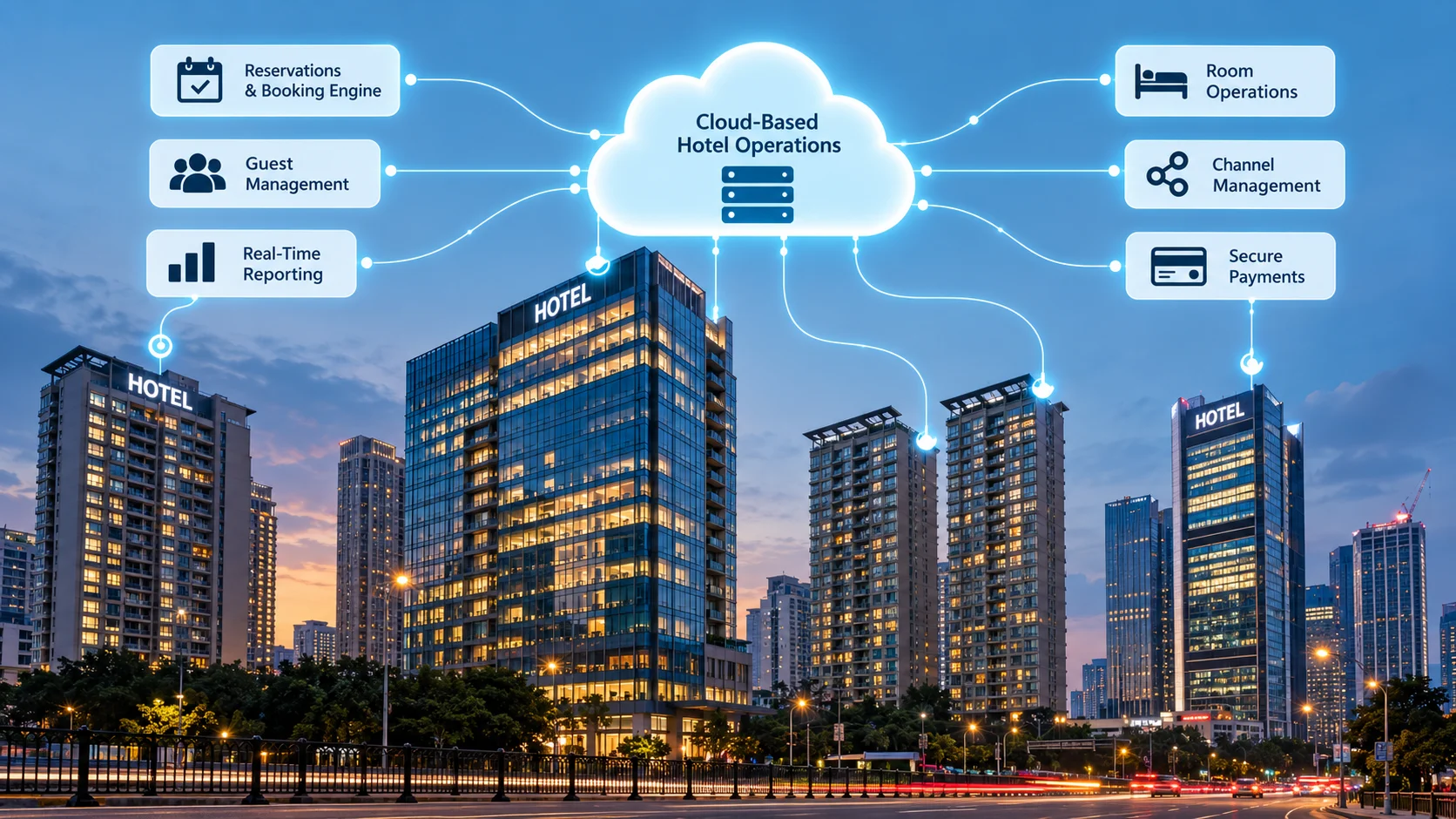
The core integrations: channel manager, booking engine, mobile PMS, payments, POS, revenue management, CRM, guest messaging, and third-party tools.
The roommaster edge: 100+ pre-built integrations with real-time, two-way sync, all on one platform.
What Is Hotel PMS Integration?
Hotel PMS integration is the process of connecting your property management system with the other software and tools your hotel relies on every day, so data flows automatically and in real time instead of being duplicated across disconnected systems.
To understand PMS integration, it helps to first understand what a hotel PMS system is. A property management system is the software that runs your core hotel operations, from room bookings and guest check-in to housekeeping and billing. It is the central nervous system of your hotel. PMS integration connects that system to your other tools so they can share data and communicate in real time.
With integration in place, reservations, guest profiles, payments, messages, room assignments, and operational tasks all move through a shared source of truth. For example, when a guest books through an online travel agency (OTA), the reservation appears instantly in the PMS and availability updates across every channel without any manual input, while charges post straight to the guest folio. That connection can happen through APIs, middleware, or direct data links. Each method has trade-offs, but the goal is the same: keep systems in sync and stop your team entering the same information twice.
The best integrations rest on a few fundamentals: clean data mapping, correct event timing, clear ownership, realistic testing, and ongoing monitoring. Many hotels manage all of this through a cloud integration platform that connects hotel PMS system and POS through self-service APIs, so the whole stack stays consistent as the property grows.
Why Hotel PMS Integration Matters
Every modern hotel needs more than a front desk to run efficiently. Behind the scenes, multiple systems have to work together to manage bookings, guests, payments, and housekeeping. Without integration, staff waste hours on manual work, switching between platforms and re-entering the same data, which leads to delays, errors, and missed revenue. Industry data shows that 39% of property managers spend more than 20 hours a month handling maintenance requests alone, often because their systems do not communicate well.
Hotel PMS integration solves this by connecting your property management system with the other tools your hotel relies on, from the booking engine and POS to the channel manager, so they work as a single unit. Hotels running on connected hospitality management software gain an even bigger advantage, since the whole stack reduces manual work and creates one unified workflow.
How Do Hotel PMS Integrations Work?
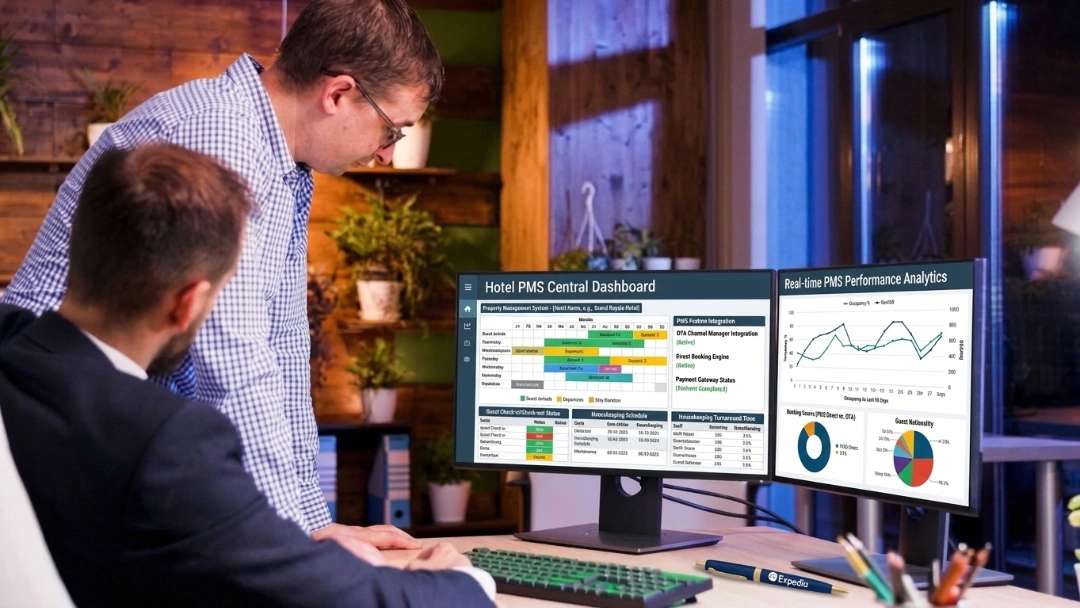
Hotel PMS integration connects your property management system with the other software your hotel uses, such as the booking engine, channel manager, POS, payment gateway, and CRM, so data flows automatically and in real time. Instead of re-entering the same information across disconnected tools, reservations, rates, payments, and guest details stay in sync through one source of truth. The result is less manual work, fewer overbookings, and one accurate view of your whole property.
At its core, a PMS integration lets two systems speak the same language and pass information back and forth with no one in the middle. That connection is usually built one of three ways:
API: the most common method, a secure channel that lets your hotel PMS software and another tool request and share data in real time.
Middleware: a connector that sits between systems that do not talk to each other directly.
Direct data link: a straight system-to-system connection.
The method varies, but the goal is the same: keep every system holding the same, current information.
What actually moves between systems is a defined set of fields, not everything. Depending on the tool, that can include:
Reservation details and guest profiles
Rates and availability
Payment status and charges
Room preferences and service requests
Your PMS sits at the center as the source of truth. It receives these updates, records them, and passes the relevant ones to the modules that need them, such as housekeeping, the front desk, and access control.
The direction of the sync decides how much the integration does for you:
One-way: pushes data from one system to another but sends nothing back. Fine for simple, read-only needs.
Two-way: syncs in both directions, so a change made anywhere updates everywhere. This is what most hotels want, because it removes double entry and keeps every channel accurate.
Here is how it looks in action. When a guest books a room through an OTA:
The reservation reaches your PMS through the channel manager.
The PMS confirms availability, creates the folio, and notifies housekeeping and the front desk.
The channel manager instantly lowers availability on every other channel, so the room cannot be sold twice.
If the guest later extends their stay, the new dates flow to each connected system automatically.
Your team never opens a second screen, and the guest never feels the difference, which is exactly the point of a well-built integration.
{{pms-one}}
List Of The Core PMS Integrations
To unlock the full value of your hotel PMS system, connect the tools that improve your core operations. Below are the most important integrations, along with what each one does for daily efficiency, accuracy, and revenue.
1. Hotel Channel Manager Integration
Managing OTAs manually wastes time and causes overbookings. A channel manager connects your PMS to multiple online travel agencies so updates happen instantly across platforms. With two-way integration, you change rates and availability in your PMS and those changes reflect everywhere, while bookings flow directly back into your PMS with no double entry.
roommaster's hotel channel Manager connects to hundreds of OTAs and all major global distribution systems (GDS), automating availability sync, pricing updates, and performance tracking. Hotels typically reduce distribution workload by 85% while expanding reach across global and regional channels.
2. Hotel Booking Engine Integration
Your website must offer a smooth path from browsing to booking. A direct booking engine connects with your PMS to capture every reservation detail, and the best ones match your brand's colors, fonts, and layout so guests book with confidence. Integration auto-fills guest details, room types, special requests, and discounts into the PMS, streamlining the whole process.
roommaster's hotel booking Engine turns your site into a powerful direct channel, with mobile-first layouts, rate calendars, and multiple engines for segmented audiences. Most properties using it shift 15% to 30% of bookings away from OTAs, saving on commission while availability syncs automatically.
3. Mobile-Friendly PMS Integration
Mobile access lets staff manage operations from any location on any device, supporting check-ins, housekeeping updates, and reporting away from the front desk. roommaster's cloud-based PMS gives hotels a single operational hub with front desk, housekeeping, finance, and reservations on mobile. The design reduces clicks and repetition, so teams work faster without feeling overwhelmed, and hotels report better guest interaction and quicker response times.
4. Hotel Payment Gateway Integration
A payment gateway integration connects your PMS to your payment provider so transactions are processed securely across the guest journey, from deposits and authorizations to refunds, all in one place. roommaster hotel payment gateway handles pre-stay deposits, on-site charges, and automated reconciliation with no external systems, and supports card storage, dispute handling, and hotel-specific features like timed pre-authorizations. Hotels using roommaster Payments reduce chargeback losses by up to 40% and free up 4 to 6 hours per week on financial tasks.
5. POS And Ancillary Tools Integration
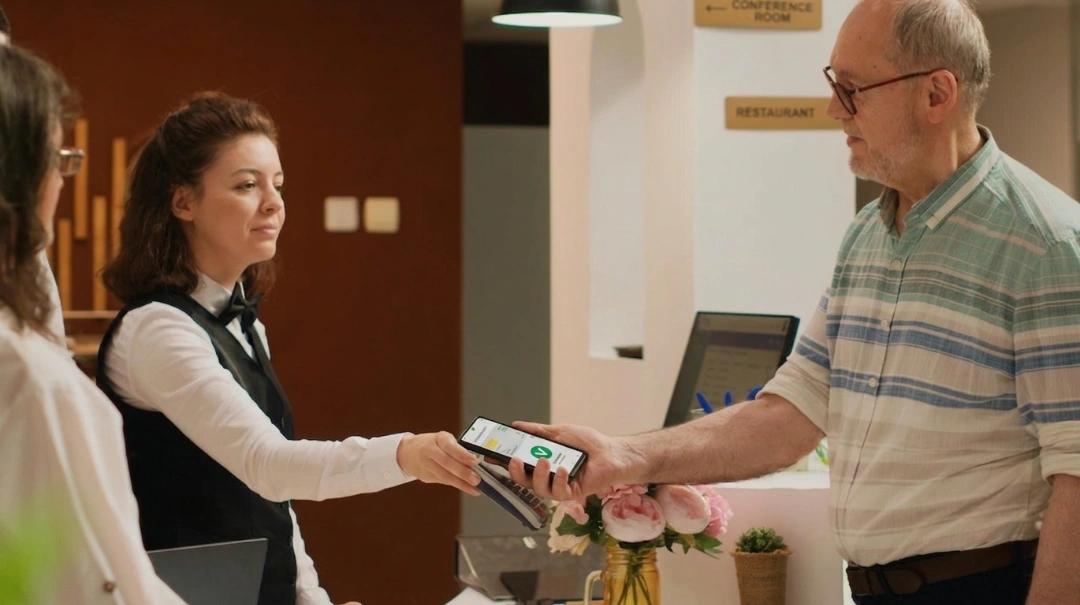
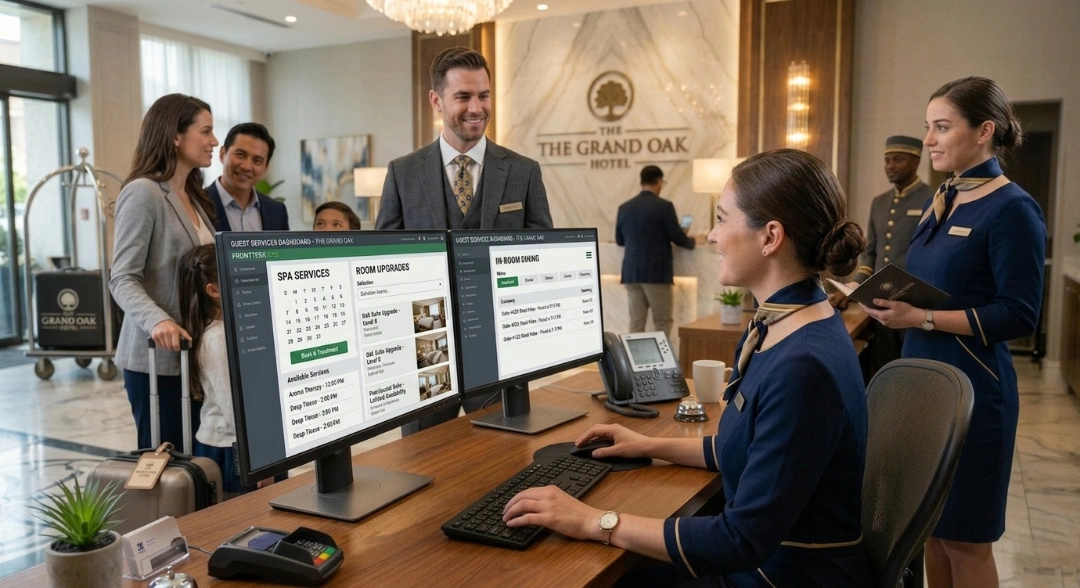
A POS integration links your restaurant, bar, spa, and retail outlets to the hotel PMS system so every charge posts straight to the guest folio instead of being keyed in twice. When POS and ancillary tools are connected, room, dining, and incidental charges appear on one bill, inventory updates in real time, and finance sees a single view of on-property revenue. This removes reconciliation errors, speeds up checkout, and captures ancillary spend that disconnected outlets often lose.
6. Revenue Management Software Integration
A revenue management system (RMS) analyzes market demand, historical data, and traveler behavior to help you set ideal pricing, and when connected to your PMS it automates rate adjustments as demand shifts. Two-way integration lets your PMS push inventory and rate data to the RMS in real time, the RMS recommends pricing, and once approved it sends the rates straight back to the PMS, eliminating manual updates and delays.
roommaster's revenue management gives independent hotels the pricing intelligence major brands use, built for speed. Its rule-based yield logic adjusts prices automatically on live market signals and forecast data, and hotels running even simple revenue management tasks typically see a 15% to 20% increase in RevPAR in their first year by capturing revenue that would otherwise be missed.
7. CRM Integration
A CRM integration connects your guest database to the PMS so every reservation, stay, and preference builds a single guest profile. Instead of scattered records, you get one view of each guest that powers personalized offers, loyalty rewards, and targeted campaigns. roommaster's AI Guest Management unifies guest data from reservations and stays, so you can segment guests, tailor communication, and turn first-time bookers into repeat, direct guests without exporting data between systems.
8. Guest Communication Integration
Most guests prefer mobile messaging over phone calls, especially for quick requests, so your messaging system should connect to the PMS. A PMS-integrated messaging app pulls guest details to send personalized, timed messages before, during, and after each stay, keeps a log of replies, and flags unanswered messages for follow-up.
roommaster's guest messaging supports every touchpoint, from automated welcome texts to post-stay review requests, tailoring each message with reservation and profile data. Hotels using it often double their review response rate and increase repeat bookings by up to 30%, proof that relevant communication drives engagement.
9. Third-Party System Integration
Every hotel runs different tools, from keycard systems and CRMs to accounting software and guest apps. Integrating these into your PMS creates one control panel instead of constant platform-switching. The roommaster Marketplace offers 100+ pre-built integrations for tools like POS systems, digital keys, accounting, and reputation management, plus an open API architecture so both legacy and cloud tools plug in easily. Hotels using these integrations report a 30% reduction in administrative workload thanks to real-time syncing and fewer manual steps.
{{pms-two}}
The Benefits Of Hotel PMS Integration
What happens when your hotel PMS system does not connect to the rest of your systems? You create delays, double the workload, and miss opportunities. That is exactly why integration is so critical. When you connect your PMS with your other key software, you unlock an end-to-end view of your hotel in one place, so you stop switching tabs, fixing sync errors, and guessing which tool holds the latest information. Here is what that delivers.
1. End Manual Work And Double Data Entry
Without integration, staff re-key the same booking, guest, and payment details into several systems. Integration lets that data flow once and appear everywhere, so your team stops doing the same job twice and spends more time on guests instead of admin.
2. Cut Errors And Prevent Overbookings
Manual updates lag, and lagging updates cause double-sold rooms and billing mistakes. With real-time, two-way sync, a booking or rate change reflects across every channel instantly, which keeps availability accurate and protects you from costly overbookings.
3. Boost Visibility Across More Booking Channels
Managing distribution across many platforms by hand wastes time and limits your reach. Integration lets you update availability across all channels from one place, with no logging into each online travel agency (OTA) separately. You reach a wider audience, including international guests, while your system handles the load.
4. Deliver A Better, More Personal Guest Experience
You cannot personalize a stay when systems work in isolation. When your PMS connects to payments, CRM, and in-room services, you deliver faster, more tailored service. Guests notice when check-in is smooth, payment is quick, and their preferences are already in place.
5. Make Better Decisions With Unified Data
When every system feeds one source of truth, your reports reflect the whole property, not scattered fragments. That gives you a clear, accurate view of revenue, occupancy, and performance, so you can act on real numbers instead of stitching data together by hand.
6. Scale Without Rebuilding Your Systems
Growing hotels add services, tools, and departments, and disconnected systems make that harder. When your PMS supports third-party integrations, you add new tools without tearing apart your existing setup, so you grow at your own pace while your core stays intact.
Why PMS Two-Way Integration Matters
Every minute spent entering bookings by hand is time taken away from your guests. That is why two-way integration makes a real difference: it syncs reservations, rates, and availability across systems automatically, so your team spends less time on data entry and more on guest service. With one-way or no integration, your team does twice the work for half the results. Here is what that looks like:
Manual updates drain time and energy: distributing rates and inventory across multiple OTAs takes hours every day, adds stress, and opens the door to human error.
No real-time updates cause delays: you cannot adjust prices or availability instantly across all channels, and that lag leads to missed sales and guest frustration.
Overbookings become a constant threat: when availability does not update live, two guests can book the same room on different platforms.
Unsold rooms stay invisible: if your inventory is not visible across channels in real time, you lose bookings and revenue you could have captured.
{{pms-three}}
Benefits Of PMS Full Integration Vs Direct Connection
Many hoteliers assume every connection between systems works the same, but there is a real difference between a full integration and a basic direct connection. A direct connection is a simple point-to-point link that often runs one way and mostly pulls data, while a full integration keeps systems in two-way, real-time sync. Understanding the distinction helps you choose the right setup for long-term efficiency and scalability.
Aspect
PMS Full Integration
Direct Connection
Data synchronization
Real-time updates between all connected systems with consistent, accurate data flow
Often one-way or delayed sync, leading to mismatched records or double entries
Two-way communication
Systems read from and write to the PMS, useful for availability, rates, and guest data
Typically supports only data retrieval, with limited write-back capability
Operational efficiency
Eliminates manual data entry across tools, reducing workload and admin time
Requires manual oversight to fix discrepancies and duplicate inputs
Automation support
Enables rule-based automation across touchpoints, including check-in triggers, housekeeping, and upsells
Minimal automation, with manual input to complete basic processes
Guest experience
Personalizes stays through synced CRM, loyalty, and messaging systems
Limited personalization due to fragmented or outdated guest profiles
System reliability
Uses tested APIs with version control to avoid disruptions during updates
Breaks often after vendor software changes, with limited recovery support
Reporting and analytics
Pulls unified data from multiple systems for complete visibility into operations
Requires manual data gathering from separate sources, making analysis slower
The pattern across every row is the same: a direct connection can move data, but a full integration keeps it accurate, automated, and reliable as you grow. For any hotel planning to add tools or scale, full two-way integration is the setup that keeps operations clean instead of creating manual cleanup later.
{{pms-five}}
Common Myths About Hotel PMS Integration
Many hoteliers avoid integrating their systems because they believe their current setup works well enough. In reality, most of the hesitation comes from outdated assumptions. Here are the most common ones, and what actually happens.
1. Integration Is Too Complex To Use
Some managers picture confusing dashboards and features they will never understand. In practice, integration does the opposite: it centralizes everything so you stop juggling tools. You log in from anywhere, your systems talk to each other in real time, and you get fewer mistakes, faster collaboration, and more control over daily operations. After more than a decade on roommaster, the Riley Hotel Group chose the roommaster booking engine integration precisely because it lifted direct bookings while keeping setup simple and consistent.
2. Connected Data In The Cloud Is Not Secure
Many assume that because cloud systems do not sit on a server in the building, the data is less safe. The opposite is true. Cloud platforms use encrypted storage, regular backups, and advanced firewall protection, so even if a device is lost or damaged, your data stays protected and accessible. roommaster's hotel PMS software is PCI compliant, meeting strict requirements for handling and storing payment card data, which leaves your information far less exposed than local servers that depend on manual updates and antivirus software.
3. My Existing System Works Just As Well
It might feel that way today, but that edge fades fast. Legacy systems stop receiving updates and become slow and costly to maintain, with service calls and downtime for every fix. A connected, cloud-based platform like roommaster evolves automatically, with new features and performance upgrades rolled out regularly as part of your plan and no extra charge for critical fixes. Eventually, disconnected systems create more work than they save, and moving to an integrated platform becomes less a choice than a necessity.
4. Only Large Hotels Need PMS Integration
Smaller and independent properties carry more responsibilities with fewer hands, which is exactly why integration helps them most. When every staff member wears several hats, disconnected systems waste time you cannot spare, and a single double entry or overbooking costs real revenue. An integrated PMS lets small properties run everything from one platform, update availability in real time, and cut manual work across the board. roommaster is built specifically for independent hotels, bed and breakfasts, and small accommodation providers, so the smallest teams get the biggest lift.
5. Integrations Are Too Expensive
Many assume connecting systems means big upfront fees and costly custom development. In practice, most modern integrations are pre-built and included with your platform or offered through a marketplace at low or no extra cost. The bigger expense is usually the opposite: the staff hours, double entry, and lost bookings that come from not integrating. When you weigh the time saved and the overbookings avoided, integration typically pays for itself quickly.
6. Software Providers Will Not Integrate With Competitors
There is a belief that vendors block each other, so your tools will never connect. Today the reverse is true. Open APIs and integration marketplaces are now standard, and providers compete on how well they connect, not on locking you in. A platform like roommaster offers 100+ pre-built integrations and an open API precisely so hotels can plug in the tools they already use, including third-party specialists.
7. An Open API Means Instant, Effortless Setup
An open API is a huge advantage, but it is not a magic switch. Someone still has to map the data fields correctly, set the event timing, decide which system owns which record, and test before going live. The API makes all of that possible and far easier, yet a good integration still needs a little planning and monitoring to run cleanly. Treating it as truly plug-and-play is where projects go wrong.
Bring Your Hotel Systems Together With roommaster
Finding the right partner for your hotel PMS integration is critical when your operations depend on multiple systems working as one. With so many options available, choose a provider that brings reliability, scale, and ease of use. roommaster hotel PMS system for hotel groups supports integration across more than 100 global platforms, and when you connect your systems with roommaster, you get:
Centralized multi-property control: manage bookings, rates, and inventory across every property from one place.
Real-time data sync: keep availability accurate across channels to avoid overbookings and hold rate parity on every connected online travel agency (OTA).
Seamless third-party connections: integrate CRMs, revenue management, booking engines, and more.
Fast onboarding and dependable support: activate new integrations without the hassle.
Connect with roommaster today to see how our hotel PMS integration can boost efficiency and grow your revenue.
{{cta-strip}}
Frequently Asked Questions
1. What is a PMS integration?
A PMS integration is a connection that lets a property management system exchange data automatically with other software, usually through an API. Instead of staff re-entering the same information in several tools, the systems share reservations, rates, payments, and guest details in real time, so everything stays in sync.
2. What is a hotel PMS integration?
A hotel PMS integration connects a hotel's property management system with the other tools it runs every day, such as the booking engine, channel manager, POS, payment gateway, and CRM. It keeps data flowing between them automatically, which removes double entry, prevents overbookings, and gives the hotel one accurate view of its operations.
3. What is PMS in the hotel industry?
PMS stands for property management system, the software that runs a hotel's core operations. It handles reservations, guest check-in and checkout, room assignments, housekeeping, and billing from one place, acting as the central hub that the rest of the hotel's tools connect to.
4. How many types of PMS are there in hotels?
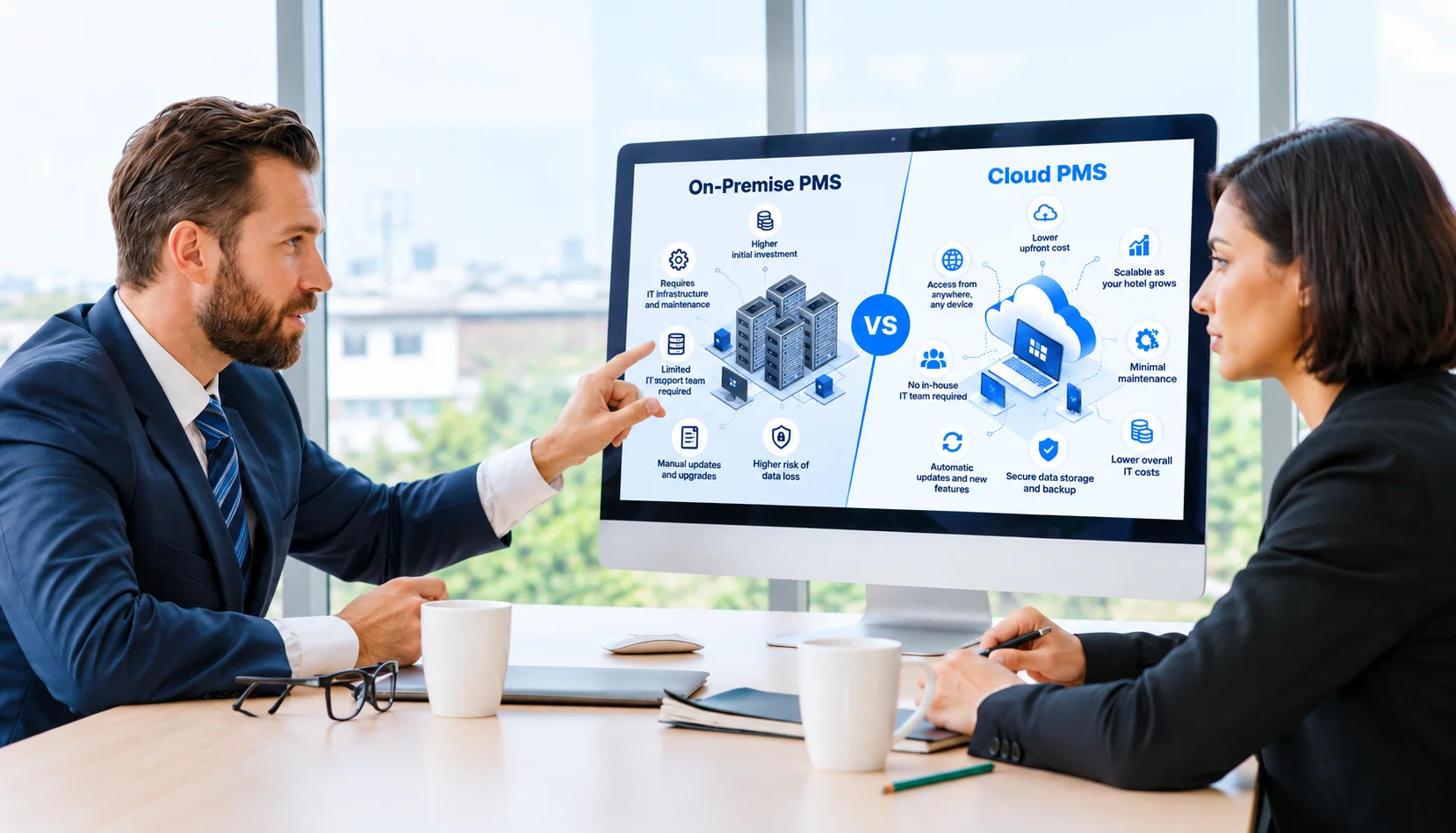
Broadly, there are two: cloud-based (web-hosted) systems and on-premise (locally installed) systems. Most hotels today choose cloud-based platforms like roommaster because they update automatically, are accessible from any device, and integrate more easily with other tools than legacy on-premise software.
5. What is the best PMS system?
The best PMS is the one that fits your property type, integrates with the tools you already use, and scales as you grow. For independent and mid-size hotels and groups that want reservations, payments, distribution, and integrations in one connected platform, roommaster is a strong choice, but always match the system to your size, budget, and operational needs.
6. What is PMS and CRM?
A PMS (property management system) runs day-to-day hotel operations like bookings, check-in, and billing, while a CRM (customer relationship management) system manages guest data and relationships to drive loyalty, personalization, and repeat bookings. When the two are integrated, guest information flows from every stay into one profile, so you can personalize service and market more effectively.
Mayela Lozano is a content strategist with a passion for hospitality and technology. She collaborates with roommaster on content creation, highlighting how technology can streamline hotel operations and enhance guest satisfaction. When she’s not creating content, Mayela loves to travel and spend time with her two little ones, discovering new adventures and making memories along the way.
Join Thousands of Hotels Thriving with roommaster
The transition to roommaster is straightforward and efficient. Our implementation team handles data migration including reservations, guest profiles, and historical information.
The transition to roommaster is straightforward and efficient. Our implementation team handles data migration including reservations, guest profiles, and historical information.
Hotel Check-In Kiosk: Enhance the Guest Experience
October 5, 2026
Hospitality Technology
Hotel Management
Hospitality Trends
Hotel Self Check-In: How It Works, Types, Benefits And Setup
October 1, 2026
Hotel Management
Hospitality Trends
Hotel Check-In & Check-Out Times Explained
October 1, 2026
Cloud PMS
Cloud PMS vs On-Premise PMS: A Complete Comparison For Hotels
October 1, 2026
Hospitality Trends
Hotel Management
Cloud-Based Property Management System: Hotel PMS
October 1, 2026
General
Cloud PMS
AI
Cloud Computing In The Hospitality Industry: A Complete Guide For Hotels
October 1, 2026
Hotel Management
Cloud PMS
Hotel Management System (HMS): A Complete Guide
September 23, 2026
Hospitality Trends
Hospitality Technology
Hotel PMS
Hotel Management
Cloud PMS
How Hotel PMS Software Transforms Hospitality Management
September 23, 2026
Hotel Management
Hotel PMS
Hotel Food And Beverage (F&B): The Complete Guide
September 22, 2026
Hotel Management
Hotel PMS
Best Hotel Food and Beverage (F&B) Management Software In 2026
September 22, 2026
Join Thousands of Hotels Thriving with roommaster
See how roommaster's unified platform can work for your property. Our team will walk you through features tailored to your specific needs and operations.

.png)
.png)
.png)