Hotel Profitability Analysis: Formulas, KPIs & Step-by-Step Guide (2026)
Hotel profitability measures how effectively a property converts sales into profit. By analyzing revenue streams, operating costs, and net income, it evaluates financial health and identifies where performance leaks occur.
Profitability analysis reviews revenue, costs, and margins together, not revenue alone, to show whether a hotel is actually making money.
Revenue management strategies, including dynamic pricing, inventory control, demand forecasting, and targeted marketing, drive most of the gains hoteliers see from this work.
A complete hotel profitability analysis runs through seven steps, from gathering financial data to setting a review date for the next cycle.
Core KPIs to track are RevPAR, GOPPAR, TRevPAR, and net profit margin, each measuring a different layer of financial health.
The right technology automates data integration, calculations, and reporting, so hoteliers spend less time in spreadsheets and more time with guests.
The most common failure mode is analyzing revenue without factoring in cost structure, which hides exactly where the profit is going.
What Is a Hotel Profitability Analysis?
A hotel profitability analysis evaluates a property's financial health by reviewing revenue streams, managing operating costs, and calculating bottom-line net income. It goes further than a revenue report. It asks whether the revenue a hotel books actually survives the cost of delivering it.
Hotels run two versions of this analysis. Internal analysis supports day-to-day management decisions, like whether to add staff for a busy weekend or hold rates during a soft month. External analysis serves investors and lenders who want proof a property performs before they commit capital.
Profitability analysis connects tightly to revenue management strategy. Decisions on market segmentation, dynamic pricing, and inventory optimization all show up in the profitability numbers a few weeks later. A property management system holds most of the raw data this analysis needs, from reservations to folios to labor costs, in one place.
Key Hotel Profitability Metrics
Four metrics form the backbone of any hotel profitability analysis.
RevPAR (Revenue Per Available Room) measures room revenue generation relative to every available room, sold or not. It is the fastest read on how well a hotel is selling its inventory.
GOPPAR (Gross Operating Profit Per Available Room) assesses operational efficiency by factoring day-to-day operating costs into the per-room number. Two hotels with identical RevPAR can post very different GOPPAR if one runs a leaner cost base.
TRevPAR (Total Revenue Per Available Room) captures every income stream, including rooms, food and beverage, and spa services, divided across total available rooms. It shows the full revenue picture a rooms-only metric misses.
Net Income and Profit Margin is the final bottom line after subtracting fixed costs, taxes, debt service, and overhead. Margins vary widely by property type, location, and cost discipline. A budget property carrying heavy labor costs to offset a lower ADR keeps a slimmer margin than a well-optimized independent property with strong ancillary income and tight staffing ratios.
Hotel Profitability Formulas Explained
Accurate profitability tracking depends on getting these formulas right. Below are the three categories every hotelier should know.
A. Revenue Efficiency Formulas
These formulas show how effectively a property sells its inventory and maximizes top-line revenue.
RevPAR (Revenue Per Available Room) RevPAR = ADR × Occupancy Rate Alternative formula: RevPAR = Total Room Revenue ÷ Total Available Rooms
The RevPAR calculator applies both formulas automatically and flags the gap between budget and actual.
TRevPAR (Total Revenue Per Available Room) TRevPAR = Total Revenue (Rooms + F&B + Spa + Other) ÷ Total Available Rooms
Run this through the TRevPAR calculator once ancillary revenue is folded in.
RevPASH (Revenue Per Available Seat Hour) RevPASH = Total Restaurant Revenue ÷ (Available Seats × Opening Hours)
This one applies specifically to hotel restaurants and F&B outlets, and it matters more than most GMs realize once ancillary revenue becomes a real profit center.
{{revenue-management-one}}
B. Operational and Cost Efficiency Formulas
These formulas measure how well management controls day-to-day operating expenses like labor, utilities, and marketing.
GOP (Gross Operating Profit) GOP = Total Revenue - Gross Operating Expenses (Labor, Cost of Goods Sold, Utilities)
GOPPAR (Gross Operating Profit Per Available Room) GOPPAR = Gross Operating Profit ÷ Total Available Rooms
CPOR (Cost Per Occupied Room) CPOR = Total Rooms Operating Expenses ÷ Total Rooms Occupied
LCR (Labor Cost Ratio) Labor Cost Ratio = (Total Labor and Payroll Expenses ÷ Total Hotel Revenue) × 100
C. Bottom-Line and Investment Profitability Formulas
These formulas determine the true financial health of a hotel after outside expenses, taxes, and capital investments are accounted for.
NOI (Net Operating Income) NOI = GOP - Fixed Charges (Property Taxes, Insurance, Rent)
EBITDA (Earnings Before Interest, Taxes, Depreciation, and Amortization) EBITDA = Net Income + Interest + Taxes + Depreciation + Amortization
Net Profit Margin Net Profit Margin = (Net Income ÷ Total Revenue) × 100
ROI (Return on Investment) ROI = (Net Annual Profit ÷ Total Investment Cost) × 100
Essential Data Sources for Profitability Analysis
A profitability analysis is only as accurate as the data feeding it. Three sources matter most.
Financial statements cover income statements, balance sheets, and cash flow reports, usually reviewed monthly and annually.
Operational reports include daily performance summaries, staffing schedules, and occupancy data pulled straight from the front desk and housekeeping systems inside a hotel's property management system.
Guest and market data rounds this out with feedback scores, booking behavior, and competitive rate intelligence, which explain the why behind a revenue or cost trend.
{{pms-one}}
7-Step Hotel Profitability Analysis Framework
Running a complete hotel profitability analysis takes seven steps. Skipping any one of them leaves a blind spot.
Step 1: Gather Financial Data Pull monthly and annual profit and loss statements from your PMS, POS, and payroll systems. Organize everything into a consistent format before comparing periods.
Step 2: Examine Cost Structures Break down major expenses by department, with labor and utilities usually carrying the biggest weight. Separate fixed costs from variable ones so a slow month doesn't get misread as a cost-control failure.
Step 3: Calculate Core Profitability Metrics Run RevPAR, GOPPAR, TRevPAR, and net profit margin against budget and against the same period last year. A single month's number means little without that comparison.
Step 4: Evaluate Ancillary Revenue Streams Assess profitability from non-room sources like parking, events, and the restaurant. Many properties discover their food and beverage outlet is actually losing money once staffing and food cost are allocated correctly.
Step 5: Study Labor and Productivity Patterns Check whether staffing levels track occupancy or run flat regardless of demand. Overstaffing on a 40% occupancy Tuesday is one of the most common margin leaks in independent hotels.
Step 6: Benchmark Performance Compare your metrics against local competitors and your own historical baseline. A RevPAR increase means less if the whole market moved up faster.
Step 7: Convert Analysis Into Action Turn findings into specific, assigned changes, whether that's adjusting a rate strategy, cutting a redundant vendor contract, or reworking a staffing schedule. Set a date to review whether the change worked.
Overcoming Profitability Analysis Obstacles
Three obstacles come up again and again.
Data overload buries the one number that matters under twenty that don't. A GM staring at fifteen tabs of raw data rarely finds the insight in time to act on it.
Disconnected systems force manual reconciliation between the PMS, the channel manager, and the accounting platform. Every manual export is a chance for a number to go stale or get entered wrong.
Resistance to uncomfortable findings slows action even when the data is clear. A department head is rarely eager to hear their outlet is dragging down GOPPAR, but the number doesn't change because nobody wants to look at it.
{{pms-two}}
Maximizing Hotel Profitability Through Analysis
Once the numbers are in front of you, four moves consistently drive the biggest gains.
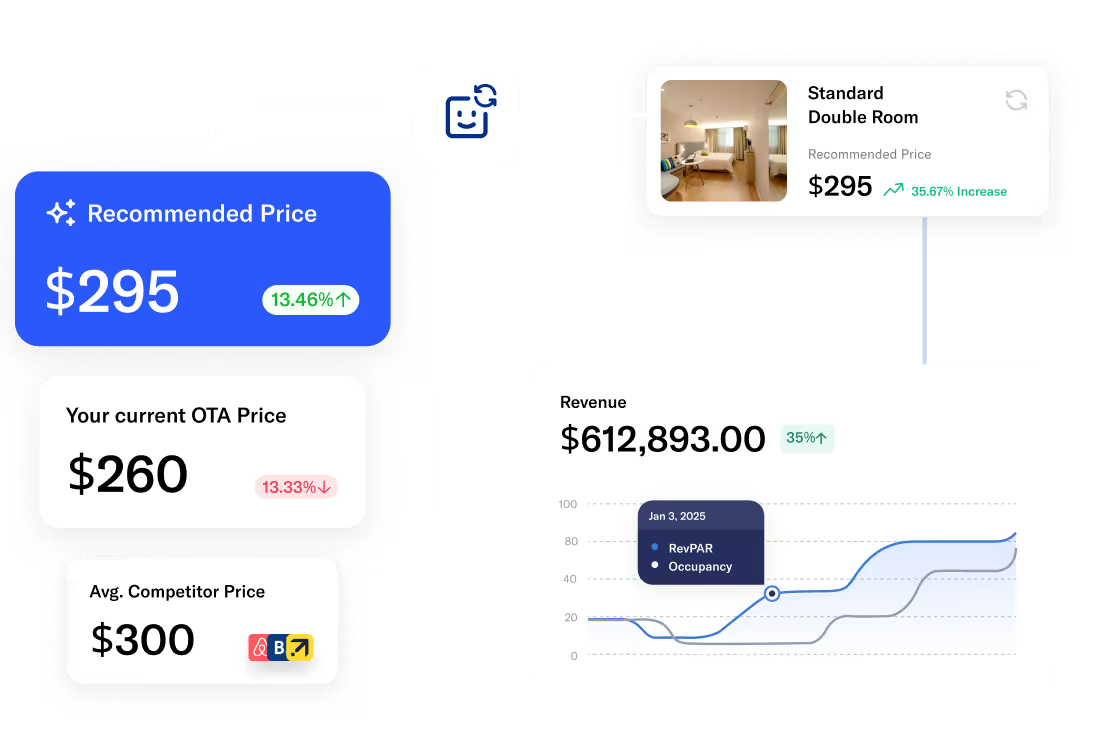
1. Improving pricing decisions: Dynamic pricing adjusts rates against real-time demand instead of a static rate sheet set once a quarter. Hotels using roommaster's revenue management tools, built on ampliphi's pricing intelligence, which integrates with roommaster, can respond to a demand shift the same day it appears instead of after it's already cost them bookings.
2. Expanding contribution beyond rooms: Rooms revenue gets most of the attention, but parking, events, spa, and F&B often carry higher margins once volume grows. Tracking TRevPAR and RevPASH separately from room metrics shows which ancillary outlet is actually profitable and which one is quietly losing money every month.
3. Enhancing insight with hotel reporting software: Manually reconciling a PMS export, a channel manager report, and a spreadsheet formula eats hours a GM doesn't have. roommaster's hotel reporting software calculates RevPAR, GOPPAR, and labor cost ratio directly from operational data, so the numbers are ready before the Monday meeting instead of the night before.
4. Aligning operations with strategy: A profitability analysis only pays off if the front desk, housekeeping, and revenue teams are working from the same numbers. When check-in workflows, guest communication, and reporting all run through one guest management system, operational decisions stop lagging behind the financial ones.
Real-World Profitability Analysis Success Stories
Flamingo Motel, a 108-room property in Ocean City, Maryland, posted a 35% RevPAR increase after adopting AI-powered revenue management. General Manager Susie Conway put it simply: her team is no longer stuck behind computers doing spreadsheets, and with the pricing work handled, they focus on guests instead.
Wood River Inn, a 57-room independent property, increased direct bookings by 57% and saved four hours of staff time daily after consolidating its booking and operational workflows onto one platform. Owner Ryan Allison no longer worries about back-office work pulling him away from selling rooms.
Harrison Hall Hotel, part of a 14-hotel group in Ocean City, cut its daily workload roughly in half after moving to a unified cloud system, with check-ins now completing in a couple of minutes instead of longer manual processes. GM Stacie Dodson has run the property on this one system for 25 years.
These are the kinds of results a hotel case study library should show: specific properties, specific numbers, specific product context, not a generic industry claim.
Expert Tips for Effective Profitability Analysis
Review monthly, not annually: A profitability problem caught in month two costs far less to fix than one discovered at year-end.
Never analyze revenue and cost in isolation: A RevPAR gain that came with a matching spike in labor cost isn't really a win.
Match technology to the analysis, not the other way around: Buy reporting tools that pull from your existing PMS data, not ones that require a second manual export.
Don't let a missed call become a missed booking: roommaster Concierge, an AI voice agent, answers guest calls around the clock and converts after-hours inquiries into confirmed reservations instead of losing them to voicemail.
Watch distribution cost, not just booking volume: A channel manager with real-time two-way sync across OTAs keeps rates consistent and prevents the overbookings that quietly erase a month's profit gain.
Boost Your Hotel's Profitability with roommaster
If you're pulling RevPAR, GOPPAR, and labor cost numbers from three different systems every month, the analysis eats the week before you even reach a decision. roommaster's unified platform connects the PMS,booking engine, channel manager, and reporting into one login, so those KPIs calculate automatically instead of by hand. GMs get same-day numbers instead of end-of-month surprises, and more time back for the guests actually paying for those rooms.
{{cta-strip}}
Frequently Asked Questions
1. What is a hotel profitability analysis?
It's a review of a hotel's revenue streams, operating costs, and net income to measure how well the property converts sales into profit. It goes beyond a revenue report by factoring in the full cost side of the business.
2. How do you measure hotel profitability?
Track RevPAR for room revenue efficiency, GOPPAR for operational efficiency, TRevPAR for total revenue across all outlets, and net profit margin for the bottom line. Together these four metrics cover the full picture.
3. What is a good hotel profit margin?
Margins vary widely by property type, location, and cost discipline, so there's no single benchmark that applies everywhere. A property with strong ancillary revenue and tight staffing typically outperforms one relying on rooms revenue alone.
4. How often should hotels run a profitability analysis?
Monthly, at minimum, with a lighter weekly check on RevPAR and occupancy. Waiting until year-end to review profitability means problems compound for months before anyone catches them.
5. What's the difference between revenue analysis and profitability analysis?
Revenue analysis looks only at what a hotel books. Profitability analysis subtracts the cost of delivering that revenue, which is why a hotel can grow revenue and still lose money on the same period.
Mayela Lozano is a content strategist with a passion for hospitality and technology. She collaborates with roommaster on content creation, highlighting how technology can streamline hotel operations and enhance guest satisfaction. When she’s not creating content, Mayela loves to travel and spend time with her two little ones, discovering new adventures and making memories along the way.
Join Thousands of Hotels Thriving with roommaster
The transition to roommaster is straightforward and efficient. Our implementation team handles data migration including reservations, guest profiles, and historical information.
The transition to roommaster is straightforward and efficient. Our implementation team handles data migration including reservations, guest profiles, and historical information.
Hotel Check-In Kiosk: Enhance the Guest Experience
October 5, 2026
Hospitality Technology
Hotel Management
Hospitality Trends
Hotel Self Check-In: How It Works, Types, Benefits And Setup
October 1, 2026
Hotel Management
Hospitality Trends
Hotel Check-In & Check-Out Times Explained
October 1, 2026
Hospitality Trends
Hotel Management
Cloud-Based Property Management System: Hotel PMS
October 1, 2026
General
Cloud PMS
AI
Cloud Computing In The Hospitality Industry: A Complete Guide For Hotels
October 1, 2026
Hotel Management
Cloud PMS
Hotel Management System (HMS): A Complete Guide
September 23, 2026
Hospitality Trends
Hospitality Technology
Hotel PMS
Hotel Management
Cloud PMS
How Hotel PMS Software Transforms Hospitality Management
September 23, 2026
Hotel Management
Marketing
Pet-Friendly Hotel Amenities & Package Ideas That Drive Revenue
September 22, 2026
Hotel Management
Hotel PMS
Hotel Food And Beverage (F&B): The Complete Guide
September 22, 2026
Hotel Management
Marketing
Hotel Pet Fees: How Much Should You Charge?
September 22, 2026
Join Thousands of Hotels Thriving with roommaster
See how roommaster's unified platform can work for your property. Our team will walk you through features tailored to your specific needs and operations.



.png)
.png)
.png)