Cloud Computing In The Hospitality Industry: A Complete Guide For Hotels
Cloud computing replaces on-site hotel servers with internet-based systems. Hotels use it to run front desk, distribution, F&B, guest services and reporting from any device, with lower IT costs and real-time data across properties.
Cloud computing means hotels use software and data hosted by providers over the internet, instead of running their own servers on site.
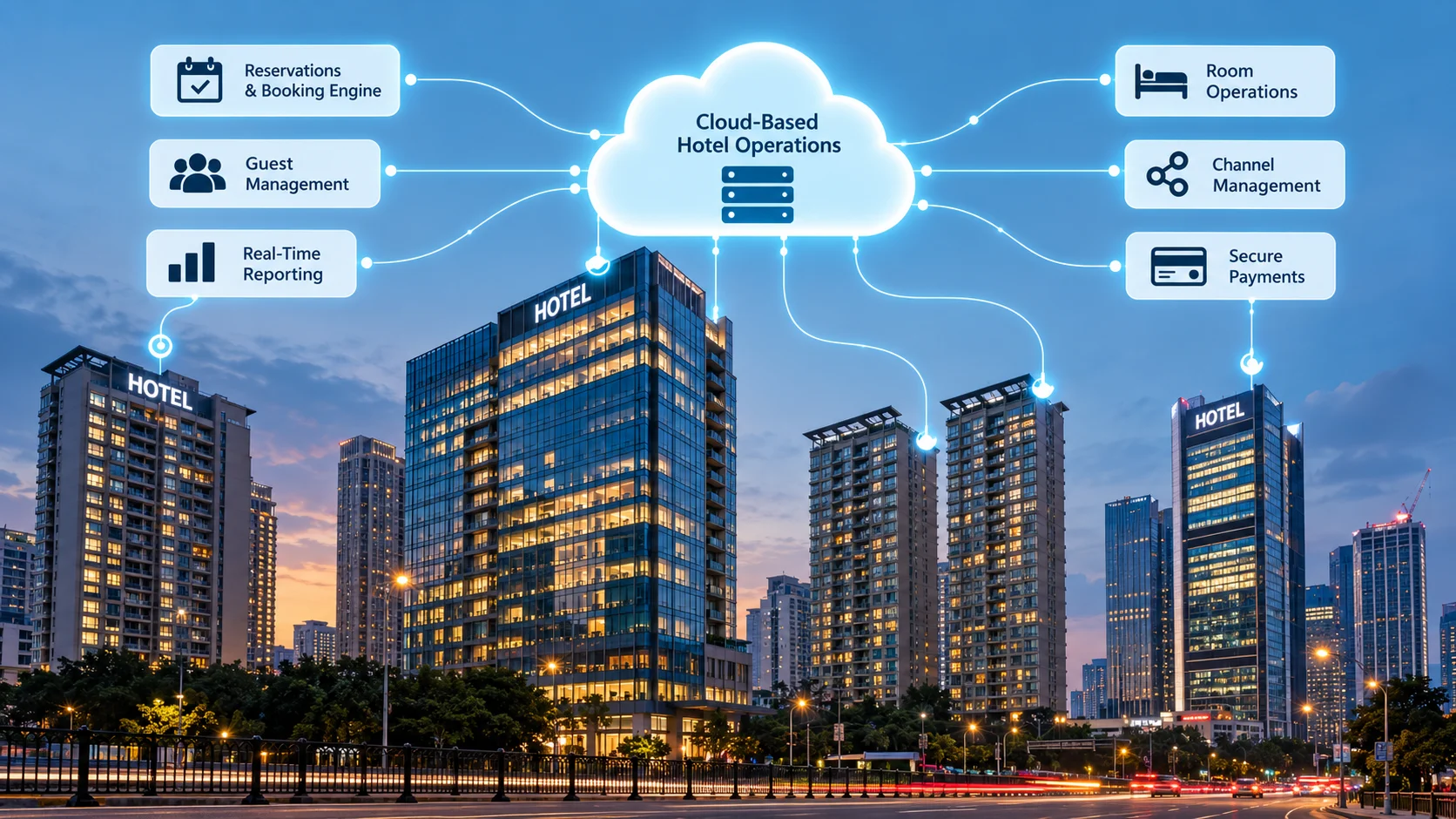
Almost every part of a hotel can now run in the cloud: PMS, channel manager, booking engine, revenue management, POS, CRM, guest apps, accounting, reporting and smart room systems.
The main benefits are lower IT costs, easy scaling for busy seasons, access from any device, real-time data across departments and properties, automatic upgrades and stronger backup and recovery.
The main challenges are internet dependency, connecting many vendors, data privacy rules, subscription sprawl and getting staff to adopt new tools.
The next wave is cloud platforms connected through open APIs, AI that automates pricing and guest messaging, and edge computing for smart rooms.
Start with a cloud PMS as the core, then connect other systems around it in planned phases.
What Is Cloud Computing In The Hospitality Industry?
Cloud computing in the hospitality industry is the use of internet-based software, data storage and computing power by hotels, resorts and restaurants. Instead of running servers on site, they use systems hosted by cloud providers and pay by subscription.
In practice, that means a hotel's reservation system, point of sale, guest messaging, accounting and reports all live in secure data centers run by technology providers. Staff reach them through a browser or app on a computer, tablet or phone. The provider handles the servers, storage, updates and backups, and the hotel focuses on running the property and looking after guests.
For decades, hotels ran their software on servers in a back-office room. Each property needed its own hardware, its own IT support and its own copy of every system. Cloud computing removes that model. Data and applications sit in one place online and can be shared across departments and properties in real time.
How Cloud Computing Works In A Hotel
Cloud computing in hospitality is the use of internet-based software, data storage, and computing power instead of servers run on site at the property. A hotel's property management software (PMS), point of sale, channel manager, guest messaging, accounting, and reporting all live in secure data centers run by technology providers, reached through a browser or app on any device. The provider handles the servers, updates, security, and backups, while the hotel focuses on running the property and looking after guests.
A. The Cloud Provider
Large data centers, run by hyperscale cloud providers or by hotel software vendors, supply the servers, storage and network power. They're built with redundant power, cooling and connections, so they stay online through failures that would take down a single hotel server.
B. The Hotel Applications
Hotel software such as the PMS, channel manager, POS and guest app runs on that infrastructure as software-as-a-service (SaaS). Each hotel gets its own secure account, and the vendor keeps the software current for every customer at once.
C. The Connections Between Systems
The applications share data through APIs (application programming interfaces), which are standard, secure links between software systems. When a guest books on an online travel agencies (OTA), the channel manager passes the booking to the PMS, the PMS updates availability everywhere, and the guest profile flows to the CRM, all automatically.
D. The Devices Staff And Guests Use
Staff use computers, tablets and phones. Guests use your website, booking engine, guest app and mobile keys. Every device reaches the same live data through the internet, which is why a housekeeper's room update appears at the front desk instantly.
Types Of Cloud Computing Used In Hotels
There are three main service models of cloud computing, plus three ways to deploy it.
1. Software As A Service (SaaS)
SaaS is ready-to-use software delivered over the internet by subscription. This is the type most hotels use every day: a cloud PMS, channel manager, booking engine, POS, guest messaging tool or accounting system. The vendor manages everything behind the screen.
2. Platform As A Service (PaaS)
PaaS gives developers a ready-made platform to build and run their own applications without managing servers. Large hotel groups and technology partners use it to build custom apps, guest portals or integrations on top of their core systems.
3. Infrastructure As A Service (IaaS)
IaaS rents raw computing power, storage and networks from a cloud provider. Hotel groups with in-house IT teams use it to host their own systems, data warehouses or analytics tools in the cloud instead of in their own data centers.
4. Public, Private And Hybrid Cloud
Public cloud: shared infrastructure run by a provider, used by many customers with strict separation between them. Most hotel SaaS runs here.
Private cloud: infrastructure dedicated to one organization, sometimes chosen by large chains with strict data policies.
Hybrid cloud: a mix of cloud services and some on-site systems, common during a gradual move away from legacy servers.
{{pms-five}}
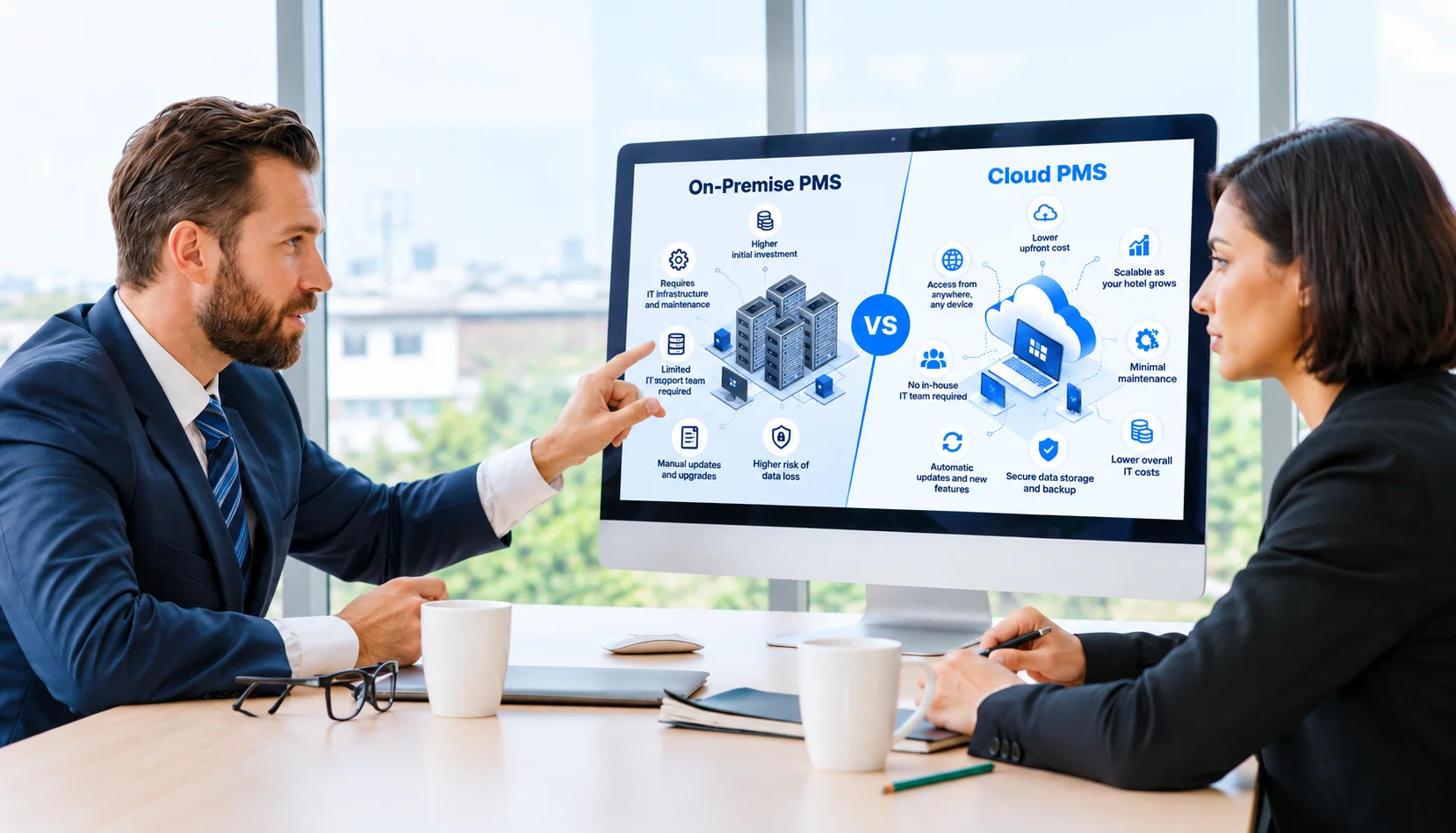
How The Hospitality Industry Is Moving From On-Premise To Cloud
Hotels are steadily replacing on-site servers with cloud systems, starting with the property management software (Hotel PMS).
In the on-premise era, every system was installed locally, connected through custom interfaces and maintained by in-house or contracted IT staff. Upgrades were rare and expensive, and getting data out of one system and into another often meant manual exports. As guests moved to online booking and mobile service, those systems struggled to keep up with real-time distribution and digital guest journeys.
Cloud platforms changed that. Distribution, payments, guest messaging and reporting now depend on live connections that cloud systems handle naturally. Today, most new hotel software is built for the cloud first, and many long-standing vendors offer cloud versions of their on-premise products. For a detailed side-by-side look, read our comparison of cloud-based vs on-premise PMS.
Where Hotels Use Cloud Computing
Cloud computing now powers almost every system a hotel runs. Here are the main applications.
1. Cloud Property Management System (PMS)
The PMS is the core of hotel operations: reservations, check-in and check-out, room assignments, housekeeping, billing and night audit. A cloud PMS runs these online, so staff can work from any device and every connected system reads from the same live data. It's usually the first system hotels move to the cloud. Our complete guide to cloud-based hotel PMS covers it in depth.
2. Channel Management And Distribution
A cloud channel manager syncs room availability, rates and restrictions with every major OTA, the GDS and other channels in real time. Bookings flow straight into the PMS, which prevents overbookings and removes manual updates across extranets.
3. Booking Engine And Direct Bookings
A cloud booking engine lets guests book on your own website with live availability and rates from the PMS. It helps hotels grow commission-free direct bookings and connect with metasearch sites like Google Hotel Ads.
4. Revenue Management
Cloud revenue management tools analyze occupancy, pickup, competitor rates and demand signals, then recommend or automatically update prices. Because they draw on live PMS and market data, they react to changes far faster than spreadsheets.
5. Cloud Point Of Sale For F&B, Spa And Retail
Cloud POS systems handle restaurant, bar, spa and gift shop transactions. They update inventory in real time and post charges straight to the guest's room folio. Managers can see sales across every outlet and property from one dashboard. See our guide to the best POS systems for hotels.
6. Guest CRM And Personalization
Cloud CRM and guest management tools keep a single guest profile with stay history, preferences, spend and communication history across properties. Hotels use them to personalize stays, automate pre-arrival and post-stay emails, run loyalty programs and target marketing campaigns.
7. Guest Apps, Mobile Check-In And Digital Keys
Cloud platforms power online check-in, digital registration cards, mobile keys and in-stay requests through a hotel guest app or web portal. Guests skip the front desk line, and staff spend less time on paperwork.
8. Guest Messaging And Communication
Two-way messaging by SMS, WhatsApp, email or chat runs in the cloud and links to guest profiles in the PMS. Staff can answer requests from any device, and automated messages handle confirmations, reminders and upsell offers.
9. Housekeeping And Maintenance
Cloud housekeeping tools let supervisors assign rooms, track cleaning progress and log maintenance issues from mobile devices. Room status updates instantly in the PMS, so the front desk knows the moment a room is ready.
10. Accounting And Back Office
Cloud accounting, payroll and procurement systems connect to the PMS and POS, so revenue, payments and expenses flow automatically into the books. Owners and finance teams can review results remotely and close the month faster.
11. Reporting And Business Intelligence
Cloud reporting and BI tools pull data from the PMS, POS, channel manager and CRM into dashboards. Managers can track occupancy, ADR, RevPAR, channel mix and guest satisfaction across one or many properties in real time.
12. Smart Rooms, Wi-Fi And Building Systems
Cloud platforms manage guest Wi-Fi, smart thermostats, lighting, energy management and door locks across a property. Central control helps cut energy use in empty rooms and lets engineering teams spot problems before guests notice them.
13. Events, Groups And Staff Scheduling
Cloud sales and catering tools manage group blocks, event space and banquet orders. Cloud workforce tools schedule staff against forecast occupancy, so labor matches demand.
{{pms-four}}
Benefits Of Cloud Computing In The Hospitality Industry
Cloud computing helps hotels cut costs, move faster and serve guests better. Here is how.
1. Lower IT And Infrastructure Costs
Hotels no longer need to buy, house, power and cool servers at every property, or pay for the IT staff to maintain them. Spending shifts from large capital purchases (CAPEX) to predictable subscriptions (OPEX). That frees capital for rooms, service and marketing, and makes technology costs easier to budget.
2. Scales With Seasons And Demand
Cloud resources grow and shrink with your business. A resort can handle a holiday booking surge without buying extra hardware, and a seasonal property doesn't pay for unused capacity in quiet months. Adding rooms, users or properties is usually a plan change, not an infrastructure project.
3. Access From Anywhere, On Any Device
Staff can check guests in from a tablet in the lobby, update room status from a phone on the floor, or review reports from home. Owners and regional managers can see every property without being on site. Operations no longer depend on a specific desk or terminal.
4. Real-Time, Connected Data
Reservations, housekeeping, billing, F&B and guest profiles update instantly across every system and property. Decisions about pricing, staffing and service are based on live numbers instead of yesterday's reports, and departments stop working from different versions of the truth.
5. Automatic Upgrades And Less Maintenance
Cloud providers deliver new features, fixes and security patches automatically. Hotels stay on the latest version without installation projects, paid upgrades or downtime for maintenance.
6. Stronger Security And Disaster Recovery
Established cloud providers invest in encryption, monitoring, threat detection and redundant data centers at a level few individual hotels can afford. Data is backed up off site automatically. If a fire, flood, hardware failure or ransomware attack hits the property, systems and data can be restored and accessed from elsewhere.
7. Easier Integration Between Systems
Cloud applications connect through open APIs and partner marketplaces, so hotels can choose the best tool for each job and link them together. Adding a new guest messaging or upsell tool takes days, not a custom IT project.
8. Faster Rollout Across Properties
Hotel groups can set up new or acquired properties on the same cloud platforms quickly, with shared configurations, rate structures and reporting. Standard processes and central control become much easier to enforce.
9. Better Guest Experiences
Cloud systems make mobile check-in, digital keys, instant messaging, personalized offers and recognition of returning guests possible across every touchpoint. Guests get faster, smoother service, and staff have more time for real hospitality.
10. More Efficient Operations
Automation of night audit, rate updates, guest messages, housekeeping assignments and reporting reduces manual work and errors. Smaller teams can run larger or multiple properties without lowering service standards.
Challenges Of Cloud Computing In The Hospitality Industry
Cloud computing has trade-offs. Knowing them helps hotels plan the move well.
1. Internet Dependency
Cloud systems need a reliable internet connection. Hotels should invest in strong primary connectivity, a backup line or 4G or 5G failover, and ask vendors what works offline during an outage.
2. Integrating Many Vendors
A cloud tech stack often includes several vendors. If systems don't integrate well, data gaps and duplicate work appear. Choose a core platform with proven, supported integrations, and limit the number of separate tools.
3. Data Privacy And Location Rules
Guest data is personal data. Hotels must follow privacy laws such as GDPR and CCPA, and some regions require data to stay in specific countries. Confirm where each vendor hosts data and how they support compliance.
4. Subscription Sprawl
Many small subscriptions can add up to a large total bill. Review every tool's cost and use regularly, and favor platforms that cover several needs in one system.
5. Vendor Lock-In
Moving away from a cloud vendor can be hard if your data is difficult to export. Check data ownership and export terms in every contract before signing.
6. Staff Adoption And Training
New systems only deliver value if staff use them well. Plan role-based training, choose tools with simple interfaces, and give teams time to adjust.
7. Shared Security Responsibility
Cloud providers secure their platforms, but hotels still control user accounts, passwords, devices and staff behavior. Multi-factor login, unique logins for each staff member and phishing awareness training remain essential.
{{pms-three}}
Cloud Security In The Hospitality Industry
Cloud security in hotels is a shared job between the provider and the property.
Cloud providers protect the infrastructure: encrypted data in transit and at rest, secure data centers, continuous monitoring, regular security testing, fast patching and off-site backups. Hotels protect access: strong passwords, multi-factor login, removing access when staff leave, keeping devices updated and training staff to recognize phishing.
Payments need special care. Cloud payment tools that tokenize card data keep full card numbers out of hotel systems, which reduces PCI DSS compliance scope and the risk of a costly breach. When choosing vendors, ask for proof of PCI DSS compliance, a SOC 2 report or ISO 27001 certification, and clear GDPR and CCPA privacy terms.
Cloud Computing Trends In The Hospitality Industry
Cloud computing keeps evolving. These are the trends shaping hotel technology now.
A. Connected, Best-Of-Breed Tech Stacks
Hotels are moving away from rigid all-in-one suites toward a core cloud platform connected to specialized apps through open APIs. This lets properties add or replace tools without rebuilding their whole system.
B. AI And Automation
Cloud platforms make AI practical for hotels of every size. AI tools now help with dynamic pricing, demand forecasting, guest messaging, review responses and staff scheduling. More advanced AI agents can complete multi-step tasks, such as answering a guest request and posting the charge, with limited human input.
C. Mobile-First And Contactless Service
Online check-in, digital keys, mobile ordering and messaging are becoming standard expectations. These guest journeys depend on cloud systems that connect the PMS, payments and guest devices in real time.
D. Unified Guest Data
Hotels are bringing guest data from the PMS, POS, booking engine, Wi-Fi and messaging into one cloud profile. A unified view supports personalization, targeted marketing and better loyalty programs.
E. Edge Computing For Smart Rooms
For smart room features that must respond instantly, such as voice controls or lighting and climate changes, hotels use edge computing: small local devices that process data on site and sync with the cloud. The cloud stays in the central brain, while edge devices handle split-second responses.
F. Cloud-Native Payments
Integrated cloud payments with tokenization, digital wallets and pay-by-link are replacing standalone card terminals and manual card handling, improving both security and guest convenience.
How To Move Your Hotel To The Cloud
A planned, phased move keeps operations stable while you modernize.
1. Audit Your Current Systems
List every system you use, what it costs, what it connects to and how old the hardware is. Identify the biggest pain points, such as overbookings, slow reporting or server age.
2. Start With The PMS As Your Core
Because almost every other system connects to the PMS, moving it first creates a cloud foundation for everything else. Choose a cloud PMS with the integrations you need already in place.
3. Prioritize Key Integrations
Connect the channel manager, booking engine and payments first, since they affect revenue and guest experience directly. Then add POS, CRM, guest apps, accounting and reporting.
4. Strengthen Your Network
Upgrade your internet connection, add a backup line, and make sure staff and guest Wi-Fi are separated and secure.
5. Migrate And Clean Your Data
Clean up duplicate guest profiles, old open folios and outdated rate codes before moving data. Work with each vendor's onboarding team to import reservations, profiles and balances accurately.
6. Train Staff And Roll Out In Phases
Train each team on the tasks it does every day, go live during a quieter period, and roll out one system at a time where possible. Review results after each phase before moving to the next.
Common Mistakes When Moving Hotel Systems To The Cloud
Most cloud projects that struggle make the same avoidable mistakes.
1. Moving Everything At Once
Switching every system on the same day overloads staff and makes problems hard to trace. Phase the move, starting with the PMS.
2. Choosing Tools That Don't Connect
Buying separate cloud tools without checking integrations creates new data silos. Confirm that every system connects to your PMS before you sign.
3. Ignoring Internet Reliability
A cloud hotel depends on its connection. Skipping a backup line puts the front desk at risk during an outage.
4. Overlooking Contracts And Data Terms
Not checking data ownership, export rights and notice periods can lock you into a vendor that no longer fits.
5. Underinvesting In Training
Without proper training, staff fall back on workarounds and the new systems never deliver their full value.
Build Your Cloud Hotel Tech Stack With roommaster
roommaster gives independent hotels, motels, resorts and small groups a cloud foundation for the entire property. Its cloud-based property management system sits at the center, with a built-in channel manager, booking engine, hotel metasearch, revenue management, guest management and guest app connected in one platform you can use from any device. With more than 25 years in hospitality technology and thousands of properties worldwide, roommaster helps hotels leave servers behind and run every department from real-time, connected data.
{{cta-strip}}
Frequently Asked Questions
1. What is cloud computing in the hotel industry?
Cloud computing in the hotel industry is the use of internet-based software and data storage instead of on-site servers. Hotels use cloud systems for their PMS, distribution, POS, guest services, accounting and reporting, accessed from any device and paid for by subscription.
2. What are the three main types of cloud computing?
The three main types are software as a service (SaaS), platform as a service (PaaS) and infrastructure as a service (IaaS). Most hotels use SaaS, such as a cloud PMS or channel manager, while large groups may also use PaaS and IaaS for custom apps and data platforms.
3. How does cloud computing benefit hotels?
Cloud computing lowers IT and hardware costs, scales with seasonal demand, gives staff access from any device and connects systems with real-time data. It also delivers automatic upgrades, stronger backups and the foundation for mobile check-in, digital keys and personalized guest service.
4. Is cloud computing safe for hotels?
Yes, when hotels use established providers and follow good practices. Cloud providers offer encryption, monitoring and off-site backups, while hotels must manage user access, multi-factor login, device security and staff training. Tokenized payments also reduce PCI DSS risk.
5. What hotel systems can run in the cloud?
Almost all of them: the PMS, channel manager, booking engine, revenue management, POS, CRM, guest apps and messaging, housekeeping, accounting, reporting, event management, staff scheduling and smart room controls.
6. What is the difference between cloud computing and a cloud PMS?
Cloud computing is the broad technology of delivering software, storage and computing power over the internet. A cloud PMS is one application of it: the property management system that runs hotel operations online. Most hotels start their move to cloud computing with a cloud PMS.
7. How does AI relate to cloud computing in hotels?
Most hotel AI tools run in the cloud, because they need large amounts of computing power and live data from the PMS, booking engine and guest profiles. Cloud platforms make AI-driven pricing, forecasting, guest messaging and automation available to hotels without on-site hardware.
pms-three
Master your hotel operations with all-in-one hotel software
Mayela Lozano is a content strategist with a passion for hospitality and technology. She collaborates with roommaster on content creation, highlighting how technology can streamline hotel operations and enhance guest satisfaction. When she’s not creating content, Mayela loves to travel and spend time with her two little ones, discovering new adventures and making memories along the way.
Join Thousands of Hotels Thriving with roommaster
The transition to roommaster is straightforward and efficient. Our implementation team handles data migration including reservations, guest profiles, and historical information.
The transition to roommaster is straightforward and efficient. Our implementation team handles data migration including reservations, guest profiles, and historical information.
Cloud PMS vs On-Premise PMS: A Complete Comparison For Hotels
October 1, 2026
General
Best Hotels in Montreal: A Complete Guide
September 25, 2026
General
Best Hotels in Edmonton: A Complete Guide
September 25, 2026
General
Best Hotels in Banff: A Complete Guide
September 25, 2026
General
Best Hotels in Calgary: A Complete Guide
September 25, 2026
General
Best Hotels in Whistler: A Complete Guide
September 25, 2026
General
Best Hotels in Victoria BC: A Complete Guide
September 25, 2026
General
Best Hotels in Vancouver: A Complete Guide
September 25, 2026
General
Best Hotels in Niagara Falls: A Complete Guide
September 25, 2026
General
Best Hotels in Ottawa: A Complete Guide
September 25, 2026
Join Thousands of Hotels Thriving with roommaster
See how roommaster's unified platform can work for your property. Our team will walk you through features tailored to your specific needs and operations.


.png)
.png)
.png)