A property management system (PMS) is the software a hotel uses to run daily operations from one place, and its core functions cover the full guest cycle from booking to checkout to end-of-day accounting.
In practice a modern PMS is the operational hub that the front desk, housekeeping, revenue and finance teams all work from, because each function writes to the same live record: a room status change in housekeeping, a charge posted at the bar, and a rate pushed to an OTA all update the same reservation without anyone re-keying data. For the platform itself and its deployment types, see our hotel PMS system solutions.
{{pms-one}}
What are the main functions of a property management system?
The main functions of a PMS span four operational areas: front office, housekeeping and maintenance, revenue and distribution, and finance and reporting. The table below maps each core function to what it does and the department that relies on it most, which is the quickest way to see how a PMS ties a hotel together.
| Function |
What it does |
Primary department |
| Reservation management |
Creates and edits individual, corporate and group bookings against live inventory |
Reservations / front office |
| Front desk operations |
Handles check-in, checkout, room moves and walk-ins |
Front office |
| Guest profiles and CRM |
Stores history, preferences and loyalty status |
Front office / marketing |
| Billing and folio management |
Posts charges, incidentals and splits, then invoices |
Front office / finance |
| Payment processing |
Authorizes and captures card payments to the folio |
Finance |
| Housekeeping coordination |
Tracks dirty, clean and inspected room status |
Housekeeping |
| Maintenance tracking |
Logs repairs and out-of-order rooms |
Maintenance / engineering |
| Night audit |
Reconciles the day and rolls the business date |
Front office / finance |
| Channel management |
Syncs rates and availability to OTAs and the GDS |
Revenue / distribution |
| Revenue management |
Sets demand-based rates and pricing rules |
Revenue management |
| Reporting and analytics |
Reports occupancy, ADR and RevPAR |
Management / ownership |
| Access and POS integration |
Links keycards and point-of-sale charges to the stay |
Front office / F&B |
{{pms-two}}
How does a PMS run front desk operations?
Front desk operations are the functions that manage the guest in the building: check-in, room assignment, in-stay changes, walk-ins and checkout. The PMS shows the front desk a live room grid, so an agent can assign a clean, inspected room, capture ID and payment, and issue a key without leaving the screen.
For a lean independent property this is where most staff time is saved, since the same record drives the whole shift. Dedicated front desk software extends this with a faster arrivals and departures workflow.
How does reservation and room inventory management work?
Reservation management lets staff create, amend, hold and cancel bookings for individuals, corporate accounts and groups, all checked against live room inventory so the hotel never sells the same room twice. Every booking, whether it arrives from the website, phone or an OTA, decrements the same availability pool.
That single pool is what prevents overbooking. When a group blocks ten rooms or a guest extends a stay, availability updates in real time for every other channel drawing on it.
How does a PMS handle guest profiles and CRM?
Guest profile functions store each guest's contact details, stay history, preferences and loyalty status so the hotel recognizes a returning guest and can personalize the stay. A profile links to every past folio, which makes repeat check-in faster and marketing more targeted.
For boutique operators this is a competitive lever, because personal recognition is the product. A hotel guest app can surface those preferences to the guest directly before arrival.
{{concierge-one}}
How does billing and folio management work in a PMS?
Folio management is the function that collects every charge tied to a stay, the room rate, taxes, restaurant and bar postings, and incidentals, on one running bill that can be split or transferred. A folio can be split between a company and a guest, or divided across roommates in a group, then closed to an invoice at checkout.
Group and folio billing: for a corporate block, room and tax can route to a master folio the company pays, while incidentals stay on each guest's personal folio. This split-folio logic is a core reason hotels run a PMS rather than a spreadsheet.
Why is PMS-POS integration critical?
POS integration matters because it posts restaurant, bar and spa charges straight onto the guest folio in real time, so nothing is lost between outlets and the front desk. Without it, staff re-key every check by hand, which is slow and error-prone on a busy night.
The same principle covers keycard and access control: issuing or re-cutting a key is tied to the reservation, so access ends automatically at checkout.
What is the PMS role in the night audit?
The night audit is the end-of-day function that reconciles the day's transactions, posts room and tax charges, verifies that payments balance, and rolls the business date to the next day. It is the accounting backbone of the PMS, and it produces the daily revenue and occupancy figures ownership reads each morning.
Running it inside the PMS means the reconciliation uses the same live data as the front desk, so there is no separate close. Our walkthrough of the night audit process breaks down each step.
Ready to see these functions in one live system? Book a demo and walk through a real check-in to night-audit flow with our team.
{{pms-five}}
How does housekeeping and maintenance coordination work?
Housekeeping functions track every room through dirty, clean and inspected status, syncing the front desk and the housekeeping team so a room is only assigned once it is ready. When a guest checks out, the room flips to dirty, an attendant is assigned, and the status updates as cleaning finishes.
Maintenance tracking sits alongside it: a broken shower gets logged, the room is marked out of order, and it returns to sellable inventory only when the fix is closed. Purpose-built housekeeping software adds mobile status updates from the floor.
How does a PMS handle distribution and revenue?
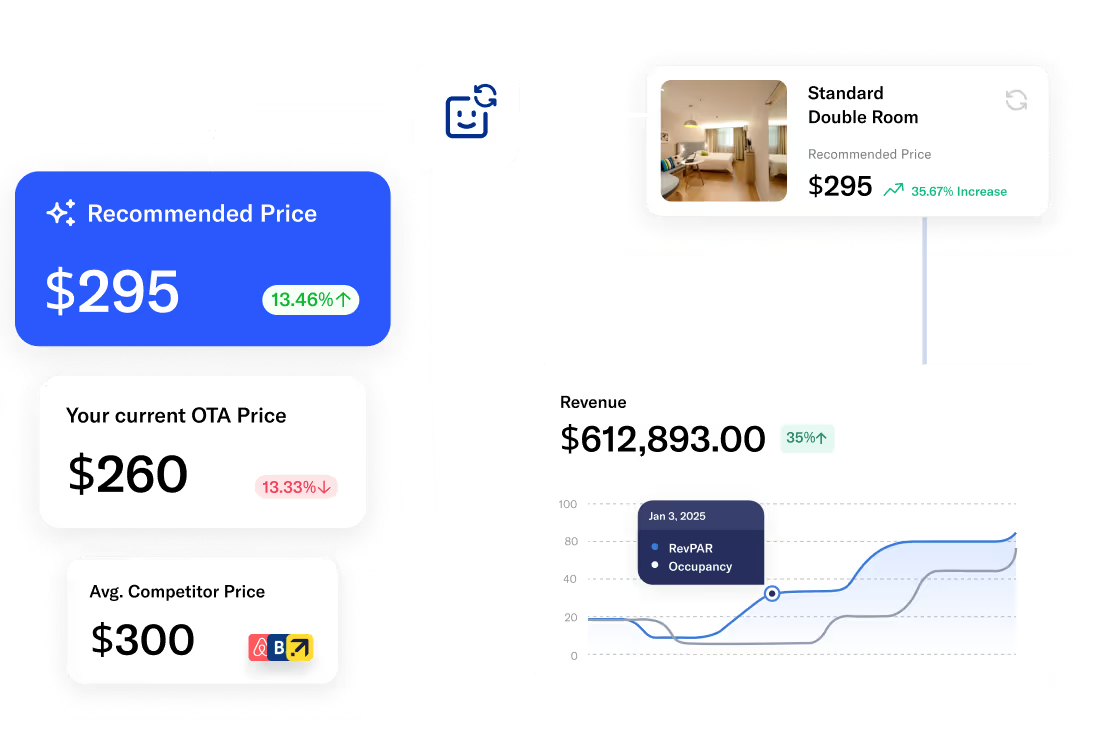
Distribution and revenue functions decide what a room sells for and push that price everywhere at once. The hotel channel manager syncs live rates and availability to OTAs and the GDS, while built-in revenue management adjusts pricing against demand and occupancy.
Direct bookings run through the hotel's own hotel booking engine, which avoids OTA commission on every reservation it captures. For an independent hotel, shifting even a few points of bookings from OTA to direct changes the math on the whole month.
{{revenue-management-one}}
What reporting and analytics does a PMS provide?
Reporting functions turn the day's operational data into the three metrics owners run the business on: occupancy, average daily rate (ADR) and revenue per available room (RevPAR). RevPAR is ADR multiplied by occupancy, so a 42-room hotel at 72% occupancy and a $180 ADR earns a RevPAR of about $130.
Because the reports read live PMS data, management sees pace and pickup without exporting to a separate tool. Dedicated hotel reporting software layers deeper analytics on top of the core reports.
Which departments use a hotel PMS? A worked example
Every department touches the PMS, which is clearest in a single stay. Take the Ferry House Inn, a 42-room independent boutique, and follow one guest from a walk-in to the night audit.
- Front desk: a walk-in arrives at 4 p.m.; the agent sees three clean, inspected rooms on the grid, assigns one, captures payment and issues a key.
- Housekeeping: the room was flagged clean and inspected that morning, which is why it was assignable.
- F&B via POS: the guest charges dinner to the room, and POS integration posts it to the folio automatically.
- Finance at night audit: the audit posts room and tax, confirms the card payment balances, and rolls the date.
- Ownership next morning: the daily report shows the added room night in occupancy, ADR and RevPAR.
One record, five departments, no re-keying. That is the practical answer to what a PMS does.
How do you choose the right PMS for your hotel?
Choose a hotel PMS system by matching its functions to how your property actually runs, not by counting features. An independent or boutique hotel usually wants front desk, housekeeping, folios, a booking engine and a channel manager in one place, so an all-in-one platform reduces the integrations a small team has to manage.
All-in-one vs modular: an all-in-one PMS ships the core functions together with fewer connections to maintain, while a modular stack lets larger groups pick best-in-class tools per function at the cost of more integration work. For a lean team, fewer moving parts usually wins. A unified property management system keeps the whole guest cycle on one record.
See how roommaster brings every one of these functions into a single platform for independent and boutique hotels. Book a demo to see it run on your property's setup.
{{cta-strip}}
FAQ
1. What is the main function of a property management system?
The main function of a PMS is to manage reservations, front desk operations and billing on one live record, so a hotel runs the full guest cycle from booking to checkout and end-of-day accounting in a single system.
2. What are the core modules of a hotel PMS?
Core modules are reservations, front desk, housekeeping, folio billing, night audit and reporting. Most systems add a channel manager, revenue management, a booking engine and POS and keycard integrations.
3. What is the PMS role in the night audit?
The night audit reconciles the day's transactions, posts room and tax charges, checks that payments balance and rolls the business date forward. Running it inside the PMS produces the daily occupancy and revenue figures automatically.
4. How does a PMS prevent overbooking?
Every booking, from the website, phone or an OTA, draws on one shared inventory pool. When a room is sold, availability updates across all channels right away, so the same room cannot be sold twice.
5. Why is PMS and POS integration important?
POS integration posts restaurant, bar and spa charges directly to the guest folio in real time. Without it, staff re-key every charge by hand, which slows checkout and causes billing errors.
6. Do independent hotels need all these PMS functions?
Most do. Even a small property runs reservations, a front desk, housekeeping, folios and OTA distribution daily, so an all-in-one PMS reduces the integrations a lean team has to manage.
7. What is the difference between a PMS and a channel manager?
A PMS runs on-property operations like the front desk, folios and housekeeping. A channel manager distributes rates and availability to OTAs and the GDS. Most hotels connect the two, or use a PMS with a built-in channel manager.

.avif)
.png)
.png)
.png)