
- The 10 best hotel management software platforms in 2027, grouped by property size: roommaster, Cloudbeds, WebRezPro, Mews, Stayntouch, Oracle OPERA Cloud, Little Hotelier, RoomRaccoon, Hotelogix and ResNexus.
- Small Hotels (1 to 20 rooms): Need easy setup and channel sync that stops overbooking. Look at roommaster, Little Hotelier, RoomRaccoon, Hotelogix, ResNexus.
- Independent Hotels & Mid-Sized Hotel Groups (20 to 150 rooms): Need one platform for PMS, booking and channels. Look at roommaster, Cloudbeds, WebRezPro.
- Large Hotel Groups (151 to 300 rooms): Need cloud-native automation, open integrations and mobile guest flows. Look at Mews and Stayntouch.
- Multi Properties & Enterprise Hotel Groups (300+ rooms): Need multi-property control and standardized reporting. Look at Oracle OPERA Cloud.
Best Hotel Management Software: At A Glance
Below we compare the best hotel management software (HMS) side by side, with best-fit property size, reported starting price and public ratings, so you can shortlist the two or three worth a demo.
| Platform | Best for | Property size | Starting price | Public rating |
|---|---|---|---|---|
| roommaster | All-in-one platform for small hotels, independent hotels and hotel groups in the US, UK, Canada and Australia | 1 to 150 rooms | Custom quote | G2 4.5, Capterra 4.3 (129 reviews), Software Advice 4.3 (129 reviews) |
| Cloudbeds | Native all-in-one PMS, channels and booking engine | 20 to 150 rooms | Entry figures of about $108 to $180 per month reported, full platform quoted | Capterra 4.3 (341 reviews), G2 4.3 (38) |
| WebRezPro | Deep reporting and group handling | 20 to 150 rooms | Quote, billed per unit | Capterra 4.6 (217) |
| Mews | Cloud-native automation and open ecosystem | 151 to 300 rooms and up | Quote | Capterra 4.6 (59), G2 4.7 (25) |
| Stayntouch | Mobile-first guest journey | 151 to 300 rooms | From about $550 per month reported | Capterra 4.6 (85) |
| Oracle OPERA Cloud | Enterprise standardization | 300+ rooms, multi-property | Enterprise quote | Capterra 3.6 (67), G2 4.2 (63), Hotel Tech Report 4.6 (761) |
| Little Hotelier | Simple small-property PMS | 1 to 20 rooms | About $29 to $179 per month reported | Capterra 4.0 (220) |
| RoomRaccoon | Automation for small and boutique hotels | Small and boutique | About $188 to $236 per month entry reported | Capterra 4.2 (72), G2 4.4 (14) |
| Hotelogix | Budget per-room pricing | Small and budget-focused | Roughly $8 to $18 per room per month reported | Capterra 4.4 (251) |
| ResNexus | Easy setup for independent lodging | Small hotels, inns, B&Bs | About $30 to $69 per month plus per-unit fees reported | Capterra 4.8 (about 430) |
Hotel management software (HMS) is a cloud-based platform that helps hoteliers run front-desk operations, manage room inventory, and handle reservations, billing, housekeeping, and payments from anywhere. By unifying the PMS, channel manager, and booking engine in one dashboard, it syncs rates and availability across OTAs like Expedia, Booking.com, and Airbnb in real time.
How We Chose The Right Software For Every Property Type And Size
The right HMS depends on the size of your property and how your team actually works. Each segment below is broken down by the roles that own operations, the KPIs they are judged on, and the features that move those numbers.
Small Hotels (1 to 20 rooms)+
| Role | Goals and KPIs | Features that deliver them |
|---|---|---|
| Owner-operator | Manage bookings, guests and payments without a big team, avoid double bookings, keep costs low. Measured in occupancy, ADR and admin hours. | Simple front desk and calendar, integrated channel manager, booking engine, integrated payments, fast setup |
| Front desk lead | Rooms, rates and guest details that stay in sync. Measured in sync reliability, overbooking rate and check-in speed. | Two-way OTA sync, drag-and-drop calendar, housekeeping status, guest messaging |
Suitable software: roommaster, Little Hotelier, RoomRaccoon, Hotelogix and ResNexus.
Talk to usIndependent Hotels & Mid-Sized Hotel Groups (20 to 150 rooms)+
| Role | Goals and KPIs | Features that deliver them |
|---|---|---|
| Hotel owner | Run on one system instead of five, cut OTA commissions, scale to a second property. Measured in RevPAR, GOPPAR, direct-versus-OTA mix and cost of acquisition. | All-in-one PMS, booking engine and channel manager, integrated payments, multi-property support, revenue management |
| General manager | One clear picture of rate, occupancy and operations with less manual work. Measured in RevPAR, ADR, occupancy and staff hours saved. | Housekeeping management, demand-based pricing, dashboards, fast onboarding |
| Front desk and reservations | Rates flowing to every channel with no re-keying. Measured in check-in time, overbooking rate and direct-booking share. | Two-way PMS sync, channel manager, commission-free booking engine, group and folio management |
Suitable software: roommaster, Cloudbeds and WebRezPro.
Talk to usLarge Hotel Groups (151 to 300 rooms)+
| Role | Goals and KPIs | Features that deliver them |
|---|---|---|
| General manager | Consistent service at scale without adding desk headcount. Measured in guest satisfaction, check-in time and RevPAR. | Self-service kiosks, mobile check-in, housekeeping automation, guest profiles |
| Revenue manager | Rate control across channels and room types. Measured in RevPAR, ADR and TRevPAR. | Dynamic pricing, channel management, reporting dashboards |
| IT lead | Open integrations with POS, locks and accounting. Measured in uptime and integration reliability. | Open API, app marketplace, PCI DSS-compliant payments |
Suitable software: Mews and Stayntouch.
Talk to usMulti Properties & Enterprise Hotel Groups (300+ rooms)+
| Role | Goals and KPIs | Features that deliver them |
|---|---|---|
| Corporate operations | Standardize operations and brand standards across sites. Measured in portfolio RevPAR, GOPPAR and cost per occupied room. | Consolidated multi-property view, central reporting, role-based permissions, standardized rate controls |
| Corporate IT | A secure, configurable system of record. Measured in uptime, compliance and integration reliability. | Cloud SLA, deep certified integrations, enterprise access controls |
Suitable software: Oracle OPERA Cloud.
Talk to usTop Hotel Management Software (Hms) Providers
Here are the best hotel management software platforms in 2027, grouped by the property type they serve best. Each entry covers what the platform does, who it fits, key features, pros, cons, pricing and public reviews, so you can shortlist the two or three worth a demo.
roommaster is a cloud-based hotel management platform built for small hotels, independent hotels and hotel groups in the United States, United Kingdom, Canada and Australia. It puts the PMS, booking engine, channel manager, payments, revenue management and guest app in one system, so bookings, rates and guest data share a single source of truth. Hoteliers with more than 30 years in the industry built it, and it scales from one boutique property to a group without re-platforming.
Key features+
- Unified PMS covering front desk, reservations, housekeeping and folio billing in one cloud system, so every department works from the same live data and no booking is re-keyed between tools.
- Integrated channel manager connecting hundreds of OTAs and GDS, with rates and availability syncing two ways to the PMS so a sale on any channel closes the room everywhere in real time.
- Commission-free booking engine tied to live PMS inventory, so direct reservations, guest details and card data land in the system without manual entry or third-party commission.
- roommaster Payments with integrated card processing and automated billing, keeping deposits, folios and refunds in one place and feeding the numbers straight into hotel reports.
- Revenue management, group blocks and multi-property tools plus hundreds of built-in reports, so groups can set rates and compare performance across properties from one login.
Pros+
- One platform replaces a separate PMS, booking engine, channel manager and payment tools, which cuts double entry, shortens staff training and gives owners a single view of rate, occupancy and revenue.
- A commission-free booking engine plus the channel manager helps shift business away from OTA commissions, which owners see in direct-booking share, cost of acquisition and RevPAR.
- It scales from a single boutique property to a hotel group without re-platforming, so a growing operator can add rooms or properties on the same system and keep one set of reports.
- Users consistently call out fast, clear 24/7 technical support, and G2 reviewers say new staff pick the interface up quickly, one reporting two days to learn it, while Capterra reviewers praise the RM Pay payments tool and group blocks.
- Vendor-reported results include 97% client retention, 99.95% uptime, 50% faster check-in, 40% fewer admin tasks and 50% less training time, and a 2025 Hotel Tech Report Certificate of Excellence, so confirm the figures in a live demo.
Cons+
- There is no public price list, so you need a custom quote based on room count, and you cannot compare cost against flat-fee tools until you talk to the sales team.
- The public review base is smaller than some rivals, with 129 reviews on Capterra, and Hotel Tech Report shows fewer than ten reviews each for Europe and Asia Pacific, so regional proof is thinner outside North America.
- G2 reviewers report limited historical reporting, since the Electronic Processing Report cannot be generated for dates older than a week, and Hotel Tech Report lists report generation among weaker areas, so test reporting in a demo.
- Some users find the Help section confusing, Capterra reviewers report short inactivity timeouts that log staff out too quickly, and a few older reviews call the product dated, so ask for recent customer references.
Pricing+
Custom quote based on room count, available as one unified platform or by product.
Reviews+
G2 4.5, Capterra 4.3 and Software Advice 4.3. "We've trusted roommaster for over 25 years. It keeps our entire hotel group running smoothly with everything we need in one easy-to-use system." Jorge Venegas, General Manager, NUVO Suites.
Best for+
- Small hotels (1 to 20 rooms): owners who want one easy platform for the front desk, booking engine, channel manager and payments.
- Independent hotels (20 to 150 rooms): boutique hotels, motels, inns, B&Bs and resorts that want to cut OTA commissions and run everything from one system.
- Hotel groups: operators who add properties without re-platforming and want one source of truth across locations.
- Markets: hotels in the United States, United Kingdom, Canada and Australia.
Cloudbeds is a cloud-based hospitality platform built for independent and mid-sized hotels that want operations and distribution in one native system. Its PMS, channel manager, booking engine and payments are built together instead of connected through integrations, and a large partner marketplace extends them. Its standout is Signals, an AI layer that forecasts demand and guides pricing. It solves the problem of running separate platforms for the front desk and for distribution.
Key features+
- Native PMS, channel manager and booking engine built on one data model, so rates, availability and reservations update without a separate integration to maintain between front desk and distribution.
- Signals AI layer that the vendor says forecasts demand up to 90 days ahead using causal AI, and Ask Signals lets managers query guest history, booking sources, payments and reviews in plain language.
- Revenue Intelligence for pricing, which the vendor says forecasts demand with up to 95% accuracy, plus portfolio-wide rate and availability control from one view for multi-property operators.
- Cloudbeds Payments, an integrated and PCI-compliant tool marketed to cut chargebacks, automate reconciliation and speed payouts, with card capture tied to the reservation and the guest folio.
- Cloudbeds Marketplace with 500+ partners across accounting, revenue management and guest engagement, including QuickBooks and Xero, plus a Zapier connection and an open API for custom builds.
Pros+
- The native architecture means operations and distribution share one system, so a booking from any channel updates inventory and folios without the sync gaps that come with stitched-together tools.
- Reviewers praise an intuitive interface and the ability to manage OTA and direct bookings under one roof, which helps small teams become productive without long training.
- It has a large verified review base for the category, with 341 reviews on Capterra, which gives buyers more real-world feedback to read before a demo than most rivals in this list.
- A wide partner ecosystem and open API let hotels connect the accounting, revenue management and guest tools they already use instead of replacing them, which suits best-of-breed setups.
- AI forecasting and plain-language queries through Signals give independents pricing intelligence once limited to large brands, although the accuracy claims come from the vendor.
Cons+
- Reviewers often call it expensive, and quote-based pricing with reported entry figures from about $108 to $180 per month makes the full cost hard to predict before add-ons and payment fees.
- Some reviewers report slow or hard-to-reach support, and one cited continuous outages, so ask about support tiers and uptime commitments before you sign a contract.
- Third-party listings suggest the channel manager and Cloudbeds Distribution sit in higher tiers than the entry plan, so a hotel that needs OTA connectivity may pay more than the headline price.
- Some users report challenges during initial setup, and reporting is described as limited by some reviewers, so budget time for onboarding and test the reports your owners need.
- Signals accuracy figures and partner counts come from the vendor's own marketing and are not independently verified, so judge the AI and marketplace claims against a live demo.
Pricing+
Entry figures of about $108 to $180 per month are reported, depending on the source, and the full platform is quoted by property. See our Cloudbeds pricing breakdown.
Reviews+
Capterra 4.3 (341 reviews) and G2 4.3 (38 reviews).
Best for+
Independent and mid-sized hotels (20 to 150 rooms) that want operations and distribution unified natively.
Comparing options? See our Cloudbeds alternatives guide.
WebRezPro is a cloud-based property management system built for independent and mid-sized hotels that want operational depth and detailed reporting. It covers the front desk, back office and OTA connectivity in one system, with integrated accounting and group tools for complex stays. Its standout is back-office control, with group folios, guest charges and a long integration list. It solves the problem of outgrowing a basic tool without moving to an enterprise system.
Key features+
- Group folios that manage every reservation for a group in one place, with room blocks, special rates and rooming lists, plus charges and payments applied to a master invoice or to individual reservations.
- Guest Charges lets staff post ancillary fees across multiple reservations at once, which speeds end-of-day billing for properties that do not have a POS integration.
- Integrated accounting inside the same cloud system as the front desk, so finance and back-office teams work from the same live data instead of re-entering charges into a separate ledger.
- An integration list that the vendor puts at 125+ systems, including POS, OTAs such as Expedia and Airbnb, electronic locks, revenue management software and payment gateways, while a third-party count shows 91 verified partners.
- Keyless entry and lock integration, announced in a vendor press release, lets guests enter rooms with digital keys, which reduces lobby traffic for properties that already use electronic locks.
Pros+
- Reviewers most often praise ease of use and quick staff training, so new hires learn the front desk workflow fast, which helps seasonal properties that deal with high staff turnover.
- Group handling is a real strength, with master invoices, rooming lists and blocks in one place, which suits hotels that take weddings, sports teams, tour operators and corporate groups.
- A Capterra rating of 4.6 across 217 reviews, with about 94% positive, puts it near the top of this list for verified satisfaction among independent hotels and small groups.
- Reliable OTA connectivity and a broad integration list mean most hotels can connect existing POS, lock and payment systems without custom development or a long integration project.
- Pricing is billed per unit, with ToolRadar listing about $10 per unit per month and a $100 monthly minimum, so cost scales with room count and can suit small independents.
Cons+
- Some reviewers describe a more complex initial setup and a dated interface, so plan for onboarding time and check whether the screens suit your front desk team before you commit.
- Reviewers mention trouble with the accounting section and rate setup, so test seasonal rate plans and your own accounting workflow during the trial before you sign.
- A few integrations reportedly did not work with other systems, and users have asked for better POS integration and group booking improvements, so confirm your own POS works before buying.
- One recent reviewer said service declined after FullSteam acquired the product, so ask the vendor for current support response times and speak with recent customers.
- Pricing is not published on the vendor page, so you cannot compare cost without a quote, and per-unit billing rises as you add rooms, which can narrow its price advantage at larger sizes.
Pricing+
Quote-based and billed per unit. ToolRadar lists about $10 per unit per month with a $100 monthly minimum for small properties.
Reviews+
Capterra 4.6 (217 reviews).
Best for+
Independent and mid-sized hotels (20 to 150 rooms) that want reporting depth and strong group handling.
Comparing options? See our WebRezPro alternatives guide.
Mews is a cloud-native hospitality platform built for modern hotels, hostels and groups that want to automate the guest journey. It combines a PMS, integrated payments, POS and guest-facing tools such as online check-in and kiosks, with an open API and marketplace for everything else. Its standout is the integration ecosystem, with the vendor citing 1,000+ integrations and no connection fee. It solves manual desk work for operators who want to build their own tech stack.
Key features+
- Mews Payments sits in one ecosystem with the PMS and POS, and the vendor says it can take payments at the booking engine, front-desk terminals, kiosk check-in and through emailed payment requests.
- Mews Kiosk on a tablet removes paper registration cards and moves check-in off the desk, though Mews' own community forum lists kiosk payment and pre-authorization improvements as upcoming.
- An open API and Marketplace, which the vendor describes as 1,000+ hospitality integrations with no connection fee, covering revenue management, accounting, guest messaging and door locks.
- Online check-in and a booking engine with Stripe payments, praised by Capterra reviewers for letting guests complete registration before arrival and for cutting front desk workload.
- A cloud-native PMS with multi-property support, so groups can run several hotels on one platform with shared reporting while each property keeps its own rates and inventory.
Pros+
- Reviewers consistently praise ease of use and an intuitive interface, and a GetApp reviewer called setup very easy, which helps teams adopt the system quickly after launch.
- The Marketplace is the strongest-reviewed part of the product, giving hotels a large choice of add-ons without connection fees, which suits operators who want to build their own stack.
- Ratings are strong, with 4.6 on Capterra from 59 reviews and 4.7 on G2 from 25, and reviewers cite frequent product updates and new integrations as a reason to stay.
- Payments, POS and PMS share one ecosystem, so charges post to the folio automatically and reconciliation takes less manual work than with separate payment tools.
- Automated check-in and payments cut repetitive desk tasks, which lets larger groups raise throughput without adding front desk headcount at busy arrival and departure times.
Cons+
- Cost is the most common complaint, and pricing is quote-based on property size and modules, so total spend is hard to compare without a custom quote from sales.
- A few reviewers report poor experiences, including a large hotel reviewer who would not recommend it and another who felt locked in, so ask for references at your own property size.
- Kiosk payments and pre-authorization support were listed as upcoming on Mews' own community forum, so confirm current kiosk payment capabilities if self check-in matters to you.
- A Hotel Tech Report reviewer said external payments should flow into the PMS automatically rather than depending on the Mews ecosystem, which matters if you use another processor.
- G2 comparisons suggest the review base skews to smaller properties, with limited public evidence from mid-sized hotels, and Trustpilot shows a lower 3.5 from 80 reviews.
Pricing+
Not published. Quote based on property size and modules.
Reviews+
Capterra 4.6 (59 reviews) and G2 4.7 (25 reviews).
Best for+
Large hotel groups (151 to 300 rooms) and cloud-first hotels that want automation and an open ecosystem.
Comparing options? See our Mews alternatives guide.
Stayntouch is a mobile-first cloud property management system built for hotels and groups that compete on guest experience. Its Rover PMS runs on touch devices, so staff can check guests in and manage rooms from anywhere in the property, and add-ons cover kiosks, payments and digital keys. Its standout is the mobile arrival journey, which the vendor says completes check-in in about 30 seconds. It solves lobby queues at high-volume properties.
Key features+
- Rover mobile PMS that runs on any touch device, so front desk staff and housekeepers can check in guests, update room status and take payments away from a fixed desk.
- A kiosk add-on integrated with the PMS, payment gateways, digital keys and ID scanning or facial recognition, with a built-in card reader and key encoder for walk-in reservations without staff.
- Mobile check-in that the vendor says completes in about 30 seconds, letting guests register, pay and receive a digital key from their phone before they reach the front desk.
- Stayntouch Pay with one-click secure payment links, fraud detection and 24/7 priority support aimed at reducing chargebacks, and the vendor states PCI DSS v4.0 compliance.
- A groups and allotment module that applies add-ons to group rates automatically across all reservations and lets guests book group rooms online, with updates flowing into the PMS.
Pros+
- Capterra rates it 4.6 from 85 reviews, with an ease-of-use score of 4.8, which suggests front desk teams learn the workflow quickly even at busy, high-volume properties.
- Reviewers describe thorough training during rollout, property building and deployment, which helps groups launch new properties with fewer mistakes and less disruption to guests.
- A mobile and tablet workflow lets front desk and housekeeping staff work where guests are, which reduces queues and speeds room turnover, and the vendor claims up to 25% better housekeeping efficiency.
- A strong self-service stack with kiosk, mobile check-in and digital keys means a hotel can run a contactless arrival without buying separate point solutions from other vendors.
- The payments module gives hotels a direct tie between the reservation and the card, and one reviewer noted upsell potential from the mobile device with a card reader.
Cons+
- Pricing is not published, and GetApp and Software Advice list a starting price of about $550 per month, which is higher than most small-hotel tools in this list.
- Some reviewers cite bugs and weak reports, so check that the reports your owners and revenue manager need are available before you sign a contract with the vendor.
- Reviewers mention limited group functionality in some cases and a hard-to-navigate availability calendar, which matters for hotels that take conferences, weddings or large room blocks.
- Kiosk, digital key and other guest tools are add-ons, so the full guest-journey stack can cost more than the base PMS price suggests once every module is included.
- Several critical reviews are older, and iPad-specific support is implied but not confirmed, so ask for current references and a live mobile demo on the device your staff will use.
Pricing+
Not published on the vendor page. GetApp and Software Advice list a starting price of about $550 per month.
Reviews+
Capterra 4.6 (85 reviews).
Best for+
Large hotel groups (151 to 300 rooms) and guest-experience-led hotels.
Comparing options? See our Stayntouch alternatives guide.
Oracle OPERA Cloud is an enterprise cloud property management platform built for large hotels, resorts and multi-property chains with complex operations. It connects reservations, front desk, revenue, sales and catering through one configurable system, backed by a large library of certified integrations. Its standout is scale and configurability, with support for franchise and brand standards across many properties. It solves the problem of standardizing operations and reporting across a portfolio that lighter systems cannot handle.
Key features+
- Multi-property and franchise configuration that lets chains apply brand standards, rates and reporting across many hotels from one system of record, with support for both single and multi-property setups.
- OPERA Cloud Sales and Event Management, which Oracle describes as extensive sales and catering software integrated with the PMS, covering group bookings, catering resources, flexible menus and item inventory control.
- Rate functionality and prebuilt integrations with revenue management solutions that the vendor says support accurate rooms forecasting driven by visibility into all group bookings across the property.
- Mobile-enabled sales and event tools that let staff check inventory and change bookings while walking the property or visiting customers off site, according to Oracle's own product material.
- Role-based access and a large library of certified integrations for POS, distribution and accounting, so corporate IT can control permissions and connect the stack the group already runs.
Pros+
- It is built for the hardest operating problems, such as large room counts, multiple revenue centers and brand standards, so complex chains can standardize on one configurable platform.
- Hotel Tech Report rates it 4.6 from 761 reviews, one of the largest review bases in this list, which gives enterprise buyers plenty of peer feedback to read before selecting a system.
- Reviewers describe it as a comprehensive operations platform that connects to almost any hotel system, which helps groups keep their existing POS, revenue and accounting tools.
- Centralized guest profiles and consolidated reporting give corporate teams a portfolio view, and reviewers note that new hires can be trained quickly once the system is configured.
- Sales and catering sit in the same ecosystem, so hotels with meetings and events can manage group bookings and room forecasts without adding a separate sales system.
Cons+
- Cost is the most common complaint, with one reviewer calling installation, support and integrations extremely expensive, and Oracle does not publish pricing, so budgeting requires a formal quote.
- Third-party estimates put implementation from about $5,000 for a mid-scale property to $500,000 or more for multi-property rollouts, so first-year cost can far exceed the subscription fee.
- Capterra shows a 3.6 rating from 67 reviews with 27% negative sentiment and customer service at 3.2, so ratings are mixed compared with the 4.6 shown on Hotel Tech Report.
- Reviewers report slow support and some downtime, and Hotel Tech Report notes implementation complexity and a learning curve for new users, which adds risk for teams without dedicated IT staff.
- It is overbuilt for small and mid-sized hotels, which would pay for configurability, franchise tools and enterprise integrations that they are unlikely to use day to day.
Pricing+
Not published. Third-party estimates put implementation from about $5,000 to $500,000 or more, depending on property size and complexity. These are benchmarks, not quotes.
Reviews+
Capterra 3.6 (67 reviews), G2 4.2 (63 reviews) and Hotel Tech Report 4.6 (761 reviews).
Best for+
Multi-property and enterprise hotel groups (300+ rooms).
Comparing options? See our Oracle OPERA alternatives guide.
Little Hotelier is a cloud-based property management platform built for small hotels, B&Bs and motels run by lean teams. It combines a front desk calendar, channel manager and direct booking engine in one dashboard, so an owner-operator can manage bookings from one screen. Its standout is simplicity, backed by SiteMinder, its parent company. It solves double bookings and manual updates for small properties that do not want a complex system or a dedicated IT team.
Key features+
- An integrated channel manager that one listing describes as linking to 450+ booking channels, with rates and availability syncing to help prevent double bookings across OTAs.
- A direct booking engine and booking page included in every plan, so a small property can take commission-free reservations on its own website without buying a separate tool.
- A visual front desk calendar for reservations, room assignments and guest details, designed so an owner can run the day from one screen without training a large team.
- A mobile app on the Pro tier, so owners and staff can check arrivals, update bookings and manage rates from a phone while they are away from the front desk or off site.
- Competitor rate insights and pricing recommendations on higher tiers, giving small hotels basic revenue guidance, though depth is lighter than dedicated revenue management systems.
Pros+
- Front desk, channel manager and booking engine are included in all plans, which gives small properties the core stack at a predictable monthly price without separate modules.
- It is backed by SiteMinder, a large hotel technology company, which gives its channel connections and booking engine a bigger platform behind them than many small-property tools have.
- The quick setup and simple interface suit owner-operators who wear every hat, and a Capterra ease-of-use score of 4.1 shows most small teams can learn it without a technical background.
- Accessible entry pricing, with reported Basics plans from about $29 to $39 per month, lets very small properties start cheaply and then move up a tier as they grow.
- Capterra shows 4.0 from 220 reviews, a reasonably large sample for the small-hotel segment, which gives buyers real feedback on day-to-day use before they start a trial.
Cons+
- Capterra scores features at 3.8 and customer service at 3.9, trailing several competitors in this list, so check support responsiveness and feature fit carefully during your free trial.
- Pricing sources conflict, with Basics reported from $29 to $39 and higher tiers from $109 to $179, and Capterra mentions a 1% booking fee on the entry plan, so confirm the current plan lineup.
- Revenue tools are lighter than dedicated revenue management systems, with revenue features concentrated on the top tier, so competitive hotels may outgrow its pricing depth quickly.
- It is built for small properties, so groups and growing hotels that add rooms or properties may need to migrate to a larger platform later, which means a second implementation.
- The mobile app and rate intelligence are tied to the Pro tier, so some features small hotels expect cost more than the entry plan, which raises the real monthly price.
Pricing+
Reported plans run from about $29 to $39 per month for Basics up to about $179 for higher tiers. Sources disagree, so check the vendor page. See our Little Hotelier pricing breakdown.
Reviews+
Capterra 4.0 (220 reviews). G2 has too few reviews to rely on.
Best for+
B&Bs, motels, guesthouses and small hotels (1 to 20 rooms).
Comparing options? See our Little Hotelier alternatives guide.
RoomRaccoon is an all-in-one hotel management platform built for small and boutique hotels that want more automation than a basic tool. It combines a PMS, channel manager, booking engine and payments in one interface, with automation to reduce daily admin. Its standout is automated yield management and upselling, available on higher tiers. It solves the problem of running pricing, distribution and payments with a lean team.
Key features+
- Automated yield management that adjusts prices based on occupancy and room-sell probability, available on higher tiers rather than the entry plan, so small hotels can price without a revenue manager.
- RaccoonPay payments that automate deposits, pre-authorizations and check-outs and show a real-time payment overview, integrated with the booking engine so card details flow into the reservation.
- Accounting integrations with QuickBooks and Xero that the vendor says enable automatic night auditing and push sales invoices once a reservation is fully paid, which cuts manual bookkeeping.
- Automated upselling is listed among the native revenue features, so guests can be offered extras before arrival and the added revenue lands on the folio without staff effort.
- A real-time housekeeping dashboard, shown on the vendor's regional site, that lets staff see room status and keeps the front desk informed of which rooms are ready to sell.
Pros+
- Core PMS, booking engine and channel manager are in the base tier, so a small hotel gets distribution and direct booking tools without buying modules one by one.
- Reviewers praise the combination of channel management and online payment integrations, and the tools for sending confirmations that keep guest communication consistent across bookings.
- Higher tiers add yield management, accounting and embedded payments, which gives a boutique hotel a clear upgrade path as it grows and its revenue needs get more complex.
- A clean, modern interface and automation suit lean teams, and the vendor sells across several regions, including the UK, Europe and South Africa, with local payment integrations such as Peach Payments.
- Capterra rates it 4.2 from 72 reviews and G2 4.4 from 14, with a 4.3 features score, which signals solid satisfaction among small hotels that use the platform daily.
Cons+
- The entry price is higher than most small-hotel tools in this list, with reported starting figures of about $188 to $236 per month and a premium tier near $441.
- Payment fees are billed separately and some add-ons require a quote, so the total monthly cost can rise above the plan price once payments and extras are included.
- Yield management is not in the lower tiers, so a hotel that wants automated pricing has to move up to a more expensive plan before it sees the main revenue benefit.
- Accrual-based accounting is still in development according to the vendor, which may matter for hotels with finance teams that need accrual reporting inside the same system.
- The public review base is smaller, with 72 reviews on Capterra and 14 on G2, and sources disagree on plan names, so confirm current tiers and prices directly with the vendor.
Pricing+
Quote-based by room count and tier. Reported entry figures run from about $188 to $236 per month. Sources disagree on tier names. See our RoomRaccoon pricing breakdown.
Reviews+
Capterra 4.2 (72 reviews) and G2 4.4 (14 reviews).
Best for+
Small and boutique hotels that want an easy all-in-one with automation.
Comparing options? See our RoomRaccoon alternatives guide.
Hotelogix is a cloud-based property management platform built for small and mid-sized hotels that want affordable per-room pricing. It combines a front desk, channel manager, POS and reporting in one system, with features such as channel manager integration and mobile access reported as included at no extra cost. Its standout is value, with reviewers saying you cannot beat the price. It solves budget limits for price-sensitive properties.
Key features+
- A built-in channel manager that syncs rates and inventory across booking channels to help prevent overbookings, and that also works with major third-party channel managers.
- An integrated POS for restaurants, bars and other outlets, so charges can post to the room folio, though a few reviewers report POS-to-PMS sync gaps that cost them revenue.
- Detailed reports covering occupancy, revenue and operations, which one reviewer describes as comprehensive, giving owners daily visibility without exporting data into spreadsheets.
- Mobile access is included at no extra cost according to a GetApp summary, so owners and managers can check bookings, arrivals and daily operations while away from the front desk.
- Per-room subscription tiers, with third-party estimates from about $8 per room per month for Premium to about $18 for Platinum, and distribution add-ons metered separately at about $1 per room.
Pros+
- Low per-room pricing makes it one of the more affordable systems in this list, and reviewers say you cannot beat the price for the features that are included in the plan.
- It is easy to learn and use, with one reviewer calling it perfect for both beginners and experienced users, so small teams can start with very little training or setup time.
- Live chat support is described as fast and customer service as good, and the UK listing shows a 4.5 support score, which helps hotels that have no dedicated IT staff.
- Capterra rates it 4.4 from 251 reviews, a large sample for a budget option, and Software Advice scores sit in a similar range of 4.3 to 4.5, which supports the rating.
- Channel manager and POS from one vendor reduce the number of separate tools a small hotel needs to manage and pay for, which keeps daily operations and billing simpler.
Cons+
- Pricing is not officially published, and sources show per-room and flat monthly figures that disagree, so request a written quote before you compare it with other platforms.
- A monthly minimum can raise the effective cost for the smallest hotels, according to one pricing guide, which weakens the low per-room price advantage for very small properties.
- Some reviewers report hidden costs, missing features and regret over prepaid subscriptions, so read the contract terms and the add-on list carefully before you commit.
- Reviewers note limited customization and difficulty setting different prices for different seasons at once, which can slow rate management for hotels with changing demand.
- A few reviews mention POS-to-PMS sync gaps and confirmation emails that did not work for channel bookings, so test both during the trial before you move your property over.
Pricing+
Not officially published. Third-party estimates run from roughly $8 to $18 per room per month depending on tier, with distribution add-ons metered separately. See our Hotelogix pricing breakdown.
Reviews+
Capterra 4.4 (251 reviews).
Best for+
Budget-conscious small properties.
Comparing options? See our Hotelogix alternatives guide.
ResNexus is a reservation and property management platform built for independent lodging businesses such as small hotels, inns and B&Bs. It combines reservations, front desk, housekeeping, payments and a booking engine in one system, with OTA channel connections and guest marketing tools. Its standout is value and support, with the highest Capterra rating in this list. It solves the problem of running a small lodging business with one low-cost tool.
Key features+
- Channel management with direct OTA connections, which GetApp lists as including Booking.com, Airbnb, Vrbo and Expedia, so a sole owner can manage reservations across platforms from one calendar.
- A booking engine and website tools so independent lodgings can take direct reservations and manage their site, with email marketing and CRM to bring past guests back.
- A built-in housekeeping module alongside the front desk and reservations, which one reviewer calls awesome, so room status stays visible to the whole team throughout the day.
- Payment processing is included in the platform, with credit card processing listed as a key feature, so deposits and balances are collected inside the reservation record.
- Gift certificate sales that track the remaining balance when redeemed, which one reviewer valued, giving small inns and B&Bs an extra revenue line beyond room bookings.
Pros+
- It has the highest Capterra rating here, about 4.8 from roughly 430 reviews, with customer service at 4.8 and features at 4.7, which signals strong satisfaction among small lodgings.
- Reviewers say the breadth of features in one platform justifies the cost, and one said the price point comes with an amazing array of features for a small property.
- A low starting price on a flat-rate model, with Capterra showing about $30 per month, and a free trial lets small properties test the system before they commit to it.
- Channel manager, CRM and website tools together mean a sole owner can run distribution and marketing without hiring staff or buying separate tools for each task.
- A strong support reputation, with a 4.8 customer support score, matters most for owner-operators who have no IT help and need quick answers when something breaks.
Cons+
- Pricing sources conflict, with about $30 per month on one listing and a Premier tier near $69 plus roughly $6 per unit on another, so confirm what you will actually pay.
- Some reviewers find payment processing confusing, citing difficulty with fees, refunds and managing multiple payment methods, so review the payment setup carefully before you go live.
- One reviewer found staff not very knowledgeable about Google Hotel Ads, which matters for hotels that want to list on metasearch and capture high-intent shoppers.
- Access controls draw complaints, with stricter password-change rules seen as cumbersome and some users wanting more graduated permission levels and CVV support.
- It is designed for independent properties, so larger groups and hotels that need deep multi-property reporting and enterprise integrations may outgrow it as they expand.
Pricing+
Capterra shows a starting price of about $30 per month. Software Advice lists a Premier tier at about $69 per month plus roughly $6 per unit. Confirm with the vendor.
Reviews+
Capterra 4.8 (about 430 reviews).
Best for+
Small hotels, inns and B&Bs (1 to 20 rooms) that want easy setup.
How To Choose The Best Hotel Management Software
- Match the platform to your room count and team. A 12-room inn and a 250-room group need different tools. Start from the property bands above.
- Confirm two-way PMS and channel sync first. Ask for a live demo of a rate change reaching Expedia and Booking.com and a booking coming back with no manual step.
- Price the total cost, not the entry price. Add the channel manager, payment processing fees, extra user seats, setup and training. Per-room and per-unit pricing scale differently as you grow.
- Test your own scenarios. Run a group booking, a split folio, a no-show and a rate parity check during the demo.
- Ask what breaks. Ask each vendor about outages, support response times and what happens to your data if you leave.
- Talk to hotels your size. Ask for two references at your room count and property type.
- Check the integrations you already use. POS, door locks, accounting and payments should connect without custom work.
Common Mistakes Hotels Make When Buying Hotel Software
Most poor software decisions come from the same few errors. Check your shortlist against these before you sign a contract.
1. Choosing on price alone
The cheapest system can leave out features you need later, and its low price often excludes extras. Channel manager access, payment fees, extra users, setup and premium support can all be billed on top. Ask each vendor for a written 12-month total cost that lists every fee for your room count.
2. Not mapping your integrations first
Software that does not connect to your PMS, POS, door locks, accounting system and payment processor creates data silos and double entry. List the tools you use today and the ones you plan to add, then ask each vendor to show those connections working and what each one costs.
3. Not testing real front desk workflows
A scripted demo shows the vendor’s best case. Ask the vendor to run a group booking, a split folio, a no-show, a mid-stay room change and a rate change on your own examples, and have your front desk team try the screens. Include housekeeping, because room status that updates in real time keeps clean rooms available to sell.
4. Accepting basic reporting
Most systems include basic reports, but owners and managers usually need more. Check that you can produce the reports you actually use, such as occupancy, ADR, RevPAR, direct-booking share and, for groups, results across properties, and that you can see them without exporting to spreadsheets.
5. Ignoring growth and multi-property needs
A system that fits one property today may not handle a second one. If you plan to add rooms or locations, check for consolidated reporting, central rate and inventory control, and what moving to a higher tier would cost, so you avoid a second implementation.
6. Skipping security and access controls
Guest data and card details need protection. Ask about PCI DSS compliance, role-based permissions so each team member sees only what they need, and an audit trail of who changed a reservation.
7. Underestimating implementation, training and support
A good system still fails if staff are poorly trained or setup is rushed. Ask what the implementation fee covers, whether you get a named contact, how long onboarding takes, and what support hours and response times apply after launch. Incomplete setup, such as inconsistent room types and rate plans, causes errors that look like software faults.
8. Overlooking contract terms and exit costs
Contract details cause the surprises that appear after go-live. Ask about the contract term, renewal price increases, data export if you leave, and any fees to end the contract early. Request references from hotels of a similar size that have used the system for at least two years.
How We Scored These Platforms
We scored each platform on public information, not on vendor claims. The weights below reflect what matters most to independent and mid-sized operators.
| Criteria | Weight | What we looked at |
|---|---|---|
| Property fit | 25% | Room-count range, property types and multi-property support |
| Core operations | 20% | PMS, front desk, housekeeping, billing and reporting |
| Distribution and direct booking | 20% | Channel manager, booking engine and OTA connectivity |
| Pricing clarity | 15% | Published pricing, billing model and reported hidden costs |
| Public reviews | 10% | Capterra, G2 and Software Advice scores and review volume |
| Support and reliability | 10% | Reported support quality, uptime and onboarding |
Sources: vendor product pages, Capterra, G2, Software Advice, GetApp, ToolRadar and Hotel Tech Report, reviewed in November 2026. Where sources disagreed on price, we show the range. Where a figure was not published, we say so. roommaster is our own product, so we apply the same criteria and list its limits alongside the others.
Core Functions and Components of Hotel Management Software
Hotel management software is a set of connected modules that work from the same data. The property management system sits at the center, and the other modules extend it into distribution, revenue, marketing and guest experience. When you compare platforms, check which of these components are built in and which need a separate vendor.
1. Property management system (PMS)
The PMS is the operational core and the screen your team uses every shift. It ties the front desk, housekeeping and finance together, so every department sees the same live room, guest and billing data. Every other module either sits inside the PMS or connects to it.
2. Reservations
This module records bookings from every source in one calendar and shows what is sold and what is open in real time. Because availability updates the moment a room is booked, it prevents double-sold rooms, walked guests and the bad reviews that follow.
3. Front desk
The front desk module handles check-ins, check-outs and room assignments from a single screen. Staff see arrivals, departures and room status together, and guest details, folios and preferences sit in one place, which speeds up check-in.
4. Channel manager
A channel manager syncs rates and availability with OTAs such as Expedia, Booking.com and Airbnb. You change a rate or close a date once, and it updates everywhere, so you never log into each extranet. Bookings from every channel flow back into the PMS, which keeps inventory accurate and prevents overbooking.
5. Booking engine
The booking engine takes direct reservations on your own website with no third-party commission. It captures guest and payment details straight into the PMS, so each direct booking is revenue you keep in full.
6. Hotel metasearch
A metasearch module shows your direct rate on comparison platforms such as Google Hotel Ads, Trivago and Tripadvisor, next to the OTAs. It reads your live rates and availability, so the price travelers see is accurate, and the click goes to your booking engine. This turns high-intent shoppers into commission-free bookings.
7. Revenue management
Revenue management analyzes demand, history and market signals to recommend the right price for each date, then pushes those rates to the PMS and every channel. You capture more revenue on busy dates and fill rooms on slow ones, instead of pricing by hand.
8. Hotel website builder
A website builder lets you create a fast, mobile-friendly site that connects directly to your booking engine. The site and the PMS share the same rates and availability, so guests see accurate prices and every direct reservation lands in the system.
9. Guest management (CRM)
The guest management module combines data from every reservation and stay into one guest profile. You can see preferences, history and contact details, personalize service, run loyalty and marketing campaigns, and turn first-time guests into repeat direct bookers.
10. AI concierge
An AI concierge answers guest questions and handles simple requests around the clock across chat and messaging channels. It uses reservation and profile data to answer accurately, takes pressure off the front desk, and passes anything complex to a person.
11. Housekeeping and maintenance
This module shows staff in real time which rooms are clean, dirty or out of order. Room status changes as guests check out and rooms are serviced, so the front desk knows what is ready to sell. Maintenance issues are logged in the same place, which keeps out-of-order rooms from being booked by mistake.
12. Billing and payments
Billing and payments process cards, track guest folios and generate financial reports. Charges from the room and connected outlets post to one folio, so checkout is fast and accurate. Deposits, payments and refunds are handled in one place and feed your financial reports without re-entry.
13. Reporting and analytics
Reporting pulls data from every module into one view of occupancy, revenue and performance. You get real-time numbers for metrics such as occupancy, ADR and RevPAR instead of stitching spreadsheets together, so pricing and staffing decisions rest on real data.
Best All-in-One Hotel Management Software for Hotels in the US, UK, Canada & Australia
The best hotel management software is the one that matches your room count, your team and the way you sell rooms. Small hotels (1 to 20 rooms) should prioritize easy setup and a channel manager that stops overbooking. Independent hotels and mid-sized groups (20 to 150 rooms) do best with one platform that joins the PMS, booking engine and channel manager. Large and enterprise groups (151 rooms and up) need automation, open integrations and portfolio-wide reporting.
roommaster is built for the first two groups, and for hotel groups that want to add properties without changing systems. It is an all-in-one hotel management software that combines the PMS, a commission-free booking engine, a channel manager connected to hundreds of OTAs and GDS, integrated payments, revenue management, housekeeping and a guest app, for hotels in the United States, United Kingdom, Canada and Australia. Because every module shares one source of truth, rates, bookings and guest data stay in sync with no re-keying. Its limits are worth knowing too: pricing is by custom quote, and its public review base is smaller outside North America.
Shortlist two or three platforms from the bands above, ask for a quote at your room count, and test your own scenarios in the demo. For more detail, read our guides to hotel PMS systems and hotel software pricing.
Frequently Asked Questions
1. What is hotel management software?
Hotel management software (HMS), also called a hotel management system or property management system (PMS), is a cloud-based platform that runs daily hotel operations. It unifies reservations, front desk, billing, housekeeping, channel distribution and payments in one dashboard and syncs rates and inventory with OTAs in real time.
2. What is the best hotel management software for small hotels?
The best choice depends on your budget and how much you want in one system. For small hotels (1 to 20 rooms), roommaster fits owners who want the PMS, booking engine, channel manager and payments in one platform with no re-keying. It serves hotels in the US, UK, Canada and Australia and is quoted by room count. Little Hotelier, RoomRaccoon, Hotelogix and ResNexus are lower-cost alternatives worth comparing.
3. What is the best hotel management software for independent hotels?
For independent hotels and mid-sized groups (20 to 150 rooms), look for one platform that joins the PMS, a commission-free booking engine and a channel manager. roommaster is built for this group. It connects to hundreds of OTAs and GDS, includes revenue management and group blocks, and scales to a hotel group without changing systems. Cloudbeds and WebRezPro are the other main options in this size range.
4. What are the types of hotel management software?
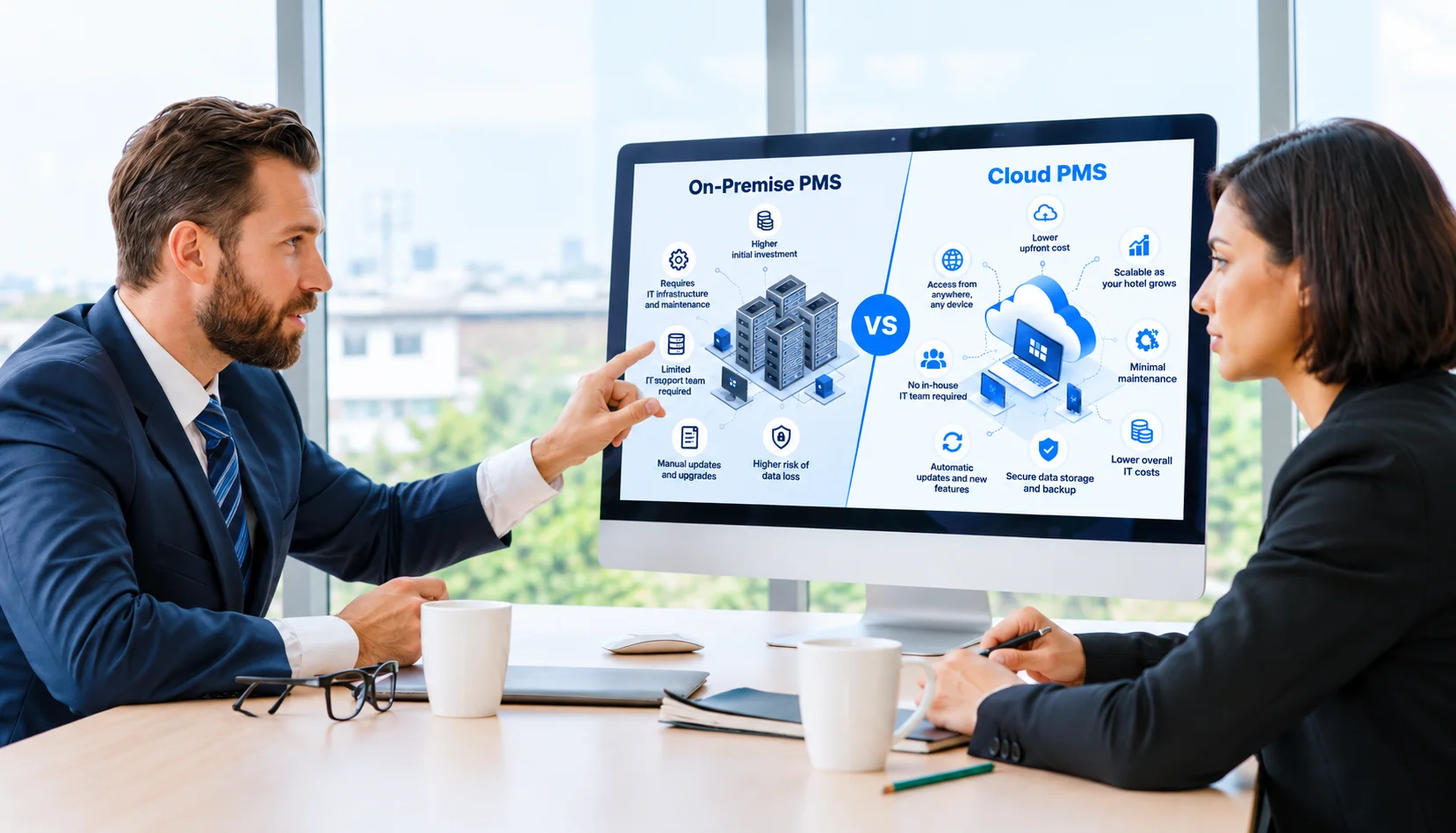
By hosting, there are three types: cloud-based (hosted online and updated automatically), on-premise (installed on your own servers) and hybrid (a mix of both). By build, an all-in-one platform covers reservations, distribution and payments from one vendor, while a modular, best-of-breed setup connects specialist tools through integrations. Most hotels today choose a cloud-based, all-in-one system because it costs less to maintain and runs from any device.
5. How to choose the best hotel management software?
Start with your room count and team size, then check that the platform has two-way PMS and channel manager sync, a direct booking engine and integrated payments. Price the total cost, including payment fees, extra users and setup, not just the entry price. Run your own scenarios in a demo, such as a group booking, a split folio and a rate change, and ask for two references from hotels your size.
6. What are the core components of hotel management software?
The core components are the property management system (PMS), reservations, front desk, channel manager, booking engine, housekeeping and maintenance, and billing and payments. Most platforms also add metasearch, revenue management, a website builder, guest management (CRM), an AI concierge, and reporting and analytics. All of these work from one shared data source, so a booking updates rates, folios and room status automatically.
7. What software do most large hotels use?
Large groups usually choose cloud-native or enterprise platforms such as Mews, Stayntouch and Oracle OPERA Cloud. Enterprise portfolios favor systems with multi-property control and standardized reporting.
8. How much does hotel management software cost?
Published figures range from under $100 to over $1,000 per month, depending on room count, billing model and modules. Some vendors charge per room, some per unit and some a flat monthly fee, and extras such as payment processing and added users cost more. Enterprise systems add implementation costs on top.
9. What is cloud-based property management software?
A PMS is hosted in the cloud, so you run the front desk, manage inventory and take payments from anywhere. It needs no on-site servers, updates automatically and syncs instantly across booking channels.
Join Thousands of Hotels Thriving with roommaster
The transition to roommaster is straightforward and efficient. Our implementation team handles data migration including reservations, guest profiles, and historical information.