Who This Guide Is For
Hospitable is built for short-term rental operators with Airbnb and Vrbo-heavy portfolios. Its guest messaging automation is genuinely excellent, and for that job it is hard to beat. This guide is for operators whose properties stopped behaving like rentals.
You have a front desk now, or you want one. Housekeeping runs on a rota rather than a turnover checklist. Guests arrive without a booking. Someone asks about ten rooms for a wedding. Your accountant wants a folio, not a payout statement.
If that is your guesthouse, inn, B&B or aparthotel, read on. If you manage scattered units and Airbnb carries your revenue, Hospitable is probably still right. Migration needs a reason beyond frustration.
Why Are Operators Actually Leaving Hospitable?
Five reasons come up repeatedly.
Channel coverage is uneven
Airbnb and Vrbo connections are strong. Booking.com and niche OTAs are weaker. Operators report sync delays and mismatches on the weaker channels. Every delay is a window where two guests can book the same night.
Automation stops at messaging
Guest messaging is the standout feature and deserves its reputation. Housekeeping, task management and payments are far less automated than a full PMS offers. So rotas live in spreadsheets, tasks live in a group chat, and payment chasing happens by hand.
Reporting stays basic
Analytics covers the essentials. It does not extend to revenue management or compliance-ready reporting.
When your accountant asks for a tax breakdown by rate plan, you build it manually.
Scaling gets difficult
Small portfolios work well. Multi-property operators outgrow it. The model assumes independent units rather than a hierarchy of properties, room types and physical rooms. Growth means repeating work instead of doing it once.
Support is thin and self-service heavy
The support footprint is smaller than larger providers offer, and onboarding leans on documentation. That suits a self-directed operator. It does not suit a Saturday when a channel is overselling.
The Two Changes Nobody Warns You About
Most migration guides list data exports. These two shifts cause more disruption than any export.
1. Your listings become room types
This is the mapping problem, and it is the whole migration. In Hospitable, every unit is a separate property. Ten rooms means ten properties. That model works when your units sit in different buildings.
A hotel PMS works the other way round. One property contains room types, and each room type contains physical rooms. You sell the type. You assign the room at check-in.
So ten Hospitable "properties" in one building become one property with three or four room types. Get this wrong and everything downstream breaks. Rates attach to the wrong inventory. Availability double-counts. Channel mapping fails.
Document the structure before you export anything. For each listing, record which physical building it sits in, which room type it belongs to, and which physical room it is.
2. You become the merchant of record
In the rental world, Airbnb collects payment and pays you out. You are rarely handling cards. In the hotel world, your PMS is the centre of every transaction. Folios, deposits, incidentals, city taxes and chargebacks all run through you. That is a genuine operational change, not a settings change.
You need a payment processor connected to your PMS. You need a card terminal at the desk if guests arrive in person. You need someone who understands a chargeback. Budget time for this. Hardware procurement and encryption setup take weeks, not days, so start early rather than the week before go-live.
Audit your existing merchant agreements before cancelling anything. Confirm whether your current hardware works with your new platform, or whether you need new terminals.
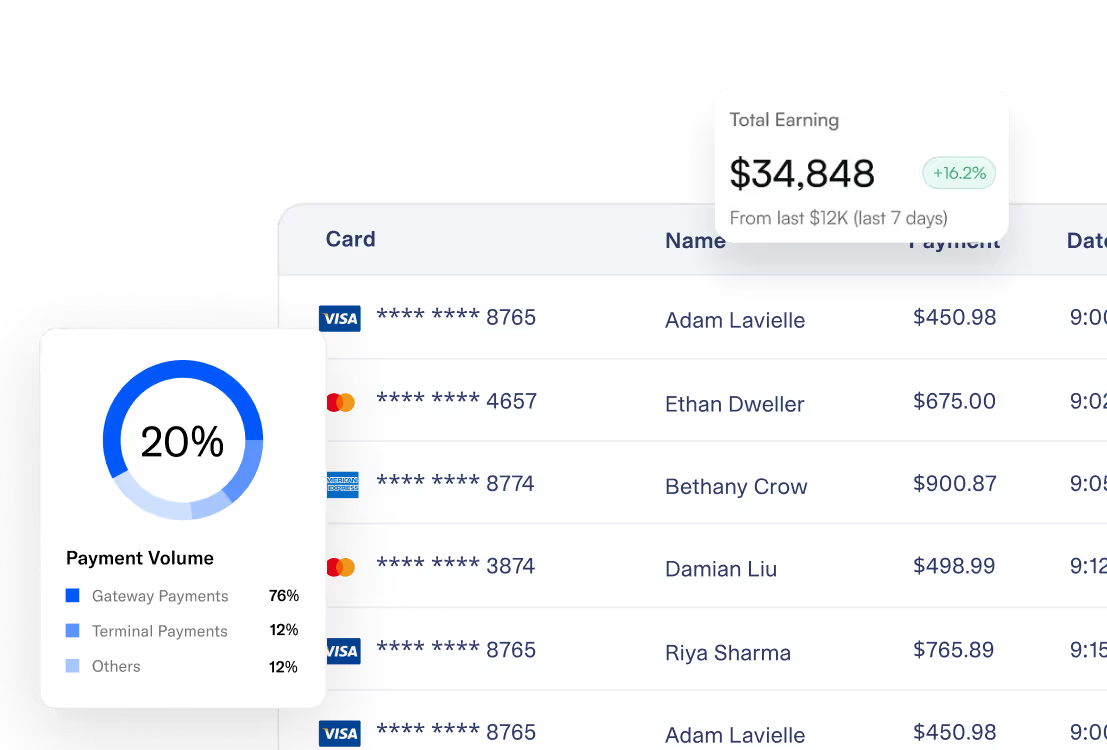
If handling payments in-house is new to you, roommaster Payments keeps card handling inside the same system as reservations and folios, with chargeback support in-house rather than outsourced.
{{payments-cta}}
What Staying Actually Costs You
Hospitable is inexpensive. The cost of staying sits elsewhere.
Count the manual hours. Housekeeping rotas built by hand. Payment chasing. Reports rebuilt in spreadsheets. Workarounds for channels that sync poorly.
Count the double bookings. One on a sold-out weekend costs a relocation, a refund, or a review that suppresses bookings for months.
Count the bookings you never took. Every enquiry that rings out while you clean a room is revenue that never existed.
Model the impact against your real occupancy and rate with the roommaster ROI and pricing calculators.
Before You Switch: The 7 Non-Negotiables
1. Audit your data before you export it
Review every reservation, guest profile, rate plan and property detail. Remove test bookings. Merge duplicate guest records. Settle anything outstanding. Ask what still earns its place. Migrate the setup you want, not the one you accumulated.
2. Map listings to room types before anything else
Do this on paper first. For every Hospitable listing, write down the building, the room type it becomes, and the physical room number. Then define your room types properly. Group by what a guest is actually choosing between. King, double, twin, suite.
Get someone who knows the property to check it. A mapping error found now costs an hour. Found after go-live it costs a weekend.
3. Export and validate the full record set
Pull everything before touching a channel connection.
- Calendars and current availability
- Reservation history and all future bookings
- Guest database with names, emails, phones and addresses
- Rates and rate structures
- Invoices and financial records for tax
Open every file. Count the rows. Compare against your dashboard. Missing fields are far easier to fix now than after cancellation.
4. Plan for card reauthorisation
Payment tokens do not move between gateways. Guests with saved cards and future bookings will re-enter details.
Four consequences follow.
- Future bookings with stored cards need new details.
- Prepaid bookings may need reauthorisation.
- Deposits already captured get reconciled by hand.
- Any recurring charge stops silently unless rebuilt.
Email affected guests two weeks ahead. Prioritise anyone arriving within a fortnight. Brief your front desk on which arrivals have no card on file, and what to say.
One habit worth building from day one. Have staff check the card against photo ID at check-in. It validates the transaction and wins chargeback disputes later.
5. Map channels carefully before you disconnect
Match room types and rate plans one to one between your new system and each OTA. Sequence decides everything. Two systems pushing to one channel will fight. No system pushing means the channel stays open and oversells.
Disconnect from Hospitable and reconnect to the new system in the same sitting, one channel at a time. Start with your lowest-volume channel.
Inside Hospitable, go to your connected channels page and disconnect there, then connect the same channel to your new platform immediately.
6. Train staff on workflows they have never used
This is a bigger training job than a normal PMS switch, because the work itself changes.
Three areas need real time. Reservations, including walk-ins and how a booking becomes an assigned room. Payments, including taking a deposit and handling incidentals. Housekeeping, including how a room moves from dirty to inspected to ready. None of that exists in a rental workflow. Do not assume it transfers.
7. Pick a low-occupancy cutover window
Switch fully during a quiet period. Avoid these entirely.
- Any period above roughly 70% occupancy
- Peak season, long weekends and public holidays
- A week with a group booking or event in-house
- Month-end, when reconciliation collides with cutover
- Any week you are short-staffed
Realistic Timeline: Sized to Your Operation
The right approach depends on what you run. Three patterns cover most operators.
Single property, one building
You mapped individual rooms as separate listings in Hospitable. Now they consolidate into one property with room types. Budget two to three weeks. One week to map and export, then a two-week dual run.
Export guest details and booking history. Enter future bookings into the new system to establish your availability baseline. Then switch off Hospitable's messaging triggers and activate your new channel manager in the same session.
The messaging triggers matter. Leave them running and guests receive instructions from two systems.
One or two larger properties
Running forty rooms or more on rental software is unusual. If you are, you are likely using it purely to automate messaging across many individual listings.
Keep the dual run short here, around two weeks. Managing a large room block across a rental app and a hotel PMS at once creates sync lag, and lag creates overselling.
Work with your new vendor's implementation team on bulk migration of future reservations and guest profiles. At this volume, manual entry is not realistic. Disconnect Hospitable's channels completely before activating your new distribution, rather than overlapping them.
Multiple locations
Two or more distinct properties need a staggered approach. Move roughly one property every two weeks. Migrating a whole portfolio at once means every problem arrives simultaneously.
Set your group-wide parameters first. Corporate account codes and anything shared across properties should exist before you import property-level inventory. Otherwise you rebuild them per site.
Start with your smallest or quietest location. It becomes the rehearsal. For the general version of this sequence, see the roommaster guide to migrating to a new property management system.
After go-live: validate before you cancel
Confirm four things. Guest data integrity, with spot-checks for truncated notes. Rate accuracy across every channel. Payment flows working end to end with a real transaction. Reporting dashboards returning numbers you recognise.
Evaluation Criteria: Pain Points and What the Switch Fixes
| Criteria | What Hospitable users report | What roommaster users report | How roommaster solves it |
|---|
| Channel coverage | Strong on Airbnb and Vrbo, weaker on Booking.com and niche OTAs, with sync delays and mismatches | "GDS/OTA integration is spot on", with two-way sync across hundreds of OTAs | Two-way sync across hundreds of OTAs plus GDS, pushing in real time from one dashboard |
| Automation | Guest messaging is robust, but housekeeping, tasks and payments need manual work | "Straightforward and logical", with training done "in a couple of shifts rather than weeks" | Housekeeping, task assignment and payment posting run inside the PMS, not in spreadsheets |
| Reporting | Basic analytics, without revenue management or compliance-ready exports | Reports described as "well detailed" and exportable to Excel and PDF | Hundreds of built-in reports with Excel and PDF exports for tax and audit |
| Scaling | Suits small portfolios, but multi-property operators outgrow it | Group and block booking handled natively, without a separate module | Strong support for multi-property groups, so adding a location does not force another migration |
| Payments | Tokens do not carry across gateways, so guests reauthorise on exit | Processing sits inside the same platform as reservations and folios | Payments and folio posting are one system, with chargeback handling in-house |
| Support | Smaller footprint, with onboarding that leans self-service | Split. Reviewers cite a "fantastic support team" that "answers the phone", while others report slower phone access | Support runs 24/7 by phone, chat and email, with implementation handled by the vendor |
Score your shortlist against these six rows. The row that made you start looking should carry the most weight.
Top 3 Hospitable Alternatives
Where you go depends on whether your properties are becoming hotels or staying rentals.
1. roommaster
Quick verdict: choose roommaster if your property now runs like a hotel, with a front desk, a housekeeping team and guests arriving in person.
Best for: guesthouses, inns, B&Bs and aparthotels that have outgrown short-term rental tooling.
roommaster pairs core property management workflows with a commission-free booking engine and a channel manager. It adds AI revenue management, an AI voice concierge that recovers revenue lost to missed calls, and a guest app. It has run hotel software for 30+ years, supported from offices in the US, Canada, UK and Australia.
Why it fits Hospitable switchers. It is built around the room type model you are moving into, so the mapping problem is solved by design rather than worked around. Housekeeping and payments run inside the system. The implementation team performs the migration, which matters when you are learning hotel operations at the same time.
Reviewers highlight ease of use and support responsiveness. See verified Capterra reviews and the G2 profile.
Trade-off: it is built for hospitality operations. If your units stay scattered rentals with no on-site team, it is more system than you need.
2. RoomRaccoon
Quick verdict: choose RoomRaccoon if you are a small European property making this exact transition and want the shortest setup.
Best for: small independents, B&Bs and boutique stays under roughly 50 rooms.
RoomRaccoon launched in the Netherlands in 2017 serving operators crossing from rentals into hospitality. It grew through acquisition, adding iHotelligence in 2023 and Lobbi in 2024.
It bundles PMS, channel manager, booking engine and payments. Upselling, dynamic pricing and contactless check-in arrive switched on rather than waiting to be configured, which suits someone learning hotel workflows for the first time.
Why it fits Hospitable switchers. The learning curve is gentle and the interface is modern. If the automation gap is your main complaint, this closes it without demanding you think like a hotelier overnight.
Trade-off: depth is tuned for smaller properties. Finance-grade reporting is limited and group handling is thin, so a growing operator may hit the ceiling twice. Reviewers report mixed support and stability, and integration breadth narrows outside core European markets.
3. Cloudbeds
Quick verdict: choose Cloudbeds if your properties are staying rentals and you mainly need better channel coverage.
Best for: operators with mixed inventory, hostels, or portfolios spread across many channels.
Cloudbeds has served properties across more than 150 countries since 2012, backed by over $275 million in funding. It has taken top Hotel Tech Report awards consistently since 2021.
It covers PMS, channel manager, booking engine and payments, with a marketplace of several hundred integrations. Mixed inventory is a real strength, handling rental units, hostel beds and hotel rooms together.
Why it fits Hospitable switchers. It fixes the Booking.com and niche OTA gaps without asking you to restructure into room types. If you are not becoming a hotel, this is the shorter move.
Trade-off: pricing scales with units and modules, so costs climb from Hospitable's level. Support draws consistent criticism for a chatbot-first model with slow escalation. Since thin support is a Hospitable complaint, test that specifically before committing.
How to Move From Hospitable to roommaster in 3 Simple Steps
Step 1: Map and plan
A roommaster implementation specialist works through your listing structure with you. Which listings belong to which building, which become room types, and which are physical rooms. You agree what transfers, what gets rebuilt, and the order channels move in. If you run several locations, you agree on the staggered sequence.
Bring your Hospitable exports and your merchant agreements. Payment setup takes the longest lead time, so it starts here.
Step 2: Build, import and dual-run
Room types, rates, taxes and operational rules get configured by the implementation team. Guest profiles and future reservations import from your validated exports. Existing bookings get blocked before any channel connects. Your payment processor connects and gets tested with a live transaction.
Hospitable keeps running. Staff train on real data, focused on reservations, payments and housekeeping.
Step 3: Cut over and verify
Hospitable's messaging triggers switch off. Your channel manager connects to one OTA at a time, lowest volume first, with a full rate and availability push after each.
You verify each channel by searching your own property as a guest. Your booking engine takes over direct bookings. A final reservation report catches anything booked during the switch.
If you are running several locations and worried this lands on one manager, roommaster offers strong support for hotel groups through the migration and after it.
{{pms-one}}
The Four Numbers That Prove Your Import Worked
Check all four before you cancel Hospitable.
1. Reservation count. Arrivals, in-house and future counts must match your final Hospitable report exactly. Not approximately. One missing reservation is a guest arriving to nothing.
2. Revenue on the books. Total future revenue must match. If counts agree but revenue does not, your rates are mapped to the wrong room types.
3. Guest profile count. Totals must match your post-cleanup figure. Spot-check ten records for truncated notes and broken contact details.
4. Outstanding balances and deposits. Deposits held and amounts owed must reconcile to the cent. This is the number your accountant will ask for.
Add a fifth unique to this migration. Count your total sellable rooms per night. If your listing-to-room-type mapping went wrong, this number will not match your physical room count. Check it before a single channel goes live.
If anything diverges, keep Hospitable open and resolve it. Cancelling is the only step you cannot undo. Properties that have run this process share their numbers in the roommaster case studies.
Bottom Line
Migrating from Hospitable is a restructuring, not a data transfer. Your listings become room types. You become the merchant of record. Both need planning before a single record moves.
Map the structure on paper first. Validate every export. Start payment setup early, because hardware takes weeks. Move channels one at a time. Verify your sellable room count before anything goes live.
If your properties are still rentals and Airbnb carries your revenue, Hospitable's messaging automation is hard to replace. Stay.
If you now run a front desk, a housekeeping rota and guests who arrive in person, the roommaster implementation team handles the mapping and the transfer rather than handing you documentation. Bring your listing structure to the first call, because that conversation shapes everything after it.
{{cta-strip}}
Frequently Asked Questions
1. How long does it take to migrate from Hospitable?
Budget two to three weeks for a single property. Multiple locations should stagger, moving roughly one property every two weeks rather than all at once.
2. How do my Hospitable listings become rooms in a hotel PMS?
Each listing maps to a room type, and each physical unit becomes a room within it. Ten listings in one building typically become one property with three or four room types.
3. Do saved guest cards transfer from Hospitable?
No. Payment tokens do not move between gateways. Guests with future bookings reauthorise. Email them two weeks ahead rather than asking at check-in.
4. What changes about payments when I leave Hospitable?
You become responsible for collecting them. Airbnb pays you out today. A hotel PMS makes you the merchant, handling deposits, incidentals and chargebacks directly.
5. How do I avoid double bookings during the switch?
Disconnect and reconnect each channel in the same sitting, one at a time. Switch off Hospitable's messaging triggers as you go, or guests hear from both systems.

.png)
.png)
.png)