Guest House Management Systems: Features, Benefits & Top Picks
"We’ve trusted roommaster for over 25 years. It keeps our entire hotel group running smoothly with everything we need in one easy-to-use system" - Jorge Venegas, General Manager, NUVO Suites
A guest house management system is a PMS built for smaller, independently operated properties such as B&Bs, inns, and boutique guest houses
Core functions include reservation management, two-way OTA sync, a direct booking engine, guest profiling, and payment processing
Without one, guest house owners lose hours daily to manual tasks and lose revenue to OTA commissions that a direct booking engine would eliminate
The right system is cloud-based, easy to learn in hours (not weeks), and connects to hundreds of OTAs without requiring manual rate updates
roommaster is the strongest all-in-one option for guest houses that need enterprise-level capability without enterprise-level pricing or complexity
A guest house management system is software that centralises reservations, front desk operations, channel distribution, payments, and guest profiles into one platform. It replaces the spreadsheets, paper registers, and disconnected tools that most small properties rely on, and lets a one or two-person team run a property without constantly firefighting.
What Is a Guest House Management System?
A guest house management system is a cloud-based software platform that handles the day-to-day operations of a guest house from a single interface. It manages reservations, room availability, OTA channel distribution, direct bookings, guest data, payments, and housekeeping in one place.
For a 10-room B&B or a 25-room inn, the practical distinction rarely matters. What matters is whether the platform handles everything your front desk needs without requiring you to juggle five separate software subscriptions and manually copy data between them.
What a Guest House Management System Actually Controls
A well-built guest house management system controls seven core areas:
Reservation calendar - manages bookings in real time across all sources
Rate and availability sync - pushes updates to every OTA simultaneously
Direct bookings - captures reservations through your own website, commission-free
Guest profiles - stores preferences, dietary needs, and stay history
Payments - processes deposits, pre-authorisations, and final billing
Housekeeping - assigns and tracks room turnover tasks
Reporting - tracks occupancy, ADR, RevPAR, and revenue performance
None of these functions are complicated on their own. The problem is that managing them across separate tools creates data gaps, overbooking risks, and hours of wasted time every week.
Core Features to Look For in Guest House Management Software
Not every platform delivers the same depth across these functions. Here is what each core feature actually needs to do to be worth paying for.
1. Reservation Management and Front Desk Tools
The reservation calendar is where most of your day happens. A good guest house PMS shows all rooms, all dates, and all booking sources on a single drag-and-drop grid. Clicking a reservation should immediately surface the guest's profile, payment status, special requests, and arrival time. Front desk staff should be able to check in a guest, assign a room, take payment, and generate a folio without switching screens.
Equally important is how the system handles modifications. A guest calls to change their dates. In a well-designed system, you drag the booking to the new dates, the channel inventory updates automatically, and a confirmation email fires without you touching anything else. In a poorly designed system, you update the dates, then remember to manually close the old dates on three OTAs, then send a manual confirmation, and hope you did not miss anything.
The difference between those two scenarios is several minutes per booking. Multiply that by forty bookings a week and it becomes a meaningful number.
2. Channel Manager With Real-Time OTA Sync
A channel manager is the component that connects your property's availability and rates to OTAs like Booking.com, Expedia, and Airbnb. The critical word here is two-way: rates and availability should sync in both directions between your PMS and every OTA, automatically, in real time.
One-way sync is not sufficient. If your system pushes availability out but does not pull bookings in automatically, you still need to manually log every OTA reservation into your PMS. That is where overbooking errors happen, typically on the busiest nights when you least want them.
roommaster connects to 100+ OTAs with genuine two-way sync, meaning a booking on Booking.com immediately closes that room on every other channel without you touching a button. That is the baseline any credible guest house management system should meet. Anything less is a manual workaround dressed up as software.
3. Commission-Free Direct Booking Engine
Every booking you receive through an OTA costs you a commission, typically between 15% and 30% of the room rate. On a $150 room for a three-night stay, that is up to $135 you hand to the OTA for a booking you could have captured directly.
A commission-free booking engine embeds directly into your guest house website and lets guests reserve rooms without any platform fees sitting between you and the payment. The booking engine should be mobile-optimised, because a large proportion of leisure travellers book on their phones. It should allow you to offer packages, add-ons, and special rates. And it should push the booking straight into your PMS without requiring manual entry.
{{booking-engine-one}}
The measure of a good booking engine is not just that it exists, but that it converts. Guest houses using roommaster's booking engine see direct booking conversions increase by 25-40% within six months. The key driver is not the technology itself but the removal of friction: a guest on your website should be able to see availability, select dates, add breakfast, enter payment details, and get a confirmation in under two minutes.
4. Guest Profile Management
A guest profile stores everything you know about a returning guest: room preferences, dietary restrictions, travel purpose, special occasions, and past stay history. For a hotel with hundreds of rooms this is useful. For a guest house with twelve rooms, it is what separates a good stay from a memorable one.
When a guest who stayed last spring calls to book again, you should already know their preference for the ground-floor room, that they are vegetarian, and that their anniversary is in September. A guest profile system that captures this data on first stay and surfaces it on every subsequent booking lets you deliver that level of service without it depending entirely on individual staff memory.
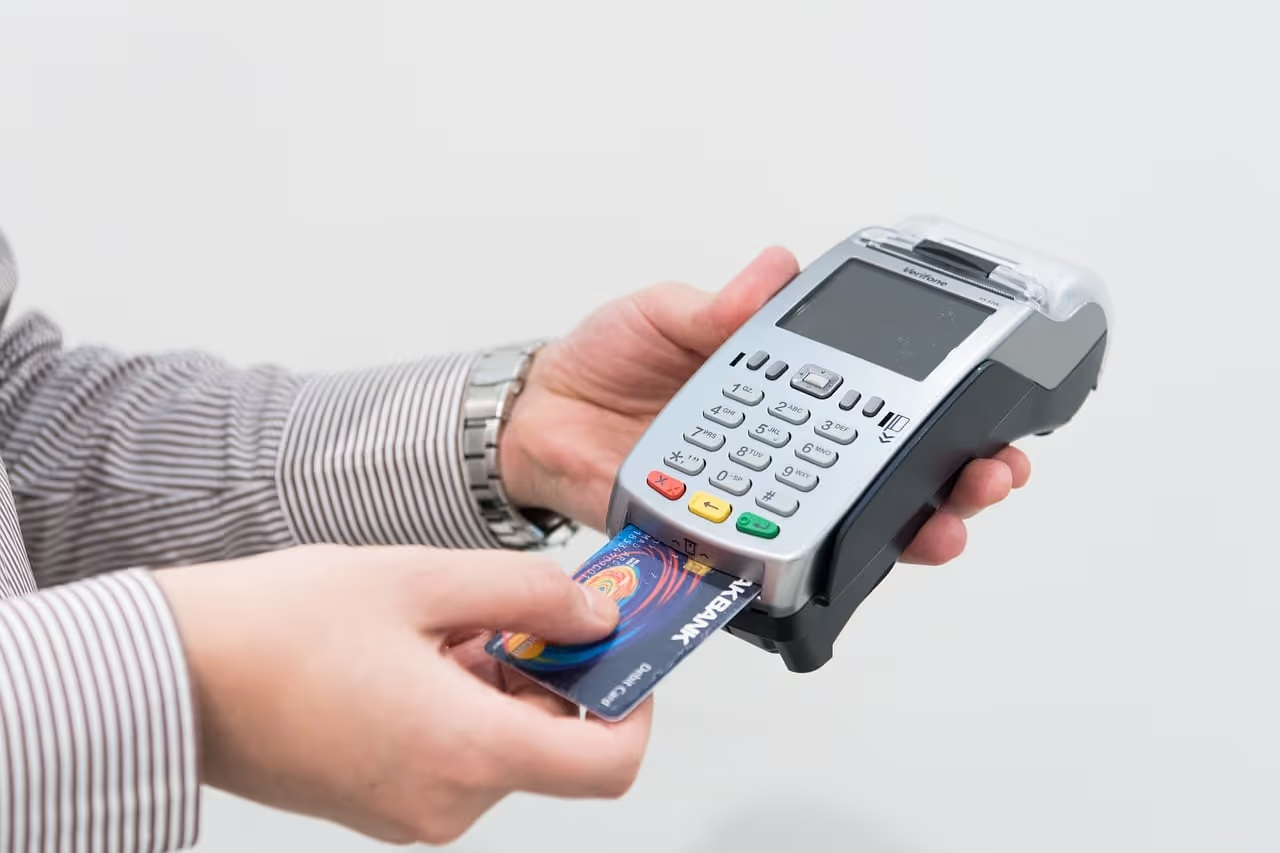
5. Integrated Payment Processing
Payments should be native to the system, not bolted on. When a booking comes in, a deposit should be collected automatically. When a guest checks out, their folio should be settled in the same interface where you checked them in. Switching between a PMS and a separate payment terminal to close a bill is slow and creates reconciliation headaches.
Integrated payment processing also removes the manual bank reconciliation work that takes most guest house owners an hour or more at the end of each week. When every transaction flows through one system, your end-of-week report is already accurate. PCI DSS compliance should be built in, not an optional add-on, because card data security is not negotiable.
6. Housekeeping and Operations Management
Housekeeping coordination is a real operational challenge in small properties. When a room changes from occupied to vacant, the housekeeper needs to know. When a guest checks out early, the room should move to the cleaning queue. When a room has a maintenance issue, it should be flagged and tracked until resolved.
A basic housekeeping module assigns rooms to staff, updates room status in real time, and prevents front desk from checking a guest into a dirty room. It sounds obvious, but properties without this feature rely on whiteboards, phone calls, and guesswork. The front desk person calls the housekeeper, the housekeeper says the room is almost done, the guest waits in the lobby, and the first impression of their stay is twenty minutes of standing around.
7. Reporting and Performance Analytics
A guest house management system should give you clear visibility into the numbers that matter: occupancy rate, ADR, RevPAR, total revenue, revenue by channel, and booking lead time. These metrics tell you when to raise rates, which channels are actually profitable after accounting for commission costs, and how your performance compares month over month.
Reporting is where many smaller systems fall short. They show you booking counts but not revenue per channel. They show total revenue but not net revenue after OTA commissions. A good reporting module shows both so you can see that your Booking.com channel drove 40% of bookings last month but only 28% of net revenue because of the commission rate.
8. AI-Powered Features
AI has moved from a selling point to a genuine operational tool in the best property management platforms. Two AI applications are directly relevant for guest houses.
The first is AI-driven pricing. Revenue management software that integrates with your PMS can monitor competitor rates, local demand signals like upcoming events, and your own booking pace, then automatically adjust your rates to optimise revenue. For a guest house owner who is also the cook, housekeeper, and host, having an AI monitor your pricing 24 hours a day is more practical than setting rates manually and hoping they are right. ampliphi, which integrates with roommaster, delivers this kind of AI-powered revenue optimisation for properties that want to run dynamic pricing without hiring a revenue manager.
The second is an AI voice concierge. roommaster Concierge is an AI voice agent that answers missed phone calls at your property, handles routine enquiries, and converts callers into confirmed bookings. Guest houses miss a lot of calls because the owner is cooking breakfast, showing a room, or simply unavailable. Every missed call is a potential booking that goes to the next result on Google instead.
The Real Cost of Running a Guest House Without a Management System
The argument for a guest house management system is not just about efficiency. It is about the specific revenue and operational damage that happens when you do not have one.
1. The Double-Booking Problem
A double booking is one of the worst things that can happen to a small property. You have two parties arriving for the same room on the same night. One of them needs to be turned away, often after travelling a distance. The online reviews that follow are harsh and public.
Double bookings happen when room inventory is not synchronised across all booking sources in real time. A property managing Booking.com, Expedia, and Airbnb through separate logins with manual updates will experience this. The window between a booking being made on one OTA and that room being manually closed on others is where the collision happens.
A two-way channel manager eliminates this entirely. The moment a booking lands on any channel, every other channel updates automatically. There is no window.
2. The OTA Commission Drain
If 70% of your bookings come through OTAs at an average 20% commission, and your annual room revenue is $200,000, you are paying $28,000 per year to distribution channels. A direct booking engine that shifts even 20 percentage points of that volume to commission-free direct bookings recovers $8,000 annually, typically enough to justify the cost of the entire platform several times over.
This is why guest house owners who have used a management system with an integrated booking engine almost never go back. The maths are too clear.
3. The Time Cost on the Owner
Manual reservation management across multiple channels typically consumes two to three hours per day in a modestly busy guest house. That is time spent on updating OTA extranets, copying booking details into spreadsheets, sending confirmation emails manually, and reconciling payment records. For an owner who is also running breakfast service and managing housekeeping staff, those hours are not available.
A management system does not just save time in aggregate. It removes the specific interruptions that disrupt the guest-facing parts of your day. When a booking confirmation sends automatically and your OTA availability updates in real time, you are not stopping mid-breakfast to log into three different websites.
How a Guest House Management System Improves Guest Experience
Operations software sounds like it benefits the operator. In practice, it is equally about the guest.
A. Pre-Arrival Communication
Automated pre-arrival emails sent two days before check-in accomplish three things. They confirm the booking, reducing no-shows. They provide practical arrival information including directions, parking, and check-in time. And they create an early opportunity to upsell breakfast, local tours, or upgraded room options.
Without automated messaging, these emails depend on the owner remembering to send them, finding time to write them, and actually doing it consistently across every booking. Automation makes the process reliable regardless of how busy the property is on any given day.
B. Personalised Service Through Guest Profiles
The detail that makes a returning guest feel valued is small and specific. Knowing their preference for a quiet room away from the road. Remembering that they asked for extra pillows last time. Recognising their name when they call without them having to spell it. These are the moments that drive repeat bookings and word-of-mouth referrals.
A guest profile system that stores this data and surfaces it automatically means that personal touch does not depend on any single staff member's memory. It belongs to the property, not to the person who checked them in last time.
C. Faster Check-In and Check-Out
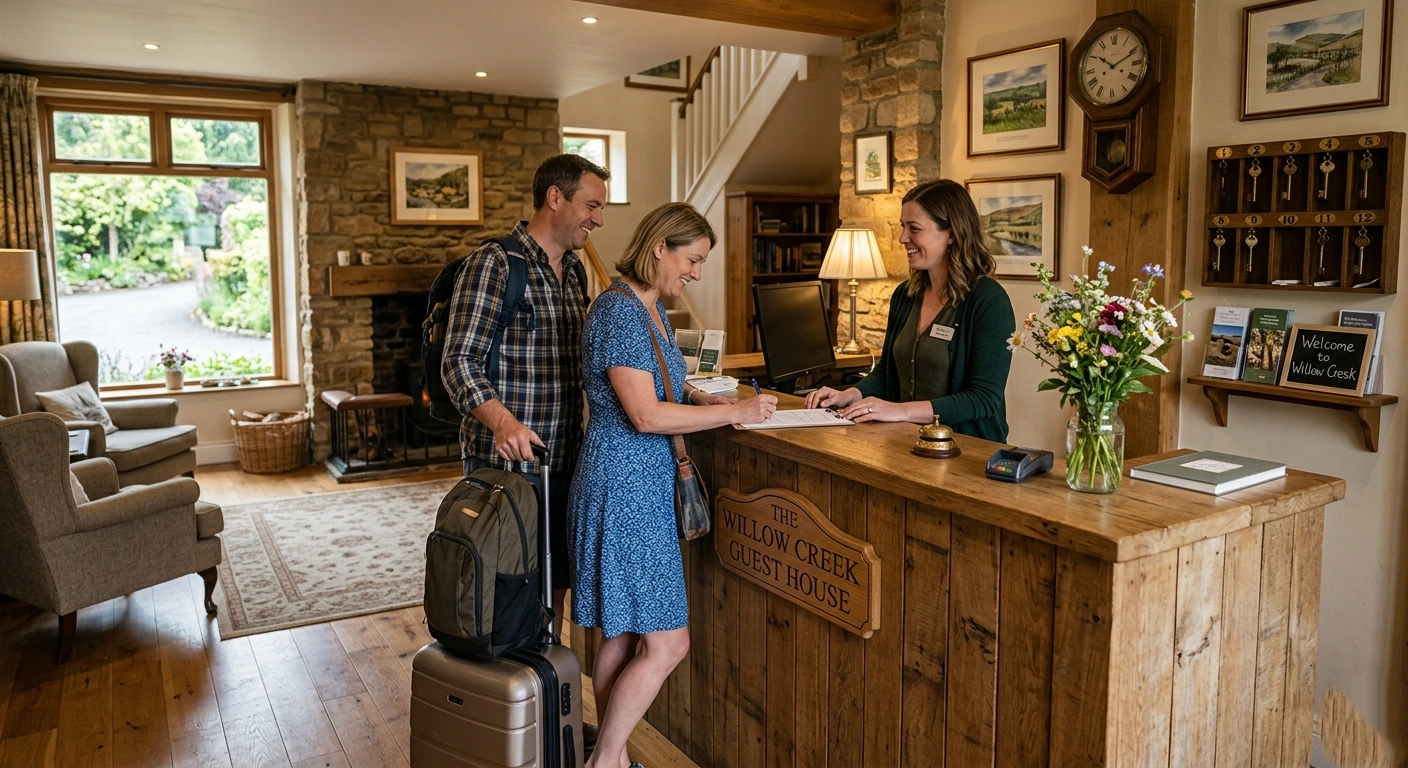
A guest arriving after a long journey wants to be in their room quickly. A front desk where the operator is searching through a paper register, manually processing a card payment, and typing an address into a separate terminal is not delivering that. A PMS where the guest's profile is already on screen, their card is pre-authorised, and the room key is ready is a two-minute process.
The same applies at check-out. An itemised folio that is already reconciled and ready to email means the guest is out the door in minutes. NUVO Suites, a property managed through roommaster, reduced check-in time by 40% after switching to the platform.
How to Choose the Right Guest House Management System
The features matter less than the fit. Here is a practical framework for evaluating options.
1. Questions to Ask Before You Buy
Start with integration coverage. Does the system connect to the OTAs you actually use, including the niche ones relevant to your market? A system that covers 50 OTAs is not the same as one that covers 300.
Ask about training time. A guest house owner with one or two staff members cannot spend weeks getting a system operational. The best platforms are functional within hours and fully set up within a week.
Ask about support. Not email support with a 48-hour response window. Live support, available 24 hours a day, from people who understand hotel operations. When something goes wrong at 10pm on a Friday before a full weekend, you need a real person.
Ask about pricing structure. Some platforms charge per room, others per booking, others as a flat monthly fee. For small properties, per-room pricing is usually the most predictable and fair.
Ask specifically about data migration. If you have existing guest records, booking history, and rate structures, the new platform should be able to import them rather than starting from scratch.
2. What to Look For in Demos
Request a live demo where you walk through a specific scenario: a new booking coming in from an OTA, a rate change across all channels, a guest profile update, and a payment reconciliation. If the demonstrator cannot show you those four things in under fifteen minutes, the system is not as intuitive as they claim.
Pay attention to the onboarding promise. "You can set it up yourself" is different from "our team sets it up with you." For a first-time PMS buyer, guided onboarding is worth more than a slightly cheaper price.
Top Guest House Management Systems in 2026
These are the platforms most relevant for guest houses, inns, and B&Bs making a software decision in 2026. Each has a different profile. The right pick depends on your property size, budget, technical comfort, and the depth of integration you need.
1. roommaster - Best All-in-One Guest House Management System
roommaster is the strongest choice for guest houses that want a single platform covering everything: PMS, channel manager, booking engine, payments, AI concierge, and guest engagement tools. It is built on 30+ years of hospitality software experience and is used by thousands of hotels worldwide across North America, the UK, and Australia.
The platform is cloud-native with 99.95% uptime, meaning your booking engine is live and your PMS is accessible from any device, anywhere. Staff learn essential functions in hours, not weeks. The B&B and guest house edition is specifically designed for smaller properties where one person often handles operations, marketing, and guest service simultaneously.
The channel manager connects to 100+ OTAs with genuine two-way sync. The commission-free booking engine typically drives a 25-40% shift toward direct bookings within six months. roommaster Concierge, the AI voice agent, answers missed phone calls and converts them into confirmed reservations, addressing one of the most common revenue leaks at small properties.
{{pms-one}}
Ryan Allison, owner of Wood River Inn, describes the practical value clearly: "I love that I'm not always on-premise, but I can be anywhere in the world with my laptop, and I can have complete visibility, and it always works."
What it does well: breadth of integration, genuine AI capability, 24/7 live support, purpose-built for independent and small properties.
Best for: Guest houses, B&Bs, and inns that want to replace multiple disconnected tools with one platform and do not want to pay enterprise pricing to do it.
2. Little Hotelier - Good for Very Small Properties
Little Hotelier is a property management platform aimed at micro-properties: guest houses with under 20 rooms, B&Bs running with a single owner, and similar ultra-small operations. The interface is simplified, setup is fast, and pricing is accessible.
The trade-off is depth. Little Hotelier covers reservations, a basic channel manager, and a booking engine, but revenue management tools, advanced reporting, and AI-powered features are limited compared to full platforms. Properties that expect to grow or need deeper analytics will likely outgrow it.
Best for: Single-owner guest houses under 15 rooms looking for a low-cost entry point.
3. Cloudbeds - Strong for Tech-First Operators
Cloudbeds is a well-funded platform with broad channel connectivity, solid revenue management tooling, and a modern interface. It serves a wider range of property sizes than Little Hotelier but is positioned more toward independent hotels in the 30-150 room range than true micro-properties.
Guest houses that have significant technical resources and want deep API access and integration flexibility will find Cloudbeds capable. Properties that want a simpler, more guided experience may find the learning curve steeper than necessary.
Best for: Tech-comfortable operators running 30+ rooms who prioritise integration flexibility.
4. WebRezPro - Solid for North American Independents
WebRezPro is a Canadian-based cloud PMS with a strong presence among independent hotels and inns in North America. It handles reservations, channel management, and reporting competently, with particular strength in group bookings.
The platform is not as feature-rich on the AI or guest engagement side as more recently built competitors. Its strength is reliability and a deep knowledge of North American property operations.
Best for: Established North American inns that prioritise operational reliability over newer AI capabilities.
5. RoomRaccoon - Good Mid-Range Option
RoomRaccoon bundles PMS, booking engine, and channel manager into a single subscription at an accessible price point. It is suitable for guest houses in the 10-50 room range that want an all-in-one solution without the complexity of enterprise platforms.
AI pricing tools are available but are less mature than platforms with longer AI development histories. The interface is clean and modern. Support responsiveness varies by region.
Best for: Mid-range guest houses that want bundled pricing and a modern UI.
Guest House Management System Comparison Table
System
Best For
OTA Connections
AI Features
Direct Booking Engine
24/7 Live Support
PMS + Channel + Booking Engine
roommaster
All-in-one for B&Bs, inns, guest houses
100+
Yes - voice concierge, AI pricing via ampliphi
Yes - commission-free
Yes
All-in-one
Little Hotelier
Micro-properties under 15 rooms
100+
Limited
Yes
Business hours
All-in-one
Cloudbeds
Tech-first operators, 30+ rooms
300+
Revenue tools
Yes
Yes
All-in-one
WebRezPro
North American independents
150+
Basic
Yes
Business hours
All-in-one
RoomRaccoon
Mid-range 10-50 rooms
100+
AI pricing
Yes
Limited
All-in-one
What to Expect From Implementation
Most cloud-based guest house management systems take three to five business days from sign-up to going live. This includes data migration (importing your existing reservations and guest profiles), system configuration (rate structures, room types, tax settings), channel setup (connecting your OTA accounts), and staff training.
The properties that struggle with implementation are those that go into it without clean data. If your current bookings live across three different spreadsheets, two email inboxes, and a paper diary, the first step is consolidating that information before migration begins.
With roommaster, the implementation team handles the migration and configuration for you. Staff training on essential front desk functions typically takes a few hours. The case studies section covers how different property types approached the transition and what the first weeks looked like operationally.
What Good Integration Coverage Actually Means
A platform claiming "200+ integrations" and one claiming "300+ integrations" are not the same. The number matters less than which specific channels are covered. Before committing to any platform, confirm that it directly integrates with every OTA you currently use and every channel you plan to add.
For guest houses in North America, the essential channels are Booking.com, Expedia, Airbnb, VRBO, and Google Hotel Ads. In the UK and Australia, add regional aggregators to that list. For properties targeting corporate travellers, GDS connectivity through Amadeus, Sabre, or Travelport matters too.
roommaster connects to 100+ OTAs, GDS systems, and metasearch channels. The full integrations marketplace covers exactly which connections are available before you commit.
Frequently Asked Questions
What is the difference between a guest house management system and a hotel PMS?
Functionally, they are the same software category. A PMS handles reservations, front desk operations, billing, and reporting. The term "guest house management system" describes a PMS configured and priced for smaller, independently operated properties like B&Bs and inns. The core technology is identical. What differs is the pricing structure, the onboarding model, and whether the platform genuinely supports small-property workflows rather than scaling down an enterprise system.
How much does a guest house management system cost?
Pricing varies significantly by platform and property size. Most cloud-based systems for guest houses are subscription-based, ranging from roughly $100 to $400 per month depending on room count, included modules, and the level of support. Platforms like roommaster price based on property requirements rather than a fixed per-room rate, which tends to be more appropriate for smaller operations. The relevant comparison is not the software cost alone but the software cost minus the OTA commission savings a direct booking engine generates.
Can a guest house management system prevent overbookings?
Yes, and this is one of its most direct operational benefits. A two-way channel manager that syncs availability in real time across all connected OTAs closes a room the moment a booking is confirmed on any platform. The only way overbookings happen with a connected system is if you manually override availability or add a booking without the system registering it.
How long does it take to learn a new guest house management system?
With a well-designed platform, front desk staff should be handling essential operations within two to four hours of training. The full feature set, including reporting, rate management, and housekeeping tools, typically takes a few days of regular use to feel comfortable. Platforms that require weeks of training are either poorly designed or built for enterprise properties with dedicated IT staff. roommaster specifically benchmarks staff proficiency time because it is a known pain point with legacy systems.
Do I need a channel manager if I only list on two or three OTAs?
Yes. The risk of overbooking exists regardless of how many channels you use. Manual channel management also takes more time than a guest house owner typically accounts for. When you add the OTA extranets you need to log into, the rate updates you need to push across platforms, and the booking confirmations you need to record in your reservation system, the cumulative time adds up to hours per week for a modestly active property. A channel manager with two-way sync eliminates that work entirely.
{{cta-strip}}
The Bottom Line
A guest house management system is not optional infrastructure anymore. It is the difference between a property that runs and a property that runs well. Manual reservation management creates overbooking risk, inflates OTA commission costs, and consumes time the owner should be spending on guests. The right system eliminates those problems and replaces them with a single, visible, accurate picture of everything happening at your property.
For guest houses evaluating options, the core criteria are straightforward: genuine two-way OTA sync across 100+ channels, a mobile-optimised direct booking engine, integrated payments, guest profile management, and real support from people who know hospitality. The platform should be learnable in hours, set up within a week, and accessible from any device.
roommaster meets all of those criteria. It is built specifically for independent and small properties, backed by 30+ years in hospitality, priced competitively for properties that do not need an enterprise system, and supported by a 24/7 live team. If you are managing a guest house where every booking counts and every hour matters, it is the place to start.
If you are running a guest house on manual processes and losing bookings to missed calls or OTA commissions, roommaster replaces all of that with one platform. Most properties are live within five business days, and the B&B and guest house solution is built for exactly the scale and workflow you are operating at.
booking-engine-one
Capture more direct bookings with a fast, reliable booking engine.
Mayela Lozano is a content strategist with a passion for hospitality and technology. She collaborates with roommaster on content creation, highlighting how technology can streamline hotel operations and enhance guest satisfaction. When she’s not creating content, Mayela loves to travel and spend time with her two little ones, discovering new adventures and making memories along the way.
Join Thousands of Hotels Thriving with roommaster
The transition to roommaster is straightforward and efficient. Our implementation team handles data migration including reservations, guest profiles, and historical information.
The transition to roommaster is straightforward and efficient. Our implementation team handles data migration including reservations, guest profiles, and historical information.
Best Practices For Hotels To Avoid Chargebacks Disputes
September 21, 2026
General
Hotel Management
Preventing Credit Card Fraud In Hotel Operations
September 21, 2026
Hotel Management
Hotel Guest WiFi: The Complete Guide for Hoteliers 2026
September 19, 2026
Hotel Management
How to Access a Hotel Lounge for Free: Guest Guide 2026
September 13, 2026
Hotel Management
Online Bookings
Hotel SEO Agency vs. Consultant vs. In-House
September 13, 2026
Hotel Management
Online Bookings
Hotel SEO: Boost Your Visibility in AI Search Results
September 13, 2026
Hotel Management
Types of Hotel Lounges: A Complete Guest Guide 2026
September 11, 2026
Hotel Management
Hotel Lounge Access Explained: A Guest's Guide 2026
September 11, 2026
Hotel Management
Hotel Lounge: Hoteliers Guide 2026
September 11, 2026
Hotel PMS
Hotel Management
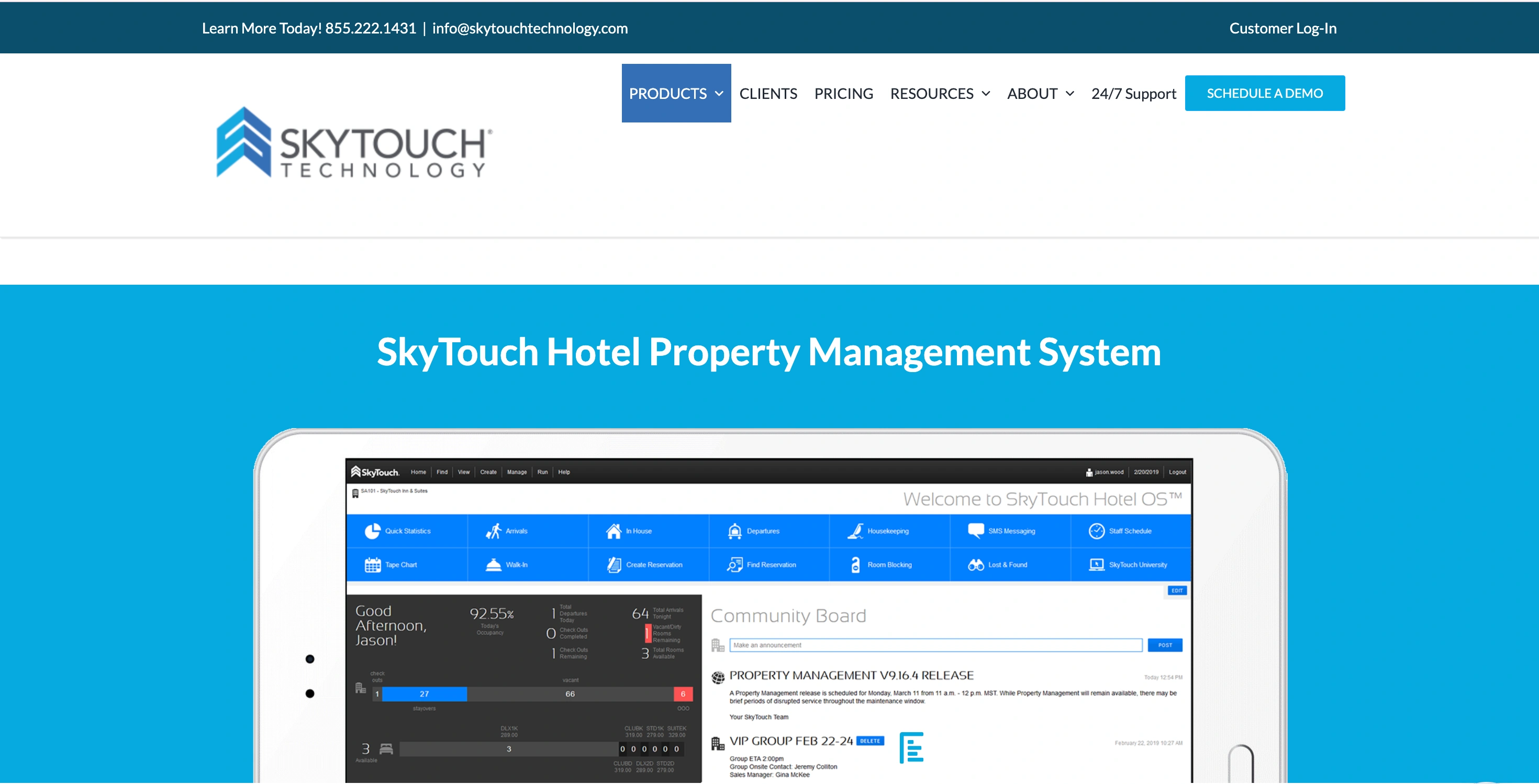
SkyTouch Alternatives, and What Changes When You Switch
September 1, 2026
Join Thousands of Hotels Thriving with roommaster
See how roommaster's unified platform can work for your property. Our team will walk you through features tailored to your specific needs and operations.



.png)
.png)
.png)