10 Best Hotel Property Management Software in the United States - 2026
“From the start of the booking process to arrival and departure to post-visit, the process is all automated, the staff appreciates its functionality and ease of use.” - Alex Moore, President & CEO, Seaboard Hotels
The Market: The US hotel property management software market is crowded, but only a handful of platforms genuinely serve the full range of property types, from boutique B&Bs to multi-property resort groups. We reviewed 10 to help you cut through.
How They Work: A modern hotel PMS centralizes reservations, front desk, housekeeping, payments, and OTA distribution into one platform, replacing manual processes and giving your team a single source of truth for every operation.
The Industry Shift: On-premise systems are being phased out. Cloud-based hotel property management software now dominates the US market because it delivers real-time control from any device, automatic updates, and no IT overhead.
Key Features to Evaluate: Two-way channel management, a commission-free booking engine, dynamic revenue management, automated housekeeping, guest communication tools, and reporting depth that goes beyond basic occupancy dashboards.
Right Fit Matters: No single platform is right for every US hotel. The best choice depends on your property size, team structure, budget, and whether you need a starter system or a full operational platform that scales.
Top Pick for 2026: roommasterleads this list for US hotels, groups, and resorts. With 30+ years of hospitality experience, 97% client retention, 50% faster check-ins, 40% fewer admin tasks, and up to 35% RevPAR growth, it delivers results that go beyond software.
Comparing the top property management software in 2026: roommaster, Cloudbeds, Mews, Oracle OPERA Cloud, Little Hotelier, WebRezPro, RMS Cloud, RoomRaccoon, ThinkReservations, and Hotelogix.
Top 10 Property Management Software in the United States 2026
A quick overview before the detailed breakdown.
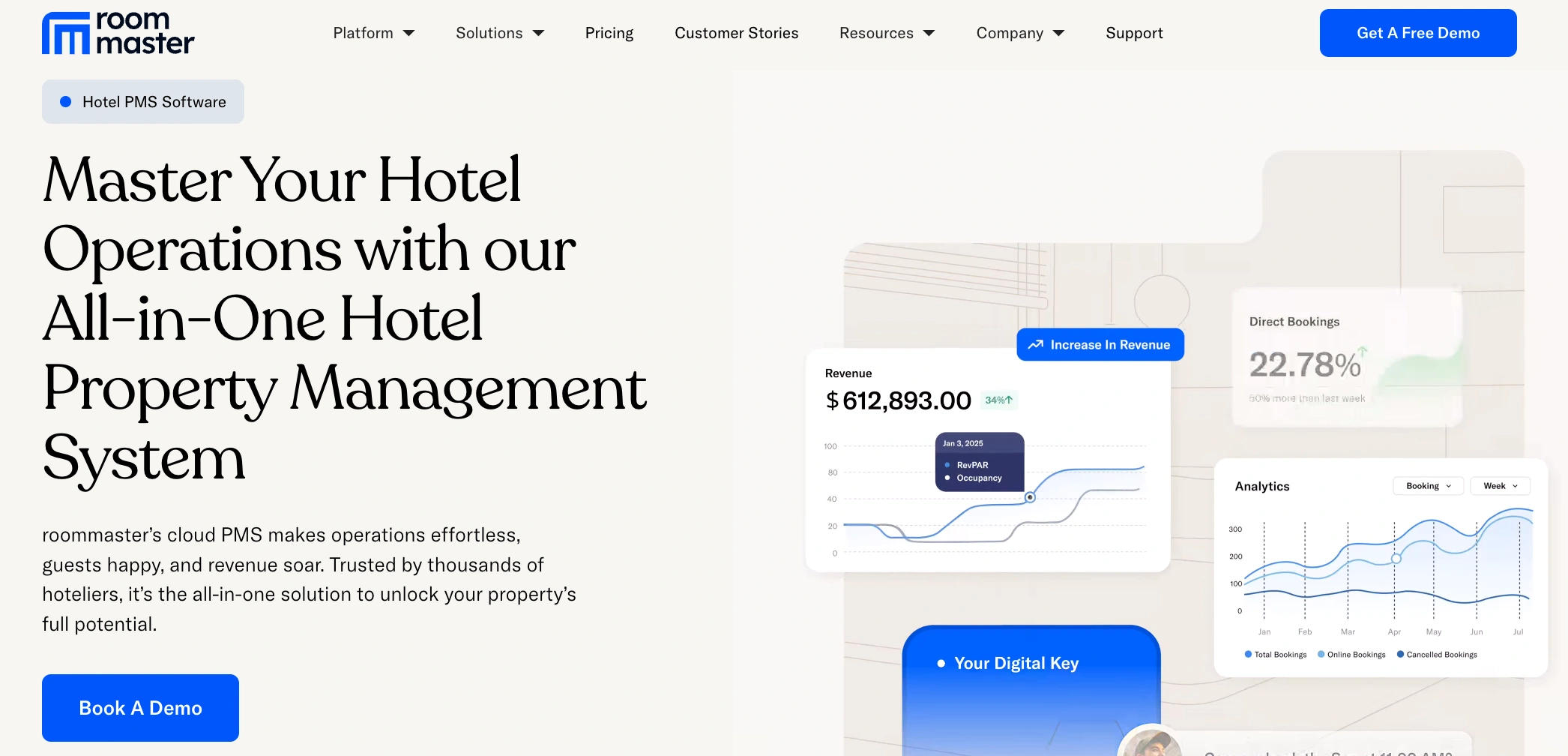
1. roommaster - The all-in-one hotel PMS built for US hotels, with 30+ years of hospitality expertise and a complete platform covering front desk management, booking engine, channel manager, payments, and AI-powered revenue management.
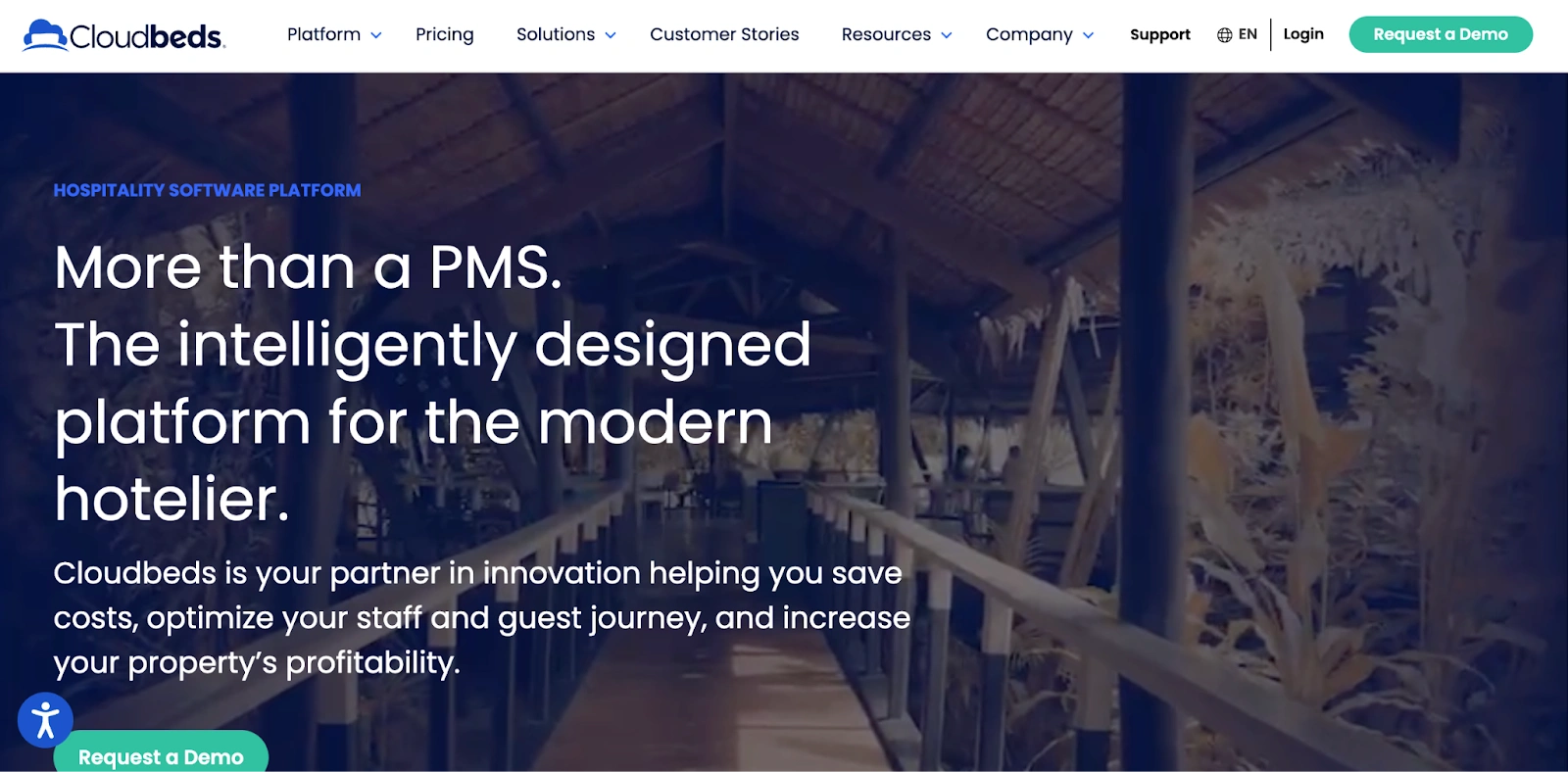
2. Cloudbeds - A cloud-based hospitality platform popular with US independent hotels and hostels, known for its broad OTA connectivity and unified guest inbox.
3. Mews - A modern, automation-first PMS built for hotels looking to reduce front desk friction and deliver digital-first guest experiences.
4. Oracle OPERA Cloud - Enterprise-grade PMS used by large US hotel chains and full-service properties requiring deep configuration and global distribution capability.
5. Little Hotelier - A simplified hotel management platform built for small US properties including B&Bs, inns, and boutique hotels that need an accessible system without enterprise complexity.
6. WebRezPro - A flexible cloud PMS serving a broad range of US property types, from campgrounds and vacation rentals to boutique hotels, with solid multi-property support.
7. RMS Cloud - A data-rich PMS popular with US resorts and multi-property operators, offering deep reporting and revenue tools for complex operations.
8. RoomRaccoon - A revenue-focused PMS for independent hotels combining front desk management with an integrated booking engine, channel manager, and upselling tools.
9. ThinkReservations - A US-built PMS for boutique hotels and B&Bs, focused on direct booking conversion and reservation management simplicity.
10. Hotelogix - A budget-friendly cloud PMS suited for small to mid-size US hotels that need core operations covered without a high entry price.
10 Best Hotel Property Management Software: At a Glance
Below, we compare the 10 best hotel property management software options in the United States side by side, highlighting key features, pros, cons, and pricing to help you decide which platform best fits your property.
Software
Key Features
Best For
roommaster
Full PMS, Booking Engine, Channel Manager, Payments, AI-powered Revenue Management, Concierge AI
Independent US hotels, boutique properties, B&Bs, motels, resorts, and hotel groups from 20 rooms upward.
Hotel property management software (PMS) is a centralized platform that manages the core operations of a hotel: reservations, front desk check-in and check-out, housekeeping, guest billing, reporting, and communications.
For US hotels, a modern cloud-based PMS also connects to online travel agencies (OTAs) like Expedia, Booking.com, and Hotels.com through a two-way channel manager, powers commission-free direct bookings through an integrated booking engine, and gives operators a real-time view of revenue and occupancy from any device.
The right property management software replaces disconnected manual processes, eliminates overbooking risk across channels, and gives hotel staff more time to focus on the guest experience rather than administrative tasks. For independent US hotels specifically, it is the operational foundation that determines whether a property runs efficiently or reactively.
Choosing the right hotel property management software takes more than a side-by-side table. These guides take a broader look at the top platforms across the hospitality industry, with more context on features, use cases, and what actually matters at the property level.
How Do We Evaluate Property Management Software Platforms? (Particularly for the US Hotels)
Evaluating a hotel PMS for the US market is not the same as evaluating one for Europe or Asia-Pacific. The US hospitality market has specific dynamics that shape which platforms actually deliver value at the property level.
1. OTA distribution requirements
US hotels rely heavily on Expedia, Hotels.com, Booking.com, and Airbnb. A PMS must integrate with all of them through a two-way channel manager that updates rates and availability the moment a booking lands, with no manual lag.
2. Direct booking capability
With OTA commissions averaging 15 to 25 percent, US hotel owners are increasingly focused on driving guests to book directly. We evaluate how well each platform's booking engine converts website visitors, supports promotional offers, and keeps guests within the hotel's own brand experience.
3. US-based support coverage
When a system issue hits during a sold-out weekend, US hotels need support from people available in their time zone and familiar with hotel operations. We assess whether each platform offers genuine 24/7 hospitality-trained support, not just a ticketing queue that resolves overnight.
4. Reporting and financial depth
US hotels need clean, exportable financial data for tax season, ownership reporting, and revenue analysis. Platforms with shallow dashboards create manual workarounds that cost staff hours every month.
5. Scalability
We consider whether a platform serves a 20-room B&B as well as a 200-room resort, and whether hotel groups can manage multiple properties from a single system without requiring a different solution as they grow.
6. Integration breadth
US hotels operate a wide range of third-party tools including POS systems, door lock controllers, accounting software, and CRM platforms. We assess how wide and reliable each platform's integration library is.
7. Pricing transparency
We note where public pricing is available and where a sales conversation is required, since US buyers typically want to self-qualify before requesting a demo.
Top 10 Property Management Software Companies in the United States
1. roommaster - Best All-in-One Hotel Property Management Software in the US Hotels
roommaster is a cloud-based hotel property management system built for hospitality operations of every kind. Founded in 1994 in the United States, it has served hotels, motels, resorts, B&Bs, boutique properties, and multi-property hotel groups for over 30 years. The platform is built around the US market, which means the product design, the support team, and the customer base reflect the way American hotels actually operate, from a 15-room inn to a 400-room resort group.
The platform covers the full hotel operation in one place. The PMS handles reservations, front desk management, housekeeping, billing, and reporting. The roommaster Booking Engine drives commission-free direct bookings from the hotel's own website. The roommaster Channel Manager connects to hundreds of OTAs with real-time two-way sync. Payments are processed through an integrated, PCI DSS-compliant payment system. Revenue management is handled through roommaster's built-in AI pricing tools that monitor competitor rates and demand signals to keep your rates competitive around the clock. And roommaster Concierge is an AI voice agent that answers guest calls 24/7, captures bookings, and feeds them directly into the PMS.
What separates roommaster from many platforms in this space is the combination of operational depth and long-term support. The finance and reporting tools go beyond dashboards. The support team is staffed by hospitality professionals. And a 97% client retention rate reflects something that product demos do not reveal: a company that treats customers as partners, not recurring contracts.
Key Features
Reservation and front desk management with check-in times up to 50% faster
Two-way channel manager connecting to hundreds of OTAs including Expedia, Booking.com, Airbnb, and Hotels.com
AI-powered revenue management with up to 35% RevPAR improvement
roommaster Concierge: AI voice agent for 24/7 call answering and booking conversion
Automated housekeeping task assignment and room status tracking
Multi-property management from a single login
100+ integrations covering POS, door locks, accounting, and CRM tools
99.95% uptime guaranteed
Pros
30+ years of US hospitality experience shapes every product decision
All-in-one platform means no need to stitch together separate tools from different vendors
97% client retention rate, one of the highest in hotel technology
24/7 support staffed by people who understand hotel operations, not general tech agents
Finance reporting depth that holds up under serious revenue analysis
Scales from a single boutique property to a multi-property hotel group
Cons
Pricing is not publicly listed; a demo is required to get a quote
The full value of the platform is realized when using multiple modules together
Best For
Independent US hotels, boutique properties, B&Bs, motels, resorts, and hotel groups from 20 rooms upward.
Pricing
Custom pricing based on property size and modules selected.
Real Customer Reviews From US Hotels Using roommaster Hotel PMS
"After switching to roommaster, we finally feel in control. One team, one system, and everything we need to run the hotel with confidence every day." - Ryan Allison, Owner/President, Wood River Inn
"The customer service is fantastic. Talking to the same people year after year is wonderful. I feel like we have built tremendous relationships with the people at roommaster." - Alex Moore, President and CEO, Seaboard Hotels
{{pms-one}}
2. Cloudbeds
Cloudbeds is a US-based hospitality management platform that bundles PMS, channel manager, booking engine, and a guest communications inbox into a single interface. It is well regarded for its onboarding experience and broad OTA connectivity, and has a strong presence among US independent hotels and hostels.
Pros
Quick setup and intuitive interface for properties new to cloud PMS
Strong OTA distribution reach across global channels
Unified inbox for managing guest communications across channels
Cons
Finance and reporting tools are less deep than platforms built for serious revenue analysis
Group and event billing workflows are limited for complex US operations
Customer support response times can be inconsistent depending on the plan
Best For
Small to mid-size US independent hotels looking for a straightforward all-in-one platform.
Pricing
Starts around $200/month; varies by property size.
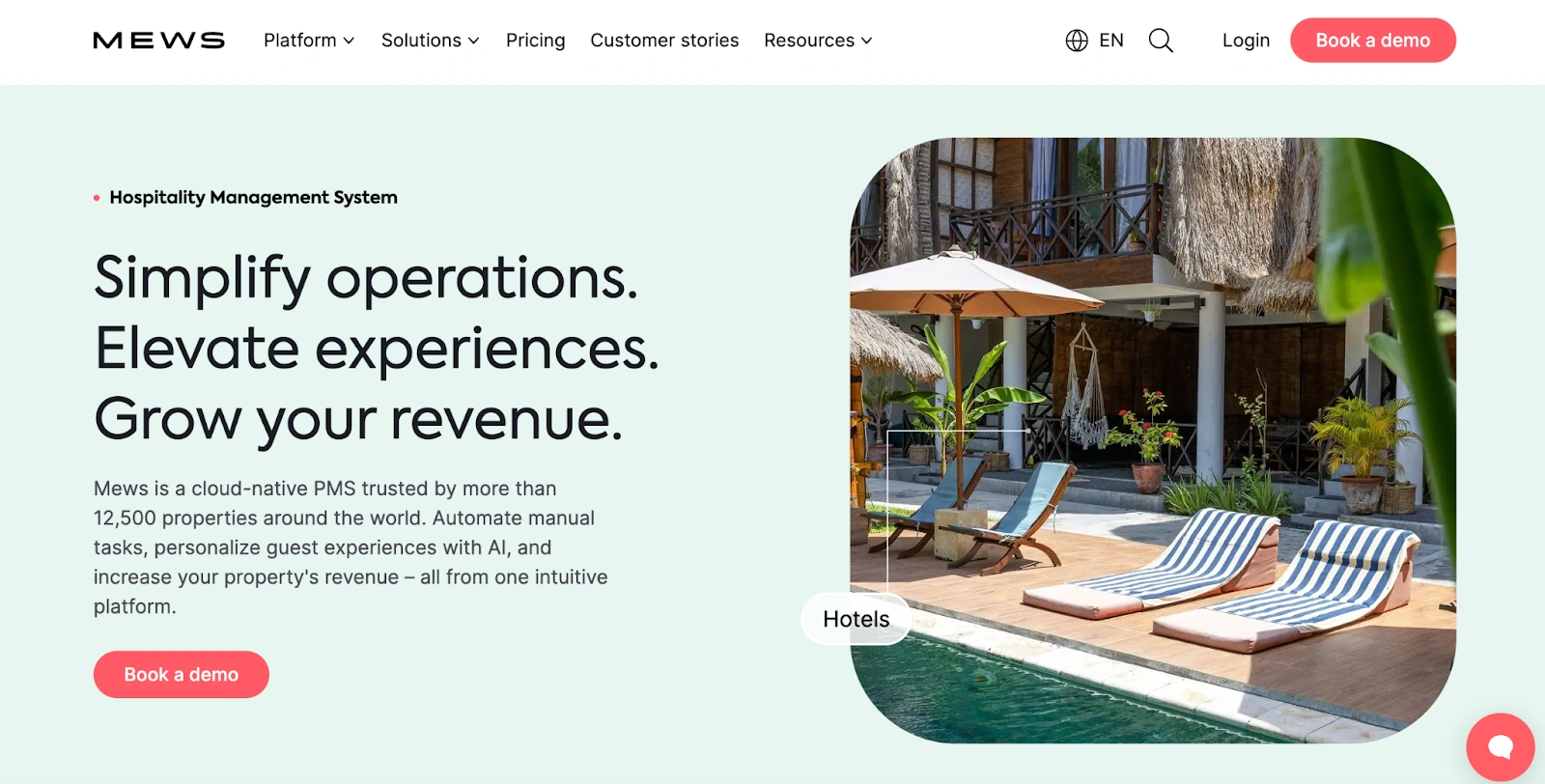
3. Mews
Mews is a modern PMS headquartered in Europe with a growing US customer base. It is built around open APIs and automation-first workflows, which appeals to tech-forward hotels that want deep customization and a digital-first guest journey.
Pros
Clean, modern interface that staff pick up quickly
Strong digital check-in and guest journey automation
Wide integration marketplace through open API
Cons
Multi-folio and group billing management is weaker than established US-focused platforms
US market support coverage is more limited compared to domestic providers
Finance-grade exports and complex accounting workflows are not a strength
Best For
Modern boutique hotels and lifestyle properties prioritizing digital guest experiences.
Pricing
Starts at approximately $10.50 per room per month.
4. Oracle OPERA Cloud
Oracle OPERA Cloud is the enterprise standard PMS for large hotel chains, full-service hotels, and luxury properties. It connects to global distribution systems (GDS) used by corporate travel agents worldwide and offers deep configuration for complex operations.
Pros
Industry standard for large-scale US hotel chain operations
Deep GDS connectivity for corporate and group travel markets
Extensive configuration options for full-service properties
Cons
High implementation cost and long onboarding timeline
Requires dedicated IT resources or vendor-managed setup
Too complex and expensive for independent properties under 100 rooms
Best For
Large US hotels, branded chains, and full-service properties with significant IT resources.
Pricing
Custom enterprise pricing; typically requires a significant annual commitment.
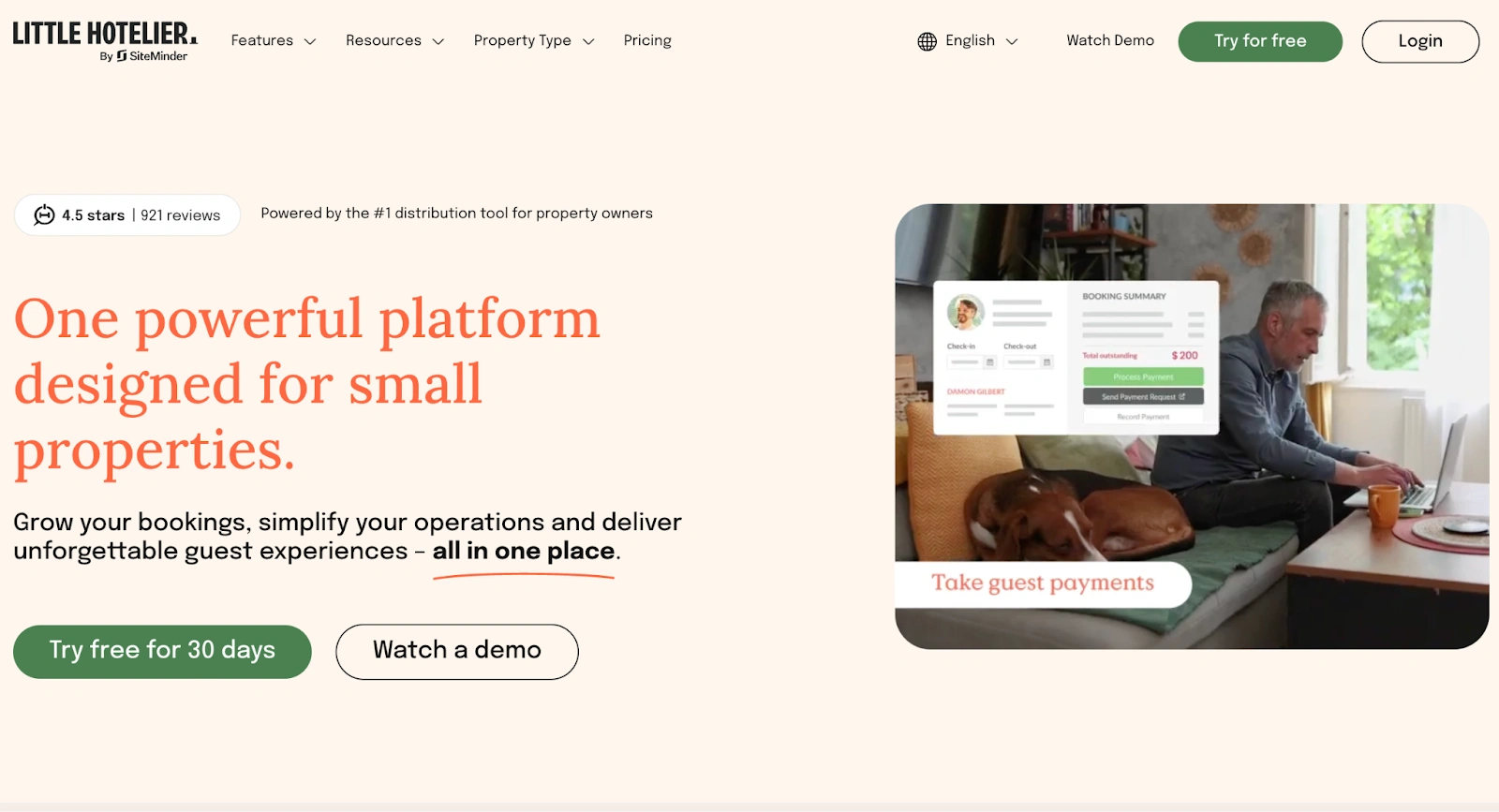
5. Little Hotelier
Little Hotelier is a simplified hotel management platform designed specifically for small US properties including B&Bs, inns, and guesthouses. It packages a front desk, a direct booking engine, and a basic channel manager into a clean, easy-to-navigate interface.
Pros
Very easy to set up without dedicated tech staff
Affordable entry price for small properties
Good for owner-operators managing solo
Cons
Limited reporting depth for properties that want to go beyond basic occupancy tracking
Does not scale well for properties growing beyond 25 to 30 rooms
Fewer integrations than mid-market platforms
Best For
Small US B&Bs, guesthouses, and inns with under 30 rooms.
Pricing
Starts around $109/month.
6. WebRezPro
WebRezPro is a Canadian cloud PMS with a strong US customer base across a wide range of property types including boutique hotels, campgrounds, and vacation rentals. It offers solid feature breadth at a competitive price point.
Pros
Good value for mid-size properties on a tight PMS budget
Flexible property type support across hotel, lodge, and campground formats
Reliable channel management and reservations management
Cons
Interface is functional but dated compared to newer platforms
Revenue automation and AI-driven pricing tools are limited
Support is based in Canada, which can affect response times for US East Coast operations
Best For
Small to mid-size US hotels and mixed-use properties needing solid core PMS functionality.
Pricing
Approximately $7 per room per month.
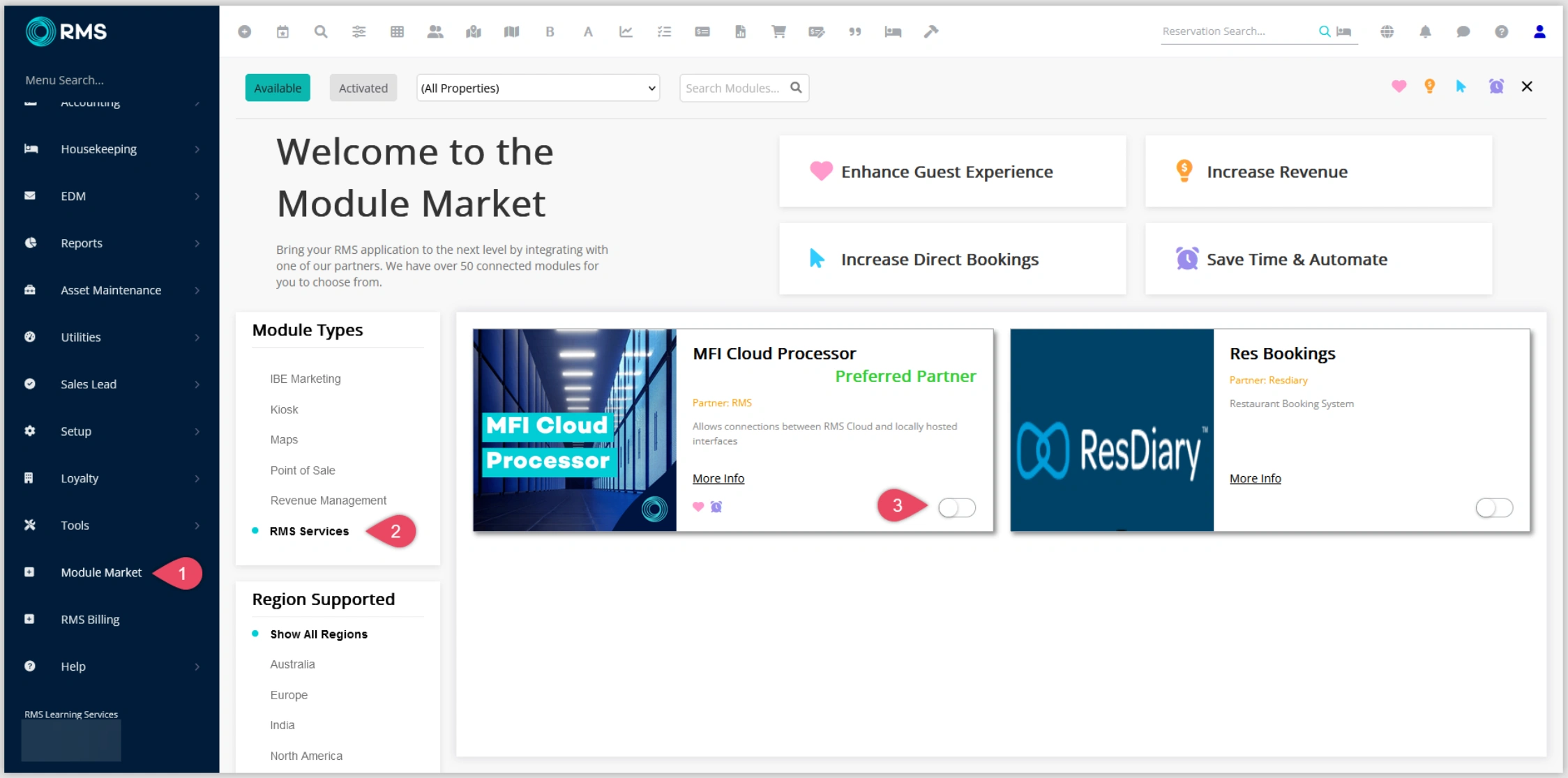
7. RMS Cloud
RMS Cloud is an Australian hotel and resort management platform with significant US adoption, particularly among resort properties and multi-property operators. It is known for deep data capabilities and strong analytics.
Pros
Strong reporting and analytics depth for resort-style properties
Good multi-property management tools for operators running several locations
Popular with US resort and holiday park operations
Cons
US-based support coverage and time zone availability is inconsistent
Implementation and configuration is complex for smaller teams
Steeper learning curve than most US-focused platforms
Best For
US resorts, holiday parks, and multi-property groups prioritizing data depth.
Pricing
Custom pricing based on property type and modules required.
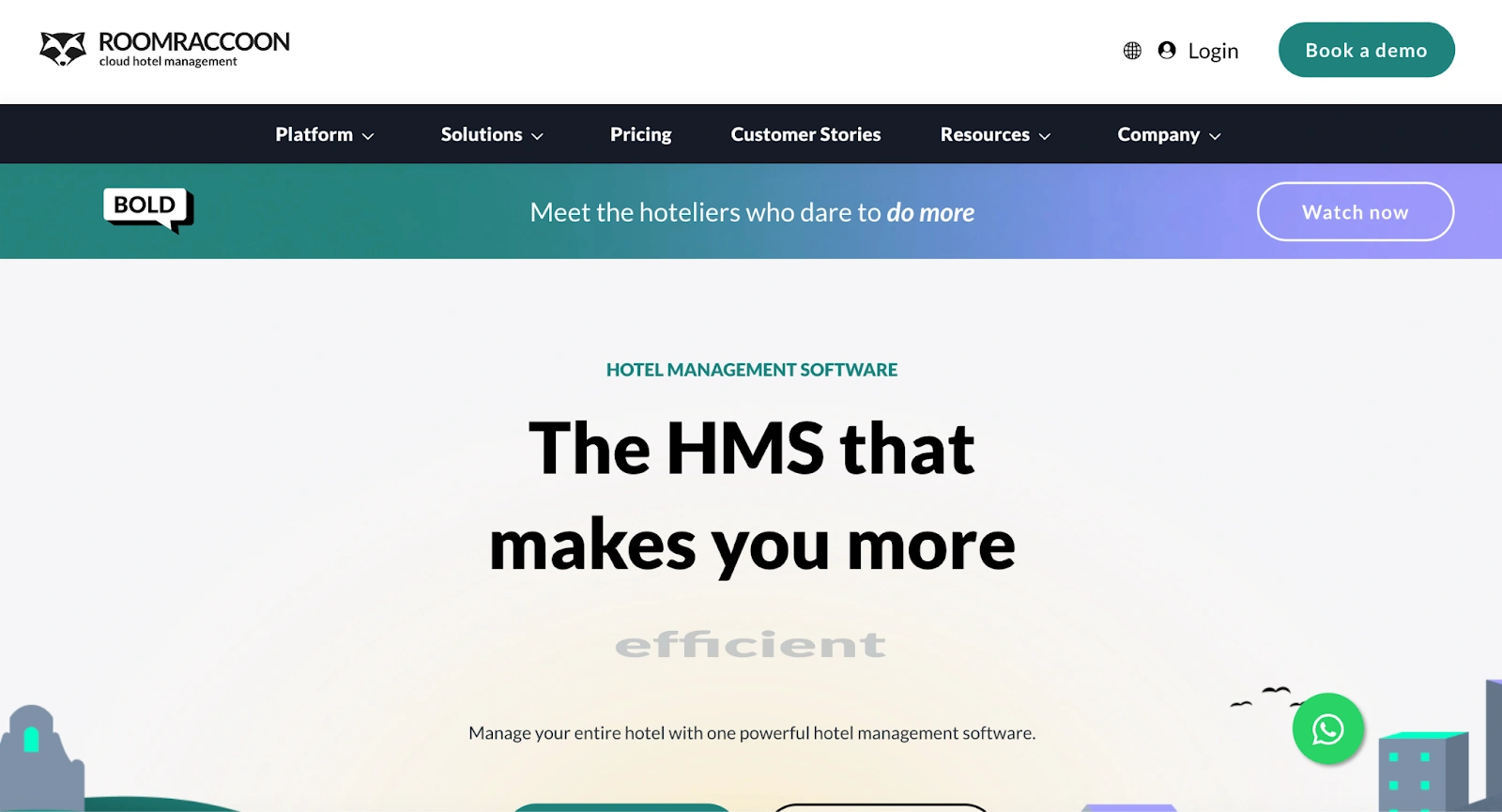
8. RoomRaccoon
RoomRaccoon is a Dutch PMS built for independent hotels, combining front desk management with an integrated booking engine, channel manager, and upselling tools. It has gained traction with boutique properties across Western markets.
Pros
Clean, modern interface
Strong upselling and ancillary revenue features built into the core platform
Relatively quick to get up and running
Cons
Priced in EUR, which adds currency conversion complexity for US properties
US customer support hours and time zone coverage are limited
Finance reporting is less robust than US-focused platforms
Best For
Small to mid-size independent hotels comfortable with a European-headquartered platform.
Pricing
Starts around €135/month.
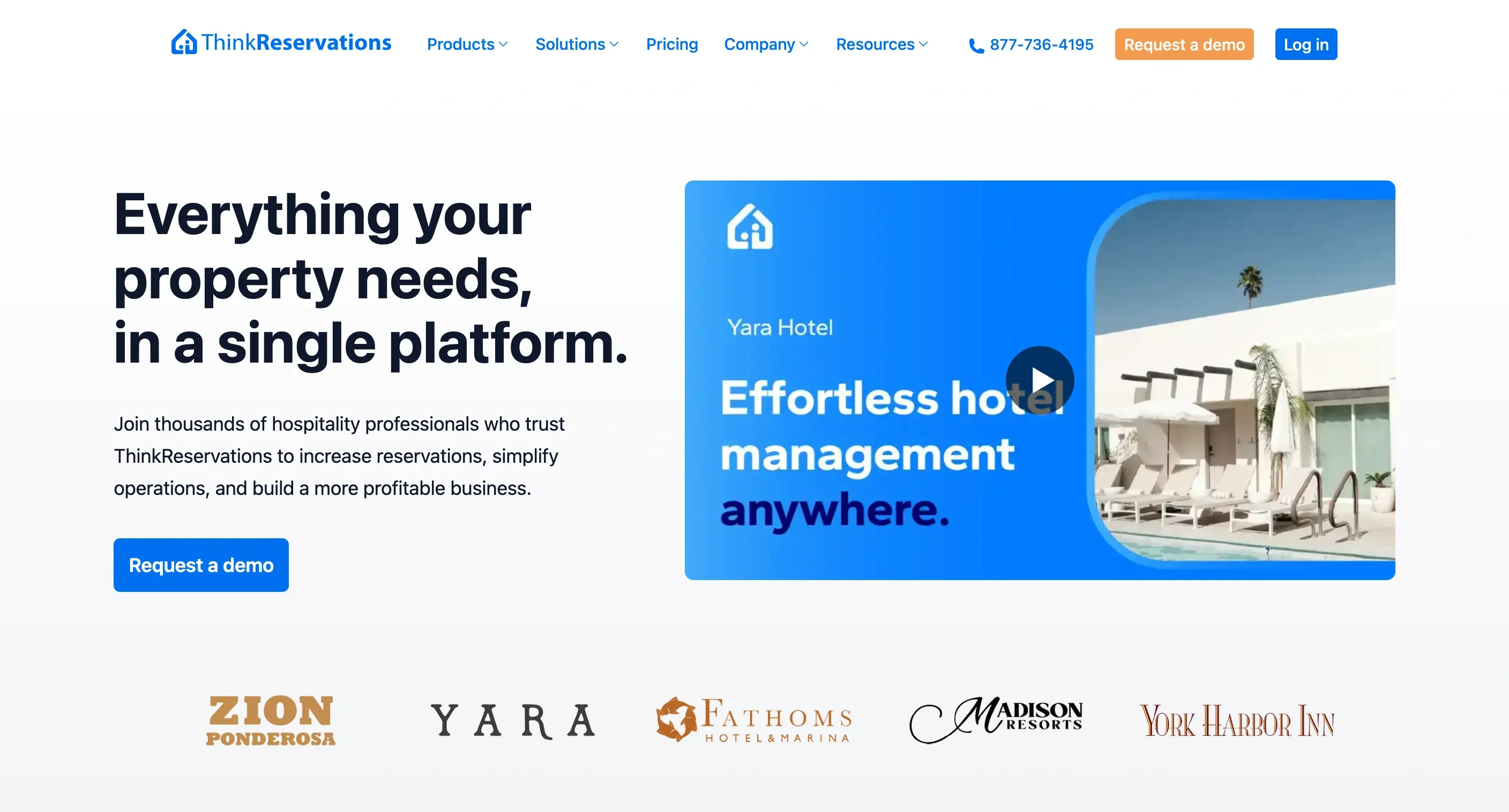
9. ThinkReservations
ThinkReservations is a US-built PMS designed specifically for boutique hotels, inns, and B&Bs. It focuses on reservation management and direct booking conversion, with an interface built for simplicity.
Pros
Built specifically for the US boutique hotel and B&B market
Strong direct booking conversion tools
Clean, intuitive interface with a short training curve
Cons
Fewer OTA integrations than broader mid-market platforms
Limited revenue management automation
Not designed to scale beyond mid-size boutique properties
Best For
US boutique hotels, B&Bs, and inns focused on direct bookings and operational simplicity.
Pricing
Starts around $100/month depending on room count.
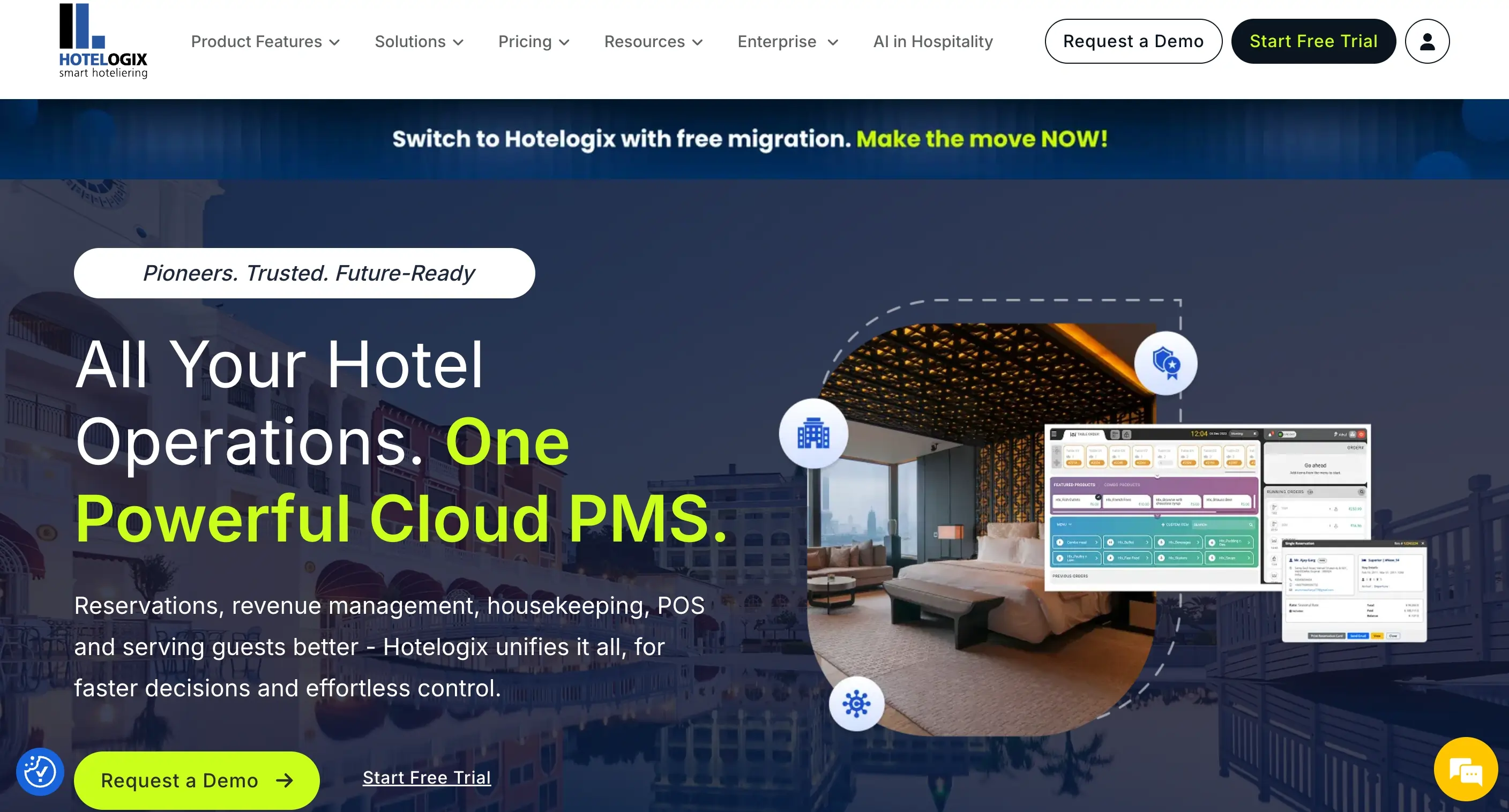
10. Hotelogix
Hotelogix is a cloud PMS built for budget-conscious small and mid-size hotels. It is popular in emerging markets but has US customers looking for core PMS functionality at a low entry price.
Pros
Very affordable price point for properties with tight technology budgets
Core PMS functions covered including reservations and front desk
OTA connectivity included at the base level
Cons
Reporting depth is limited for properties doing serious revenue management
Support time zones may not align reliably with US business hours
Feature depth is below what most mid-market US platforms offer
Best For
Small US hotels with limited budgets that need basic PMS coverage.
Pricing
Starts around $3.99 per room per month.
{{pms-five}}
10 Important Features of Hotel Property Management Software
When evaluating any hotel PMS for a US property, these are the 10 features that matter most.
1. Real-Time Reservation Management
The system must update availability across every channel the moment a booking is made, preventing overbooking and the manual reconciliation that comes with them.
2. Two-Way Channel Manager Integration
Rates and inventory must sync automatically between the PMS and OTAs like Expedia, Booking.com, Hotels.com, and Airbnb. One-way sync is not enough.
{{channel-manager-two}}
3. Commission-Free Booking Engine
A direct booking engine on the hotel's own website reduces OTA commissions and builds a direct relationship with guests. Every booking that bypasses an OTA improves margin.
4. Front Desk and Folio Management
Check-in, check-out, room assignments, billing adjustments, and split folios should all be manageable from a single screen without toggling between modules.
5. Housekeeping Management
Automated task assignment, room status tracking, and inspection checklists keep operations running without constant verbal coordination between front desk and housekeeping staff.
6. AI-Powered Revenue Management
Rate recommendations based on competitor pricing, demand forecasting, and occupancy patterns help US hotels capture peak revenue without a dedicated revenue manager on staff.
7. Reporting and Analytics
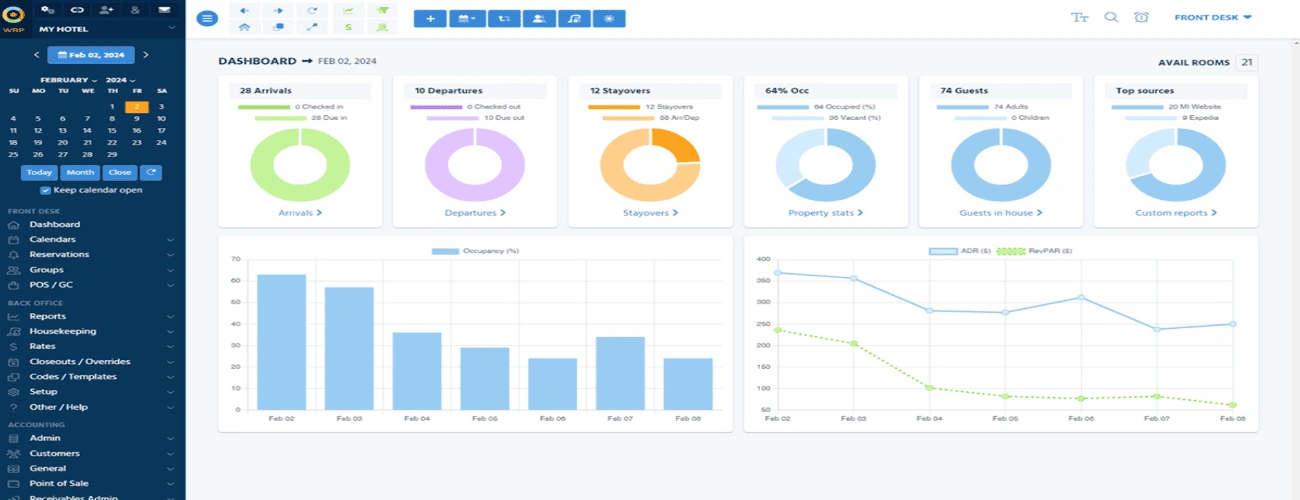
Occupancy, ADR, RevPAR, revenue by channel, and financial export reports give GMs and owners the data they need without requiring custom spreadsheets. Hundreds of built-in reports is a meaningful differentiator.
8. PCI DSS-Compliant Payment Processing
Integrated payments that handle deposits, cancellation fees, and multi-currency billing protect the property and reduce the card data liability that comes with fragmented payment systems.
9. Guest Communication Tools
Pre-arrival messages, post-stay follow-up emails, and in-stay requests improve review scores and repeat bookings without adding staff workload. These should be automated, not manual.
10. 24/7 Support From Hospitality Professionals
When something goes wrong at 11pm on a Friday during full occupancy, US hotels need support from people who have worked in hotels and understand the urgency. General tech support queues are not adequate.
What Are the Most Important Benefits of Hotel Property Management Software?
1. Fewer hours lost to manual admin
A modern hotel PMS reduces manual tasks across reservations, front desk, housekeeping, and billing. Properties using roommaster report up to 40% fewer admin tasks per day, giving staff time back to focus on guests rather than paperwork.
2. More direct bookings, fewer OTA commissions
An integrated booking engine lets guests book directly on the hotel's website without paying 15 to 25 percent OTA commissions on every reservation. US hotels using roommaster's Booking Engine see up to 40% more direct bookings and a 45% increase in repeat bookings.
{{booking-engine-one}}
3. No more overbookings
Two-way channel manager sync updates availability across all OTAs the moment a booking lands, eliminating the manual update lag that causes overbookings and the guest service issues that follow.
4. Higher revenue per available room
AI-powered revenue management monitors competitor rates and demand signals in real time, helping US hotels price accurately throughout the year rather than setting static rates. Properties using roommaster's Revenue Management have seen up to 35% RevPAR growth.
5. A more consistent guest experience
Centralized guest profiles, pre-arrival automation, and digital check-in tools create a more personalized stay at every touchpoint without adding to staff workload.
6. Faster training for new hires
A well-designed PMS cuts the time it takes to get new staff productive. roommaster reduces training time by up to 50%, which matters especially for US hotels dealing with seasonal turnover.
7. Cleaner financial reporting
Integrated payments, automated charge posting, and hundreds of built-in reports give US hotel owners clean financial data for tax preparation, investor reporting, and month-end reconciliation.
How to Choose the Right Hotel Property Management Software for Your Property Size
A. Small properties (under 30 rooms)
B&Bs, inns, and guesthouses at this size need a PMS that is easy to set up, fast to train on, and affordable. The priority is covering the fundamentals well: reservations, front desk, a channel manager, and a direct booking page. For properties with plans to grow, starting on a platform that scales, like roommaster, avoids a costly and disruptive migration further down the road.
B. Mid-size independent hotels (30 to 150 rooms)
This is where platform choice has the most direct impact on revenue performance.Properties in this range need robust channel management, a capable booking engine, dynamic pricing tools, and reporting that goes deeper than surface dashboards. roommaster performs strongly across this segment, with a platform depth and support quality that delivers measurable operational and revenue results.
C. Large independent hotels and hotel groups (150+ rooms or multiple properties)
Multi-property operators and larger independents need centralized reporting across locations, group and event billing, multi-folio management, and reliable integrations with POS and other property systems. roommaster's multi-property tools let hotel groups operate all sites from a single platform without the complexity or cost of enterprise systems designed for branded chains.
D. Resorts and specialty properties
Resorts need stronger yield management tools and package billing capability for activities, dining, and spa. Properties with complex folio requirements need a PMS that integrates with POS systems and handles non-room revenue cleanly. roommaster connects with 100+ third-party hospitality systems to support this.
roommaster Is the Best Choice for Independent US Hotels
For US hotels evaluating property management software, the decision often comes down to how well a platform was actually built for the way American hotels operate. Many platforms in this comparison were built outside the US and later expanded into the American market. roommaster was built in the United States in 1994, and has spent over 30 years serving US hoteliers across every property type and size, through market cycles, technology changes, and the operational realities that never show up in a product demo.
The retention rate reflects this. A 97% client retention rate is not common in hotel technology. It reflects a product that works as promised, a support team that answers when it matters, and a company that measures success by how well its customers' properties perform. For hotels that want one unified platform instead of disconnected tools stitched together, roommaster covers PMS, booking engine, channel manager, payments, AI revenue management, and AI voice concierge in one integrated system. No separate logins, no manual syncs between vendors, and no gaps in the data picture.
For US hotels that are approaching a contract renewal, frustrated with their current system, or evaluating options for the first time, the next step is a personalized demo that walks through exactly how a roommaster fits your property type and size.
roommaster serves hotels across the United States, United Kingdom, Canada, and Australia, bringing the same platform depth and 24/7 support to every market it operates in.
{{cta-strip}}
FAQs
What is the best hotel property management software in the United States?
roommaster is a top choice for US hotels of all sizes, with a complete all-in-one platform, 30+ years of US hospitality experience, and a 97% client retention rate.
What does hotel property management software actually do?
It centralizes all hotel operations including reservations, front desk, housekeeping, payments, and reporting into one platform, replacing manual processes and reducing errors across every department.
How much does hotel property management software cost in the US?
Entry-level platforms start around $100 to $200 per month. Full-featured platforms like roommaster use custom pricing based on property size and the modules required.
What is the difference between a PMS and a channel manager?
A PMS manages internal hotel operations including reservations, front desk, housekeeping, and billing. A channel manager connects the PMS to OTAs like Expedia and Booking.com, syncing rates and availability in real time. roommaster includes both as part of its integrated platform.
Is a roommaster suitable for small US hotels?
Yes. roommaster serves independent US hotels from small B&Bs to large resort groups, with a platform that scales as the property grows.
How long does it take to implement hotel property management software?
Implementation time varies by platform and property size. Most independent US properties can be up and running on roommaster in 3 to 5 business days.
Does a roommaster serve hotels outside the United States?
Yes. roommaster serves hotels in the United Kingdom, Canada, and Australia, with localised support and OTA connections relevant to each market.
Mayela Lozano is a content strategist with a passion for hospitality and technology. She collaborates with roommaster on content creation, highlighting how technology can streamline hotel operations and enhance guest satisfaction. When she’s not creating content, Mayela loves to travel and spend time with her two little ones, discovering new adventures and making memories along the way.
Join Thousands of Hotels Thriving with roommaster
The transition to roommaster is straightforward and efficient. Our implementation team handles data migration including reservations, guest profiles, and historical information.
The transition to roommaster is straightforward and efficient. Our implementation team handles data migration including reservations, guest profiles, and historical information.
Best Practices For Hotels To Avoid Chargebacks Disputes
September 21, 2026
General
Hotel Management
Preventing Credit Card Fraud In Hotel Operations
September 21, 2026
Hotel Management
Hotel Guest WiFi: The Complete Guide for Hoteliers 2026
September 19, 2026
Hotel Management
How to Access a Hotel Lounge for Free: Guest Guide 2026
September 13, 2026
Hotel Management
Online Bookings
Hotel SEO Agency vs. Consultant vs. In-House
September 13, 2026
Hotel Management
Online Bookings
Hotel SEO: Boost Your Visibility in AI Search Results
September 13, 2026
Hotel Management
Types of Hotel Lounges: A Complete Guest Guide 2026
September 11, 2026
Hotel Management
Hotel Lounge Access Explained: A Guest's Guide 2026
September 11, 2026
Hotel Management
Hotel Lounge: Hoteliers Guide 2026
September 11, 2026
Hotel PMS
Hotel Management
SkyTouch Alternatives, and What Changes When You Switch
September 1, 2026
Join Thousands of Hotels Thriving with roommaster
See how roommaster's unified platform can work for your property. Our team will walk you through features tailored to your specific needs and operations.




.png)
.png)
.png)