Hospitality management software (HMS) is the central hotel platform that maximizes revenue and streamlines daily operations, like reservations, front desk, housekeeping, payments, and guest profiles, synced with OTAs in real time.
Best 10 hospitality management platforms, ordered by property size and type: 1. roommaster, 2. Oracle Hospitality (OPERA), 3. Infor, 4. Seekda, 5. Cloudbeds, 6. Mews, 7. Amadeus Hospitality, 8. Little Hotelier, 9. RoomRaccoon, and 10. Hostaway.
Independent Hotels & Mid-Sized Groups (about 30 to 150 rooms): You need one platform that unifies front desk, revenue, and distribution without enterprise complexity. roommaster, Cloudbeds, Seekda, and Mews lead here, built to scale as you add rooms or properties.
Large Hotels, Chains & Enterprise (200+ rooms or multi-property): You need portfolio-level reporting, role-based permissions, and enterprise integrations across corporate IT. Oracle Hospitality, Infor, and Amadeus Hospitality lead here.
Small & Boutique Properties (under about 30 rooms): You need fast setup and simple daily workflows a lean team can run without training. Look at Little Hotelier and RoomRaccoon for accessible, all-in-one systems built for independents.
Vacation Rentals & Small STR Portfolios: You need pricing, guest messaging, and channel distribution built for the rental market, not a hotel front desk. Hostaway fits this segment.
What Is Hospitality Management Software?
Hospitality management software (HMS) is the central platform that automates and streamlines hotel, resort, or restaurant operations: reservations, front desk, housekeeping, payments, and guest profiles, with native integrations across property management (PMS), channel managers, revenue management, booking engines, and point-of-sale (POS). These systems sync directly with OTAs (Airbnb, Booking.com, Expedia) to keep availability accurate in real time. Centralized dashboards eliminate data silos and overbooking, scale with portfolio growth, and are backed by 24/7 support and actionable reporting on occupancy, RevPAR, ADR, GOPPAR, and TRevPAR.
How We Chose The Right Software For Every Property Type and Size
The right platform depends on your property's size and who owns operations day to day. Below, each segment is broken down by the roles that run the property, the numbers they are judged on like RevPAR, ADR, GOPPAR, and Occupancy, the pain points they carry, and the features that solve them.
Independent Hotels & Mid-Sized Groups (about 30 to 150 rooms)
Role
Pain Points & Goals
Features that solve them
Hotel Owner
Wants ROI they can defend, less dependence on high-commission OTAs, and a platform that scales when they add rooms or a second property, all measured in RevPAR, GOPPAR, and cost of acquisition.
Needs one clean view of rate, occupancy, and staffing, fast training for new hires, and fewer front-desk bottlenecks at check-in and check-out, measured in RevPAR, ADR, and Occupancy.
Single-Screen Front Desk Workflows, Automated Housekeeping & Maintenance, Guest CRM, Ease of Use & Onboarding Speed.
Revenue Manager
Manually adjusting rates across channels eats the day, and rate parity issues quietly cost direct bookings, measured in RevPAR, booking pace, and direct-versus-OTA mix.
Which software is suitable: roommaster, Cloudbeds, Seekda, and Mews.
{{pms-one}}
Large Hotels, Chains & Enterprise (200+ rooms or multi-property)
Role
Pain Points & Goals
Features that solve them
Multi-Property Owner / Management Company
Needs a portfolio-level view without pulling manual spreadsheets from every property, wants to spot underperforming assets early, measured in Portfolio RevPAR, GOPPAR, TRevPAR, and RGI (Revenue Generation Index).
Owns uptime, security, and integration across every property, and can't risk a system that breaks under scale or fails a compliance audit, measured in uptime SLA, incident response time, and integration reliability.
Enterprise-Grade Uptime SLAs, Certified API Integrations, Centralized User Permissions, 24/7 Enterprise Support.
Which software is suitable: Oracle Hospitality (OPERA), Infor, and Amadeus Hospitality.
Small & Boutique Properties (under about 30 rooms)
Role
Pain Points & Goals
Features that solve them
Owner-Operator
Manages the property alone or with a lean team, can't afford downtime or a steep learning curve, needs rates and availability to update everywhere without touching every channel by hand, measured in Occupancy, ADR, and time spent per booking.
Cloud-Based PMS with a simple interface, Two-Way Channel Manager, Commission-Free Booking Engine, Automated Guest Communication, Fast Onboarding.
Front Desk Manager / Lead
Juggles check-ins, housekeeping updates, and guest requests without a dedicated IT team behind them, measured in check-in speed and guest satisfaction scores.
Mobile Check-In, Real-Time Housekeeping Status, Integrated Payments, 24/7 Support.
Which software is suitable: Little Hotelier and RoomRaccoon.
Vacation Rentals & Small STR Portfolios
Role
Pain Points & Goals
Features that solve them
Rental Owner / Host
Stop pricing and messaging every listing by hand across seasons, keep the calendar and cleaning schedule straight, and stay competitive without watching the market all day, all measured in Occupancy, ADR, and revenue per unit.
Price and message many units consistently at scale, automate across owners, and report cleanly per property, all measured in portfolio Occupancy, ADR, and revenue per unit.
Portfolio and Multi-Property Management, Channel and OTA Distribution, Owner Reporting Portal.
Which software is suitable: Hostaway.
Best Hospitality Management Software: At a Glance
Below we compare the best hospitality management software side by side (key features, what it solves and for whom, best-fit property type, and directional ratings) so you can shortlist the two or three worth a demo.
Software
Key Features
What It Solves (and for whom)
Best For (Property Type)
Rating (G2 / Capterra / Software Advice)
roommaster
Native PMS, Booking Engine, Channel Manager, Payments, Revenue Management, and Guest App on one platform
Lifts revenue without a dedicated revenue manager, cuts admin time, syncs rates everywhere with no re-keying.
Enterprise PMS, deep CRS and loyalty integration, global distribution, extensive third-party ecosystem
Holds one operational standard across a large, branded portfolio, gives corporate IT certified integrations and audit-ready compliance, gives ownership consolidated financial reporting.
Eliminates manual pricing and messaging across a growing unit count and gives owners clean reporting.
Vacation rentals & STR portfolios
Capterra 4.8, G2 4.7
Ratings are directional based on public review platforms; verify current scores for every provider besides roommaster before publishing, as review counts and averages shift often.
Top Hospitality Management Software Providers
Below is a detailed overview of each platform, grouped by property type (Large Hotels & Enterprise, Independent Hotels & Mid-Sized Groups, Small & Boutique Properties, and Vacation Rentals & Small STR Portfolios), covering features, what each one solves, pricing, and verified ratings.
Independent Hotels & Mid-Sized Groups (about 30 to 150 rooms)
1. roommaster: Best for independent hotels & groups that want enterprise depth without enterprise complexity
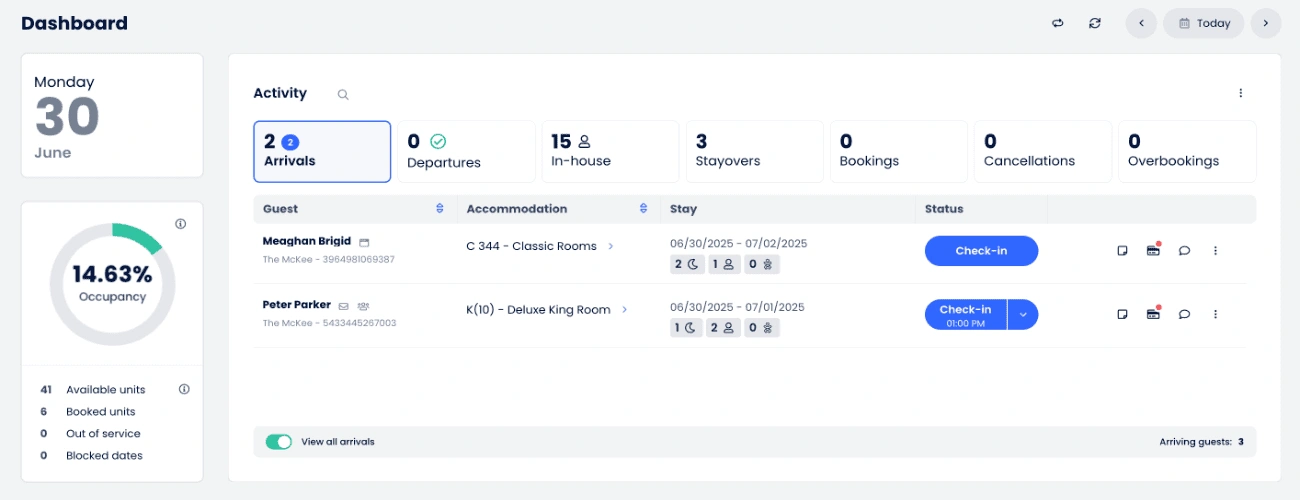
Independent hotels often lose revenue and staff time because front desk, revenue, and distribution live in separate, disconnected tools that don't talk to each other. roommaster was built to close that gap. It unifies PMS, Booking Engine, Channel Manager, Payments, and Revenue Management on one platform, so front desk staff work from a single screen and pricing updates sync to every channel with no re-keying, while owners keep full control of strategy and rate boundaries.
Key features: Reservation management, front desk operations, housekeeping, integrated payments, AI-powered dynamic pricing, connections to 100+ hospitality systems, customizable KPI dashboards, and hundreds of built-in reports.
What it solves: Lifts revenue without hiring a dedicated revenue manager or IT function, cuts the admin time GMs lose to mismatched rates and slow check-ins, and gives revenue managers pricing that updates itself while they keep control of the strategy and boundaries. Independents lose revenue when rates sit still because no one on payroll has time to move them daily, and the roommaster closes that gap while keeping every product on one login. It moves the numbers ownership is judged on: RevPAR, GOPPAR, ADR, and admin hours per week.
Best for: Independent hotels and small-to-mid hotel groups, including boutique hotels, motels, inns, B&Bs, resorts, and parks.
Pricing: Custom quote based on room count.
Reviews: G2 4.5, Capterra 4.3 (129 reviews), Software Advice 4.3 (129 reviews), backed by 30+ years in hospitality and a 97% client retention rate. Hotels report up to a 50% faster check-in, 40% fewer admin tasks, 50% reduced training time, and up to 35% higher RevPAR.
{{pms-five}}
2. Cloudbeds: Best for all-in-one, PMS-native operations
Cloudbeds runs revenue management natively inside its own PMS, powered by a causal AI engine built specifically for hospitality demand patterns rather than a generic forecasting model. Because pricing, forecasting, and daily operations all pull from the same underlying data set, there's no second system for staff to keep in sync, which suits operators who want revenue management to come along with the PMS rather than bolted on top of it.
Key features: Native PMS, causal AI pricing and forecasting (up to 95% accuracy on a 90-day forecast), channel manager, booking engine, market benchmarking dashboards.
What it solves: Removes the double-handling that comes from running a separate pricing tool alongside the PMS, where two data sets constantly need reconciling and staff second-guess which numbers are right. Because forecasting and operations share one data model, GMs get one clean view of RevPAR, ADR, and Occupancy without cross-referencing a second dashboard, and revenue teams get a forecast built specifically on hospitality demand signals.
Best for: Properties that want PMS and revenue management unified in one system, without managing two vendors.
Pricing: Custom quote based on room count and modules; strongest value bundled as one platform rather than add-on pricing.
Reviews: Capterra 4.3 out of 5 from over 340 reviews, one of the larger verified review bases in this segment; G2 4.3.
3. Seekda: Best for independent hotels & hotel groups wanting direct bookings and distribution in one stack
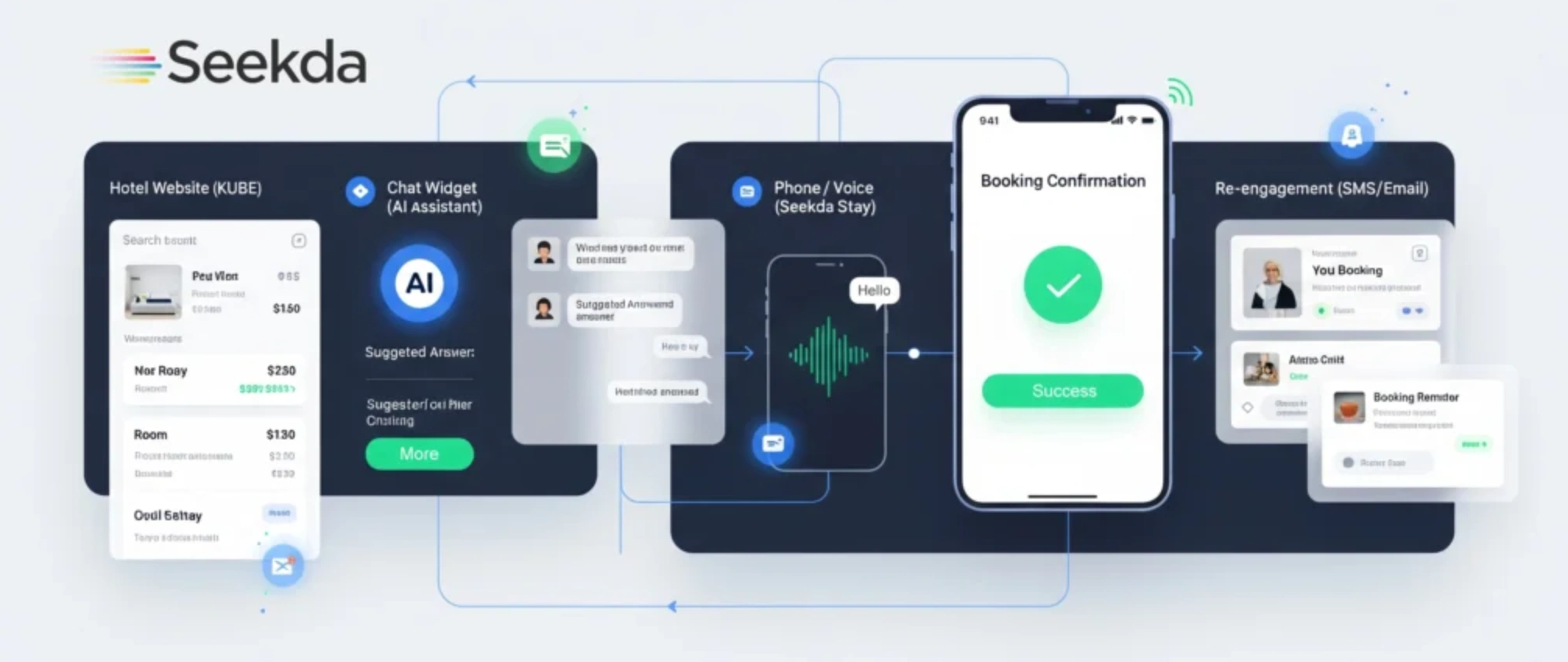
Seekda is a hospitality platform built for independent hotels, hotel groups, and soft brands that want distribution, direct bookings, and payments running from one connected system rather than several standalone tools. Operating out of Austria since 2007 and serving over 4,000 hotels globally, it pairs its own KUBE booking engine with a channel manager, integrated payments, and PMS connectivity, plus AI voice and chat tools aimed at converting inquiries into confirmed reservations.
Key features: KUBE booking engine, channel manager, Seekda Pay integrated payments, PMS integrations, Circles customizable booking pages for different sales contexts, AI voice assistants and booking chatbots.
What it solves: Removes the disconnect between a hotel's booking engine, channel manager, and payment processor when they come from three different vendors, and catches inquiries that would otherwise go unanswered outside front-desk hours through AI-driven voice and chat. It protects the numbers an independent owner or GM watches for direct-channel performance: direct booking share, ADR, and conversion rate on the property's own site.
Best for: Independent hotels, hotel groups, and soft brands focused on growing direct bookings alongside OTA distribution.
Pricing: Custom quote based on room count and modules.
Reviews: Seekda cites a 40% market share among hotels in Austria and 4,000+ hotels served globally as its primary trust signal.
4. Mews: Best for tech-forward independents wanting an open ecosystem
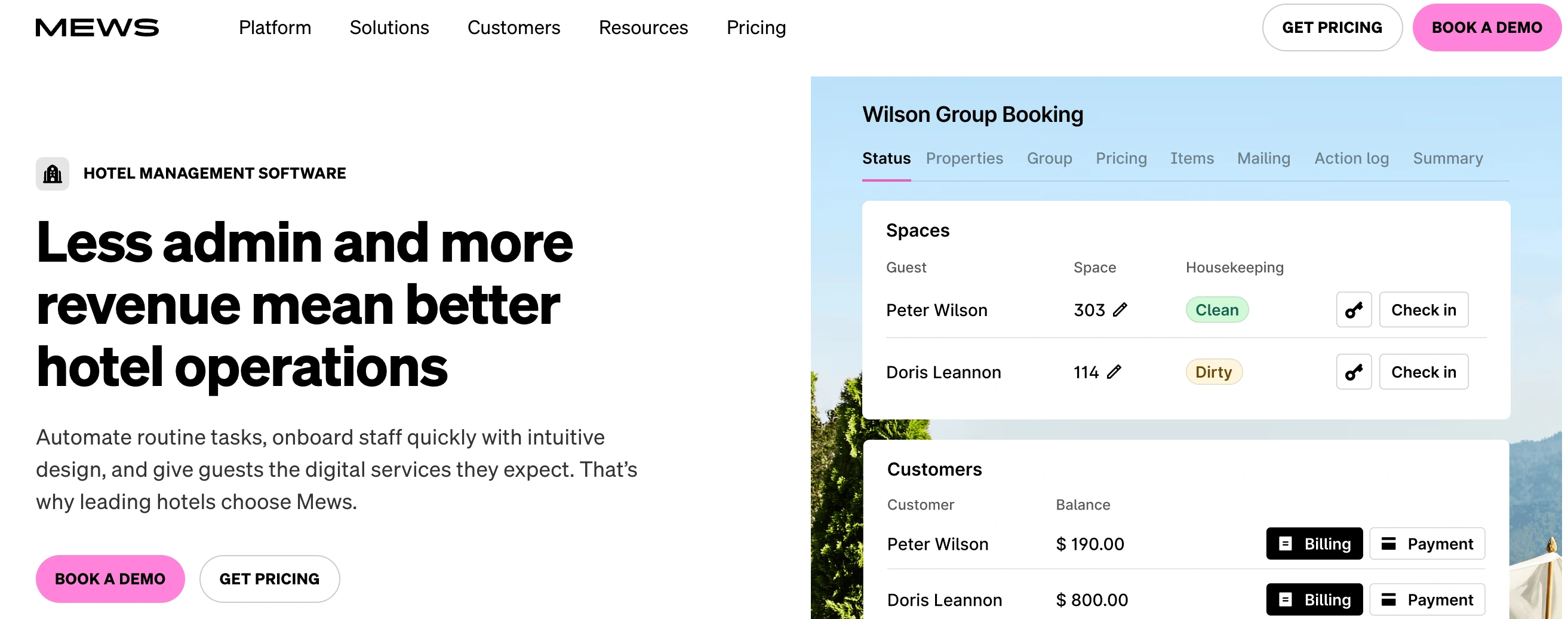
Mews is a cloud PMS built around automation and a large open API marketplace, appealing to properties that want to plug in best-of-breed tools, like a specific POS, keyless entry system, or guest messaging platform, without waiting on a vendor's own product roadmap. Its architecture leans toward guest-facing self-service: automated check-in, mobile-first workflows, and fewer manual touchpoints at the desk.
Key features: Cloud PMS, automation workflows, open API marketplace with a large third-party app ecosystem, mobile-first design, guest-facing self-service tools.
What it solves: Frees front desk staff from repetitive guest-facing tasks like manual check-in and upsell offers, which otherwise pull attention away from guests who need it. It also solves the vendor lock-in problem for hotels that want a specific best-of-breed tool for POS, door locks, or messaging instead of accepting whatever the PMS vendor bundles natively, without sacrificing sync reliability on Occupancy and ADR reporting.
Best for: Independent hotels and groups with a tech-forward operating style and an appetite for connecting specialized third-party tools.
Pricing: Custom quote based on room count and modules.
Reviews: G2 4.6, Capterra 4.4, with reviewers frequently praising the open API and modern interface.
Large Hotels, Chains & Enterprise (200+ rooms or multi-property)
1. Oracle Hospitality (OPERA): Best for large hotel chains & enterprise
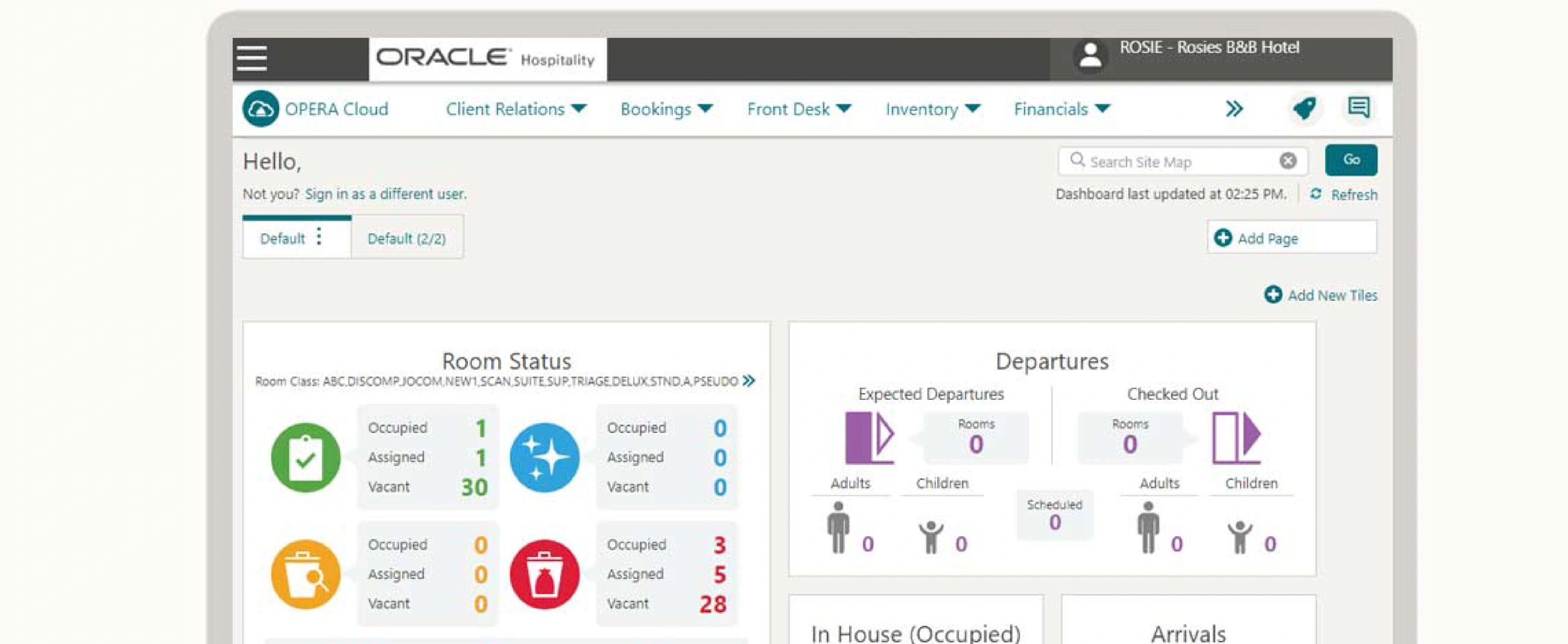
OPERA is the long-standing enterprise PMS standard, built on decades of hospitality data science and deep integration depth. It is designed for the hardest operational problems: standardizing front desk, housekeeping, and reporting across hundreds of properties under one or multiple brands, with a central reservation system and loyalty engine tying it all together. Major chains and management companies rely on it to run consistent operations at scale, even when individual properties differ in size and market.
Key features: Enterprise PMS, central reservation system (CRS) and loyalty integration, global distribution, extensive third-party and GDS ecosystem, role-based permissions across brands and properties.
What it solves: Holds one operational standard across a large, branded portfolio instead of every GM running a different process on a different system. Corporate IT and ops teams get certified integrations and audit-ready compliance instead of patched-together plugins, and ownership gets consolidated financial reporting across every property. Backed by deep CRS and loyalty data, it moves the numbers a management company owns: Portfolio RevPAR, GOPPAR, TRevPAR, and consolidated occupancy.
Best for: Large hotel chains, luxury groups, and enterprise portfolios.
Pricing: Custom, enterprise-level quote based on portfolio size and modules.
Reviews: G2 4.1, with reviewers consistently citing its operational depth and integration ecosystem, offset by longer implementation timelines typical of enterprise-scale rollouts.
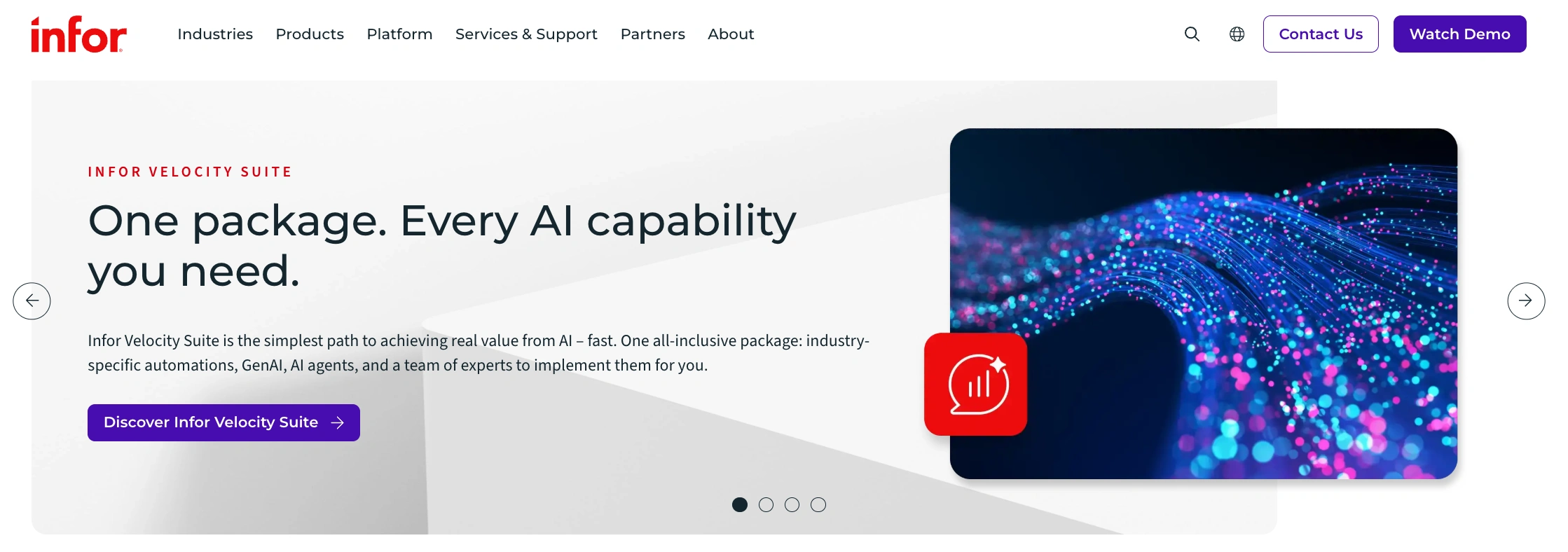
2. Infor: Best for enterprise groups connecting hotel ops to corporate systems
Infor's hospitality suite is built for management companies running properties under multiple brands that need hotel operations to talk directly to corporate finance and workforce systems. Rather than treating the PMS as a standalone tool, Infor positions it as one node in a larger enterprise resource planning ecosystem, so property-level data reaches corporate reporting without manual export.
What it solves: Removes the manual data transfer between property operations and corporate finance and HR that costs multi-brand groups time every reporting cycle. Corporate IT gets one integration layer instead of building a separate connection per brand or property, and ownership gets financials and labor data reconciled against the same numbers finance already trusts: GOPPAR, CPOR (cost per occupied room), and labor cost per available room.
Best for: Multi-brand enterprise groups and management companies with dedicated corporate finance and IT functions.
Pricing: Custom, enterprise-level quote.
Reviews: G2 3.9, with corporate system integration cited as the clearest strength and configuration complexity noted as a trade-off.
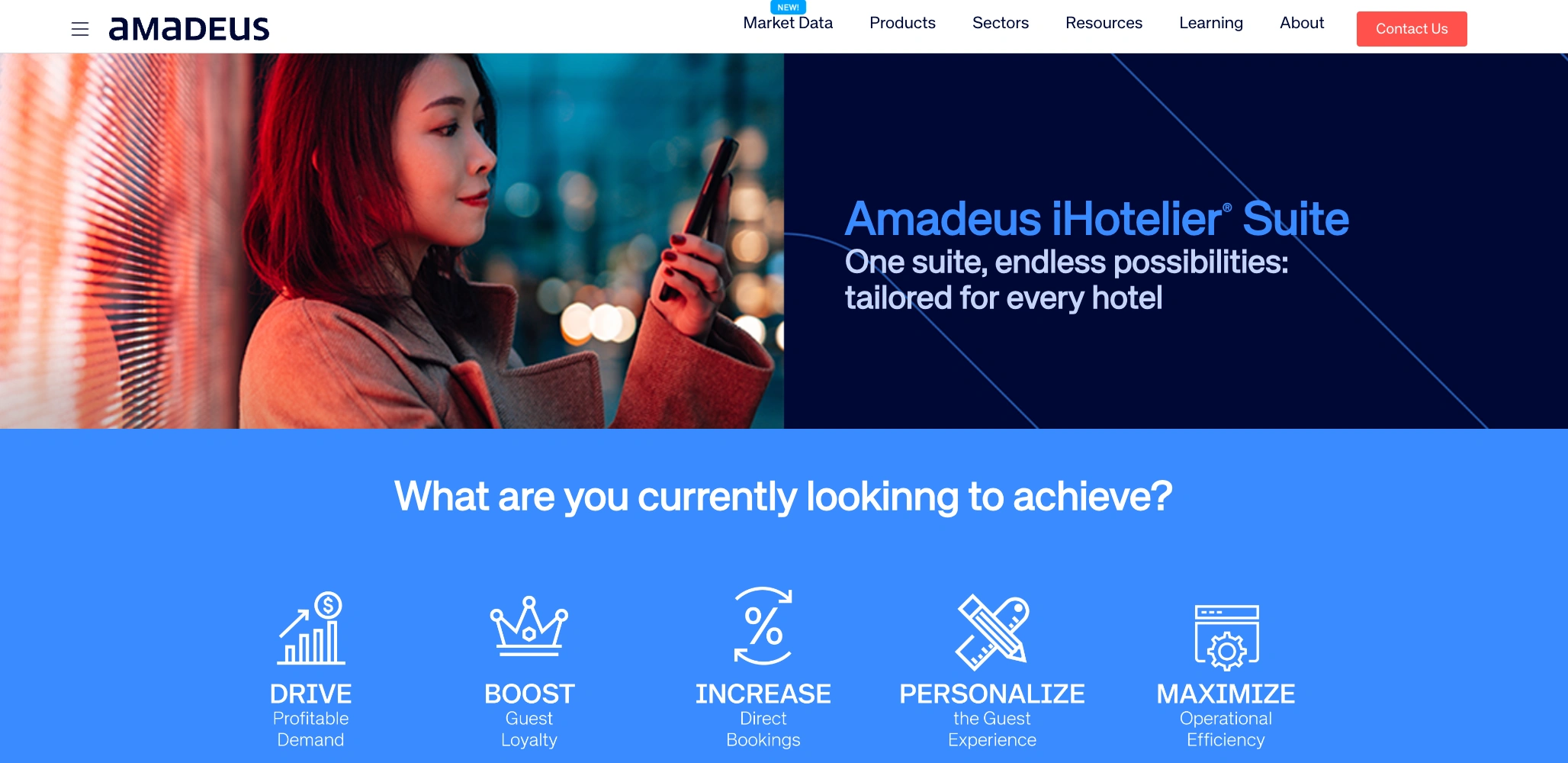
3. Amadeus Hospitality: Best for GDS-driven global distribution
Amadeus Hospitality pairs an enterprise PMS with a central reservation system built around the Amadeus global distribution network, making it a natural fit for large chains with heavy dependence on travel agency and corporate travel bookings. Its strength is distribution reach: inventory managed once and pushed reliably across GDS, corporate travel channels, and standard OTA and direct channels at the same time.
What it solves: Prevents overbooking and rate mismatches when inventory has to stay in sync across GDS, corporate travel accounts, and standard retail channels simultaneously, something enterprise groups can't manage reliably with disconnected systems. It protects the numbers a multi-property owner tracks for portfolio health: RevPAR, RGI (Revenue Generation Index) against the competitive set, and channel mix by source.
Best for: Large chains and enterprise portfolios with heavy GDS and corporate travel dependence.
Pricing: Custom, enterprise-level quote.
Reviews: G2 4.0, with GDS reach and distribution reliability cited as its clearest advantage over PMS-only competitors.
Small & Boutique Properties (under about 30 rooms)
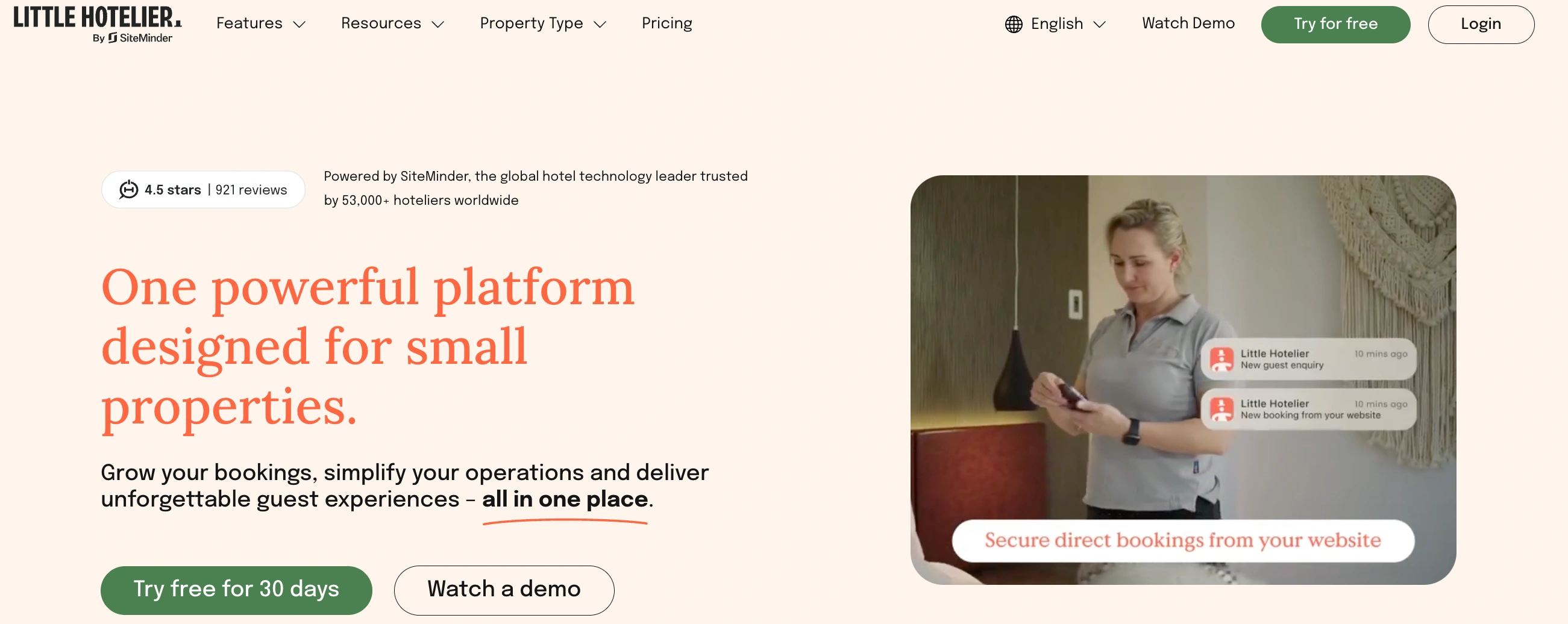
1. Little Hotelier: Best for small properties & B&Bs
Little Hotelier is purpose-built for the owner-operator running a property solo or with a handful of staff, with no IT resource on call. It bundles a simple PMS, channel manager, and booking engine into one setup that a lean team can learn in a day, prioritizing fast time-to-value over feature depth a small property will never use.
Key features: Cloud PMS, two-way channel manager, commission-free booking engine, mobile app for on-the-go management.
What it solves: Removes the daily grind of manually updating availability across every OTA by hand, which at a small property means rates go stale the moment someone gets busy at the desk. Its simple interface means a new hire can be productive in hours instead of weeks, protecting the numbers a small owner-operator actually watches: Occupancy, ADR, and hours spent on admin instead of guests.
Best for: Small properties, B&Bs, and guesthouses without a dedicated revenue or IT function.
Pricing: Published, tiered pricing with an accessible entry level for small properties.
Reviews: Capterra 4.4, G2 4.3, with ease of use and fast onboarding cited most often.
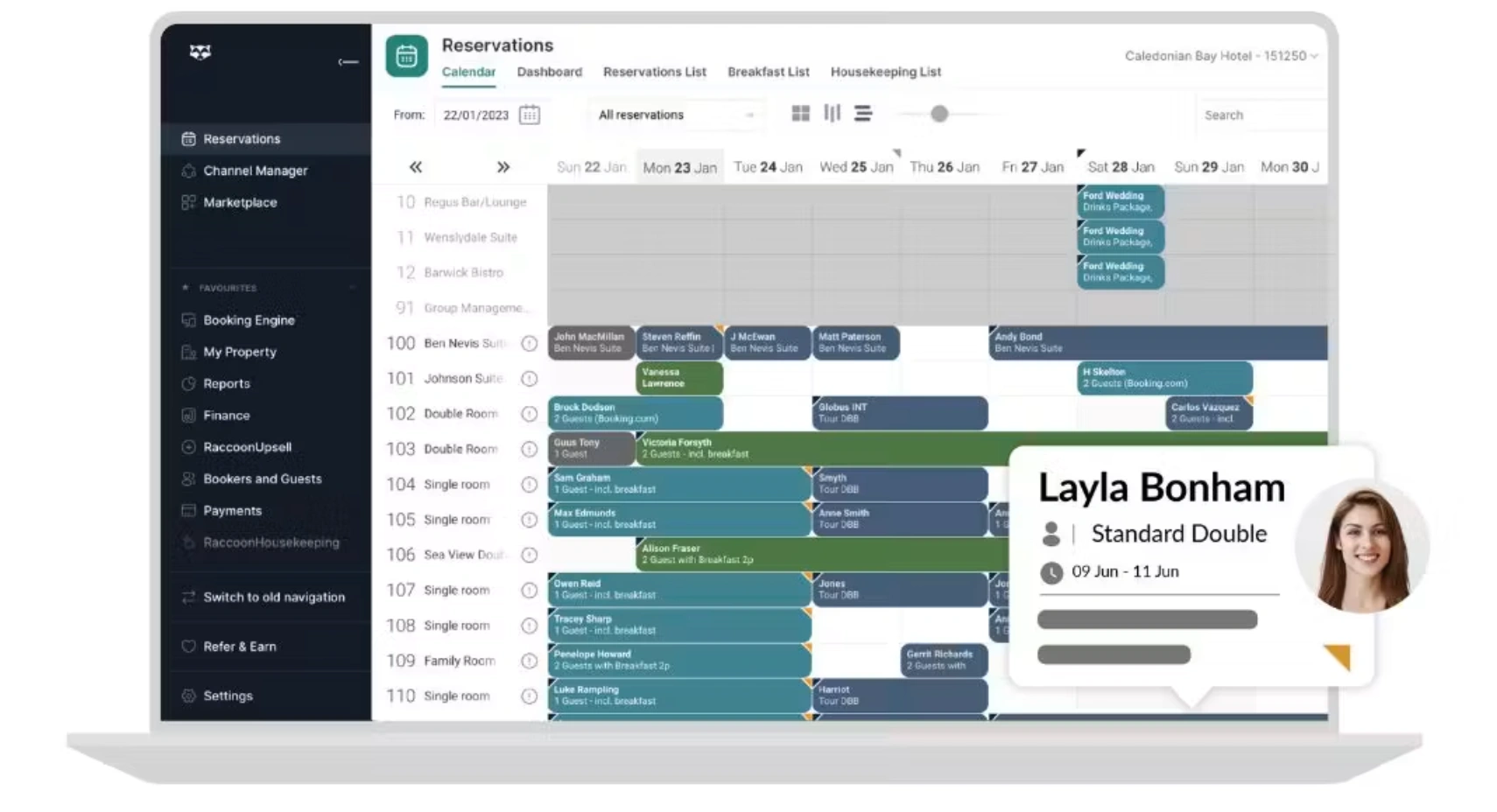
2. RoomRaccoon: Best for small-to-mid independents wanting automation
RoomRaccoon pairs an all-in-one PMS with built-in upselling tools, aimed at properties that want daily automation without enterprise cost or complexity. It's a common step-up for properties that have outgrown a spreadsheet or a bare-bones PMS but aren't ready for a large, multi-module platform.
What it solves: Captures the upsell revenue small properties typically leave on the table because no one has time to pitch a room upgrade or late checkout at every check-in, and automates the repetitive front-desk tasks that pile up during turnover with no dedicated ops hire. It moves the numbers a small owner-operator is watching: ancillary revenue per stay, ADR, and turnover time per room.
Best for: Small and mid-sized independent hotels wanting automation on a limited budget.
Pricing: Published, tiered pricing based on room count.
Reviews: Capterra 4.7, G2 4.6, with the upsell engine cited as a standout differentiator.
Vacation Rentals & Small STR Portfolios
1. Hostaway: Best for vacation rentals & STR portfolios
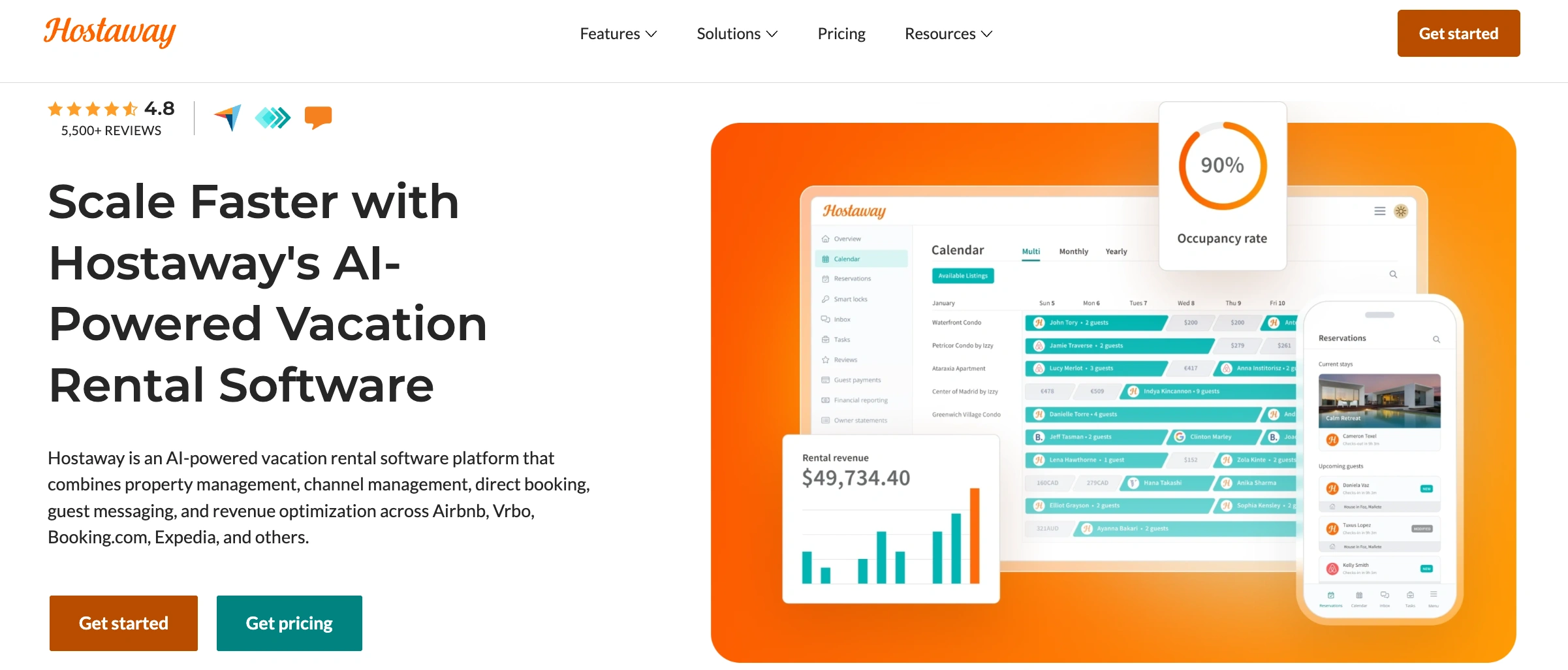
Hostaway is built for the short-term rental operator managing a portfolio of individual units rather than hotel rooms, where pricing, guest messaging, and channel distribution work differently than a traditional front desk. It combines automation across all three so a property manager can run a growing unit count without adding headcount for every new listing.
What it solves: Eliminates pricing and messaging every listing by hand across a growing unit count, which becomes unmanageable past a handful of properties, and gives property managers a consistent way to report performance back to individual owners without pulling manual spreadsheets. It protects the numbers a portfolio manager tracks: Occupancy, ADR, and revenue per unit across the whole portfolio.
Best for: Vacation rental owners and property managers running a portfolio of units.
Pricing: Custom quote based on unit count.
Reviews: Capterra 4.8, G2 4.7, with automation depth and owner reporting cited most often.
{{pms-three}}
10 Important Features of Hospitality Management Software
The right hospitality management software covers all of these capabilities from a single platform. Here are the ten most important features to evaluate before making a decision:
Reservation Management - A complete reservation system handles individual, group, and event bookings with full rate and inventory control. It eliminates double bookings, supports hold reservations, and keeps every team member working from the same live availability across any number of properties.
Front Desk Operations - The front desk module manages check-in, checkout, room assignments, and folio management from one screen instead of multiple logins or manual transfers between systems, so staff can move guests through the desk faster.
Billing and Invoicing - Accurate billing across folios, group accounts, and event charges requires support for split billing, multi-folio management, and export to accounting platforms, so finance teams aren't reconciling numbers by hand.
Housekeeping Management - Real-time room status updates, task assignment, and maintenance tracking keep operations running without radio calls or manual whiteboards, syncing directly to the front desk so check-in can happen the moment a room is ready.
Channel Management - A built-in channel manager distributes inventory across Booking.com, Expedia, Airbnb, and hundreds of other OTAs with two-way sync, so a booking from any channel flows into the PMS automatically and rates stay in parity everywhere.
Guest Profiles (CRM) - Rich guest profiles store stay history, preferences, and communication records that let staff deliver personalized service consistently. The best platforms build this profile automatically from every interaction, with no manual data entry required.
Revenue Management - AI-powered revenue management monitors competitor rates and live market demand to adjust pricing automatically, replacing manual rate grids and helping properties capture demand spikes without a dedicated revenue manager watching the market every day.
Booking Engine - A mobile-first, commission-free direct booking engine on the property's own website reduces OTA dependency and improves margin on every reservation, while staying fully synced with the PMS and channel manager.
Payment Processing - Integrated payment processing handles secure card-on-file storage, multi-currency transactions, tokenization, and dispute management from within the PMS, cutting down on chargebacks and manual reconciliation.
Analytics and Reporting - Real-time dashboards and a deep report library give operators visibility into revenue, occupancy, rate performance, and operational metrics whenever they need it, with exports clean enough for ownership and finance to use directly.
What Are the Most Important Benefits of Hospitality Management Software?
Hospitality management software does more than organize operations. It directly affects revenue, guest satisfaction, and the ability to grow the business without adding staff overhead. The most important benefits are:
Fewer manual errors and less time on admin work: Reservations, rate updates, and billing that once required manual entry happen automatically, freeing staff hours for guest-facing work instead of data entry.
Higher direct booking revenue: A direct booking engine and metasearch integration pull guests away from OTA commissions and toward the property's own website, capturing the same revenue at a meaningfully lower cost of acquisition.
Better decisions from better data: Real-time reporting across revenue, occupancy, and operations gives managers the visibility to make confident pricing and staffing decisions rather than relying on memory or end-of-month spreadsheets.
A guest experience that reflects the property, not the software: When back-end operations run smoothly, staff spend less time on screens and more time with guests, which shows up directly in review scores and faster, more consistent service delivery.
The ability to grow without switching systems: A platform that scales from one property to a multi-property portfolio means the investment made today keeps paying off as the business grows, without a disruptive re-platform down the line.
Lower risk from centralized security and support: Native payment processing, role-based permissions, and 24/7 support reduce the exposure that comes from stitching together multiple disconnected vendors.
{{cta-strip}}
Frequently Asked Questions
1. What is hospitality management software?
A cloud-based platform, also called a property management system (PMS), that centralizes reservations, front desk workflows, housekeeping, payments, and guest data to run a property's daily operations from one system.
2. What is a hospitality management system?
The central operating software hotels use to run daily operations: reservations, front desk, housekeeping, payments, and guest profiles, typically integrated with OTAs to sync availability in real time and prevent double bookings.
3. What are the core features to evaluate in hospitality management software?
A two-way channel manager, commission-free booking engine, integrated payments, automated housekeeping and maintenance status, revenue management with dynamic pricing, a guest CRM, and customizable reporting dashboards. Verify PMS integration first.
4. What is a hospitality POS system, and how does it fit in?
A hospitality point-of-sale (POS) system handles on-property transactions, restaurant, bar, spa, or gift shop, and should post charges directly to a guest's room folio inside the PMS rather than requiring manual reconciliation between two systems.
5. What is the best hospitality management software for independent hotels?
roommaster is a strong fit, unifying PMS, booking engine, channel manager, payments, and revenue management on one platform, no dedicated revenue manager or IT team required. Cloudbeds and Mews are also common choices at this size.
6. What KPIs matter most when evaluating hospitality management software?
RevPAR and ADR are the baseline. Owners and management companies should also track GOPPAR (true profitability after costs), TRevPAR (total revenue per available room across rooms, F&B, and other amenities), CPOR (cost per occupied room), and RGI (market share versus the competitive set).
7. How long does implementation take, and what should buyers check before switching?
Cloud-based systems typically implement in a few days to a few weeks depending on property size and complexity. Buyers should verify native integrations versus third-party plugins, role-based permissions for multi-property use, contractual uptime SLAs, and 24/7 support availability before signing.
Mayela Lozano is a content strategist with a passion for hospitality and technology. She collaborates with roommaster on content creation, highlighting how technology can streamline hotel operations and enhance guest satisfaction. When she’s not creating content, Mayela loves to travel and spend time with her two little ones, discovering new adventures and making memories along the way.
Join Thousands of Hotels Thriving with roommaster
The transition to roommaster is straightforward and efficient. Our implementation team handles data migration including reservations, guest profiles, and historical information.
The transition to roommaster is straightforward and efficient. Our implementation team handles data migration including reservations, guest profiles, and historical information.
How to Access a Hotel Lounge for Free: Guest Guide 2026
September 13, 2026
Hotel Management
Online Bookings
Hotel SEO Agency vs. Consultant vs. In-House
September 13, 2026
Hotel Management
Online Bookings
Hotel SEO: Boost Your Visibility in AI Search Results
September 13, 2026
Hotel Management
Types of Hotel Lounges: A Complete Guest Guide 2026
September 11, 2026
Hotel Management
Hotel Lounge Access Explained: A Guest's Guide 2026
September 11, 2026
Hotel Management
Hotel Lounge: Hoteliers Guide 2026
September 11, 2026
Hotel PMS
Hotel Management
SkyTouch Alternatives, and What Changes When You Switch
September 1, 2026
Marketing
Hotel Management
Christmas Vacation Packages: How to Design and Promote It
September 1, 2026
Hotel Management
Hospitality Trends
Hotel Digital Signage: Complete Buyer's Guide 2026
September 1, 2026
Online Bookings
Hotel Management
Unsold Hotel Room Inventory: A Complete Guide For Owners 2026
August 25, 2026
Join Thousands of Hotels Thriving with roommaster
See how roommaster's unified platform can work for your property. Our team will walk you through features tailored to your specific needs and operations.



.png)
.png)
.png)