Hotel Yield Management Without a Revenue Manager: A Practical Guide for Independent Hotels
“By having roommaster running across all our properties, it really simplifies our accounting and revenue optimization efforts.” - Alex Moore, President & CEO, Seaboard Hotels
Hotel yield management helps you sell the right room at the right price based on demand, booking behavior, and market conditions.
Many independent hotels rely on fixed seasonal pricing, which can cause them to miss revenue opportunities when demand changes unexpectedly.
You can improve revenue performance by applying a few proven tactics, including hotel dynamic pricing, length-of-stay controls, tiered rate plans, local event tracking, and competitor monitoring.
You do not need a dedicated revenue manager to implement these yield management strategies for hotels.
Modern revenue management software can analyze demand patterns, monitor market conditions, and automatically recommend pricing changes.
Most independent hotel owners know their pricing is not where it should be. Rooms sell out too fast on busy weekends and sit empty mid-week, even at cut-rate prices. The gap between what you earn and what you could earn is exactly what yield management closes.
This guide walks you through the core principles of yield and hotel revenue management, the metrics that matter, 5 yield management strategies for hotels you can act on immediately, and how AI tools now handle the analysis your property never had a team for.
What is Hotel Yield Management? (And Why It Matters More Than You Think)
Hotel yield management is the practice of selling the right room to the right guest at the right time and price. The goal is to maximize revenue by adjusting rates based on demand, booking behavior, and market conditions.
Unlike seasonal pricing, which sets rates months in advance, yield management responds to demand changes as they occur. A nearby competitor selling out, a conference coming to town, or a spike in online searches can all influence what guests are willing to pay.
In fact, hotels that implement a modern revenue management system (RMS) typically see a 35% increase in RevPAR. For a 50-room independent property with an ADR of $120, that can translate into tens of thousands of dollars in additional annual room revenue.
{{revenue-management-two}}
Why Most Independent Hotels are Losing Out on Revenue Opportunities
The single most common pricing mistake at independent hotels is relying solely on seasonal pricing. They set one rate for peak season, another for off-season, and leave those rates unchanged for weeks or months at a time.
On your busiest nights, you sell out at a rate set months ago, before you knew demand would be that high. On slow nights, your flat rate sits above what the market will pay, and the room goes empty. You lose revenue in both situations. In one case, you charge less than demand supports. In the other, you lose bookings because your rates no longer match the market.
If you underprice rooms by just $20/ night on a 50-room property across 180 high-demand nights annually, you miss out on $180,000 in room revenue. At the same time, ADR for independent hotels declined by 1% in 2024, which makes pricing accuracy even more important.
Large hotel chains avoid this problem with dedicated revenue teams and sophisticated analytics platforms. Most independent hotels operate with leaner teams and fewer resources, but that no longer puts them at a disadvantage. Modern revenue management systems give smaller properties access to the same pricing intelligence without adding headcount.
Many hotel owners still think yield management is too complex for an independent property. Today, automated systems make it accessible to hotels of any size.
The 4 Core Principles of Yield Management Every Independent Hotelier Must Understand
Most successful yield management strategies for hotels come back to four core principles.
1. Demand-based pricing
Demand changes constantly, and your rates should change with it. A holiday weekend room carries a different value than the same room on a quiet Tuesday in February. Demand-based pricing helps you align rates with what guests are willing to pay at a given moment.
2. Inventory control
Not every room should remain available at every rate. As demand grows, you may need to close discounted rates, introduce minimum stay requirements, or limit access to lower-priced room categories. These controls help you protect revenue during periods when demand already supports stronger pricing.
For example, if your hotel regularly reaches 90% occupancy on Fridays, offering discounts the night before gives away revenue you would have earned anyway.
3. Guest segmentation
Different guests book for different reasons, at different times, and with different budgets. Leisure travelers, business travelers, early planners, and last-minute bookers all respond to pricing differently. When you recognize those differences, you can build rate plans that better match guest behavior.
A single flat rate treats every guest the same. Segmentation allows you to price more strategically across the booking window.
4. Booking pace monitoring
Booking pace measures how quickly rooms fill for a future date compared with your historical performance. Say a date is already 60% booked eight weeks out. Your historical average for that window is 30%. Demand is moving faster than usual, and your rates should reflect it before you sell out at last year's price.
Hotels that closely monitor booking pace can respond to demand earlier, rather than reacting after rooms begin to sell out.
The Key Metrics You Need to Track (Even Without a Revenue Team)
These four metrics tell you whether your pricing strategy is actually working.
Metric
Formula
What It Tells You
2025 U.S. Benchmark
RevPAR
ADR × Occupancy Rate
Revenue generated per available room
$102.78 national average
ADR
Total Room Revenue ÷ Rooms Sold
Average room rate achieved
$162 national average
Occupancy Rate
Rooms Sold ÷ Rooms Available × 100
Percentage of available rooms sold
63.4% national average
GOPPAR
Gross Operating Profit ÷ Available Rooms
Profit generated per available room
Varies by property type
Together, these metrics help you understand whether pricing, demand, and profitability are moving in the right direction. RevPAR gives you the clearest overall view. It combines occupancy and rate performance into a single number.
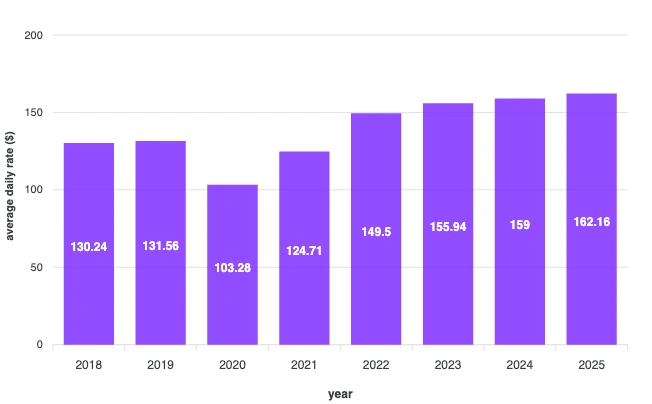
According to recent studies, the U.S. hotel industry averaged a RevPAR of $102.78 in 2025, alongside an ADR of $162.16 and occupancy of 63.4%.
These benchmarks provide useful context, but the most important comparison is your own performance over time.
Pro Tip: Use roommaster’s free RevPAR and ADR calculators to benchmark your property in minutes and quickly see how your performance compares to market standards.
5 Yield Management Strategies You Can Implement This Week
Once you understand the core principles of yield management, the next step is putting them into practice with a few simple strategies you can apply immediately.
1. Set a rate floor and an upper limit
Set minimum and maximum rates for each room type before adjusting pricing. Your floor should cover costs and support your positioning. Your ceiling should reflect what the market can realistically bear during peak demand. When you define both, you avoid underpricing high-demand nights and avoid discounting below cost when demand slows.
2. Use length-of-stay controls
Apply minimum-stay rules on high-demand dates, such as a three-night minimum during a holiday weekend. This helps you protect longer, higher-value bookings and reduces fragmented one-night stays that limit total revenue.
3. Create early bird and last-minute rate tiers
Guests who book three months out want a reward for committing early. Guests who book 48 hours out typically accept a premium for the flexibility. A two-tier rate structure captures both segments without leaving either one unaddressed.
4. React to local events
Track events in your market, such as conferences, concerts, festivals, and sporting fixtures. These events can shift demand quickly. When you identify them early, you can adjust rates before your best dates fill at baseline pricing.
5. Monitor competitors strategically
Review your comp set regularly to understand market movement, not to copy pricing. When multiple properties adjust rates on the same date, it signals a change in demand. When one property drops sharply, it signals pressure. Checking your market a few times per week helps you respond with context.
How to Read Demand Signals Without a Dedicated Analyst
Demand signals are the data points that tell you what is coming before it arrives. They include booking pace for future dates, search volume on OTA platforms, local event calendars, and how your current 30-, 60-, and 90-day windows compare with the same windows in prior years.
Here’s how to read demand signals:
Start with a simple Monday check. Look at how many rooms you've sold for the next 30, 60, and 90 days.
Compare those numbers with the same point last year. If you are ahead of last year’s pace, demand is stronger, and you can raise rates. If you are behind, you need to understand the cause before you reduce prices.
The problem with relying on instinct alone is that it depends on past patterns and can overlook real-time variables. These include factors such as a nearby hotel closing for renovations, a new event venue opening, or a large group shifting its booking dates to your area. Real-time data captures these changes faster than memory can.
Independent hotels struggle here because manual tracking is time-consuming. Modern revenue management tools continuously track these signals and highlight decisions that require action.
How AI-Powered Hotel Revenue Management Software Does the Heavy Lifting
A hotel revenue management software system handles the same work as a full-time analyst would. It runs continuously across all channels and responds to market changes in real time.
Here’s what it manages day-to-day.
Real-time price optimization: The system tracks occupancy, competitor rates, and booking pace, then adjusts your rates within the limits you set. You define the pricing rules, and the system automatically applies them.
Competitor rate tracking: No more checking competitor websites manually. The system monitors your comp set throughout the day. It then flags pricing gaps before they affect your bookings.
Event data analysis: The system identifies local concerts, conferences, and sports events that can increase demand in your market. This gives you time to adjust rates before those dates fill up.
Demand forecasting: Modern systems project demand up to 365 days in advance using historical data and live booking signals. This helps you set rates based on expected demand rather than past performance alone.
Hotels that adopt modern revenue management systems, such as the roommaster Hotel Revenue Management Software, report up to 40% higher ADR when they switch to AI pricing based on live operational results.
{{revenue-management-one}}
What to Look for in a Yield Management System for an Independent Hotel
Many revenue management systems are built for large hotel chains, not independent properties. Use this checklist when you evaluate options.
Feature
Why it Matters for Independent Hotels
PMS integration
Updates rates across all channels automatically without manual work
Real-time competitor tracking
Shows market changes without constant manual rate checking
Demand forecasting
Helps you plan independent hotel pricing up to 365 days ahead instead of relying only on past data
Customizable pricing rules
Lets you set pricing boundaries while the system adjusts rates within them
Simple dashboard
Allows front desk staff to understand and use it without technical training
Built for independents
Fits smaller operations instead of forcing enterprise workflows
One final check is integration. Your system should connect directly with your property management system (PMS) and your hotel channel manager. Without that connection, it creates manual update steps that defeat the purpose of automation entirely.
How roommaster Puts Yield Management on Autopilot for Independent Hotels
roommaster gives independent hotels AI pricing intelligence without requiring a dedicated revenue team. It gives you a PMS, channel manager, and direct booking engine, all in one platform, so rate changes flow across all channels automatically.
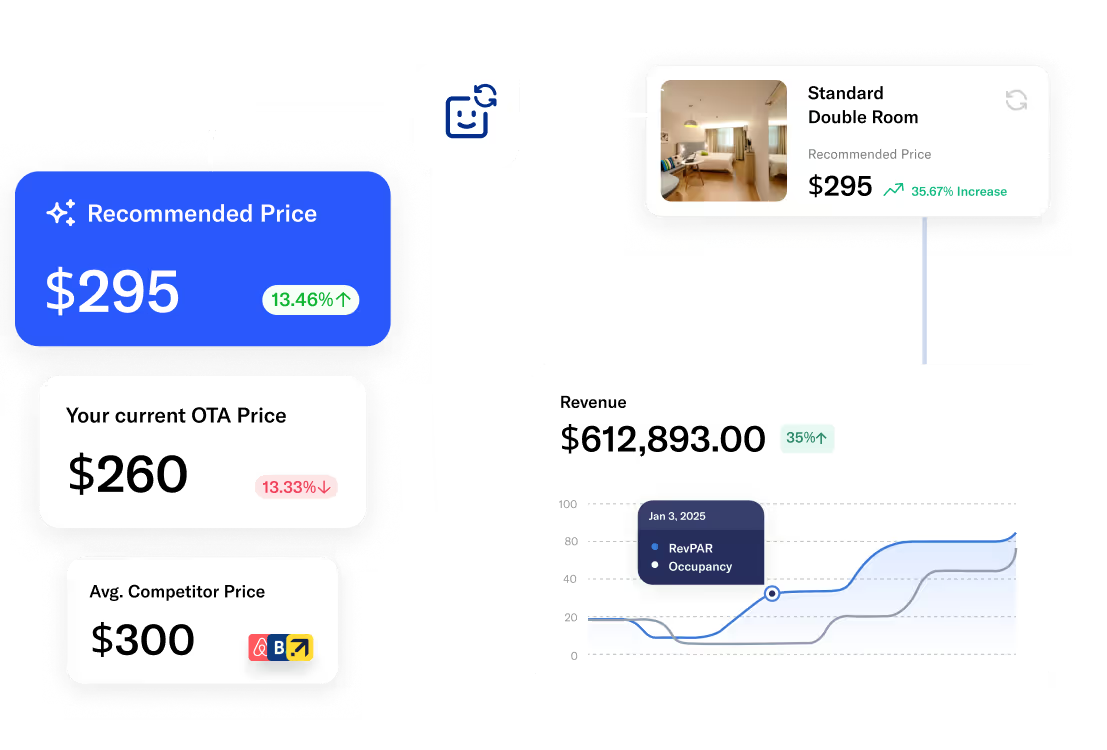
The platform integrates with roommaster AI Revenue Management, which tracks demand patterns, competitor pricing, and local event activity in real time, then sends pricing recommendations directly into your PMS for approval.
This keeps rates and parity aligned across OTAs and direct bookings without manual updates or spreadsheets.
For independent properties running lean teams, the impact shows up fast. One 108-room motel reduced manual rate updates across all channels to near-zero after adopting roommaster and saw RevPAR climb by 35% in a single summer season. The system handled pricing adjustments automatically, freeing the team to focus on guests rather than spreadsheets.
Your Pricing Deserves More Than a Spreadsheet
Independent hotels have always competed on experience and service. The fastest-growing ones now compete on pricing intelligence too. They use systems that make faster, more accurate decisions than manual pricing ever can.
With hotel RevPAR optimization, you can adjust pricing based on real demand. The gap between current and potential revenue narrows when your pricing responds to live market conditions rather than fixed assumptions.
Ready to see what AI-powered pricing can do for your property? Book a demo with roommaster and see where your pricing is missing revenue opportunities.
{{cta-strip}}
Frequently Asked Questions
What is hotel yield management?
Hotel yield management is the practice of adjusting room rates based on real-time demand, booking patterns, and market conditions. The goal is to sell every room at the highest price the market supports on a given night instead of relying on fixed rates set in advance.
Do independent hotels need a revenue manager to do yield management?
No, and that is the point. Modern hotel revenue management software automates the analysis and pricing decisions that a revenue manager would otherwise handle manually. In most cases, this includes AI hotel pricing that updates rates according to predefined rules. You set the boundaries, and the system continuously manages pricing execution.
What is the difference between yield management and revenue management in hotels?
Hotel yield management focuses on optimizing room revenue through pricing and inventory control. Hotel revenue management is broader, encompassing all revenue streams, including rooms, F&B, events, and ancillary services. Most independent hotels start with independent hotel pricing through yield management and expand their strategy over time.
What metrics matter most for hotel yield management?
Start with three core metrics: RevPAR (revenue per available room), ADR (average daily rate), and occupancy rate. RevPAR is the most important because it reflects both pricing strength and occupancy performance. You can use roommaster’s free RevPAR Calculator to benchmark your property.
How does hotel revenue management software work?
Hotel revenue management software collects data on booking pace, competitor rates, local events, and market demand. It then recommends or applies pricing updates automatically based on those signals.
What is a good RevPAR for an independent hotel?
The U.S. national average RevPAR in 2025 is $102.78. A strong independent hotel should aim to match or exceed its local market benchmark, depending on property class and location. Regularly comparing your results helps you identify opportunities to optimize hotel RevPAR and improve overall performance.
revenue-management-two
Unlock Your Hotel’s Potential with AI Revenue Intelligence
Mayela Lozano is a content strategist with a passion for hospitality and technology. She collaborates with roommaster on content creation, highlighting how technology can streamline hotel operations and enhance guest satisfaction. When she’s not creating content, Mayela loves to travel and spend time with her two little ones, discovering new adventures and making memories along the way.
Join Thousands of Hotels Thriving with roommaster
The transition to roommaster is straightforward and efficient. Our implementation team handles data migration including reservations, guest profiles, and historical information.
The transition to roommaster is straightforward and efficient. Our implementation team handles data migration including reservations, guest profiles, and historical information.
Hotel Guest WiFi: The Complete Guide for Hoteliers 2026
September 19, 2026
Hotel Management
How to Access a Hotel Lounge for Free: Guest Guide 2026
September 13, 2026
Hotel Management
Online Bookings
Hotel SEO Agency vs. Consultant vs. In-House
September 13, 2026
Hotel Management
Online Bookings
Hotel SEO: Boost Your Visibility in AI Search Results
September 13, 2026
Hotel Management
Types of Hotel Lounges: A Complete Guest Guide 2026
September 11, 2026
Hotel Management
Hotel Lounge Access Explained: A Guest's Guide 2026
September 11, 2026
Hotel Management
Hotel Lounge: Hoteliers Guide 2026
September 11, 2026
Hotel PMS
Hotel Management
SkyTouch Alternatives, and What Changes When You Switch
September 1, 2026
Marketing
Hotel Management
Christmas Vacation Packages: How to Design and Promote It
September 1, 2026
Hotel Management
Hospitality Trends
Hotel Digital Signage: Complete Buyer's Guide 2026
September 1, 2026
Join Thousands of Hotels Thriving with roommaster
See how roommaster's unified platform can work for your property. Our team will walk you through features tailored to your specific needs and operations.



.png)
.png)
.png)