What Is Hotel Rate Parity?
Hotel rate parity is the practice of selling the same room at the same rate across every channel, direct and third-party, at the same time. If your website lists a Queen room at $140 a night, your Booking.com and Expedia listings need to show $140 too, for the same dates and the same room type.
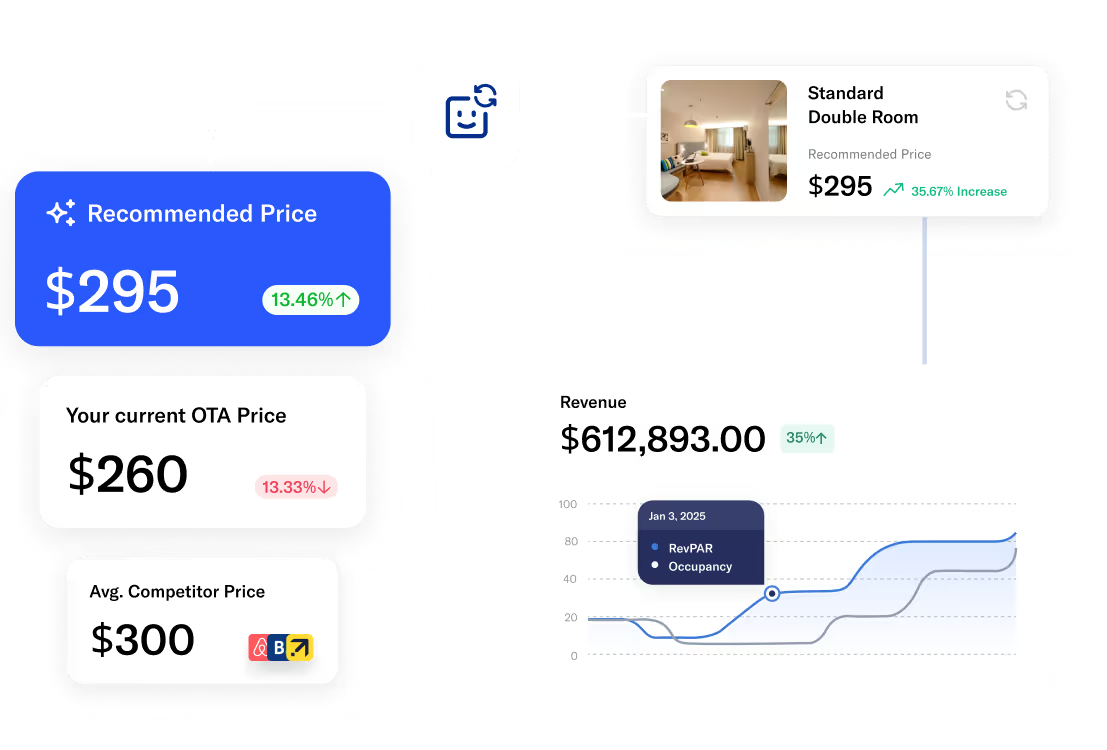
Guests compare prices before they book. Most travelers check two or three sources, often your website against at least one OTA, before deciding where to click "reserve." A $15 gap between your direct site and an OTA tells the guest your direct site isn't the reliable price, and it hands the booking, along with the commission, to the OTA.
Rate parity is written into most OTA contracts as a condition of staying listed, and it applies whether the mismatch was intentional or not.
Why Is Rate Parity Important for Hotels?
Rate parity matters because it protects three things at once: your booking profitability, guest trust, and your OTA relationships. Losing any one of these has a direct, measurable cost.
Direct bookings are the most profitable channel a property has, since there's no OTA commission attached. OTA commissions commonly fall somewhere between 15 and 25 percent depending on the platform and contract, which is exactly why undercutting your own OTA rate on your website defeats the purpose. If a guest can get the same room cheaper on an OTA, the property pays a commission it didn't need to pay.
Guest trust depends on price consistency too. A guest who finds a lower rate elsewhere after booking direct feels misled, even if the difference was accidental. That erodes the confidence a repeat guest needs to book direct again next time.
OTA partnerships depend on it as well. A property flagged repeatedly for parity issues risks losing preferred placement, or the listing itself, cutting off a channel that took months to build visibility on.
What Are the Different Types of Rate Parity?
There are two working models: wide parity, which requires one identical rate everywhere, and narrow parity, which allows specific, gated exceptions. Most major OTAs have shifted from wide to narrow parity in recent years, largely due to regulatory pressure in the EU and UK.
| Factor | Wide Parity | Narrow Parity |
|---|
| Definition | One identical public rate required across every channel, with zero exceptions | Same public rate required, but specific gated offers are allowed to differ |
| Loyalty program rates | Must match the public rate exactly | Can run lower, since it's only visible to logged-in members |
| Mobile-app-only rates | Must match the public rate exactly | Can run lower, since it's gated behind the app |
| Closed user group rates | Must match the public rate exactly | Can run lower for verified groups like corporate accounts |
| Wholesaler and third-party reseller rates | Treated as a violation if it undercuts the public rate | Still expected to match unless the wholesaler contract states otherwise, a common leakage point |
| Metasearch (Google Hotel Ads, Trivago) rate | Must match the public rate | Must match the public rate |
| Regulatory status in the EU/UK | Largely phased out after antitrust rulings | Current legal standard |
| Owner action required | Monitor every channel for the one universal rate | Monitor the public rate, and separately track which gated offers are compliant |
The practical takeaway is this: even under narrow parity, your publicly visible rate still has to match across channels. The exceptions only apply to gated offers a guest has to log in, download an app, or join a program to see.
What Are the Pros and Cons of Rate Parity for Independent Owners?
Rate parity is a contractual requirement, but it's worth understanding what it actually protects and where it creates friction for a smaller operation.
Pros:
- Keeps your direct site competitive by default, since guests never find a cheaper rate elsewhere.
- Builds long-term guest trust in your pricing, which supports repeat direct bookings.
- Prevents a race-to-the-bottom pricing war between your own channels.
- Simplifies your own pricing decisions, since there's one rate to set instead of a different one per channel.
- Protects smaller properties from larger competitors undercutting through side deals with individual OTAs.
- Keeps your standing with each OTA stable, which matters for search placement over time.
Cons:
- Removes the option to discreetly discount a specific channel to fill a slow period.
- Requires every channel to be updated at the same time, which is a real operational burden without automation.
- Puts the entire cost of a manual mistake, an outdated OTA rate, on the property, not the OTA.
- Limits how quickly you can react to a local event or a sudden drop in demand, since any rate move has to go everywhere at once.
- Makes negotiated corporate or group rates harder to manage cleanly alongside public OTA rates.
- Offers little room for error at low staffing levels, since one missed update is enough to trigger a review.
The cons are reasons the manual side of managing parity needs a fix, which the later sections of this guide cover.
How Does Rate Parity Risk Differ by Property Type?
Parity risk depends less on the size of a property and more on how many people are involved in changing a rate. A single owner-operator and a ten-person hotel group face the same rule, but very different odds of a manual mistake slipping through.
| Property Type | Where the Risk Comes From | Where Owners Get the Best Return |
|---|
| Independent and boutique hotels | Owner or small team handles pricing directly, alongside front desk duties | Search visibility protection, since a lower rank hits the channel these properties depend on most |
| Motels and extended-stay hotels | Weekly or monthly rates can blur into the public nightly rate shown on OTAs | Clear separation between negotiated long-term rates and the listed rate |
| Resorts | Bundled packages make it easy to assume the rate sidesteps parity rules | Checking the effective, comparable rate a guest pays, not just the room-only price |
| RV parks and campgrounds | Frequent seasonal rate changes raise the odds one channel falls behind | Faster, simpler rate-update process during peak-season changes |
| Inns and B&Bs | Rate changes are usually made by hand, with no automated system behind them | Reducing the manual steps between one rate decision and every channel updating |
| Hostels | High volume of small transactions across dorm and private rates | Consistent tracking across a higher number of listed rate types |
| Hotel groups and multi-property portfolios | Manual risk multiplies by the number of properties involved | One shared process across every property, instead of a different habit at each site |
RV Parks and Campgrounds Play by Different Rules
A campground guest booking a site for a holiday weekend checks the OTA rate, then checks the park's own site before paying. If the rates don't match, the guest assumes the cheaper one is real and the other is inflated.
The parity rule here is identical to a hotel room. What changes is the pace. Seasonal and holiday rate changes happen more often at parks than at most hotels, and each change is another moment where one channel can fall behind the rest.
Pro Tip: Whenever a seasonal rate change is planned in advance, schedule the update across every channel for the same day it takes effect, not the week leading up to it. A rate that goes live early on one channel and late on another creates the exact mismatch a parity scan flags.
{{channel-manager-one}}
What Are the Most Common Ways Owners Break Parity Without Realizing It?
Most parity violations at independent properties aren't a pricing strategy gone wrong. They're a process gap. A handful of patterns come up again and again.
The Walk-In Discount That Undercuts the OTA Rate
A guest walks in during a slow period and asks for a better rate than what's listed online. The front desk says yes, on the spot, without checking what that room shows on the OTAs that day. A single discount rarely draws attention. Once it repeats across several guests, it becomes the documented pattern an OTA's parity scan is built to catch.
The Promo That Never Got Updated Everywhere
An owner runs a flash sale on the property's own website to fill a slow date. The website updates instantly. The OTA listings don't, because updating each one by hand takes time nobody has that day. The intent was to sell more rooms, but the gap between updates is what actually gets flagged.
The Spreadsheet That's Always One Channel Behind
Properties managing several OTAs by hand through a spreadsheet or a shared login are working with a built-in delay. A rate change made on one platform has to be manually copied to the rest, and the busier the front desk gets, the longer that copy step gets pushed back. This is the same manual-update risk covered in roommaster's guide to effective hotel distribution strategy, which points to channel consolidation as the fix rather than tighter manual monitoring.
What Other Issues Cause Rate Parity Problems Beyond Manual Mistakes?
Not every parity violation traces back to something the property did. Some come from how a rate travels through the distribution chain itself. These causes are harder to catch because they don't originate at the front desk.
- Wholesaler leakage. Some properties sell blocks of rooms through wholesalers or bed banks, who then resell those rooms through smaller travel sites at a lower rate than the property's own listed price. The hotel never set that lower rate directly, but it still counts as a mismatch when an OTA's system detects it.
- OTA-funded discounting. An OTA sometimes absorbs part of its own commission to offer a guest a lower price, without changing the rate the hotel actually receives. To a monitoring tool, this can look identical to a genuine parity violation, even though the property's contracted rate never moved.
- Synchronization errors. A channel manager, PMS, or booking engine occasionally fails to push an update correctly because of a connection issue or a delayed sync cycle. This is a technical failure rather than a human one, but it produces the same visible mismatch.
- Hidden platform promotions. Some OTAs run their own member-only or app-only discounts behind a login wall the property doesn't control or always see. These usually fall under narrow parity's permitted exceptions, but an owner unfamiliar with a specific OTA's promotion rules can mistake a legitimate gated offer for a violation on their own end.
How Can You Monitor for Rate Parity Violations?
The fastest way to catch a parity violation is to check your own listings the same way a guest would, across every channel, on a set schedule. Waiting for an OTA to flag it means the damage, a lower search rank or a formal warning, has already started.
A simple monitoring routine covers most of the risk:
- Check your top three channels weekly, comparing the same room type and dates side by side.
- Check your Google Hotel Ads listing alongside your OTAs, since metasearch rates are held to the same parity standard and are easy to overlook.
- Log every discount or promo you grant, including who approved it and which channels it should have touched.
- Review OTA extranet notices immediately, since most parity warnings arrive there before anywhere else.
- Track how long a rate change takes to appear everywhere, and treat any lag over a day as a process problem worth fixing.
Some revenue and channel management platforms include a built-in rate comparison tool that flags a mismatch automatically, which removes the need to check every channel by hand.
Pro Tip: Keep the discount log in the same place your team already checks daily, like a shared front desk sheet, rather than a separate tracker nobody remembers to open.
{{revenue-management-one}}
How Can You Strengthen Direct Bookings While Maintaining Parity?
Since you can't legally undercut your OTA rate, the way to win direct bookings is to add value the OTA rate doesn't include. Rate parity sets the price. It says nothing about what comes bundled around it.
- Offer a value-add unavailable on OTAs, like early check-in, a welcome amenity, or a free upgrade when available, tied only to direct bookings.
- Use loyalty pricing for repeat guests, which narrow parity rules generally permit as a gated exception.
- Build packages around the room rather than discounting it, bundling breakfast or parking at the same room price rather than a lower one.
- Make the "billboard effect" work for you, since guests who discover a property on an OTA often check the direct website before booking, so a clear, easy direct booking path recaptures some of that traffic.
Owners looking to correct pricing gaps more broadly can also review roommaster's hotel pricing strategy guide for how rate structure decisions interact with parity requirements.
Common Mistakes That Trigger a Parity Violation
Treating a Single Complaint as a One-Off
An OTA doesn't need a formal audit to notice a mismatch. A single guest complaint, filed through the OTA's own support channel, is often enough to trigger a review. Owners who dismiss one complaint as an isolated case sometimes miss that it's a symptom of a rate that's been out of sync for days.
Assuming Manual Updates Are "Good Enough" at Low Volume
A property with two OTAs might manage fine on manual updates for months. The risk doesn't show up until a busy weekend, a last-minute rate change, or a new channel gets added, and by then the habit of manual updates is already built in and harder to change under pressure.
Confusing a Package Rate With a Parity Exception
Bundling a room with breakfast or a spa credit feels like a way around parity rules, since the room-only rate can look unchanged. OTAs generally still expect the effective, comparable rate to line up, so packaging alone isn't a safe workaround without checking the specific OTA's policy first.
How a Channel Manager Removes the Manual Parity Risk
A channel manager updates your rate on every connected OTA the moment it changes in one place, so parity stays intact without anyone checking it by hand. Instead of a rate change traveling through a spreadsheet or several separate extranet logins, it travels once, automatically, to every channel at the same time.
roommaster Channel Manager connects to hundreds of OTAs and syncs rates and availability in real time, so a promo, a seasonal change, or a correction lands everywhere simultaneously. Properties using it report an 85% reduction in distribution management time, time that used to go into manually checking and copying rates across platforms. Automatic syncing also removes the synchronization-error risk covered earlier, since a single connected system replaces the separate manual updates that used to fall out of step with each other.
- Independent hotels get one rate change that reaches every channel instantly, without a manual checklist.
- Motels and extended-stay properties can separate negotiated long-term rates from the public nightly rate without extra spreadsheet work.
- Resorts can push a package rate update across every channel the same moment it changes on-site.
- RV parks and campgrounds can update seasonal rates once and have every listing reflect it the same day.
- Hotel groups get one consistent process across every property instead of a different habit at each site.
For a deeper look at how this fits into a wider distribution setup, roommaster's guide on OTA channel management walks through how a channel manager, PMS, and booking engine work together. It also helps close the gap between direct bookings and OTA bookings covered in roommaster's comparison of direct bookings versus OTAs, since a synced rate across every channel makes the direct site a genuinely competitive option rather than a guessing game for guests.
See how roommaster Channel Manager keeps every rate in sync, or book a demo to see it running on your own property.
Bottom Line
Rate parity isn't complicated in principle. Keep one rate, everywhere, in sync. What trips up independent owners, regardless of property type, is the manual process behind it, along with technical and third-party gaps outside their direct control. A clear rate-change process closes most of the risk, and a channel manager closes the rest by removing the manual step entirely.
{{cta-strip}}
Frequently Asked Questions
1. What is hotel rate parity?
Hotel rate parity refers to keeping the same room rate across your direct website and every OTA where that room is listed.
2. Is rate parity legally required?
Rate parity is a contractual requirement set by individual OTAs, not a government regulation, though EU and UK rules have pushed OTAs toward narrower parity terms.
3. What happens if I break rate parity?
OTAs typically respond with lower search rank, a formal warning, or in repeated cases, removal from the platform.
4. Can I ever offer a lower rate than my OTA listing?
Yes, under narrow parity, gated rates like loyalty program pricing or closed user group offers are usually allowed to differ from the public rate.
5. Do walk-in guests count toward rate parity?
Yes, a walk-in rate lower than your listed OTA rate can trigger a violation if it becomes a repeated or advertised pattern.
6. Can a parity violation happen without the hotel changing its own rate?
Yes, wholesaler leakage, OTA-funded discounts, and synchronization errors can all create a visible mismatch the property never directly caused.
7. Does rate parity apply differently to RV parks, hostels, or extended-stay properties?
The rule is the same everywhere, but the risk of a manual mistake is higher wherever rates change often or across many small transactions.
8. How does a channel manager help with rate parity?
A channel manager pushes a single rate change to every connected OTA automatically, closing the manual gaps that usually cause violations.


.png)
.png)
.png)