What Is Hotel Waste Management?
Hotel waste management is a strategic operational process built to minimize environmental impact, ensure regulatory compliance, and lower high hauling and procurement costs. Hotels use a disproportionate amount of resources compared to most other businesses. That is why the waste hierarchy, reduce, reuse, recycle, has become standard practice across modern properties worldwide.
For an independent owner, this is not an abstract sustainability initiative. It is a direct line to two numbers that matter every month: hauling fees and procurement spend.
A typical guest generates over a kilogram of waste per night. Multiply that across a full house and the number gets large fast. Most owners already do some of this without naming it, from a supplier relationship that avoids over-ordering to a front desk that prints fewer receipts. Waste management gives those habits a structure and a way to measure whether they are working.
Why Does Waste Management Matter for Independent Owners?
Waste management matters because it lowers two costs at once, what you throw away and what you buy to replace it, while keeping you compliant with local rules.
Independent hotels do not have the buying power or dedicated sustainability staff that large chains use to negotiate down hauling contracts. That makes waste reduction one of the few cost levers an independent owner can pull directly, without new headcount.
Compliance adds a second, less visible reason to act. Municipal green mandates, landfill bans, and hazardous waste rules increasingly apply to hotels the same way they apply to restaurants. Grease and lint from laundry and kitchens can trigger plumbing blockages and code violations if fat, oil, and grease interceptors go unmaintained.
Hazardous waste rules add a third compliance layer beyond general landfill and green mandates. Used batteries, certain cleaning chemicals, and spent cooking oil often fall under separate hazardous waste disposal requirements, with fines for improper disposal that most owners don't budget for until the first violation.
Properties that formalize their waste program can also pursue recognition like LEED or Green Key certification, which gives a concrete credential to show corporate travel bookers and eco-conscious guests, beyond a general "we recycle" claim.
There is also a guest-facing side. Corporate travel bookers and eco-conscious guests increasingly look for visible green credentials before choosing a property. That perception effect compounds with the direct cost savings, but the cost savings are the part an owner should lead with when building the internal case for change.
What Are the Key Waste Streams in Hotels?
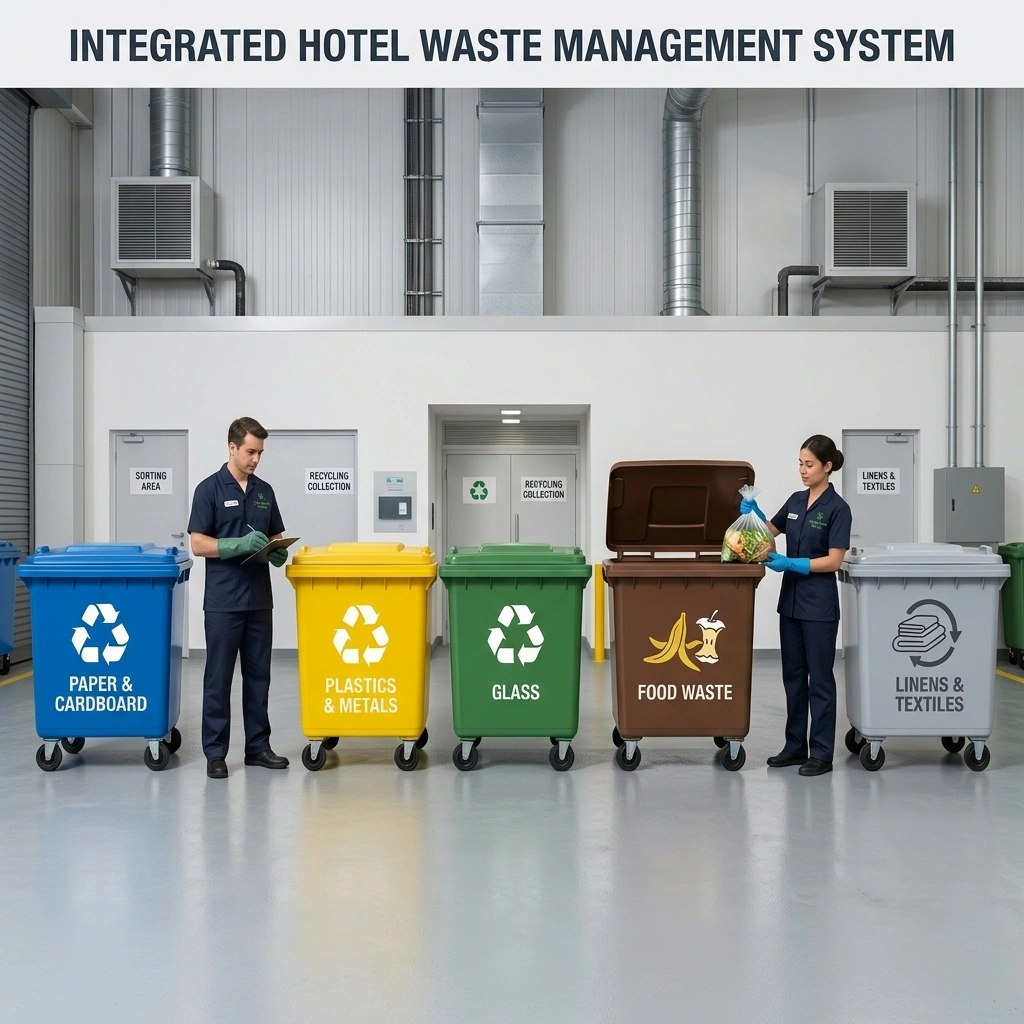
Hotels generate five key waste streams: food, plastics, paper and cardboard, textiles, and liquid or greywater debris.
| Waste Stream | What It Includes | Why It Adds Up |
|---|
| Food waste | Plate waste, over-produced buffets, prep scraps, spoiled inventory | Usually the largest and heaviest stream |
| Plastics | Single-use toiletries, water bottles, laundry bags, food packaging | Steady daily volume across every occupied room |
| Paper and cardboard | Bulk delivery packaging, guest receipts, brochures, admin paperwork | Easiest stream to eliminate through digital systems |
| Textiles | Stained sheets, towels, pillows, worn staff uniforms | Bulky and costly to dispose of properly |
| Liquid and greywater debris | Kitchen fat, oil, and grease (FOG), laundry lint | Rarely tracked, but a common cause of plumbing failures |
Pro Tip: Track food waste by weight for two weeks before changing anything. Owners are consistently surprised by which meal period generates the most loss, and the fix is usually a prep schedule change, not a new system.
What Are the Main Sources of Waste in Hotels?
The main sources of hotel waste are guest behavior, kitchen over-production, bulk supply deliveries, and untracked back-of-house habits.
- Customer plate waste and over-budgeted buffets drive most avoidable food loss.
- Bulk supply deliveries generate cardboard and plastic pallet wrapping before a guest ever checks in.
- Guest-side habits, like daily towel changes and single-use amenities, quietly compound the plastic and textile stream.
- Untracked kitchen prep, run without reference to booking data, causes repeat over-ordering week after week.
Identifying the source matters more than identifying the stream. Two properties can both generate heavy food waste, but one traces back to buffet over-production while the other traces back to a broken prep schedule. The fix is different in each case.
What Reduction Strategies Cut Waste at the Source?
Reduction strategies prevent waste before it happens, which is always cheaper than sorting or hauling it later.
- Switch to bulk and refillable dispensers for soap, shampoo, and breakfast condiments instead of single-serving packaging.
- Match kitchen prep and buffet size to booking data instead of a fixed daily quantity regardless of occupancy.
- Remove disposable trash liners from guestroom bins where dry trash is collected, saving plastic across thousands of checkouts.
- Digitize check-in, folios, and marketing materials to cut paper waste before it's ever printed.
None of these require new construction or major capital. Most are supplier or process changes an owner can make within a single budget cycle.
What Reduction and Diversion Strategies Handle What's Left?
Diversion strategies redirect waste that source reduction can't eliminate, through composting, donation, and circular partnerships.
- Composting and biodigestion: kitchen scraps go to on-site landscaping, local farms, or anaerobic digesters that convert organic waste into biogas energy.
- Soap upcycling: partnerships with organizations that collect partially used bars, sanitize them, and re-press them for community distribution.
- Linen circularity: stained or torn sheets and towels go to ventures that upcycle them into rags, budget rentals, or consumer totes.
- Standardized diversion tracking: the Sustainable Hospitality Alliance methodology gives properties a consistent way to measure what's actually being diverted versus landfilled.
Diversion works best as a second layer, applied after reduction, not as a replacement for it.
What Are Common Misconceptions About Hotel Waste?
The most common misconception is that hotel waste is too costly or time-consuming to track, when most fixes take less effort than the waste itself.
Tracking Waste Takes Too Much Staff Time
Weighing a few bins for two weeks takes less staff time than most owners assume, and it only needs to happen once to set a baseline.
Our Recycling Doesn't Actually Get Recycled
This is true only when bins are contaminated by mixed waste. Clear signage and short staff training fix most contamination issues.
Food Waste Is Inevitable at a Buffet
Buffet waste drops sharply once portions and refill timing are matched to actual booking counts instead of a fixed daily setup.
Composting Requires Special Equipment
A basic composting arrangement with a local hauler or community garden needs no on-site equipment for most independent properties.
How Does Waste Break Down by Department?
Waste breaks down differently by department, and each one needs a distinct fix rather than one blanket policy.
A single "reduce waste" memo rarely works because housekeeping, kitchen, and front office are solving different problems. Splitting the plan by department makes each fix concrete enough for staff to actually follow.
What Housekeeping Should Focus On
Housekeeping generates the textile and amenity waste: worn linens, half-used toiletries, and packaging from single-use items. The highest-return fix is replacing small bottles with wall-mounted refillable dispensers, which cuts plastic waste and restocking labor together. A guest opt-out program for daily towel and linen changes cuts both water use and laundry-driven wear, and it requires only a card in the room, not new equipment.
What Kitchen and F&B Should Focus On
Kitchen waste is dominated by food, so the fix starts with ordering discipline rather than composting alone. Chefs who review historical booking data before setting buffet size cut over-production before it happens.
What Front Office Should Focus On
Front office waste is almost entirely paper: printed folios, receipts, and marketing collateral left at the desk. Moving these onto digital workflows removes most of this stream without asking staff to change habits.
How Does Waste Management Differ by Property Type?
Waste management priorities shift by property type, since the source of waste and the guest behavior around it change from a campground to a hotel group.
| Property Type | Where the Volume Comes From | What to Prioritize |
|---|
| RV Parks and Campgrounds | Guest-managed sites, propane canisters, vehicle holding tanks | Centralized, wildlife-proof disposal and dump stations |
| Independent and Boutique Hotels | Guest rooms and a small restaurant kitchen | Design-matched sorting bins and local farm partnerships |
| Extended-Stay Hotels | Kitchenette grocery packaging over weeks-long stays | In-unit sorting drawers and bulk lobby grocery options |
| Inns, B&Bs, and Hostels | Shared kitchens and communal breakfast service | Guest education and bulk breakfast dispensers |
| Hotel Groups and Multi-Property Portfolios | Supply chain and cross-property inconsistency | Standardized procurement contracts and shared audit dashboards |
RV Parks and Campgrounds Play by Different Rules
RV parks and campgrounds hand guests their own outdoor space, which changes the waste problem from in-room sorting to containment. Open bins attract wildlife, so heavy-duty, animal-proof central stations near the camp store replace individual site trash cans.
Two other risks are specific to this property type. Empty single-use propane canisters need a dedicated, clearly marked drop-off cage rather than mixed disposal. Filtered dump stations for vehicle holding tanks prevent guests from dumping greywater onto open soil, which is both an environmental and a compliance risk.
Pro Tip: Place the propane and greywater stations near the camp store, not at individual sites. Visibility at a staffed location cuts misuse far more than signage alone.
How Do You Measure and Track Waste Reduction?
Measuring waste reduction means tracking volume or weight over time, not just counting the number of new programs you started.
This is the step most hotel waste guides skip, and it is the one that decides whether a program lasts. A recycling bin that nobody weighs or audits tends to quietly stop working within a few months.
The World Sustainable Hospitality Alliance publishes a standardized Hotel Waste Measurement Methodology that gives owners a consistent way to track specific waste factors and daily volumes. Adopting a simple version, even just tracking hauling invoices and food waste by weight monthly, turns a one-time cleanup into an ongoing metric. Hotel groups running multiple properties can extend this into a shared dashboard that flags which locations are missing sorting goals or overpaying for pickups.
Pro Tip: Compare hauling invoices month over month before and after a change. A drop in pickup frequency or bin count is often the clearest proof a program is working, well before a formal audit confirms it.
What Mistakes Make Waste Programs Fail?
Waste programs fail most often when they rely on staff memory instead of built-in systems, or when nobody follows up after launch.
Launching Bins Without Training Staff
Recycling and composting bins only work if staff and guests know what goes where. A property that installs sorting bins but skips a short training session usually ends up with contaminated recycling that gets sent to landfill anyway.
Treating It as a One-Time Project
A waste audit run once, with no repeat measurement, tends to lose momentum within a season. Waste management works as an ongoing habit, not a single initiative marked complete.
Ignoring the Kitchen's Ordering Pattern
Composting and donation programs help, but they treat the symptom. If a kitchen consistently over-orders for occupancy, no amount of downstream sorting fixes the underlying cost problem.
What Is roommaster's Role in Reducing Hotel Waste?
A property management system will not sort recycling or run a composting program, but it removes one entire waste stream directly: paper. A platform like roommaster replaces printed folios, paper check-in forms, and manual marketing handouts with digital versions staff and guests use the same way, without an extra printing step.
roommaster's real-time occupancy and booking data also supports the food waste fix described earlier. A kitchen that can see actual booking counts, instead of guessing, has what it needs to size prep and buffet volume to real demand rather than a fixed daily quantity. This is the one place a PMS meaningfully connects to waste reduction, and it is worth being specific about rather than overstating.
For independent owners already running lean, this matters because it needs no new staff training beyond what the front desk already does daily.
Bottom Line
Hotel waste management is a cost and compliance problem before it is an environmental one. Reduction stops waste before it happens, while diversion handles what remains through composting and circular partnerships. The right mix shifts by property type, and the owners who see lasting results are the ones who measure the change.
{{cta-strip}}
Frequently Asked Questions
1. What is hotel waste management?
Hotel waste management means reducing, reusing, and recycling everything a property discards, covering food, plastics, paper, and textiles.
2. What type of waste do hotels produce the most?
Food and kitchen waste typically makes up the largest and heaviest share of a hotel's total waste stream.
3. What is the difference between reduction and diversion strategies?
Reduction prevents waste before it happens, while diversion redirects unavoidable waste through composting, donation, or upcycling.
4. How does waste management differ for an RV park versus a hotel?
RV parks focus on wildlife-proof containment and dump stations, while hotels focus on in-room sorting and kitchen ordering discipline.
5. How do you know if a waste reduction program is working?
Track hauling invoices and food waste by weight over time, since a drop in pickup frequency is usually the clearest early signal.
6. Does a PMS have anything to do with hotel waste management?
Yes, a connected PMS removes paper waste directly and gives kitchens the occupancy data to size prep accurately.
7. Do hotels need special permits for hazardous waste?
Yes, items like batteries, cleaning chemicals, and used cooking oil often require separate hazardous waste disposal handling.

.png)
.png)
.png)