Hotel guest feedback analysis is the critical process of evaluating raw guest reviews, surveys, and complaints and turning them into structured trends, operational priorities, and actionable improvement plans.
Hotel guest feedback analysis is the step between collecting and acting on reviews, not the collecting itself.
Quantitative scores tell you something has changed. Qualitative comments tell you why, and those are two different jobs.
It runs on a repeatable process: gather feedback from every channel, score sentiment by department, spot patterns, then act.
The most common failure is collecting detailed data that never changes a staffing decision or a service standard.
What Is Hotel Guest Feedback Analysis?
Hotel guest feedback analysis is the systematic process of collecting, categorizing, and evaluating guest comments, ratings, and reviews. It turns unstructured text into clear operational improvements. Hotel guest evaluation goes beyond collecting opinions and focuses on understanding guest perspectives that inform practical actions.
Hotel guest feedback analysis is the step between collecting and acting on reviews. It includes evaluating feedback and using sentiment analysis to plan changes that improve operations and guest satisfaction. The task is to transform unstructured comments into clear trends, priorities, and opportunities.
Why Guest Feedback Analysis Matters For Reputation And Revenue
Sentiment analysis turns a wall of review text into a number a manager can act on. Instead of reading two hundred reviews line by line, a hotel can see cleanliness sentiment dropping over three weeks. That gives a housekeeping supervisor time to fix it before it shows up in the star rating.
That speed matters because reputation and revenue move together. A guest comparing properties reads recent reviews before comparing rates. A pattern of unresolved complaints reads as risk, not just a lower number. Tracking sentiment by category, rather than one blended score, shows whether a rating dip traces back to one fixable department or a broader problem.
Quantitative Vs. Qualitative Feedback: What Each One Actually Tells You
A star rating is quantitative. It tells you something changed, up or down, but not why. A written review is qualitative, and that's where the actual cause usually lives.
A hotel that only tracks its average rating knows it dropped from 4.4 to 4.1 last month. It doesn't know whether that's a housekeeping issue, a noisy renovation next door, or one bad batch of front desk hires. Reading the comments behind the score, not just the score, is what turns a number into a decision.
Both matter, but for different reasons. Quantitative data is what you report to ownership and track over time. Qualitative data is what you hand to the department head who has to actually fix something.
{{ai-guest-management}}
Where Hotel Guest Feedback Comes From
Feedback reaches a hotel through three channels. Direct feedback comes from front desk conversations, text messages, and automated post-stay surveys. Indirect feedback shows up in public reviews on TripAdvisor, Google Reviews, and Booking.com. In-stay touchpoints, a QR code in the room or a mid-stay SMS check-in, catch issues while the guest can still be helped.
In-stay touchpoints matter more than hotels usually give them credit for. A guest who flags a broken AC unit at 2pm can get a fix and a better stay. The same complaint showing up in a post-stay survey three days later only tells you what already went wrong.
A 4-Step Framework For Analyzing Hotel Guest Feedback
Managing review insights runs on a repeatable four-step process, not a one-time cleanup.
1. Collect Every Channel Into One View
Gather direct feedback from front desk chats and post-stay surveys. Add indirect feedback from Google, TripAdvisor, and Booking.com. A hotel checking five separate dashboards will miss patterns a single view would show immediately.
2. Score Sentiment By Department
Use sentiment analysis tools to tag feedback as positive, neutral, or negative. Map each tag to a specific department, not one blended score. A negative tag on "check-in speed" tells the front desk manager something a general 3-star rating never will.
3. Categorize And Segment
Group feedback by theme, cleanliness, staff interaction, pricing, or amenities. Segment it further by traveler type, business versus leisure, or by length of stay. A business traveler flagging slow Wi-Fi points to a different fix than a leisure guest flagging pool hours.
4. Apply The ACAF Method And Plan Action
Acknowledge the feedback, clarify anything ambiguous, act on the insight, and follow up with the guest. Prioritize capital investments, staff training, or procedural changes based on which friction points actually recur.
How To Analyze Feedback Effectively
Hotels running structured feedback programs see it pay off directly, stronger guest satisfaction scores, a real lift in repeat bookings, and better upselling conversion. That combination is what actually builds loyalty and reputation over time, not just a higher star rating in isolation.
Track a focused set of KPIs: Hotels that watch fewer, clearly defined metrics act faster than teams drowning in every number available. Prioritize ADR, RevPAR, and direct bookings for revenue goals, NPS and repeat guest ratios for relationship strength, and conversion rate and review volume for demand generation. Choose KPIs your team can actually influence through training or service recovery, not just numbers to watch.
Build one simple dashboard: Separate revenue metrics, operational indicators, and sentiment scores clearly, update it weekly, and assign one owner so every department works from the same source of truth.
Analyze trends before reacting to one review: Compare feedback before and after an operational change, a new process, a staffing shift, to see if satisfaction actually moved, rather than reacting to a single complaint.
Act on what repeats:80% of hotel guests prioritize quick resolution to their complaints, and hotels that reply fast are the ones guests actually trust enough to return to. Clear, fast communication is what separates hotels guests trust from ones they don't.
Monitor after you act: Staff who get customer service training targeted at the specific issues feedback surfaces improve guest satisfaction more reliably than generic training. Targeted responses, not one-time fixes, are what drive lasting improvement.
{{ai-guest-management-one}}
What Good Sentiment Analysis Extracts Beyond A Star Rating
A star rating tells you a guest is unhappy. Good sentiment analysis tells you why they're unhappy, where the breakdown happened, and what it costs you if it goes unfixed.
Four layers of business intelligence separate real sentiment analysis from a flat star rating.
1. Granular Aspect Mapping: The What And Where
A 3-star rating gives a vague, blended score to the entire property. Sentiment analysis breaks a single review into separate aspect-sentiment pairs instead, isolating individual operational elements within one block of text.
A single review might praise the front desk, complain about AC noise, and stay neutral on breakfast variety, all in the same paragraph. Mapped correctly, each of those points routes back to a specific department, not one blended score nobody owns.
2. Emotion Intensity And Intent: The How Bad
A 1-star review from a guest whose shower ran lukewarm looks identical to a 1-star review from a guest who found bedbugs, if you're only reading the number. Natural language processing can weigh the modifiers, urgency, and language behind a complaint to score how severe it actually is.
That scoring flags high-risk language, phrases like "unacceptable," "never returning," or "health hazard," so a team can skip the standard queue and act on the highest-risk complaints first, before a guest posts about it publicly.
3. Topic Correlation And Root-Cause Tracking: The Why
Star ratings move with occupancy, season, or weather, and rarely point to the actual operational cause behind a dip. A stronger sentiment engine groups recurring, related language across reviews to surface the pattern driving a score down.
If a hotel's overall rating drops, this kind of tracking can show that "wait time," "line," and "understaffed" spike specifically between 3pm and 5pm on Fridays, pointing straight at a front desk scheduling gap rather than a vague service problem.
4. Value Vs. Price Perception: The Wallet Share
A 4-star review at a luxury resort and a 4-star review at a roadside motel read the same on paper, even though the guest's price expectations were completely different. Isolating comments that explicitly link the stay to what the guest paid gives a clearer read on perceived value than the star score alone.
Tracking phrases like "not worth the money" against "great value for the price" gives revenue teams the actual signal behind an ADR decision, instead of adjusting rate based on a star average that hides why guests feel that way.
Advantages Of A Hotel PMS With Automated Guest Feedback Analysis
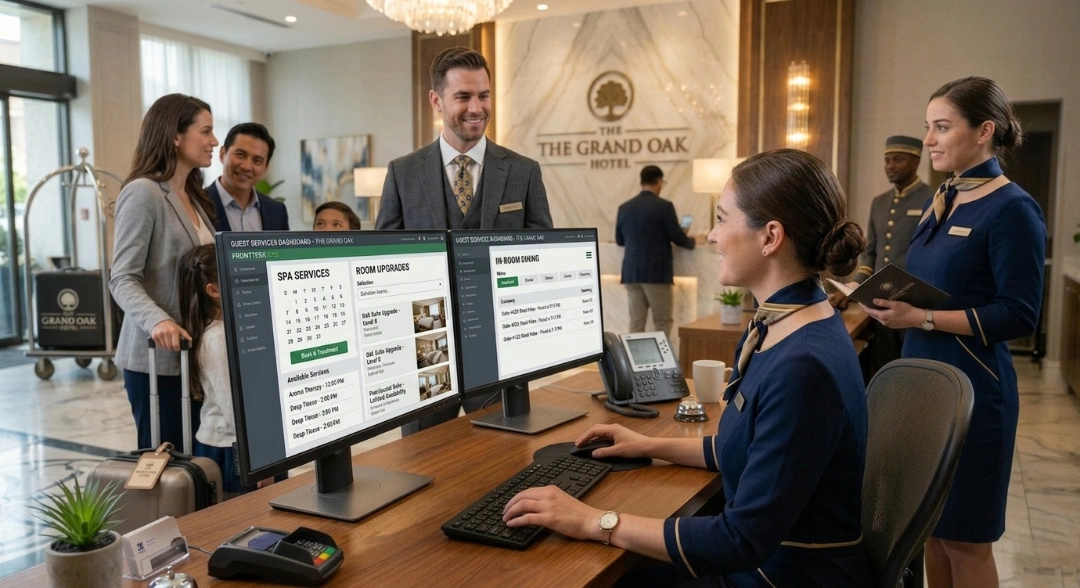
Feedback spread across a survey tool, a review site, and a messaging app is hard to read as one picture. Someone has to manually stitch it together before any pattern shows up. A property management system that centralizes guest profiles fixes that, giving every department the same feedback history against the same guest record.
A connected guest engagement platform keeps pre-arrival, in-stay, and post-stay messages tied to that same profile. A guest who flagged a noisy room on night one won't get the same generic checkout survey as everyone else. For questions that come in by phone rather than by review, an AI voice agent like roommaster Concierge captures the call and logs it instead of letting it go unrecorded.
A hotel guest app that lets guests flag an issue in-stay, rather than waiting for a post-stay survey, catches problems while staff can still fix the actual visit.
Common Pitfalls In Hotel Guest Feedback Analysis
Treating it as a one-time report. Feedback patterns shift with seasons and staffing changes, so a single audit goes stale within a quarter.
Reading every comment individually instead of by pattern. One complaint about a slow check-in means less than the same complaint from five guests in a month.
Scoring sentiment without mapping it to a department. A blended score tells you something is wrong. A department-level score tells you what to fix.
Collecting feedback with no clear owner. Data nobody is assigned to act on sits in a dashboard instead of becoming a decision.
Closing the loop internally but never with the guest. Fixing the issue without telling the guest who raised it misses the trust-building part.
{{ai-guest-management-two}}
How roommaster Hotels Respond To Guest Feedback
After a review comes in, 40% of consumers expect a reply within the first hour, and 79% expect one within 24 hours. Five habits turn that response into trust instead of a checked box.
Thank the guest by name. "Thank you, [Guest Name], for sharing your thoughts. We're sorry for the inconvenience with [specific issue], and we hope to welcome you back soon."
Acknowledge the specific points raised. Reference details from the review itself, so the guest knows it was actually read, not skimmed.
Show empathy without being defensive. Validate what the guest felt rather than explaining why it wasn't the hotel's fault.
Explain what's changing. Naming a concrete step, personalized follow-up, staff training, or a maintenance fix, shows the feedback led somewhere.
Invite them back. "We'd love to welcome you again on your next visit" works for praise. "We hope to make your next stay better" works for complaints.
Staying consistent and on-brand across every response is what compounds this into a stronger reputation over time, not just a single good reply.
Boost Guest Sentiment And Drive Better Experiences With roommaster
The hardest part of guest feedback analysis isn't reading the reviews. It's keeping the process current without turning it into a manual chore every week. roommaster keeps guest profiles, messaging, and sentiment history connected across the PMS and guest engagement platform, so front desk, housekeeping, and management read the same record.
If your team is piecing together guest sentiment from scattered surveys and review sites, recurring issues keep surfacing after checkout instead of during the stay. roommaster connects feedback collection to the same platform running your reservations and guest communication. Reviewing real examples in roommaster's case studies shows how independent hotels have used that connection to close the loop faster.
Real Examples of Hotels Improving Through Feedback
Many hotels have transformed their operations and guest experiences by listening to feedback and leveraging the right technology, such as roommaster PMS.
Here are two real-world examples of independent properties that improved performance, efficiency, and guest satisfaction:
1. Wood River Inn
Since 1998, Wood River Inn has thrived as a 57-room independent hotel. Owner Ryan Allison implemented roommaster to streamline operations while preserving the property’s unique identity. This allowed the hotel to:
Unify systems, eliminate data silos, reduce administrative burden, and save four hours per day
Gain real-time visibility, enabling Ryan to adjust rates, monitor arrivals, and make decisions remotely
Increase direct bookings by 57% through the integrated booking engine to improve margins and strengthen guest relationships
As a result, staff now focus on delivering exceptional experiences rather than back-office tasks.
2. NUVO Suites
NUVO Suites, a 384-unit independent property in Miami, faced challenges competing with large hotel chains. roommaster tailored its PMS to handle NUVO’s unique room layouts, non-traditional numbering, and varied room types.
Here’s what NUVO Suites achieved next:
Implemented mobile key access and OTA channel management to streamline operations, reduce errors, and allow staff to focus on guests
Used integrated payments and automated workflows to speed up check-in and check-out, improving service efficiency
Achieved measurable improvements in guest satisfaction and operational performance, enabling the hotel to compete effectively with larger brands
Leveraged personalized support and seamless technology to deliver consistent, tech-enabled guest experiences
{{cta-strip}}
Frequently Asked Questions
1. What is the best way to analyze guest feedback?
Collect feedback from every channel, direct, indirect, and in-stay, then score sentiment by department rather than as one blended number. Categorize by theme, watch for patterns that repeat, and apply the ACAF method, acknowledge, clarify, act, and follow up, to close the loop with the guest.
2. What's the difference between quantitative and qualitative guest feedback?
Quantitative feedback is a score, a star rating or an NPS number, and it tells you that something changed. Qualitative feedback is the written comment behind it, and it tells you why, which is usually the part that actually leads to a fix.
3. How does sentiment analysis help hotels improve guest experience?
Sentiment analysis turns unstructured review text into a department-level score a manager can act on the same day. It surfaces patterns, like cleanliness sentiment dropping over several weeks, before they show up as a lower star rating or a canceled repeat booking.
4. How often should hotels review guest feedback?
Review sentiment and recurring themes weekly. A monthly cadence lets a fixable issue repeat for a month before anyone acts. Property-level context, like which departments to focus on, can be reassessed quarterly since it shifts more slowly than day-to-day sentiment.
5. What tools help hotels analyze guest feedback at scale?
An integrated PMS with guest engagement software, like roommaster, keeps feedback tied to the same guest profile used at booking and check-in. Sentiment analysis and review aggregation tools add scale once volume gets too high to read manually.
6. What is the ACAF method for handling guest feedback?
ACAF stands for acknowledge, clarify, act, and follow up. Acknowledge the feedback so the guest knows it was received, clarify anything ambiguous in what they raised, act on the underlying issue, then follow up with that same guest to confirm the fix landed. It turns a one-way complaint into a closed loop.
7. Can a small independent hotel run guest feedback analysis without a dedicated team?
Yes. The four-step framework, collect, score, categorize, act, works with one person checking a single dashboard weekly. The scale that requires a dedicated analyst comes later, at the point where review volume across channels gets too high to read manually, not at the starting line.
8. How should hotels handle a negative review that isn't accurate?
Respond calmly, acknowledge the guest's experience without conceding a false claim, and correct the specific detail without getting defensive. A factual, even-toned reply reads better to future guests than either silence or an argumentative one, since most readers are judging the response as much as the original complaint.
pms-two
Hotel Operations Made Simple and Effective with roommaster
Mayela Lozano is a content strategist with a passion for hospitality and technology. She collaborates with roommaster on content creation, highlighting how technology can streamline hotel operations and enhance guest satisfaction. When she’s not creating content, Mayela loves to travel and spend time with her two little ones, discovering new adventures and making memories along the way.
Join Thousands of Hotels Thriving with roommaster
The transition to roommaster is straightforward and efficient. Our implementation team handles data migration including reservations, guest profiles, and historical information.
The transition to roommaster is straightforward and efficient. Our implementation team handles data migration including reservations, guest profiles, and historical information.
Hotel Check-In Kiosk: Enhance the Guest Experience
October 5, 2026
Hospitality Technology
Hotel Management
Hospitality Trends
Hotel Self Check-In: How It Works, Types, Benefits And Setup
October 1, 2026
Hotel Management
Hospitality Trends
Hotel Check-In & Check-Out Times Explained
October 1, 2026
Hospitality Trends
Hotel Management
Cloud-Based Property Management System: Hotel PMS
October 1, 2026
General
Cloud PMS
AI
Cloud Computing In The Hospitality Industry: A Complete Guide For Hotels
October 1, 2026
General
Best Hotels in Montreal: A Complete Guide
September 25, 2026
General
Best Hotels in Edmonton: A Complete Guide
September 25, 2026
General
Best Hotels in Banff: A Complete Guide
September 25, 2026
General
Best Hotels in Calgary: A Complete Guide
September 25, 2026
General
Best Hotels in Whistler: A Complete Guide
September 25, 2026
Join Thousands of Hotels Thriving with roommaster
See how roommaster's unified platform can work for your property. Our team will walk you through features tailored to your specific needs and operations.




.png)
.png)
.png)