Hotel's Competitive Set (Compset): Hoteliers Guide 2026
A competitive set (comp set) is a group of direct hotel rivals sharing a target audience, pricing tier, and location, chosen by class, size, and guest profile to benchmark rate, occupancy, and growth opportunities.
A comp set is the small group of direct competitors a hotel benchmarks itself against for rate, occupancy, and revenue performance, not just the nearest properties on a map.
Hotels build a comp set around location, product tier, pricing and target market, and shared amenities, then keep it to roughly 5 to 7 properties.
Three index scores, MPI, ARI, and RGI, turn raw comp set data into a clear read on occupancy share, rate positioning, and overall revenue performance.
Reviewing the comp set at least twice a year and watching for bias keeps the benchmark honest as the local market changes.
What Is A Hotel's Competitive Set (Comp Set)?
A hotel's competitive set, or comp set, is a curated group of 5 to 7 direct competitor properties a hotel uses to benchmark its rates, occupancy, and revenue performance. It reflects the actual alternatives a guest weighs when booking a stay, not simply the hotels sitting closest to it.
A comp set only works when it mirrors real guest choice. Two hotels can sit on the same block and still belong in different comp sets if one is a budget motel and the other a boutique property, since neither one is who the other's guest is actually comparing rates against. Getting this grouping right is the foundation for every benchmarking decision that follows, including how a property prices its rooms through roommaster Revenue Management.
The Role Of A Comp Set In Hotel Revenue Management
A comp set isn't just a benchmarking exercise, it's one of the core inputs a revenue manager works from every day. Every rate change, forecast, and distribution decision assumes some read on how the property stacks up against its direct competitors, and the comp set is what makes that read concrete instead of a gut feeling.
Within revenue management specifically, a comp set feeds three ongoing decisions:
Pricing: Whether today's rate sits where the market will actually bear it, based on what comparable properties are charging for the same dates.
Forecasting: Whether a soft booking pace reflects a property-specific problem or a market-wide dip, since comp set occupancy trends show which one it is.
Positioning: Whether the property's rate and product actually match the tier it's competing in, or needs to shift up or down to align with guest expectations.
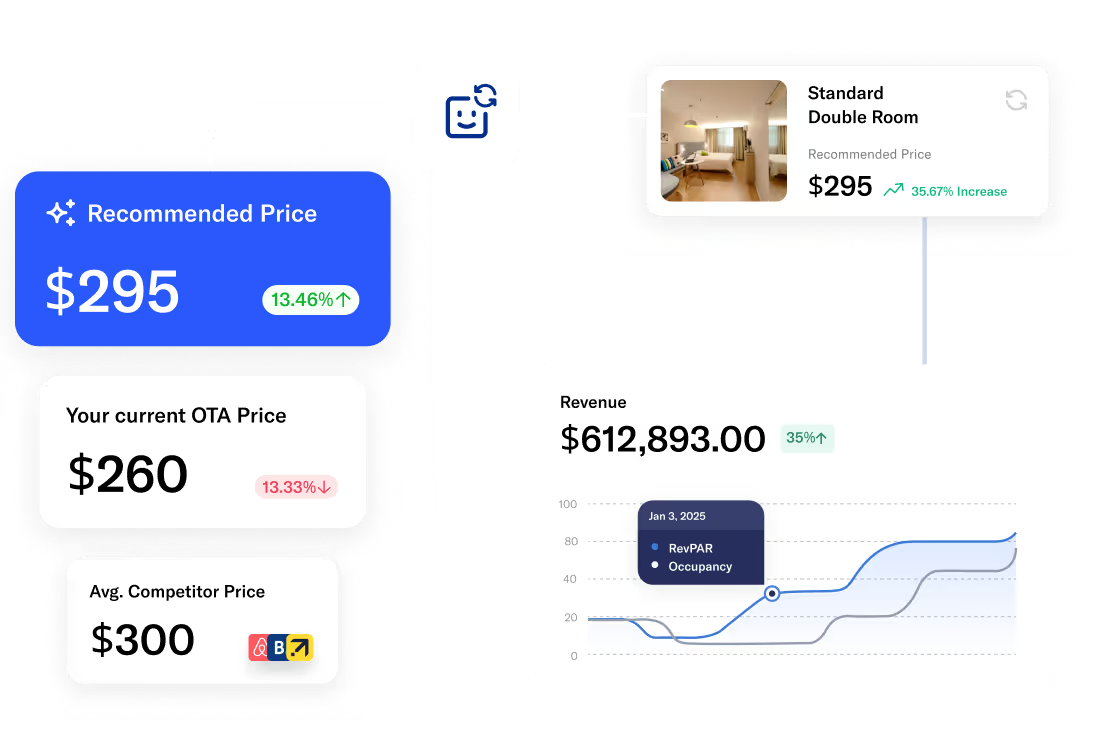
Most hotels don't run this manually for long. A dedicated revenue management software automates the rate changes once the comp set data points to one."
This is why RevPAR alone rarely tells the full story. A property can hit its own RevPAR target and still be losing ground if the whole comp set is growing faster, which is exactly what the RGI metric below is built to catch.
{{revenue-management-one}}
How To Determine Your Hotel's Competitive Set
A comp set gets built around a small set of shared traits, not proximity alone. The properties that belong in it are the ones a guest would genuinely cross-shop against yours.
Location: Properties in the same neighborhood, district, or logical destination a guest would consider as an alternative.
Product tier: Comparable star ratings, class, and overall physical quality.
Pricing and target market: A similar average daily rate (ADR) and guest mix, whether that's corporate, leisure, or group business.
Amenities: Shared core offerings, like a spa, meeting space, or complimentary breakfast, that shape how guests compare options.
Online reputation: Review scores, rating volume, and metasearch rankings that reveal how guests actually perceive comparable properties.
Most hotels land on 5 to 7 properties. A smaller group stays easy to track meaningfully; a larger one starts diluting the benchmark. For a full property and rate-tracking worksheet once the group is set, the Hotel Competitive Set Analysis Template walks through building the profile for each competitor.
Most properties also keep a version or two of this core group for a specific purpose: a seasonal comp set that shifts for high versus low season demand, or an aspirational comp set of higher-tier properties used to guide where the hotel wants to position itself next. The reverse comp set, covered below, rounds out the picture.
How To Analyze Your Competitive Set
Building the list is step one. The value comes from what a hotel does with the data once the comp set is in place.
What comp set analysis reveals:
Benchmarking: Where your occupancy, rate, and revenue actually stand against peers, not just against last year's numbers.
Pricing strategy: Whether your rates are positioned above, at, or below what the market is willing to pay for a comparable stay.
Gap analysis: Where a competitor's offering falls short, whether that's amenities, distribution, or guest reviews, and where your property can win instead.
A common gap worth watching for: an ADR sitting below the comp set average despite guest reviews that are just as strong, or stronger. That combination usually signals the property is undervalued rather than overpriced, and points toward raising rates rather than discounting further.
Best practices for keeping it accurate:
Avoid bias by resisting the urge to pick weaker hotels just to make your own numbers look better.
Re-evaluate the group at least twice a year, since new openings and shifting demand change who guests actually compare you to.
Track a reverse comp set too, the hotels that list you as one of their competitors, since it often surfaces rivals you hadn't considered.
Most independent hotels pull this data from direct rate shopping and public OTA listings. Properties that subscribe to an industry benchmarking service can also read it through a STR report, which packages comp set comparisons into a standardized monthly format.
{{revenue-management-two}}
How To Analyze Your Competitive Set
Building the list is step one. The value comes from what a hotel does with the data once the comp set is in place.
What comp set analysis reveals:
Benchmarking: Where your occupancy, rate, and revenue actually stand against peers, not just against last year's numbers.
Pricing strategy: Whether your rates are positioned above, at, or below what the market is willing to pay for a comparable stay.
Gap analysis: Where a competitor's offering falls short, whether that's amenities, distribution, or guest reviews, and where your property can win instead.
A common gap worth watching for: an ADR sitting below the comp set average despite guest reviews that are just as strong, or stronger. That combination usually signals the property is undervalued rather than overpriced, and points toward raising rates rather than discounting further.
Best practices for keeping it accurate:
Avoid bias by resisting the urge to pick weaker hotels just to make your own numbers look better.
Re-evaluate the group at least twice a year, since new openings and shifting demand change who guests actually compare you to.
Track a reverse comp set too, the hotels that list you as one of their competitors, since it often surfaces rivals you hadn't considered.
Most independent hotels pull this data from direct rate shopping and public OTA listings. Properties that subscribe to an industry benchmarking service can also read it through a STR report, which packages comp set comparisons into a standardized monthly format.
Key Metrics To Track Against Your Comp Set
Three index scores turn raw comp set numbers into a performance read at a glance.
MPI (Market Penetration Index): Benchmarks your occupancy against the comp set average.
ARI (Average Rate Index): Benchmarks your ADR against the comp set average.
RGI (Revenue Generation Index): Benchmarks your overall RevPAR against the comp set average.
A score above 100 on any of these means you're outperforming the comp set; below 100 signals a gap worth investigating. For the full formulas and a ready-to-use tracker to calculate each one, see the Hotel Competitive Set Analysis Template.
Common Comp Set Mistakes To Avoid
Picking properties that are geographically close but not genuine alternatives from a guest's point of view.
Choosing weaker hotels on purpose so your own performance numbers look better than they are.
Letting the group go stale instead of revisiting it as new properties open or old ones reposition.
Comparing on rate alone and skipping the gap analysis on amenities, distribution, and guest reviews.
Ignoring the reverse comp set, the hotels that already consider you a competitor.
Comparing raw review scores without checking review volume, since a property with 50 reviews and one with 2,000 aren't measuring guest sentiment the same way.
Turn Your Comp Set Into A Competitive Advantage
A comp set is only as useful as the pricing decisions it drives, and that's where the benchmark has to connect directly to your day-to-day rate strategy. roommaster is built by hoteliers with 30+ years in the industry, and its Revenue Management tools use real-time demand signals, competitor pricing, and local events to help independent hotels turn comp set data into action rather than a static report that sits unread. Properties using roommaster's AI-driven pricing have seen RevPAR increase by up to 35%, the kind of result a comp set is meant to point you toward.
{{cta-strip}}
Frequently Asked Questions
1. What is a competitive set (comp set) in hotel revenue management?
In revenue management, a competitive set (comp set) is the group of 5 to 7 direct competitor properties a revenue manager benchmarks rate, occupancy, and RevPAR against to guide pricing and forecasting decisions. It turns general market awareness into a specific, trackable comparison that pricing strategy can actually be built on.
2. What's the difference between a comp set and a market segment?
A comp set is a group of competing properties you benchmark against. A market {{revenue-management-one}}segment is a group of guests you target, grouped by traits like travel purpose or booking behavior. One measures your competition, the other measures your demand.
3. What is a reverse comp set, and why does it matter?
A reverse comp set is the group of hotels that list your property as one of their own competitors. It often includes properties you hadn't considered a direct rival, and reviewing it regularly helps catch blind spots in your primary comp set.
4. Should online-only competitors like Airbnb be included in a comp set?
Only if they genuinely compete for the same guest and occasion your hotel does. A short-term rental drawing a different traveler, like an extended-stay family group, usually belongs in a separate analysis rather than your core comp set.
5. How is a comp set different from your target market or ideal guest profile?
A comp set is about who else the guest is considering, not who the guest is. Your target market or guest profile describes the traveler you want to attract; the comp set describes the other properties competing for that same traveler.
6. Who should own comp set tracking at an independent hotel?
At most independent properties, this falls to the general manager or whoever owns pricing decisions, since the comp set directly informs rate strategy. Larger properties or groups often assign it to a dedicated revenue manager instead.
7. Does a comp set stay the same over time?
No. A comp set should shift as new hotels open, existing ones renovate or reposition, and local demand patterns change. Reviewing it at least twice a year keeps the benchmark accurate instead of comparing against a market that no longer exists.
8. Does a hotel need more than one comp set?
Full-service properties often do. A hotel's room inventory competes with nearby hotels, but its restaurant may compete with independent local dining and its spa with standalone wellness centers. Tracking each revenue center against its own comparable set gives a more accurate read than folding everything into one list.
Key Metrics To Track Against Your Comp Set
Three index scores turn raw comp set numbers into a performance read at a glance.
MPI (Market Penetration Index): Benchmarks your occupancy against the comp set average.
ARI (Average Rate Index): Benchmarks your ADR against the comp set average.
RGI (Revenue Generation Index): Benchmarks your overall RevPAR against the comp set average.
A score above 100 on any of these means you're outperforming the comp set; below 100 signals a gap worth investigating. For the full formulas and a ready-to-use tracker to calculate each one, see the Hotel Competitive Set Analysis Template.
Common Comp Set Mistakes To Avoid
Picking properties that are geographically close but not genuine alternatives from a guest's point of view.
Choosing weaker hotels on purpose so your own performance numbers look better than they are.
Letting the group go stale instead of revisiting it as new properties open or old ones reposition.
Comparing on rate alone and skipping the gap analysis on amenities, distribution, and guest reviews.
Ignoring the reverse comp set, the hotels that already consider you a competitor.
Comparing raw review scores without checking review volume, since a property with 50 reviews and one with 2,000 aren't measuring guest sentiment the same way.
Turn Your Comp Set Into A Competitive Advantage
A comp set is only as useful as the pricing decisions it drives, and that's where the benchmark has to connect directly to your day-to-day rate strategy. roommaster is built by hoteliers with 30+ years in the industry, and its Revenue Management tools use real-time demand signals, competitor pricing, and local events to help independent hotels turn comp set data into action rather than a static report that sits unread. Properties using roommaster's AI-driven pricing have seen RevPAR increase by up to 35%, the kind of result a comp set is meant to point you toward.
{{cta-strip}}
Frequently Asked Questions
1. What is a competitive set (comp set) in hotel revenue management?
In revenue management, a competitive set (comp set) is the group of 5 to 7 direct competitor properties a revenue manager benchmarks rate, occupancy, and RevPAR against to guide pricing and forecasting decisions. It turns general market awareness into a specific, trackable comparison that pricing strategy can actually be built on.
2. What's the difference between a comp set and a market segment?
A comp set is a group of competing properties you benchmark against. A market segment is a group of guests you target, grouped by traits like travel purpose or booking behavior. One measures your competition, the other measures your demand.
3. What is a reverse comp set, and why does it matter?
A reverse comp set is the group of hotels that list your property as one of their own competitors. It often includes properties you hadn't considered a direct rival, and reviewing it regularly helps catch blind spots in your primary comp set.
4. Should online-only competitors like Airbnb be included in a comp set?
Only if they genuinely compete for the same guest and occasion your hotel does. A short-term rental drawing a different traveler, like an extended-stay family group, usually belongs in a separate analysis rather than your core comp set.
5. How is a comp set different from your target market or ideal guest profile?
A comp set is about who else the guest is considering, not who the guest is. Your target market or guest profile describes the traveler you want to attract; the comp set describes the other properties competing for that same traveler.
6. Who should own comp set tracking at an independent hotel?
At most independent properties, this falls to the general manager or whoever owns pricing decisions, since the comp set directly informs rate strategy. Larger properties or groups often assign it to a dedicated revenue manager instead.
7. Does a comp set stay the same over time?
No. A comp set should shift as new hotels open, existing ones renovate or reposition, and local demand patterns change. Reviewing it at least twice a year keeps the benchmark accurate instead of comparing against a market that no longer exists.
8. Does a hotel need more than one comp set?
Full-service properties often do. A hotel's room inventory competes with nearby hotels, but its restaurant may compete with independent local dining and its spa with standalone wellness centers. Tracking each revenue center against its own comparable set gives a more accurate read than folding everything into one list.
revenue-management-one
Put Your Hotel Pricing Optimization on Autopilot with AI
Mayela Lozano is a content strategist with a passion for hospitality and technology. She collaborates with roommaster on content creation, highlighting how technology can streamline hotel operations and enhance guest satisfaction. When she’s not creating content, Mayela loves to travel and spend time with her two little ones, discovering new adventures and making memories along the way.
Join Thousands of Hotels Thriving with roommaster
The transition to roommaster is straightforward and efficient. Our implementation team handles data migration including reservations, guest profiles, and historical information.
The transition to roommaster is straightforward and efficient. Our implementation team handles data migration including reservations, guest profiles, and historical information.
Hotel Check-In Kiosk: Enhance the Guest Experience
October 5, 2026
Hospitality Technology
Hotel Management
Hospitality Trends
Hotel Self Check-In: How It Works, Types, Benefits And Setup
October 1, 2026
Hotel Management
Hospitality Trends
Hotel Check-In & Check-Out Times Explained
October 1, 2026
Hospitality Trends
Hotel Management
Cloud-Based Property Management System: Hotel PMS
October 1, 2026
Hotel Management
Cloud PMS
Hotel Management System (HMS): A Complete Guide
September 23, 2026
Hospitality Trends
Hospitality Technology
Hotel PMS
Hotel Management
Cloud PMS
How Hotel PMS Software Transforms Hospitality Management
September 23, 2026
Hotel Management
Marketing
Pet-Friendly Hotel Amenities & Package Ideas That Drive Revenue
September 22, 2026
Hotel Management
Hotel PMS
Hotel Food And Beverage (F&B): The Complete Guide
September 22, 2026
Hotel Management
Marketing
Hotel Pet Fees: How Much Should You Charge?
September 22, 2026
Hotel Management
Hotel PMS
Best Hotel Food and Beverage (F&B) Management Software In 2026
September 22, 2026
Join Thousands of Hotels Thriving with roommaster
See how roommaster's unified platform can work for your property. Our team will walk you through features tailored to your specific needs and operations.


.png)
.png)
.png)