Looking for an Ampliphi alternative? Here are six revenue-management options worth comparing: 1. roommaster, 2. IDeaS, 3. Duetto, 4. RoomPriceGenie, 5. Atomize and 6. PriceLabs.
Each one fixes a different gap that Ampliphi leaves open, from wanting pricing built into your PMS rather than a separate subscription to needing enterprise-grade forecasting for a large revenue team.
This guide sorts them by segment fit, pricing model, automation style and how the pricing connects to the rest of your operation.
Why hotels look for Ampliphi alternatives
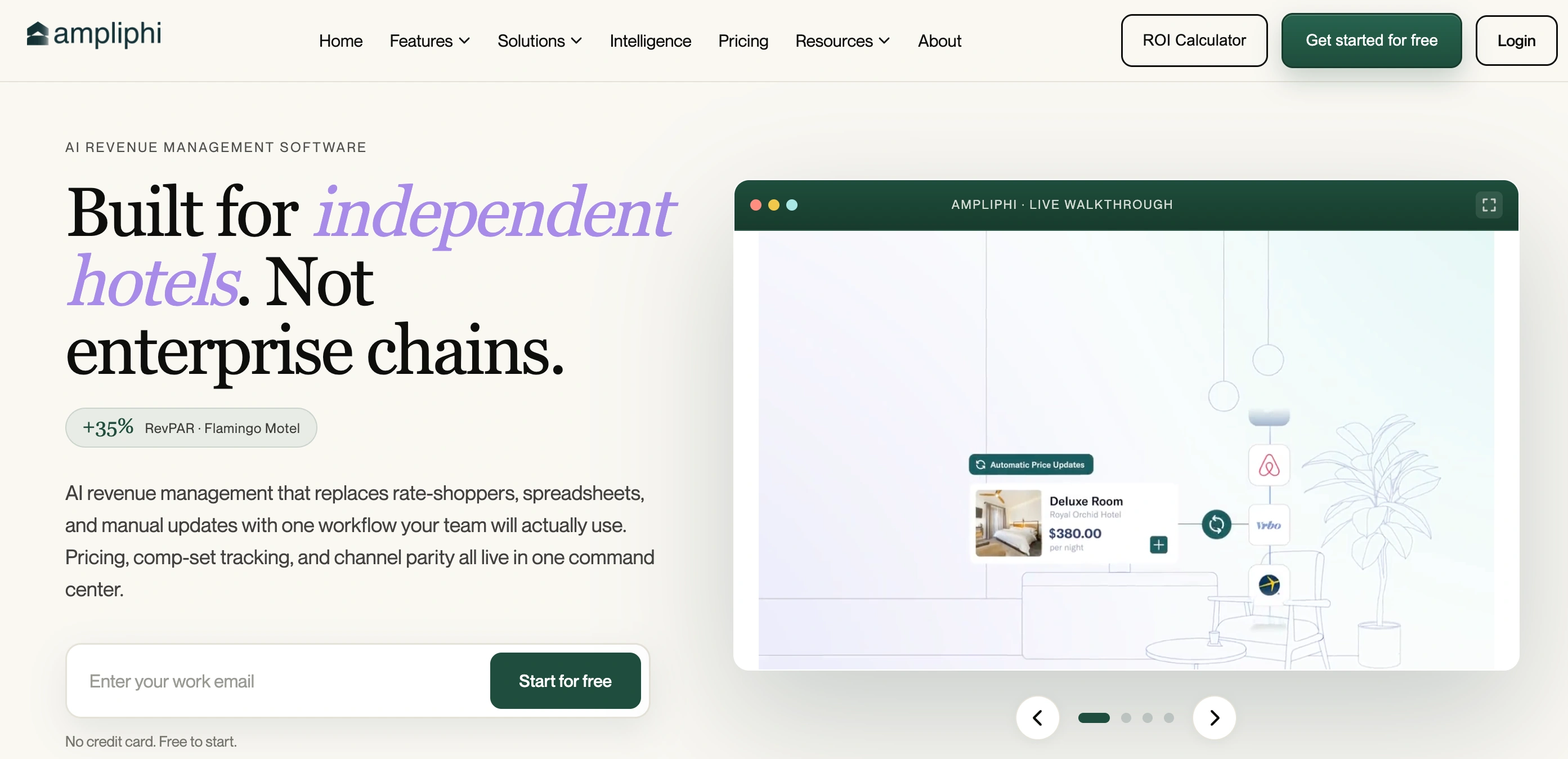
Ampliphi is a young AI revenue-management system built for independent hotels, and it does one job: automate pricing off live market data. That focus is also why teams compare it against other options before committing:
- It is a standalone RMS, not a full operating system: Ampliphi sits on top of your PMS and channel manager, so you still pay for and manage those separately. Some independents would rather have revenue management live inside the PMS they already run.
- It is a newer entrant: founded in 2024 and headquartered in Clearwater, Florida, Ampliphi has a shorter track record and a smaller review history than long-established RMS names, which matters when you are trusting software to move your rates automatically.
- Pure-play depth versus simplicity: operators with a dedicated revenue manager often want the deeper forecasting and segmentation that enterprise systems like IDeaS or Duetto provide, while very small properties want something even simpler and cheaper.
- Integration dependence: because an RMS only works well when it is wired tightly to your PMS and rate distribution, the switch reason is often less about the pricing engine itself and more about wanting fewer moving parts.
What hoteliers say: On Reddit's r/askhotels, revenue managers repeatedly split the category by property size. They point to IDeaS for serious automation at larger or brand-managed hotels, and to Lighthouse (formerly OTA Insight) for rate shopping and market intelligence, while operators of small independents say the enterprise tools are overkill and ask for simpler, cheaper set-and-forget pricing (names like RoomPriceGenie and happyhotel come up as easy to run without a dedicated revenue manager). The recurring theme: match the tool to whether you actually have someone to run it.
If those trade-offs sound familiar, the six alternatives below map to the switch reasons independent hoteliers cite most.
Comparing the 6 best Ampliphi alternatives
Pricing models below reflect each vendor's published or commonly cited entry point as of July 2026. Ratings and review context come from Capterra, G2 and Hotel Tech Report, since sample size matters when a score looks high.
| Tool |
Best for |
Pricing model |
Property/segment fit |
Standout capability |
| roommaster |
Pricing built into the PMS |
Custom quote (contact sales) |
Independent, boutique, groups, motels, resorts |
Built-in revenue management inside a full cloud PMS |
| IDeaS |
Large hotels and chains |
Enterprise-tiered quote |
200+ rooms, chains, casino resorts |
Deep AI forecasting and automation (G3) |
| Duetto |
Groups with revenue teams |
Quote, scales with complexity |
Larger properties, casino resorts, groups |
Open Pricing across room type, segment and channel |
| RoomPriceGenie |
Small independents |
From about EUR 198/month (Core) |
Independents, B&Bs, hostels (5 to 60 rooms) |
Simple, fast-to-set-up dynamic pricing |
| Atomize |
Set-and-forget automation |
Quote-based |
Independent and mid-size hotels |
Real-time price updates as demand shifts |
| PriceLabs |
Mixed hotel and rental units |
From about $19.99/month or ~1% of revenue |
Independents, STRs, mixed portfolios |
Hybrid automation with granular manual control |
The pricing model matters more than any single number here. Ampliphi, roommaster, IDeaS, Duetto and Atomize all quote per property, so a headline rate rarely tells the full story once room count and modules are added. RoomPriceGenie and PriceLabs publish entry rates, but PriceLabs also scales as a percentage of revenue, and a standalone RMS still assumes you are paying separately for the PMS and channel manager it plugs into.
A worked cost example: what a RevPAR uplift is worth
For a revenue-management tool, the number that matters is not the subscription but the lift it produces. Take a 40-room independent hotel running a $150 average daily rate at 72% occupancy. That is a RevPAR (revenue per available room) of $108 a night.
- Available room-nights per month: 40 rooms x 30 nights = 1,200.
- Baseline monthly room revenue: 1,200 x $108 = about $129,600.
- A conservative 6% RevPAR uplift from smarter dynamic pricing: $108 x 0.06 = $6.48 more per available room-night.
- Extra monthly revenue: 1,200 x $6.48 = about $7,776.
Vendors like Atomize publicly report 10 to 20% RevPAR gains in their case studies, so 6% is a deliberately cautious figure. Even at that level, the uplift dwarfs the software cost, which is why the right question is not "what does the RMS cost" but "how reliably does it move RevPAR for a property my size, and does it wire cleanly into the rates my channel manager pushes out."
How we chose these Ampliphi alternatives
This list is built for independent and boutique operators weighing an Ampliphi replacement, not for enterprise chains with in-house data science teams. Four criteria shaped it:
- Segment fit: each tool is placed by the property size it actually serves well, since an RMS built for casino resorts behaves very differently from one built for a 20-room inn. The split between enterprise depth and independent simplicity is clearest in a head-to-head like IDeaS vs Duetto.
- Automation style: fully automated versus hybrid human-control pricing, because a lean team and a property with a dedicated revenue manager want opposite things.
- How pricing connects to operations: whether the tool is a standalone RMS you bolt on, or revenue management that lives inside the PMS and pushes rates straight to the channel manager.
- Transparent evaluation: published or commonly cited pricing models and public review context, not marketing claims.
Top 6 Ampliphi alternatives
1. roommaster (best for revenue management built into the PMS)
Best for: independent and boutique hotels that want dynamic pricing to live inside the same system as their front desk, distribution and booking engine, rather than as a separate RMS subscription.
roommaster (formerly innQuest) is a cloud hotel property management system with revenue management built in, alongside a channel manager, a commission-free booking engine, an AI concierge and a guest app. roommaster has run hotel software for more than 25 years and supports properties from offices in the US, Canada, UK and Australia.
Key features
- Built-in revenue management that adjusts rates automatically off demand and occupancy, so pricing decisions happen inside the PMS instead of a bolt-on tool you have to reconcile
- Front desk, reservations, housekeeping and night audit in one cloud PMS, giving the revenue engine live occupancy and pickup data to price against
- Channel manager with real-time OTA sync across Booking.com, Expedia, Airbnb, Vrbo and Agoda, so a new rate reaches every channel without a separate push
- Commission-free booking engine that turns your own website into a zero-fee direct channel, protecting the margin a pricing lift is meant to capture
- Openness to connect a dedicated standalone RMS if a hotel wants pure-play depth, so revenue management can grow with the property rather than force a rip-and-replace
- AI concierge, AI guest management and a hotel guest app with mobile check-in and digital keys for the guest-facing side of the operation
- Integrated payments plus a marketplace of 100+ integrations covering accounting, POS and door locks
{{pms-two}}
Pros
- Pricing, distribution and the front desk share one system of record, so a rate change is informed by real-time pickup and flows to every channel without the sync errors that come from stitching an RMS, PMS and channel manager from three vendors.
- The commission-free booking engine goes after OTA commission, the biggest cost line for most independents, so a RevPAR lift on direct bookings is not immediately handed back as a 15% fee.
- 24/7 phone, chat and email support from offices across four countries means a pricing or distribution error at 2am reaches a human, not a ticket queue.
- One vendor and one invoice cover the whole operation, which removes the "who owns this bug" finger-pointing that fragmented revenue stacks create.
Cons
- The built-in revenue management is aimed at hotels that want solid automated pricing inside the PMS, not the deepest forecasting and segmentation a large revenue team would get from a dedicated IDeaS or Duetto deployment.
- Pricing is quote-based rather than published, so you need a short sales call to benchmark it against a transparently priced tool like RoomPriceGenie.
- Because it is a full PMS, a property that only wants a pricing engine to sit on top of an existing system it is happy with is buying more platform than the narrow use case needs.
Verdict: the strongest fit if you want revenue management, distribution and the front desk in one platform rather than a standalone RMS to manage and reconcile.
{{pms-three}}
2. IDeaS (best for large hotels and chains)
Best for: large hotels, brand-managed properties and casino resorts with a dedicated revenue team and deep forecasting requirements.
IDeaS, owned by the analytics company SAS, is widely regarded as the enterprise standard in revenue management. Its G3 system is a fully automated, AI-powered RMS, and the company reports serving more than 13,000 clients across 140 countries.
Key features
- G3 automated pricing engine with AI-driven demand forecasting built for high-volume, complex properties
- Deep segmentation and group-pricing analytics suited to hotels with mixed transient, corporate and group business
- Enterprise reporting and analytics designed for revenue teams, not just an owner-operator
- Broad PMS and channel-manager integrations across major hospitality systems
- Scenario modeling and forecasting depth that supports multi-property and portfolio-level strategy
Pros
- The forecasting and automation depth is hard to match, so a large property with the data volume and a revenue manager to run it can extract more nuanced pricing than a lightweight tool allows.
- Its scale and 140-country footprint mean strong integrations and a mature partner network, which lowers the risk of a connection gap with your existing stack.
- Being SAS-owned brings serious analytics credibility, reassuring for a group standardizing an RMS across many hotels.
Cons
- IDeaS requires proper training to use effectively and can be more than an independent needs, so a small property without a revenue manager often leaves most of the value unused.
- Pricing is enterprise-tiered and not publicly listed, and it scales with complexity, so budgets can climb fast for a smaller operator. Weigh other IDeaS alternatives if you run under 100 rooms.
- Implementation and configuration take longer than a plug-and-play tool, which is a real cost for a lean team.
Verdict: the pick for a large or brand-managed property with a revenue team, and usually overkill for a single independent.
3. Duetto (best for groups with a revenue team)
Best for: larger independent hotels, groups and casino resorts that want to price by room type, segment and channel independently.
Duetto is a standalone cloud RMS built around Open Pricing, a model that lets a hotel set rates independently across room types, segments and channels rather than moving one master rate. It suits properties with the operational depth to configure and maintain a sophisticated system.
Key features
- Open Pricing engine that prices each room type, channel and segment on its own curve
- Demand forecasting that blends historical, on-the-books and market data
- Analytics and reporting geared to revenue managers running active pricing strategies
- Group and event pricing tools for properties with meaningful group business
- Integrations with major PMS and distribution systems for real-time rate delivery
Pros
- Open Pricing gives an experienced revenue team fine-grained control that flat, single-rate tools cannot match, which pays off at properties with varied room types and channels.
- It is purpose-built for larger and more complex operations, so a group with dedicated revenue staff gets depth rather than a simplified engine.
- Strong analytics help teams justify and refine pricing decisions with data, useful when reporting up to ownership.
Cons
- Duetto is aimed at hotels with revenue teams and enterprise budgets, so a small independent without dedicated staff can find it heavy to configure and maintain. Compare lighter Duetto alternatives before committing.
- Pricing is quote-based and scales with complexity, which makes budgeting harder for a smaller operator.
- The learning curve and setup effort are real, and the payoff depends on having someone to actively manage the system.
Verdict: a strong choice for a group or larger property with a revenue team, and more system than a lean independent needs.
4. RoomPriceGenie (best for small independents)
Best for: independent hotels, B&Bs and hostels of roughly 5 to 60 rooms that want simple, reliable dynamic pricing without hiring a revenue manager.
RoomPriceGenie is a dynamic pricing tool built specifically for small properties, with a user-friendly interface that is quick to set up and run. It was named the top overall RMS in the 2026 HotelTechAwards and rates highly with B&B and inn operators on Hotel Tech Report.
Key features
- Automated daily price recommendations, with options to run on full autopilot or keep manual control
- Simplified setup designed for owners without a revenue background
- Competitor-rate and market-demand inputs feeding the pricing engine
- Multi-property dashboard on the higher tier for operators with a couple of sites
- Broad PMS and channel-manager integrations for small-hotel systems
Pros
- It is built for exactly the segment Ampliphi targets, so a small independent gets dynamic pricing without the density of an enterprise tool it would never fully use.
- Published, predictable pricing (plans run from about EUR 198/month Core to EUR 297 Premium to EUR 440 Professional, with roughly 17% off on annual billing) makes budgeting easy, a rarity in this category.
- Fast setup and a gentle learning curve mean a lean team can be live and pricing within days, not weeks. See other RoomPriceGenie alternatives if you expect to scale past 60 rooms.
Cons
- The simplicity that suits small hotels is a ceiling for larger or more complex properties that need deep segmentation and channel-level pricing.
- It is a standalone tool, so you still run and pay for your PMS and channel manager separately and depend on those integrations staying healthy.
- Very large or multi-property groups will outgrow its scope and want an enterprise system.
Verdict: the easiest and most transparently priced fit for a small independent that wants pricing handled without a specialist.
5. Atomize (best for real-time set-and-forget automation)
Best for: independent and mid-size hotels that want rates to update the moment demand shifts, with minimal manual input.
Atomize, now part of Mews, built its reputation on real-time price optimization: it was among the first systems to update rates as market conditions change rather than on a fixed schedule. It ranks near the top of Hotel Tech Report's RMS category and is well regarded for ease of use among independents.
Key features
- Real-time price optimization that updates rates as demand and market signals move, not on a nightly batch
- Autopilot mode for hands-off automation, with guardrails to cap how far rates can move
- Clean interface and mobile app rated highly by independent properties
- Demand forecasting and performance reporting tied to ADR and RevPAR goals
- Integrations across major PMS and channel-manager systems, including the wider Mews ecosystem
Pros
- Real-time updates capture short-lived demand spikes that a once-a-day tool can miss, which is where much of the reported RevPAR uplift comes from.
- The autopilot approach suits a lean team that wants pricing to run itself, with boundaries set once rather than watched daily.
- Ease of use scores well with independents, so onboarding is quicker than with an enterprise system.
Cons
- Pricing is quote-based rather than published, so you need a demo to know where it lands for your property size.
- As a standalone RMS, it depends on tight PMS and channel-manager integrations, and its closest ties are within the Mews ecosystem after the acquisition.
- Fully automated pricing takes trust and careful guardrail setup, which some hands-on operators find takes time to get comfortable with.
Verdict: a strong pick for an independent that wants genuinely real-time, hands-off pricing and is comfortable running a separate RMS.
6. PriceLabs (best for mixed hotel and rental portfolios)
Best for: independents and operators running both hotel rooms and short-term-rental units who want hybrid automation with granular manual control.
PriceLabs is a dynamic pricing tool used by more than 500,000 properties, with a large short-term-rental base and growing hotel use. It combines automation with human control through customizable rules, market data and event-based pricing.
Key features
- Rule-based automation that pairs algorithmic pricing with operator-set overrides and minimum-stay controls
- Customizable dashboards and event-demand data for hands-on revenue managers
- Broad integrations across PMS, channel-manager and vacation-rental platforms
- Portfolio-level controls suited to operators managing many units at once
- Published entry pricing from about $19.99/month, or roughly 1% of revenue at scale
Pros
- The hybrid model gives operators fine manual control on top of automation, which suits those who want to shape pricing rather than hand it over entirely.
- Its strong short-term-rental heritage makes it a practical fit for a property that also runs apartments or vacation-rental units alongside hotel rooms.
- Transparent, low entry pricing and event-data tooling give hands-on operators a lot of control for the money.
Cons
- Its center of gravity is short-term rentals, so a pure hotel with complex segment and group pricing may find hotel-specific depth thinner than a dedicated hotel RMS.
- The rule-based control that power users like means more setup and ongoing tuning than a set-and-forget tool.
- Pricing as a percentage of revenue can rise for a larger portfolio, so confirm where the cost lands at your scale.
Verdict: the best fit for a mixed hotel-and-rental operator who wants hands-on control and a low entry point.
{{pms-one}}
How to choose between Ampliphi and these alternatives
Use your property size and how much you want to manage the pricing, not the feature list, to narrow the field. Borrow the questions any good RMS demo should answer:
- Do you want pricing inside your PMS or as a standalone tool? Built-in favors roommaster; a dedicated engine on top of an existing PMS points to Atomize, RoomPriceGenie or PriceLabs.
- Do you have a revenue manager? With a dedicated team and a larger property, IDeaS or Duetto earn their depth; without one, a small independent is better served by RoomPriceGenie or roommaster's built-in pricing. The side-by-side roommaster vs RoomPriceGenie view makes that trade concrete.
- Fully automated or hybrid control? Atomize leans set-and-forget; PriceLabs gives rule-based manual control; RoomPriceGenie offers both.
- Do you also run vacation-rental units? PriceLabs handles mixed portfolios best.
- How does the RMS connect to your channel manager, and what are the pricing model, setup effort and support hours? Confirm these in writing, because an RMS only pays off when its rates reach every channel cleanly.
Match against property size too: under about 50 rooms with no revenue manager leans to RoomPriceGenie or roommaster's built-in pricing; mid-size independents suit Atomize; larger properties and groups with revenue teams favor IDeaS or Duetto.
See how roommaster prices, distributes and runs your front desk in one platform. Book a demo and bring your current ADR and occupancy so the numbers are real.
Why roommaster is a strong Ampliphi alternative
For teams weighing Ampliphi, the honest question is whether you want revenue management as a standalone system or built into the platform that already runs your hotel. Ampliphi is a dedicated RMS that sits on top of your PMS and channel manager, so pricing lives apart from operations. roommaster takes the opposite approach and closes that gap:
- Built-in revenue management runs inside the same system as the front desk, so pricing decisions use live occupancy and pickup and reach every channel without a separate push.
- A commission-free booking engine protects the direct-booking margin a pricing lift is meant to earn, which a standalone RMS on its own cannot do.
- A channel manager and payments ship in the same platform, so a new rate is distributed and settled without stitching vendors together.
- 24/7 phone, chat and email support across four countries covers the overnight pricing or distribution issue that a young, narrowly scoped tool may not.
- One vendor and one invoice replace the RMS-plus-PMS-plus-channel-manager stack with a single system of record.
That said, be honest about where a pure-play RMS wins. If you run a large or complex property with a dedicated revenue team, a standalone IDeaS integration or Duetto integration will give deeper forecasting and segmentation than any built-in engine, and roommaster can connect one rather than force a compromise. The side-by-side roommaster vs IDeaS and roommaster vs Duetto breakdowns show that trade plainly. For most independents, though, the practical win is having pricing, distribution and the front desk in one platform instead of a bolt-on RMS to manage and reconcile.
Bottom line
Ampliphi is a capable young RMS for independents that want automated pricing on top of their existing stack. But if you would rather not run a separate revenue system, or if you need either enterprise depth or small-hotel simplicity, the six alternatives here cover every switch reason. A single small property gets the easiest path from RoomPriceGenie or roommaster's built-in pricing; a large group with a revenue team gets more from IDeaS or Duetto; and an operator who wants pricing, distribution and the front desk in one platform gets the most complete fit from roommaster. Shortlist two, run demos with your own ADR and occupancy, and let the RevPAR lift, not the sticker price, decide.
{{cta-strip}}
FAQs
What is the best Ampliphi alternative for independent hotels?
For a small independent that wants simple, transparent pricing, RoomPriceGenie is a strong fit. If you would rather have revenue management built into your PMS alongside the front desk and channel manager, roommaster is the more complete option.
How does roommaster compare to Ampliphi?
Ampliphi is a standalone RMS that sits on top of your PMS. roommaster is a full cloud PMS with revenue management built in, so pricing runs inside the same system as your front desk, channel manager and commission-free booking engine, and it can also connect a dedicated RMS if you want one.
Is Ampliphi a roommaster product?
No. Ampliphi is a separate, independent revenue-management company (getampliphi.com), founded in 2024. roommaster has its own built-in revenue management and can integrate with various standalone RMS tools, but Ampliphi is a competitor, not a roommaster feature.
Which Ampliphi alternative is best for large hotels?
IDeaS and Duetto are built for large hotels, chains and casino resorts with dedicated revenue teams. Both offer deeper forecasting and segmentation than tools aimed at independents, though they need more setup and a revenue manager to run well.
Are there cheaper alternatives to Ampliphi?
Ampliphi and most enterprise RMS tools quote per property. RoomPriceGenie publishes plans from about EUR 198/month, and PriceLabs starts around $19.99/month or roughly 1% of revenue. Always confirm what the quote or plan includes for your room count.
Do I need a standalone RMS or can pricing live in my PMS?
It depends on scale. A small or mid-size independent without a revenue manager can often rely on built-in PMS pricing like roommaster's. A larger property with a revenue team gets more from a dedicated RMS such as IDeaS or Duetto connected to the PMS.

.png)
.png)
.png)