Hotel SEM Guide 2026: Search Engine Marketing Explained
"roommaster is really a combination between the operational ease of use, training, the functionality of the program itself, coupled with the service makes it a winning combination." - Alex Moore, President & CEO, Seaboard Hotels
Hotel search engine marketing (SEM) drives direct bookings through paid, targeted ads that secure top positions on search engines like Google.
With Google averaging 85.2 billion visits per month, top visibility on search engine results pages (SERP) creates immediate exposure for your hotel's website.
A strong campaign combines search engine optimization (SEO) and SEM, while protecting branded traffic and targeting high-intent guests.
Smart keyword targeting, remarketing, and Google Hotel Ads help independent hotels compete with OTAs that dominate search engine advertising.
Every dollar spent on hotel SEM is trackable through Google Analytics and conversion tracking, making ROI measurable and controllable.
Effective execution requires strong landing pages, smart bidding, clear tracking of key metrics, and constant optimization.
No matter what type of property you run, you need direct bookings to grow revenue. When guests book on your site, you keep more profit and build a stronger relationship from the start.
If you want travelers to find you, you need to show up on page one of search results on Google, Bing, and Yahoo. Most people never look past that first page. If you do not appear there, you lose bookings to someone else.
Page one rankings do not happen by luck. You need a clear search engine marketing (SEM) strategy that helps you compete with other hotels, online travel agencies (OTAs), and metasearch sites. Every property fights for the same guest. You need the right strategy and the right budget to stand out.
In this guide, you will learn how hotel search engine marketing works and how you can build a strategy that drives more direct bookings starting today.
What is SEM?
Search engine marketing is a process that uses paid advertisement to place your hotel at the top of search results.
In hotel marketing, SEM focuses on paid campaigns on Google and other search engines to capture booking intent right away. Hotels bid on specific search terms, appear at the top of search engine results pages (SERPs), and direct travelers to optimized web pages that convert.
You do not wait months to see results. SEM gives you instant visibility and clear data that shows what works and what does not.
How Does Hotel Search Engine Marketing Work?
Every winning hotel marketing campaign starts with keyword research. You need to know what travelers type into search engines when they look for a place to stay.
You choose keywords that match your rooms, location, and amenities. From there, you run pay-per-click (PPC) ads that target those terms. When someone searches for one of your keywords, your ad appears. If they click, you pay for that click and guide them to a page built to convert them into a guest.
Common terms like “nice hotels” attract a lot of searches, and hence, heavy competition, which makes it difficult for your ads to run on SERPs. Targeted, long-tail keywords like “hotel with a pool in San Francisco near the Golden Gate Bridge” attract fewer searches, but they bring stronger intent. These more specific keywords tend to convert at a higher rate because travelers who search with clear, detailed intent are usually much closer to booking than those browsing with broad, general terms.
You can use tools like Semrush, Google Keyword Planner, and Ahrefs to find the right keywords. These platforms show search volume, competition level, and keyword difficulty. When you match your keywords to real booking intent, you drive better traffic and more direct reservations.
SEO Vs SEM
If you are new to hotel marketing, the difference between SEO and SEM can be confusing. SEO, or search engine optimization, focuses on organic, non-paid methods to rank your website. SEM, or search engine marketing, uses paid ads to appear in search results.
A well-designed search marketing strategy should combine both hotel SEO and SEM techniques in order to produce the best results. Both techniques complement each other. SEM gives instant visibility, while local SEO builds long-term credibility and authority.
Google considers your website’s quality when ranking ads. Part of that quality score comes from how credible your site appears. An SEO strategy strengthens credibility through:
High-quality website content with relevant keywords
Link building and earning backlinks
Properly formatted URLs and site structure
Consistent content updates and optimization
When you use SEO and SEM together, you attract more qualified visitors to your website. That traffic converts into direct bookings more often than visitors who find you through other channels.
Every hotelier asks the same question at some point. How do we reach Google’s top 10 search results and stay there? Keywords guide travelers to your site, but only the ones that match their intent will convert.
While there are many strategies you can use to choose your focus keywords, these work the best:
Long-tail keywords
Trending topics and current events
Already-ranking keywords
These keywords can help you reach page one, but they work best when combined with a solid content strategy.
1. Target long-tail keywords
Long-tail keywords are specific, descriptive search phrases that help you rank faster and attract the right guests. Think of the difference between “golf club” and “left-handed titanium golf club.” While broad keywords are competitive and take months to rank for, long-tail keywords connect you with people who are ready to take action.
It’s better to have 10 highly interested visitors who are ready to book than 1,000 casual browsers.
Here’s how to find them:
Listen to your guests: Read reviews of your hotel and competitors to see how people describe services, amenities, and experiences.
Use keyword research tools: Platforms like Google Keyword Planner, Ahrefs, or SEMrush can reveal specific long-tail phrases your audience searches for.
Think like a guest: Combine location, service, and experience, e.g., “pet-friendly downtown hotel near conference center” or “romantic beachfront hotel with spa.”
2. Target trending keywords
Another way to boost your Google rankings is to create content around trending topics or events. This technique is also known as newsjacking. While it can be hit or miss, timely content can land your page in Google’s News section or higher in organic search results.
Since many others will also be covering the story, your edge comes from unique insights, expert opinions, or fresh angles that set your content apart.
Here’s how you can find trending topics:
Google Trends
Social media feeds like Twitter Moments and Facebook Trends
Industry news or local events relevant to your guests
3. Leverage already-ranking keywords
Your existing content may already rank for keywords you did not target. Use this advantage.
Check your analytics dashboard for search queries that drive traffic. Focus on:
Keywords related to your amenities or services that lack dedicated content
Existing pages that could expand to cover more terms
Variations of keywords you already cover
Creating content for these keywords boosts your rankings and strengthens your entire site.
To reach, or exceed, this benchmark, your landing pages must deliver real value to both your business and your target audience. Here is what separates average hotel pages from high-performing ones.
1. Tight message match
The headline must immediately reflect the exact promise made in the search ad or email campaign. If your ad promotes “Luxury Weekend Spa Escape in Vegas,” the landing page cannot open with a generic brand statement. It must continue that same narrative.
When the message matches, visitors feel they landed in the right place, and that reassurance reduces bounce rates and increases booking intent.
2. Minimalist, focused design
High-converting landing pages remove top navigation menus, footer clutter, and unnecessary outbound links. When users have fewer choices, they make decisions faster.
A streamlined layout keeps attention fixed on the booking engine and the offer itself.
3. Compelling above-the-fold experience
The first screen must communicate value instantly while creating emotional engagement. This section should combine a strong, benefit-driven headline with a high-resolution hero image or short cinematic video that captures the experience being sold.
At the same time, the booking form or primary call to action must remain visible without forcing the user to scroll.
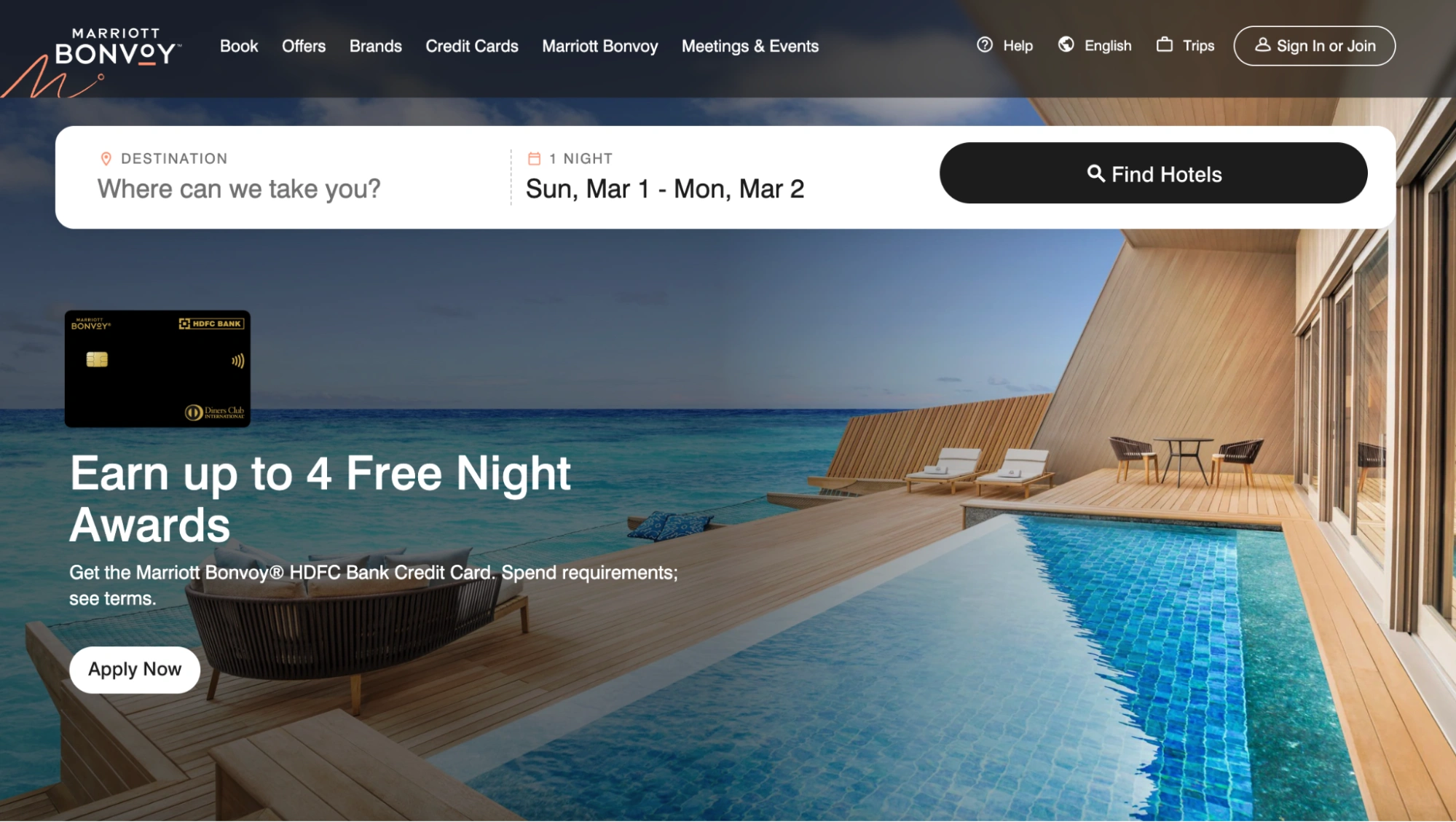
For example, when you look at the landing page of Marriott Bonvoy, what do you notice?
The expansive oceanfront villa, the infinity pool merging into the horizon, and the sense of aspirational luxury immediately draw you in. Before you consciously read the copy, the imagery has already sold you an experience. Then, your eyes move to the bold value proposition, “Earn up to 4 Free Night Awards,” which clearly communicates the benefit without unnecessary explanation.
Visitors decide within seconds whether to stay or leave, so the opening section must clearly answer what the offer is, why it matters, and how to secure it.
4. Strong and specific calls to action
Generic buttons such as “Submit” or “Learn More” weaken performance. Action-oriented CTAs convert better because they clarify the outcome.
Hence, you must use phrases like:
“Book Your Spa Package”
“Secure Your Exclusive Rate”
“Reserve Your Ocean View Room”
The CTA should appear multiple times throughout the page, especially after persuasive sections.
As we noticed in the Marriot’s landing page example, the destination search field, date selector, and “Find Hotels” button sit prominently in the navigation bar, ensuring users can take immediate action. The primary CTA, “Apply Now,” also appears clearly within the hero section, providing a second conversion path aligned with the campaign objective.
The result is a seamless above-the-fold experience that answers three essential questions instantly:
What is the offer? Earn up to four free night awards.
Why does it matter? It provides tangible travel rewards tied to a luxury brand experience.
How do I act? Use the search bar to find hotels or click “Apply Now” to secure the card benefit.
Within seconds, the visitor receives emotional inspiration, rational value, and a clear path forward.
5. Social proof and trust signals
Travel purchases involve emotional and financial commitment, which means trust plays a decisive role in the hotel booking journey.
High-converting pages include:
Guest testimonials
Review ratings
Awards and certifications
TripAdvisor or Google badges
Security assurances
When visitors see validation from other guests, their hesitation drops and trust increases.
6. Direct booking benefits
Many guests compare OTAs and hotel websites side by side. Your landing page must clearly state why booking direct offers more value.
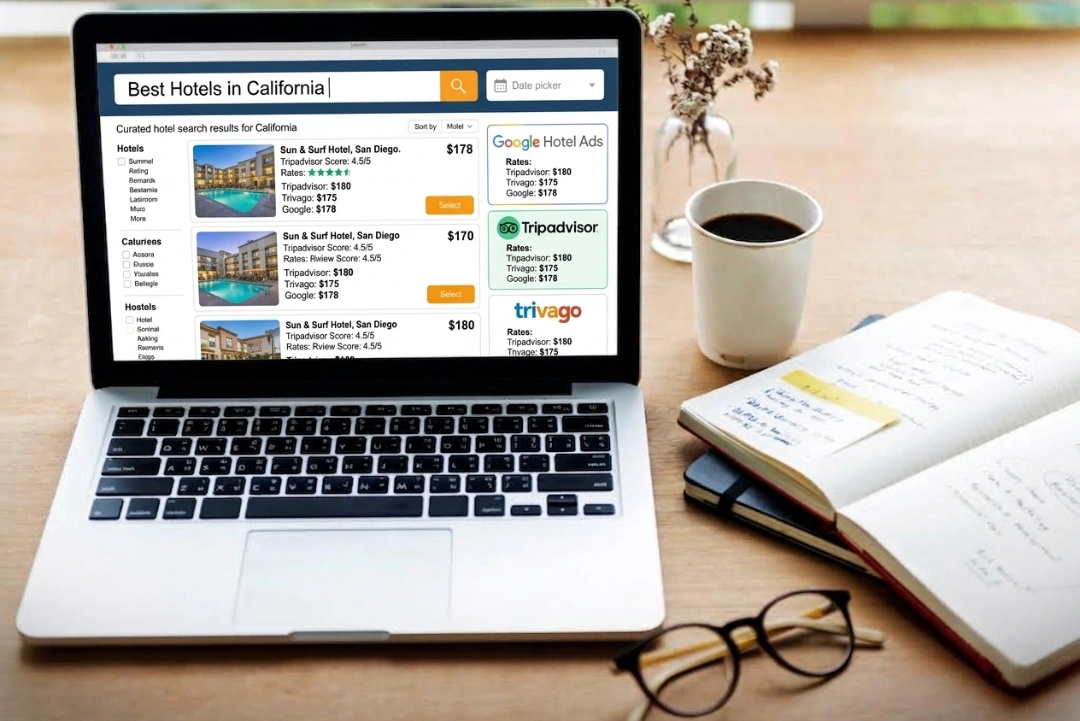
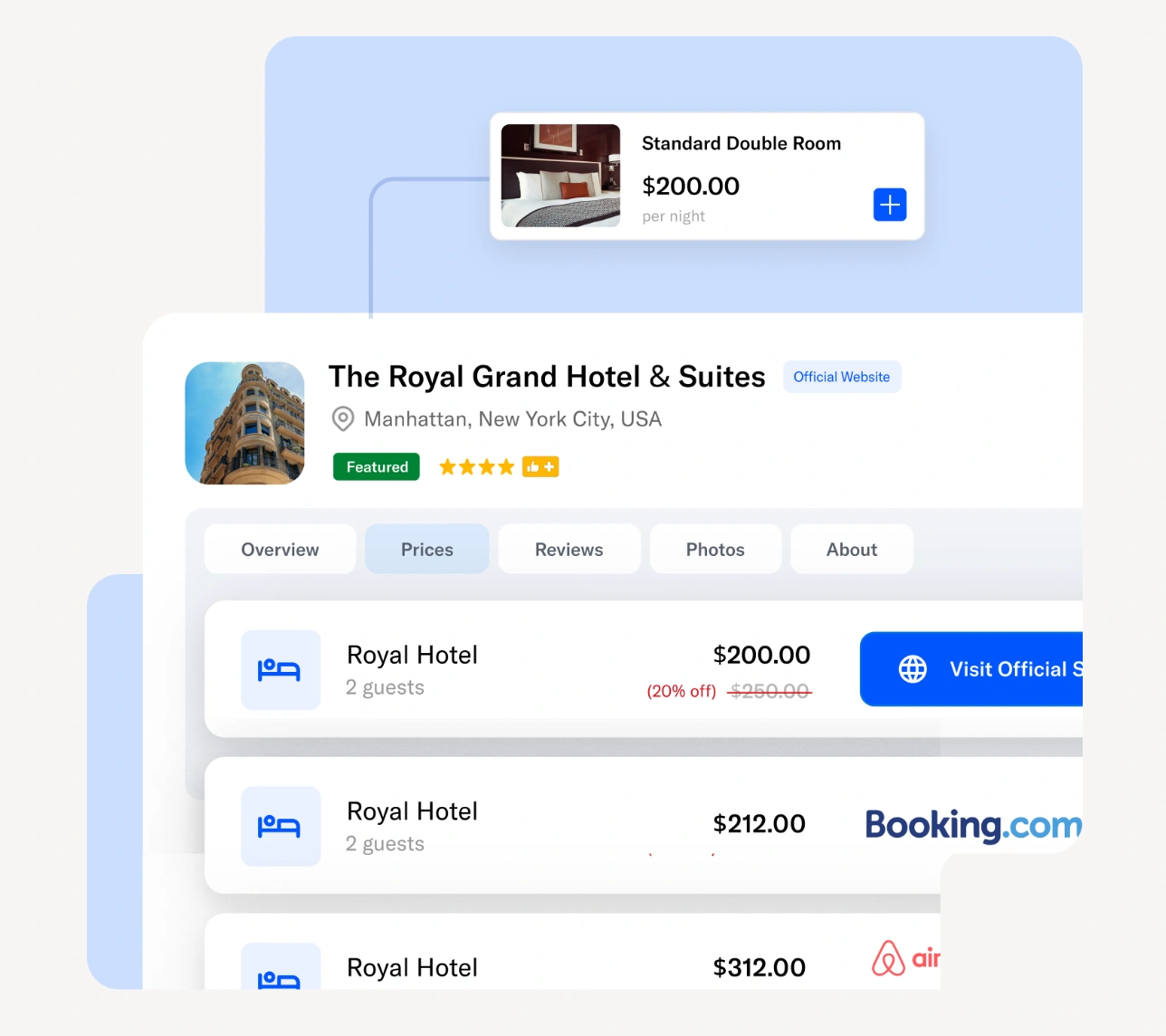
Hotels can drive direct bookings on metasearch platforms like Google, TripAdvisor, and Trivago, display real-time rates from their direct booking engine, earn the “Official Site” designation on metasearch listings, and implement express booking formats, all of which create a seamless path from search to reservation completion.
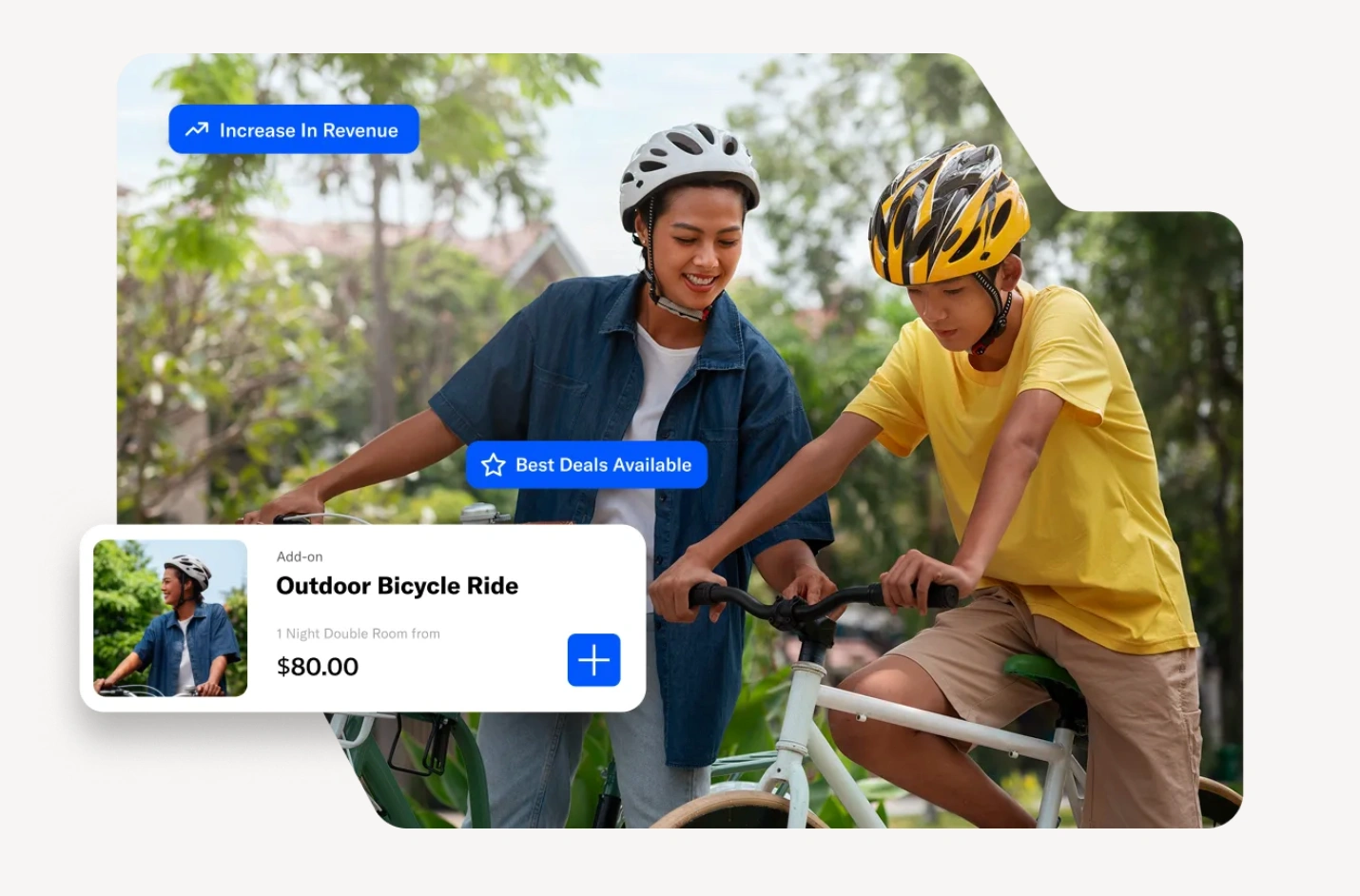
With a mobile-first interface, an interactive calendar with real-time pricing, and a streamlined booking flow, your hotel can reduce friction and prevent abandonment during date selection or rate comparison. Additionally, integrated upselling opportunities and package builders further strengthen the direct value proposition by presenting exclusive add-ons, personalized enhancements, or bundled offers that are often unavailable on third-party platforms.
When guests encounter tailored promotions and seamless checkout within a branded, secure environment, booking direct feels both rewarding and trustworthy.
7. Mobile-first optimization
Since most paid search traffic now originates from mobile devices (50%), performance on smaller screens directly impacts revenue. The page must load quickly, maintain visual clarity, and present thumb-friendly buttons that make interaction effortless.
A simplified form structure, smooth vertical scrolling, and an intuitive booking engine prevent frustration. In fact, mobile performance directly influences SEM return on investment.
Strong landing pages mean nothing if your SEM budget is misallocated or your bids are misaligned with intent. The good news is that hotel paid search budgeting does not need to be complex. It needs to be disciplined, data-driven, and aligned with revenue goals.
Here is a practical way to approach it.
A. Start with revenue, not spend
Instead of asking, “How much should we spend?” start by asking, “How many direct bookings do we need?”
Work backward from your target revenue. If your average booking value is $120 and you want $12,000 in incremental direct revenue from paid search, you need 100 bookings. If your landing page converts at 5%, you need 2,000 qualified clicks. From there, you can estimate your allowable cost per click based on your acceptable cost per acquisition.
This revenue-first approach keeps budgeting anchored in business outcomes rather than arbitrary monthly caps.
B. Protect your brand terms
Brand keywords usually deliver the highest return on ad spend. Even if you rank organically, paid brand campaigns protect your visibility against OTAs bidding on your name.
For example, if mobile converts 30% better than desktop, shift budget accordingly. If weekend searches outperform weekday traffic, adjust bids during peak booking windows.
Avoid reacting emotionally to daily fluctuations. Look at trend patterns over 2–4 weeks before making structural changes.
D. Allocate budget by seasonality
Hotels are seasonal businesses, and hence, budget allocation should reflect occupancy patterns, local events, holidays, and demand surges.
During high-demand periods:
Increase bids on high-intent keywords
Expand impression share
Capture incremental demand
During low-demand periods:
Focus on packages and value-driven campaigns
Promote length-of-stay offers
Target staycation or regional traffic
Budgeting dynamically helps match your spend to the opportunity.
To ensure your budget drives measurable direct bookings rather than just traffic, your SEM strategy must be aligned with how modern travelers search, compare, and book.
Here are five practical, hotel-specific strategies to maximize your return.
1. Make your ad copy irresistible
Hotel search results are crowded with OTAs and competing properties, so your ad must stand out instantly. Instead of generic descriptions, highlight tangible benefits such as:
“Free Breakfast Included”
“No Booking Fees”
“Best Price Guaranteed”
These value-driven hooks immediately differentiate your property from OTA listings.
Take full advantage of site extensions to expand visibility and give travelers multiple reasons to click. Direct them to relevant landing pages such as spa packages, weekend deals, loyalty benefits, or event-specific offers.
The more specific and relevant your extensions are, the higher your click-through and conversion potential.
2. Conduct thorough, intent-driven keyword research
Successful hotel SEM campaigns start with intent segmentation. High-intent searches like “book hotel in Chicago tonight” or “airport hotel with free shuttle” deserve priority because they signal readiness to purchase.
At the same time, do not ignore long-tail, low-volume keywords. Hyper-specific searches often produce higher conversion rates because they reflect clear traveler needs.
3. Align your landing page and booking experience
Relevance directly impacts both Quality Score and conversion performance. If your ad promotes a “Romantic Weekend Package,” the landing page headline, imagery, and offer details must immediately reinforce that exact promise.
Equally important is the booking engine experience itself. When travelers can instantly see availability, compare dates effortlessly, and complete a reservation in just a few intuitive steps, paid traffic converts at a higher rate.
Brand-aligned booking interfaces further strengthen trust and message continuity, while secure payment processing reassures guests at the final decision stage. The smoother the transition from ad click to confirmed reservation, the stronger your SEM ROI.
4. Set a competitive budget and bid strategically
Visibility in Google Ads auctions depends on both bid strategy and budget sufficiency. High-intent and brand keywords should receive priority because they typically deliver the highest return on ad spend.
Rather than going after the total impressions, focus on impression quality. Allocate budget to keywords that align with revenue objectives and monitor cost per acquisition.
5. Continuously optimize using performance data
SEM success requires ongoing refinement. Use Google Analytics and Google Ads to track click-through rate, conversion rate, cost per acquisition, and revenue per click. These metrics reveal which campaigns generate profitable bookings and which require adjustment.
For example, if certain campaigns consistently drive higher average daily rate (ADR) or lower acquisition costs, reallocate budget accordingly.
Implement A/B testing for headlines, descriptions, landing page messaging, and promotional offers. Once you have sufficient data, optimize for conversions and revenue, not just traffic volume.
Measuring SEM Success (KPIs That Matter)
Running hotel SEM campaigns without clear performance metrics leads to wasted budget and unclear results.
To measure real success, focus on the KPIs that directly impact revenue. Starting with:
Conversion rate: Are clicks turning into bookings?
Cost per acquisition (CPA): How much are you paying for each reservation?
Return on ad spend (ROAS): Are your campaigns generating profitable revenue?
Revenue per click: What is each visitor actually worth?
Click-through rate (CTR): Is your ad compelling enough to win the click?
Impression share: Are you capturing enough visibility in competitive auctions?
Direct revenue vs. OTA cost: Is SEM reducing commission dependency and increasing direct profitability?
If these metrics trend in the right direction, your SEM strategy is working.
Common Mistakes (and Quick Fixes)
Hotels often undermine their own SEM performance when they misalign strategy and execution. Fortunately, you can correct most of these mistakes quickly once you recognize them.
Sending all paid traffic to the homepage: Many hotels send every ad click to the main website, which forces visitors to search again for the offer they just clicked on and weakens booking intent. Route traffic to campaign-specific landing pages that directly reflect the keyword and promotion featured in the ad. When the message flows seamlessly from search to landing page, conversions increase.
Failing to protect brand keywords: If you are not bidding on your own hotel name, OTAs likely are. This means high-intent users who were already searching for you may end up booking through a third party. Running dedicated brand campaigns ensures you control the top position and retain direct revenue.
Overlooking mobile performance: A slow or complicated mobile booking experience drives users away and wastes ad spend. Optimize load speed, simplify the booking flow, and guarantee thumb-friendly navigation to protect conversion rates.
Running campaigns without defined benchmarks: Hotels that launch campaigns without CPA or ROAS targets struggle to make disciplined optimization decisions. Set clear performance benchmarks from the start and adjust bids based on measurable results.
Turn Visibility Into Revenue With roommaster
Competition for online bookings intensifies every year as OTAs dominate paid placements, travelers compare options in seconds, and attention spans continue to shrink. In this environment, visibility alone is not enough. Hotels must capture intent at the precise moment a traveler searches and guide that intent toward a direct booking.
Hotels that invest in hotel search engine marketing position themselves exactly where decisions happen. roommaster supports this strategy by combining a conversion-focused Booking Engine, real-time synchronization across channels, and performance insights that help hotels turn paid traffic into confirmed reservations. With a streamlined, mobile-first booking experience and centralized control over rates and inventory, hotels reduce friction and increase direct booking share.
Ready to transform visibility into revenue and reduce reliance on OTAs? Book a demo today and see how roommaster can power your direct booking growth.
{{cta-strip}}
FAQs
What is SEM in hotel marketing?
SEM in hotel marketing is a process that uses paid search advertising to place your property at the top of search engine results. Hotels bid on targeted keywords and pay per click to attract high-intent travelers and generate direct bookings quickly.
What’s the difference between SEO and SEM for hotels?
SEO improves organic rankings through content strategy and technical optimization, while SEM delivers immediate visibility through paid placements. SEO builds long-term authority and search equity, whereas SEM drives faster results and gives hotels stronger control over direct booking traffic.
How much should a hotel spend on SEM each month?
Monthly investment on SEM depends on property size, competitive intensity, and revenue targets. Many independent hotels allocate between $1,000 and $3,000 per month to SEM in order to maintain visibility and capture high-intent demand consistently. However, a balanced approach to marketing suggests allocating around 60-70% of your budget to SEM for immediate results and 30-40% to SEO for sustainable growth.
Is hotel SEM worth it for small independent hotels?
SEM allows small hotels to compete for high-intent searches and protect branded keywords without relying solely on OTAs. With focused targeting and disciplined bidding, independent properties often achieve strong returns without requiring large budgets.
What are the best SEM keywords for hotels?
High-performing keywords include branded hotel names, location-specific searches, amenity-driven phrases, and long-tail queries such as “pet-friendly hotel near airport.” Prioritize search intent over volume to improve conversion rates and profitability.
Should hotels bid on their own brand name?
Hotels should actively bid on branded keywords to prevent OTAs from intercepting direct traffic. Brand campaigns typically cost less per click and convert at higher rates because they target users who already intend to book the property.
How do hotels compete with OTAs on Google Ads?
Hotels can compete effectively by running brand campaigns, promoting clear direct-booking incentives, and aligning ads with optimized landing pages. Strong ad relevance and high Quality Scores often lower cost per click and improve ad placement.
What’s a good cost per booking for hotel SEM?
Hotels should target a cost per acquisition that remains lower than OTA commission rates. Many properties aim for CPA levels that is atleast 20% below typical OTA commissions to protect profitability.
What’s a good ROAS for hotel SEM campaigns?
Hotels commonly target a return on ad spend of 4:1 or higher. When keyword targeting, bidding strategy, and landing page experience align, campaigns frequently exceed this benchmark.
How do I track bookings and revenue from Google Ads?
To track bookings and revenue, integrate Google Ads with Google Analytics and your booking engine. Set up revenue-based conversion tracking so you can monitor cost per booking, ROAS, and total revenue generated by each campaign in real time.
guest-app
Put Your Front Desk in Guests’ Pockets with roommaster App
Mayela Lozano is a content strategist with a passion for hospitality and technology. She collaborates with roommaster on content creation, highlighting how technology can streamline hotel operations and enhance guest satisfaction. When she’s not creating content, Mayela loves to travel and spend time with her two little ones, discovering new adventures and making memories along the way.
Join Thousands of Hotels Thriving with roommaster
The transition to roommaster is straightforward and efficient. Our implementation team handles data migration including reservations, guest profiles, and historical information.
The transition to roommaster is straightforward and efficient. Our implementation team handles data migration including reservations, guest profiles, and historical information.
How Hotel PMS Software Transforms Hospitality Management
September 23, 2026
Marketing
Online Bookings
Hotel Metasearch Strategy: 8 Tactics That Drive Direct Bookings
September 22, 2026
Hotel Management
Marketing
Pet-Friendly Hotel Amenities & Package Ideas That Drive Revenue
September 22, 2026
Hotel Management
Marketing
Hotel Pet Fees: How Much Should You Charge?
September 22, 2026
Hotel Management
Marketing
Pet-Friendly Hotel Guide: Policy, Fees & Amenities
September 22, 2026
Hospitality Technology
Best Hotel Metasearch Management Software In 2026
September 22, 2026
Marketing
Online Bookings
Hotel Metasearch: The Complete Guide For Hotels
September 22, 2026
Marketing
SEO Strategies For Hospitality Websites 2026
September 13, 2026
Marketing
Hotel Management
Christmas Vacation Packages: How to Design and Promote It
September 1, 2026
Hospitality Technology
Data Management
Hospitality Phishing Attacks Are Rising: How Guests Can Protect Themselves
August 24, 2026
Join Thousands of Hotels Thriving with roommaster
See how roommaster's unified platform can work for your property. Our team will walk you through features tailored to your specific needs and operations.
.png)
.png)
.png)