Hospitality ERP: Managing Your Hotel Business In One Platform

"roommaster is really a combination between the operational ease of use, training, the functionality of the program itself, coupled with the service makes it a winning combination." - Alex Moore, President & CEO, Seaboard Hotels
Mayela lozano
May 15, 2026
12
min. read
hotel-erp-software

TL;DR

  • Hospitality ERP software integrates front office, finance, HR, procurement, and guest management into one system, but most independent hotels don’t need the full enterprise version.
  • A hotel ERP system and a hotel PMS are not the same. A PMS handles reservations and front desk operations, while an ERP covers the broader business back end.
  • Most independent properties get stronger value from a unified hospitality platform with targeted integrations than from a traditional enterprise ERP.
  • Platforms like roommaster function as the core of hospitality operations, connecting with accounting, POS, and payment tools to deliver the ERP outcome without the overhead.

Hotel managers rarely make it through a single morning without handling a dozen competing priorities at once. Reservations come in through five different channels, housekeeping needs real-time room status, your accountant is working off a spreadsheet that's already 24 hours old, and a guest is asking about their bill at the front desk…all at once. 

The technology promised to fix this is called hospitality enterprise resource planning (ERP) software, and for the past decade, it's been marketed almost exclusively to large hotel chains with enterprise budgets and dedicated IT teams. Independent and mid-sized properties often get stuck in a frustrating middle ground. Basic tools no longer work well enough for their operations, but a full ERP system is usually too expensive and complicated to implement.

This article breaks down what hospitality ERP actually is, who genuinely needs it, and what the smarter path forward looks like for most operators.

What is Hospitality ERP? 

Hospitality ERP software is a centralized system that connects every major function of a hotel business into one unified data environment. Rather than running separate tools for reservations, payroll, purchasing, and financial reporting, a hotel ERP system pulls all of those functions into a shared platform where data moves between departments without manual re-entry.

The concept originates from manufacturing, where ERP systems were designed to coordinate production, supply chain, and finance in real time. 

Applied to hospitality, the same logic applies. A completed check-in should:

  • Trigger housekeeping assignments and update the front desk
  • Update room revenue in the accounting ledger
  • Adjust inventory for the minibar
  • Log a guest interaction in the CRM

ERP for hotels makes that kind of interconnection possible at a system level.

Hospitality ERP vs. Hotel PMS: What's the Real Difference

This is where most buying decisions go wrong. A hotel management software platform and a hospitality ERP are frequently conflated, even by vendors. 

Here's the actual difference:

Hotel PMS Hospitality ERP Software
Primary focus Front office operations Whole business management
Core functions Reservations, check-in/out, housekeeping Finance, HR, procurement, PMS, CRM, BI
Users Front desk, housekeeping All departments, including finance and HR
Data scope Operational/guest data Financial, operational and workforce data
Integration approach Connects to third-party tools Native multi-module system
Typical user Independent to mid-sized hotels Multi-property groups, branded chains
Implementation timeline Days to weeks 9 to 18 months
Cost range Subscription-based, lower entry cost High upfront and per-module licensing

A PMS is the guest-facing operational engine. A hospitality management ERP, on the other hand, is the business-wide nervous system that sits around it. Most independent hotels already have the former. 

{{pms-one}}

The question is whether they genuinely need the latter, or whether a smarter configuration of the former can do the same work.

Core Modules of a Hospitality ERP

Hospitality ERP systems are designed to help hotels manage the operational and financial challenges that come with running multiproperty organizations.

Some of the core modules of hospitality ERP solutions include:

  • Front Office and Guest Management covers reservations, check-in and check-out, rate management, and guest profile tracking. This is the territory a modern PMS already occupies and often handles better than a generic ERP module.
  • Housekeeping connects room status in real time to the front desk and maintenance queues. When it's part of a unified system rather than a separate app, room turnovers happen faster, and status errors drop significantly.
  • Channel Management distributes rates and availability across OTAs and direct booking channels simultaneously. A strong channel manager is non-negotiable for any property relying on more than one booking source, which is virtually every property operating today.
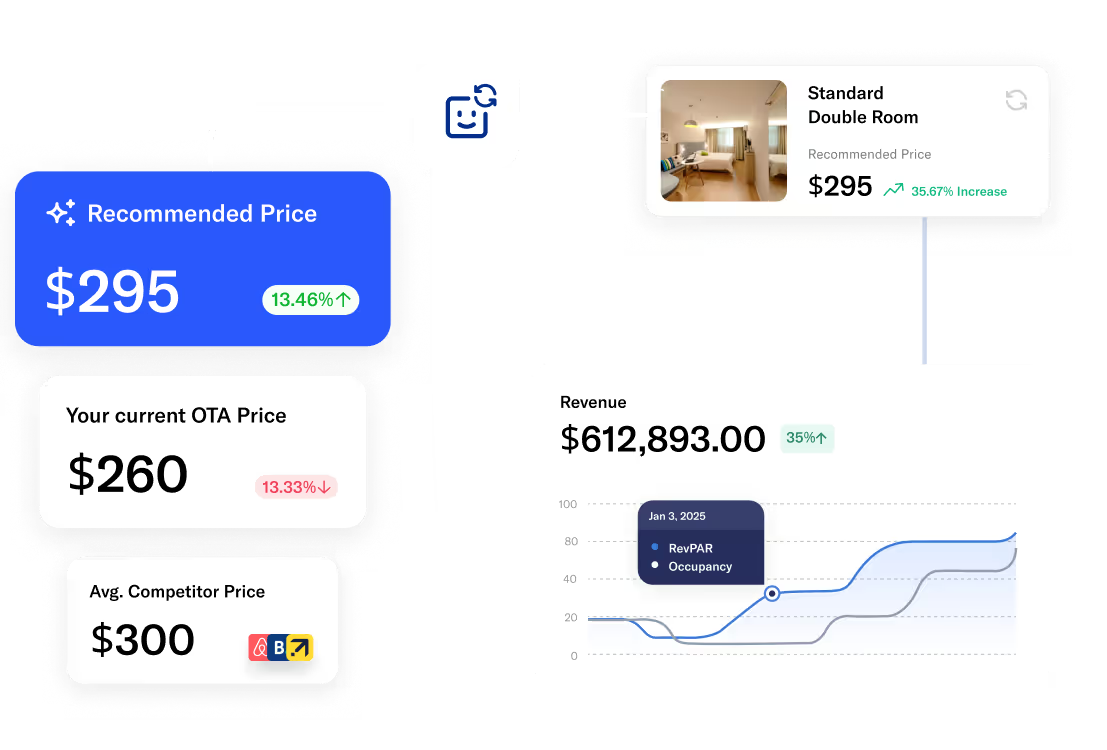
  • Revenue Management uses demand signals, historical data, and competitive pricing intelligence to recommend or automate rate adjustments. This module has historically been an enterprise luxury, but AI-driven tools have changed that calculus entirely for mid-sized properties.
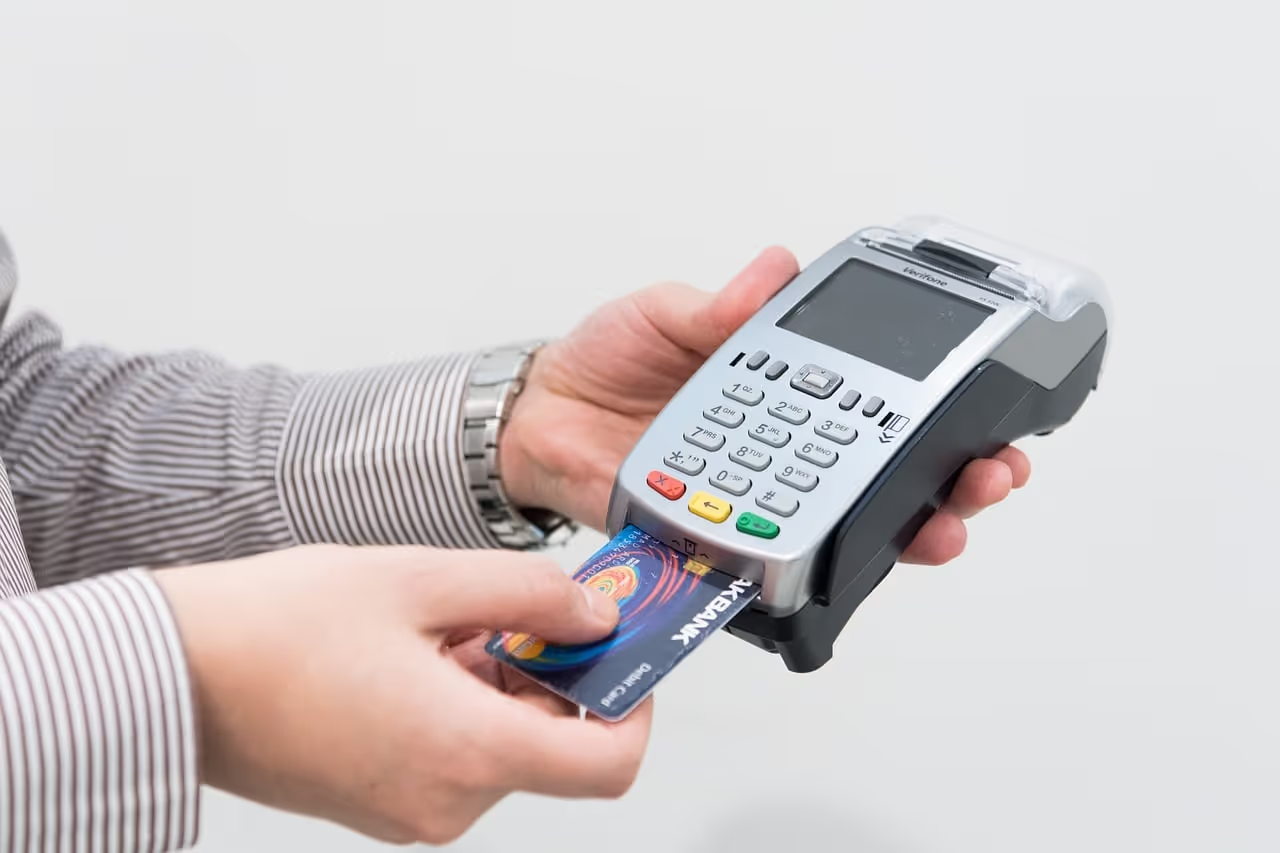
  • Payment Processing and Reporting closes the financial loop. From EMV card processing at the front desk to consolidated revenue reports across departments, this module determines how fast your team can see what the business is actually doing. The shift toward cloud-based, centralized platforms is accelerating, and the properties making that move are the ones most likely to gain an operational edge.

Who Actually Needs a Full Hospitality ERP

If you run a large branded chain, a multi-property group with centralized HR and procurement, or a resort with F&B, spa, and events revenue all flowing into a consolidated P&L, a full ERP makes operational and financial sense. The complexity of your business genuinely matches the complexity of the system.

For these operators, having payroll, purchasing, asset management, and front-office data in a single environment enables them to maintain oversight across dozens of cost centers and thousands of employees. Enterprise platforms like Oracle OPERA, Infor HMS, and SAP manage this at scale, and the implementation investment reflects the value delivered at that scale.

The numbers behind those implementations tell a different story for smaller operators, however. Their implementation timelines regularly run 9 to 18 months, and nearly 40% of small and mid-sized hotel operators cite budget constraints as a major barrier to adopting advanced management software. 

For an independent hotel or a small regional group, a full ERP rollout also strains the team, the timeline, and often the guest experience during the transition period. 

The Practical Alternative: A Unified Hospitality Platform With Targeted Integrations

For most independent hotels and bed-and-breakfast properties, the challenge is the burden of using too much of it. Enterprise ERP systems are powerful, but they are often designed for large, complex operations that require deep configuration, specialist teams, and long implementation cycles.

For smaller properties, that level of complexity is rarely necessary. A reliable operational platform that keeps core functions connected, simplifies day-to-day work, and integrates with the tools you already use is often enough.

1. A platform designed by hoteliers, for hoteliers

roommaster is built for exactly that configuration. Built over three decades for independent hotels, inns, resorts, and management groups, trusted by thousands of hotels worldwide, roommaster functions as the hospitality property management software (PMS) that handles front office, distribution, revenue, and guest experience in a single system.

Rather than replacing your ecosystem, it connects with key external tools such as accounting systems and POS platforms, giving you flexibility without fragmentation.

2. Core operations in one connected system

The integrated suite includes a property management system, a commission-free booking engine, and a channel manager that synchronizes rates across hundreds of online travel agencies (OTAs). roommaster Concierge, powered by Sadie AI, answers every incoming guest call 24/7, capturing booking opportunities that would otherwise go to voicemail or OTAs.

{{concierge-one}}

By answering every guest call in real time, it helps capture booking opportunities that would otherwise be missed. It also supports multilingual conversations, helping hotels serve international guests without language barriers and offering consistent, always-on guest communication throughout the stay.

3. Built for independent operators, not enterprise overhead

For operators who want to go deeper on AI-driven revenue strategy, roommaster's 24/7 recovery guide ebook covers how properties are using always-on automation to capture revenue that would otherwise be lost overnight.

In fact, properties using roommaster typically experience up to an 80% reduction in manual tasks and a 20% increase in direct bookings. Those are ERP-level outcomes delivered through a platform sized and priced for the operators who actually need them.

📌Also read: How Hotel AI Agents Improve Service and Bookings in 2026?

Key Capabilities Independent and Mid-Sized Hotels Should Look For

When looking at hotel ERP software or an all-in-one hospitality platform, these are the features that really make a difference for independent and mid-sized hotels:

  • Property management system (PMS): The operational foundation. Look for intuitive interfaces, real-time room status, and reporting that doesn't require a data analyst to interpret. Case in point, roommaster's intuitive interface reduces staff training time by 50% compared to competing systems, allowing new team members to become productive faster. 
  • Booking engine: Commission-free direct bookings are one of the highest-ROI levers available to independent properties. A built-in booking engine that converts well and feeds directly into your PMS eliminates the data gap that third-party engines create.
  • Channel manager: As a general rule of thumb, rates and availability need to update across every connected OTA the moment a booking comes in. Manual channel management creates rate parity problems and double bookings, both of which are completely avoidable.
  • Revenue management: Dynamic pricing based on demand, seasonality, and competitive data lifts RevPAR without requiring a dedicated revenue manager. AI-assisted pricing tools have made this accessible to independent hotels for the first time.
  • Hotel AI agent: Voice and messaging AI handles inbound guest calls and inquiries 24 hours a day. For lean teams, this is the difference between capturing a late-night reservation and losing it to an OTA.
  • Integrations: No single platform does everything. Look for open API connectivity to accounting software, POS systems, payment processors, and CRM tools, so the platform complements your tech stack rather than competing with it.
  • Native reporting: Over 270+ report types, including flash reporting, give operators a real-time financial picture without manual consolidation. That's the back-office clarity that most independent hotels associate exclusively with enterprise ERP.

Common Pitfalls When Choosing Hospitality ERP

The biggest mistakes operators make when evaluating hospitality ERP software aren't about choosing the wrong vendor. They're about misjudging the fit between system complexity and operational reality.

1. Over-buying for the current scale

Enterprise ERP platforms are architected for enterprise complexity. When a 60-room independent hotel implements a system designed for a 600-room chain, the mismatch shows up everywhere, in unused modules, in staff workarounds, and in recurring IT costs that deliver no proportional value.

2. Paying for modules that never get used

Full ERP licensing typically bundles HR, procurement, asset management, and financial consolidation into a package. The need to bounce from system to system, rely on multiple platforms and logins, and the increase in potential points of failure are making many hoteliers reconsider the piecemeal approach. 

However, over-bundling creates the same fragmentation problem from the opposite direction. 

3. Underestimating implementation cycles

A platform that takes 12 months to go live isn't neutral during that period. Staff attention diverts from operations to implementation, data migration creates gaps in historical reporting, and the team absorbs a change management burden that smaller properties are rarely staffed to handle.

4. Integration debt

Choosing a closed platform that requires expensive custom development every time you need to connect a new tool creates a compounding cost. 

Open API ecosystems avoid that trap by design, and that architectural choice alone can save a mid-sized property tens of thousands of dollars over a five-year technology cycle.

Why Bigger Isn’t Always Better in Hotel Technology

For large hotel groups managing hundreds of rooms, centralized procurement, and multi-entity financial reporting, a full hospitality ERP system is the right investment. The complexity is real, and the right enterprise platform manages it. 

But for independent hotels, boutique properties, inns, and mid-sized regional groups, the calculus is different. The goal is to get unified data, connected operations and real-time visibility, but the path to it doesn't require a six-figure system with an 18-month implementation runway.

An all-in-one hospitality platform like roommaster, built specifically for the way independent operators actually work, delivers that outcome through a tightly integrated core of PMS, booking engine, channel manager, revenue management, payments, and AI-powered guest engagement. It also provides open integrations to the accounting and POS tools that complete the picture. 

The right technology for your hotel is the one that fits the operation you're running today and scales with the one you're building toward. For most independent operators, that's not a full ERP. It's a smarter platform.

See how roommaster works for independent hotels → [Book a Free Demo]

{{cta-strip}}

FAQs

What is hospitality ERP, and how does it work?

Hospitality ERP software connects every major function of a hotel business, including reservations, finance, HR, procurement, and guest management, into one integrated platform. Data flows automatically between departments, so a completed check-in updates the accounting ledger, triggers housekeeping, and logs a guest record all at once. This removes the manual data transfer that slows down most hotel operations.

What's the difference between a hospitality ERP and a hotel PMS?

A hotel PMS manages front office operations, such as reservations, check-in, check-out, and housekeeping coordination. In contrast, a hotel ERP system wraps around the PMS to include finance, HR, procurement, and business intelligence. 

Do independent hotels and B&Bs need a full hospitality ERP?

Most independent hotels and B&Bs don't need a full enterprise ERP. A unified hotel management software platform with targeted integrations for accounting, payments, and POS delivers the same operational clarity at a fraction of the cost and implementation time. 

What modules are typically included in a hospitality ERP system?

A standard hospitality management ERP includes front office management, housekeeping, channel management, revenue management, CRM, procurement, HR, payroll, financial reporting, and POS integration. 

How long does it take to implement a hospitality ERP?

Full enterprise hospitality ERP solutions typically take 9 to 18 months to implement, depending on property complexity, data migration scope, and staff training requirements. A purpose-built unified platform like roommaster can go live in no time, with onboarding support from a team that understands hotel operations.

pms-one

Run Your Entire Hotel From One System

  • Streamline daily tasks
  • Delight every guest
  • Increase profitability
concierge-one

Turn Missed Calls into Bookings with Hotel AI Agent

Ready to make the switch? Let's work together

Mayela lozano

Mayela Lozano is a content strategist with a passion for hospitality and technology. She collaborates with roommaster on content creation, highlighting how technology can streamline hotel operations and enhance guest satisfaction. When she’s not creating content, Mayela loves to travel and spend time with her two little ones, discovering new adventures and making memories along the way.

Join Thousands of Hotels Thriving with roommaster

The transition to roommaster is straightforward and efficient. Our implementation team handles data migration including reservations, guest profiles, and historical information.

Table of Contents

Join Thousands of Hotels Thriving with roommaster

The transition to roommaster is straightforward and efficient. Our implementation team handles data migration including reservations, guest profiles, and historical information.

Latest Posts

group-bookings
Online Bookings
Hotel Management

Managing Group Bookings for Hotels: A Complete 2026 Guide

May 13, 2026
hotel-online-bookings
Online Bookings
Hotel Management

How To Reduce OTA Commission Costs: Strategies That Actually Work

May 12, 2026
hotel-guest
Hotel Management
Online Bookings

Channel Manager Vs Booking Engine: The Difference And Why You Need Both

May 12, 2026
hotel-management
Cloud PMS
Hotel Management

Clarity PMS Vs roommaster: Feature Comparison

May 10, 2026
hotel-frontdesk
Cloud PMS
Hotel Management

Moving Off Clarity PMS: A Side-By-Side Comparison Of Replacement Options

May 9, 2026
hotel-pms
Cloud PMS
Hotel Management

Clarity PMS Alternatives For APAC Hotels In 2026

May 9, 2026
hotel-guests
Hotel Management

Hotel Sales Software: Drive More Bookings And Revenue

May 8, 2026
erp-software
Hotel Management
Hospitality Technology

Hotel ERP Software: The All-In-One Solution For Modern Hotels

May 6, 2026
guest-house-management-software
Hotel Management

Guest House Management Systems: Features, Benefits & Top Picks

May 6, 2026
hotel-epos-system
Hospitality Technology
Hotel Management

Hospitality Till Systems: How To Choose The Right EPOS For Your Venue

April 29, 2026
Join Thousands of Hotels Thriving with roommaster

See how roommaster's unified platform can work for your property. Our team will walk you through features tailored to your specific needs and operations.