How To Reduce OTA Commission Costs: Strategies That Actually Work
“roommaster is very easy with our channel management, our OTAs, the availability is updated right away. So there’s no delay, doesn’t cause any overbookings.” - Stacy Dadson, General Manager, Harrison Hall Hotel
OTA commissions typically run 15 to 25 percent per booking, plus hidden costs like Genius discounts and preferred listing fees.
You cannot meaningfully negotiate commission rates as an independent. The path forward is shifting share, not lowering the percentage.
The biggest wins come from operational discipline: occupancy-based throttling, post-stay conversion to direct, and stopping wasted OTA visibility spend.
A connected PMS, booking engine, and channel manager are required to actually execute these strategies. Without them, the rules cannot be enforced.
Reducing your OTA mix by 10 percentage points usually returns more profit than any rate increase.
For most independent hotels, OTA commissions are the single largest variable expense after payroll. Every Booking.com or Expedia reservation skims 15 to 25 percent off the top before housekeeping, payroll, or a single utility bill is paid. That cost is not going away. But it can be controlled.
This guide skips the surface-level advice. Instead, it covers what independent hoteliers can actually change this quarter to move bookings from high-cost OTAs to lower-cost direct and diversified channels, without losing visibility or occupancy.
What reducing OTA commission costs actually means
Reducing OTA commission costs means shifting a larger share of your bookings to lower-cost channels, primarily your direct website, while keeping OTA visibility for discovery. It does not mean leaving OTAs. It means treating them as a marketing cost, not a default booking channel, and using operational rules to control how much of your inventory they sell.
There are three levers: commission percentage, OTA share of total bookings, and lifetime cost per guest. Independents have almost no control over the first lever. They have full control over the other two.
Why this matters more in 2026
OTA commissions are not the only cost. Add Genius and Mobile Rate discounts on Booking.com, sponsored listings on Expedia, payment processing for OTA-routed cards, and the cost of staff manually reconciling rates across platforms. The blended cost of an OTA booking is often closer to 22 to 28 percent than the headline 15 percent.
The compounding problem is repeat business. When a guest first finds you on an OTA, you pay commission on that stay. If that same guest re-books through the same OTA on their next visit, you pay again, this time for a guest who already knew your property. That second commission is pure margin loss. It is the most expensive line item most hoteliers never measure.
Use roommaster's OTA overdependence checklist to audit how much of your revenue is at risk and where to start pulling it back
9 strategies to reduce OTA commission costs
1. Calculate your real blended OTA cost first
Most hoteliers know their headline commission rate. Few know their true cost per OTA booking. Before you change tactics, get the number right.
For each OTA, add: base commission, payment processing fees on OTA-routed cards, Genius or loyalty program discounts, preferred listing or sponsored ad spend, and the labour cost of reconciliation. Divide by total OTA bookings to get blended cost per reservation.
Once you see the number, two things become obvious. First, your OTA cost is higher than you thought. Second, the channels you assumed were equivalent are not. One OTA may be costing you 18 percent. Another may be costing you 27 percent. That gap changes which channels you push and which you throttle.
This calculation is impossible without a PMS that captures booking source data cleanly. If your reports do not break revenue down by channel with associated cost, that is the first fix.
2. Build a direct booking engine that actually converts
Your website is the cheapest acquisition channel you have. But only if it converts. Most hotel websites lose guests at the booking stage, not the discovery stage.
A direct booking engine should match the OTA experience for speed and clarity. That means mobile-first checkout, rate calendars showing live availability, no redirects, and a payment flow that takes seconds. Anything slower and the guest opens a new tab to Booking.com.
Direct bookings carry zero commission, full guest data ownership, and the option to upsell at the point of sale. roommaster's hotel booking engine integrates with the PMS so rates and availability stay in sync without manual updates. For a feature-by-feature view of what to look for, see the booking engine comparison guide.
{{booking-engine-two}}
3. Use rate parity, then beat OTAs on value
Rate parity rules require you to show the same room rate on your site as on OTAs. That sounds restrictive. It is actually a tool.
You cannot offer a lower rate on your website. But you can offer more value at the same rate. Free breakfast, late checkout, room upgrades on availability, welcome amenities, flexible cancellation. None of these violate parity. All of them tip the booking toward your site for a guest comparing options.
Make the value advantage visible on the booking engine itself. A line like "book direct for free breakfast and late checkout" on the rate page converts more than a homepage banner.
4. Throttle OTA inventory based on occupancy
This is the strategy most independents miss. You do not need to give every channel access to every room every day.
Set occupancy thresholds in your channel manager and let the system close OTA channels automatically as you fill up. A simple rule structure works:
At 60 percent occupancy, close discount-heavy OTA promotions like Last Minute Deals and Mobile Rates.
At 75 percent occupancy, close additional secondary OTAs and reduce inventory allocated to high-commission channels.
At 85 percent occupancy, close the highest-commission OTA channels entirely and hold remaining inventory for direct and lower-cost sources.
The logic: at low occupancy you need OTA reach. At high occupancy you do not. Why pay 22 percent commission on a room you would have sold direct anyway?
This is impossible to execute manually across hundreds of OTAs. It requires a hotel channel manager with rule-based automation tied to live PMS occupancy data.
5. Convert OTA guests into direct repeat bookers
The single biggest leverage point most hoteliers ignore. Pay the OTA commission for the first stay. Pay nothing for every stay after.
The mechanism is simple. Capture the guest's direct email and preferences during the stay, not from the OTA's anonymised contact info. Send a post-stay thank-you that reinforces the value of booking direct next time. Add a clear, no-pressure offer for the return visit. Track which guests you successfully convert.
The systems matter here. If your PMS does not track guest stay history across channels, you cannot identify which OTA guests have re-booked direct. If your guest engagement tools cannot send branded post-stay messaging, you cannot run the conversion sequence at all. roommaster's PMS consolidates this guest data so the same profile follows the guest from first OTA stay to repeat direct booking.
For tactical depth on the direct booking conversion side, the direct booking strategy guide breaks the playbook down further.
{{booking-engine-one}}
6. Diversify your channel mix
Most independent hotels get 70 percent or more of their OTA bookings from two platforms: Booking.com and Expedia. That concentration is expensive. It is also a leverage problem. The fewer alternatives you have, the more dependent you are on the rate cards of two companies.
Add regional and niche OTAs to your distribution mix. Hostelworld for hostels and budget properties. Mr & Mrs Smith for boutique. HotelTonight for last-minute. Specialty platforms targeting business travel, families, or extended stay depending on your guest profile. Many of these carry lower commissions and bring higher-intent guests.
Diversification only works if rates and availability stay synced. Without that, you create rate parity violations and overbookings, which cost more than the savings. A connected channel manager makes diversification operationally feasible. For the operational side, how channel management software enhances OTA bookings covers the integration logic.
7. Use metasearch to compete with OTAs at the consideration stage
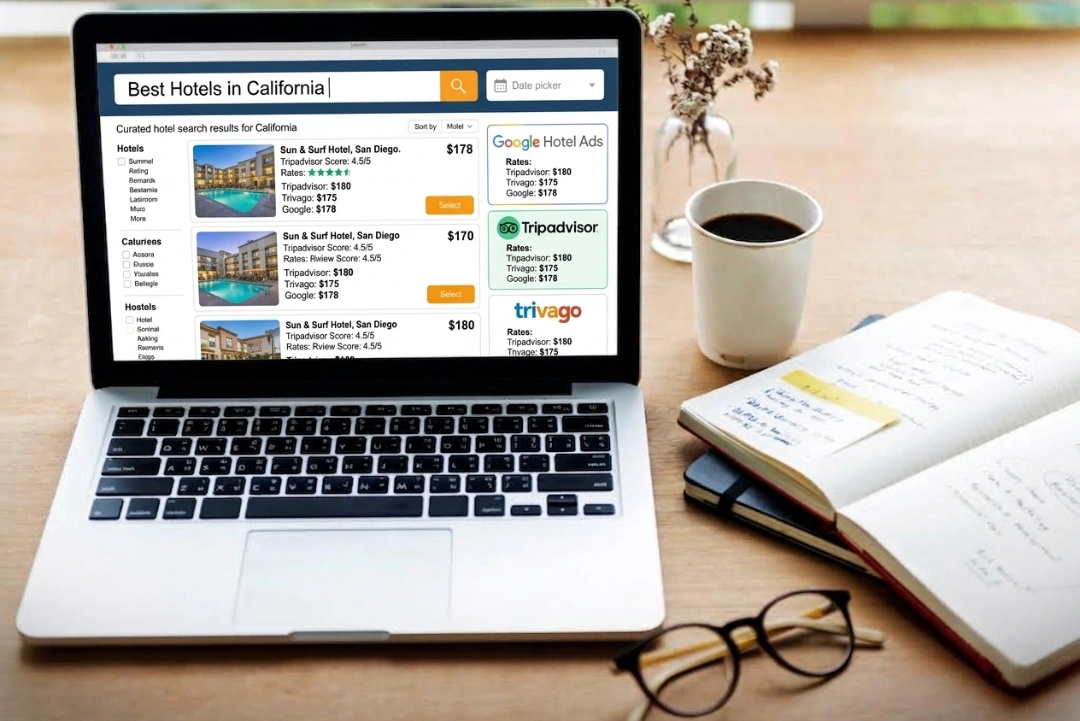
Metasearch engines like Google Hotel Ads, Trivago, and Kayak show your direct rate alongside OTA rates on the same screen. This is the moment a guest decides whether to book direct or click through to an OTA.
Bidding on metasearch is paid, so it is not free. But cost per booking through metasearch typically runs lower than OTA commission. A 6 to 10 percent effective acquisition cost on metasearch beats 18 to 22 percent on Booking.com for the same guest.
The tactic only works if your direct rate is at parity, your booking engine converts well, and your bid strategy is tuned. Get any of those three wrong and you are subsidising OTA visibility instead of competing with it.
8. Stop overspending on OTA visibility programs
OTAs sell visibility upgrades: Booking.com's Preferred Partner Programme, Expedia's Accelerator, sponsored placement, premium positioning. These programs add commission percentage points on top of the base rate. Often 1 to 5 additional points.
The promise is more bookings. Sometimes that is true. Often it is not. The bookings you get may have come anyway through the base listing, in which case you have just paid extra commission on the same revenue.
The fix is to test, not opt in by default. Run a 60-day window with the program off and compare booking volume and revenue to a matched window with the program on. Measure incremental bookings, not total bookings. Most properties find one or two programs deliver real lift. The rest are quiet revenue drains.
9. Tie revenue management to channel cost
Standard revenue management asks one question: what is the right rate to charge given demand? Channel-aware revenue management asks a second question: what is the cheapest channel to sell this room through?
The implication: a $200 direct booking is worth more than a $210 OTA booking after a 22 percent commission. Your pricing logic should account for that. Selectively raising OTA rates while holding direct rates flat encourages guests to book direct without violating parity (because parity allows direct rates to be lower than OTA, just not higher).
This requires a revenue management system that integrates with your channel manager and PMS. roommaster integrates with ampliphi for AI-driven pricing recommendations that factor in channel mix and demand signals together. For a broader view of revenue strategy, the hotel revenue management strategies guide covers the principles.
For revenue managers building this kind of operational discipline, the revenue manager workflow page outlines the tooling stack needed.
What not to do
Three tactics get recommended often. They rarely work for independents.
Do not try to negotiate your commission rate. Major OTAs negotiate with chains, not independents. The leverage is one-sided. Spending hours on this returns nothing.
Do not race to the bottom on rate to undercut OTAs. It violates parity, triggers OTA penalties, and trains guests to expect lower prices over time. The damage to ADR outlasts any short-term direct booking gains.
Do not delist from OTAs to "send a message". Most properties that do this lose more in occupancy than they save in commission. The right move is to throttle inventory and shift mix gradually, not to walk away.
Channel cost comparison
Channel
Typical commission
Hidden costs
Effective cost
Strategic role
Direct website
0 percent
Booking engine fee, payment processing, marketing
3 to 7 percent
Primary, scale aggressively
Metasearch (Google, Trivago)
Pay per click
Bid management, conversion drop-off
6 to 12 percent
Acquisition channel, tune carefully
Booking.com
15 to 18 percent
Genius, Mobile Rate, Preferred Partner
18 to 25 percent
Discovery, throttle at high occupancy
Expedia Group
18 to 22 percent
Accelerator, marketing fees, package rate gaps
22 to 28 percent
Discovery, throttle at high occupancy
Niche and regional OTAs
8 to 15 percent
Lower volume, integration setup
10 to 18 percent
Diversification, supplementary mix
GDS
Flat fee plus 8 to 10 percent
Membership and tech fees
12 to 18 percent
Corporate and travel agent business
{{cta-strip}}
FAQs
What is a typical OTA commission rate?
Major OTAs charge 15 to 25 percent per booking. Booking.com runs 15 to 18 percent in most markets. Expedia Group properties typically pay 18 to 22 percent. Add hidden costs and effective rates often reach 25 percent or more.
Can independent hotels negotiate OTA commissions?
Rarely with meaningful results. OTAs negotiate volume-based reductions with hotel chains. Independents have almost no leverage. Time spent here is better spent shifting mix to direct channels.
How quickly can a hotel reduce OTA dependency?
Operational changes like inventory throttling can shift 5 to 8 percentage points of OTA share within a quarter. Direct booking conversion takes longer because it depends on guest cycles. Six to twelve months is realistic for a meaningful shift.
Does reducing OTA bookings hurt visibility?
Throttling inventory at high occupancy does not affect visibility, because OTAs only need access during periods you actually need bookings. Delisting from major OTAs entirely does hurt visibility and is rarely the right move.
Is a commission-free booking engine actually free?
Most direct booking engines charge a software fee, not per-booking commission. The economics work because the software fee is fixed regardless of volume, while OTA commission scales with revenue. At any meaningful occupancy, direct is cheaper.
Bottom line
Reducing OTA commission costs is not about cutting OTAs out. It is about treating each channel as a measurable cost centre and shifting mix toward the cheaper ones, with the discipline to do it consistently over months. The tactics work. They just require the systems to execute them: a PMS that tracks channel cost, a booking engine that converts, a channel manager that enforces inventory rules, and a revenue management layer that connects pricing to channel mix.
Most independent hotels lose money on OTAs not because the commissions are too high, but because they have no way to control the mix in real time. Fix the operating model and the savings follow.
Take the next step
If you are running 60 percent or more of your bookings through Booking.com and Expedia and watching margins shrink, the issue is not the commission rate. It is the lack of inventory control across your channels. roommaster gives you a PMS, channel manager, and booking engine on one platform, with rule-based automation that throttles OTA inventory and shifts share to direct as occupancy builds. Most properties recover 8 to 12 percent of revenue lost to commissions within the first year.
booking-engine-two
Turn Your Hotel Website into a Direct Booking Powerhouse
Mayela Lozano is a content strategist with a passion for hospitality and technology. She collaborates with roommaster on content creation, highlighting how technology can streamline hotel operations and enhance guest satisfaction. When she’s not creating content, Mayela loves to travel and spend time with her two little ones, discovering new adventures and making memories along the way.
Join Thousands of Hotels Thriving with roommaster
The transition to roommaster is straightforward and efficient. Our implementation team handles data migration including reservations, guest profiles, and historical information.
The transition to roommaster is straightforward and efficient. Our implementation team handles data migration including reservations, guest profiles, and historical information.
How Hotel PMS Software Transforms Hospitality Management
September 23, 2026
Marketing
Online Bookings
Hotel Metasearch Strategy: 8 Tactics That Drive Direct Bookings
September 22, 2026
Hotel Management
Marketing
Pet-Friendly Hotel Amenities & Package Ideas That Drive Revenue
September 22, 2026
Hotel Management
Hotel PMS
Hotel Food And Beverage (F&B): The Complete Guide
September 22, 2026
Hotel Management
Marketing
Hotel Pet Fees: How Much Should You Charge?
September 22, 2026
Hotel Management
Hotel PMS
Best Hotel Food and Beverage (F&B) Management Software In 2026
September 22, 2026
Hotel Management
Marketing
Pet-Friendly Hotel Guide: Policy, Fees & Amenities
September 22, 2026
Marketing
Online Bookings
Hotel Metasearch: The Complete Guide For Hotels
September 22, 2026
Hotel Management
Payment Processing
Best Practices For Hotels To Avoid Chargebacks Disputes
September 21, 2026
Join Thousands of Hotels Thriving with roommaster
See how roommaster's unified platform can work for your property. Our team will walk you through features tailored to your specific needs and operations.




.png)
.png)
.png)