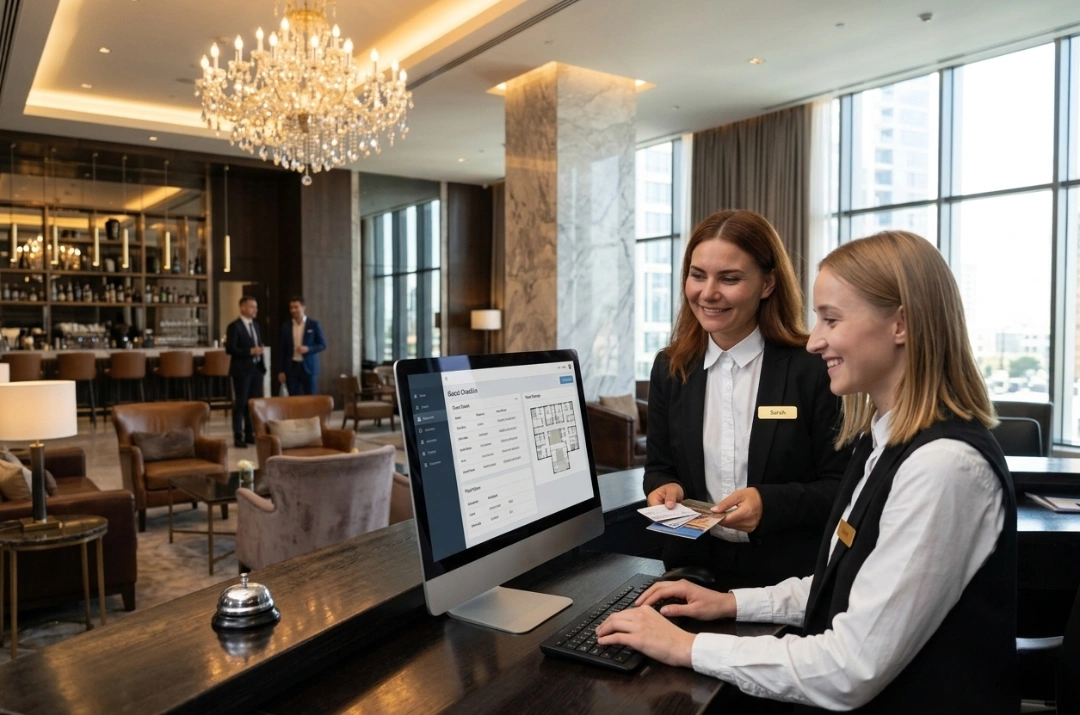
What is an extended stay hotel?
An extended stay hotel is a property built for guests who book by the week or month rather than the night. Rooms are furnished suites with a full kitchen or kitchenette, a work area, in-room laundry and more storage than a standard guest room, so a guest can live and work there comfortably for weeks. The segment is also called long-stay, aparthotel or apartment-style lodging, and it sits between a traditional hotel and a serviced apartment.
For an operator, the defining feature is not the kitchen. It is the booking behavior. A long-stay guest commits to a longer length of stay in exchange for a lower nightly rate, which changes how you price, staff and bill the room. Take a 40-room boutique near a regional hospital: converting 10 rooms to long-stay for traveling nurses on 13-week contracts can hold those rooms above 90 percent occupancy through a soft season while the front desk handles far fewer arrivals. That single shift is what makes extended stay a distinct operating model, not just a room type, and it is why it runs best on a hotel property management system built for mixed inventory rather than nightly stays alone.
{{pms-three}}
How do extended stay hotels work?
Guests book directly through your own hotel booking engine, through a corporate contract, or through an OTA, usually for a minimum number of nights. Once they check in, three things run differently from a transient hotel:
Housekeeping: cleaning drops to a weekly or bi-weekly full service, with fresh linen and towel swaps in between, rather than daily turndown. That is the single biggest labor saving in the model.
Billing: the folio runs on a recurring weekly or monthly cycle, often with a card on file, instead of a single checkout charge. Longer stays may take a deposit and a signed stay agreement.
Pricing: the rate is tiered by length of stay, so the effective nightly rate falls as the commitment grows. The guest sees a bargain; you see a room that stays sold.
Who stays at extended stay hotels?
Understanding the demand drivers is how you decide whether the segment fits your market. Long-stay demand is remarkably recession-resilient because much of it is work-driven, not leisure-driven:
- Relocating employees and corporate executives between homes or on long assignments.
- Traveling nurses and healthcare staff on 13-week contracts near hospital systems.
- Project and infrastructure crews in construction, energy and engineering.
- Insurance and displacement guests whose homes are being repaired after a claim.
- Government and military personnel on temporary duty.
- Digital nomads and long-haul business travelers who want a kitchen and a desk.
If your property sits near a hospital network, a corporate campus, a large construction pipeline or a relocation-heavy metro, the demand is probably already there.
{{pms-one}}
Extended stay vs traditional hotels vs serviced apartments
Guests and operators confuse these three models constantly. Here is the quick reference, then a link out for the finer distinction:
| Factor |
Extended stay hotel |
Traditional hotel |
Serviced apartment / Airbnb |
| Typical stay |
7 nights to several months |
1 to 3 nights |
Nights to months, highly variable |
| Room |
Suite with full kitchen and laundry |
Standard room, no kitchen |
Full apartment, home layout |
| Housekeeping |
Weekly or bi-weekly |
Daily |
Rare or on request |
| Pricing |
Tiered weekly and monthly rates |
Nightly rate |
Nightly or monthly, host-set |
| Front desk |
Lean, staffed |
Full service |
Often none |
| Best for |
Work-driven long stays |
Short trips |
Space-first stays |
For a deeper split between the last two models, see the difference between service apartment and hotel.
Is extended stay right for your property?
Run this quick screen before you commit inventory:
- Demand: is there a hospital, corporate campus, university or major project within a short drive? Steady work-travel demand is the whole game.
- Product: can your rooms take a kitchenette, or at least a microwave, fridge and workspace? You do not need to gut-renovate to start.
- Rate position: is your transient occupancy soft midweek or off-season? Long stays fill exactly those troughs.
- Operations: can your team handle recurring billing and a weekly housekeeping cadence? Software matters more than headcount here.
You do not have to convert the whole property. Many independent operators fence a block of rooms for long stays and keep the rest transient, which is the lowest-risk way in. If most of your answers point to long stays, independent hotel software built for a lean team will carry the extra billing and housekeeping logic.
{{revenue-management-one}}
How to price weekly and monthly extended stay rates
The most common mistake is one flat discount for anything over a week. Price in tiers instead, so the guest is rewarded for a longer commitment and you protect your rate on shorter bookings. A worked example on a room with a $110 nightly rate:
| Length of stay |
Effective nightly rate |
Discount vs nightly |
Why it works |
| 1 to 6 nights |
$110 |
0% |
Full transient rate |
| 7 to 29 nights (weekly) |
$95 |
14% |
Locks a week, cuts turnover cost |
| 30-plus nights (monthly) |
$79 |
28% |
Fills a month, often tax-exempt |
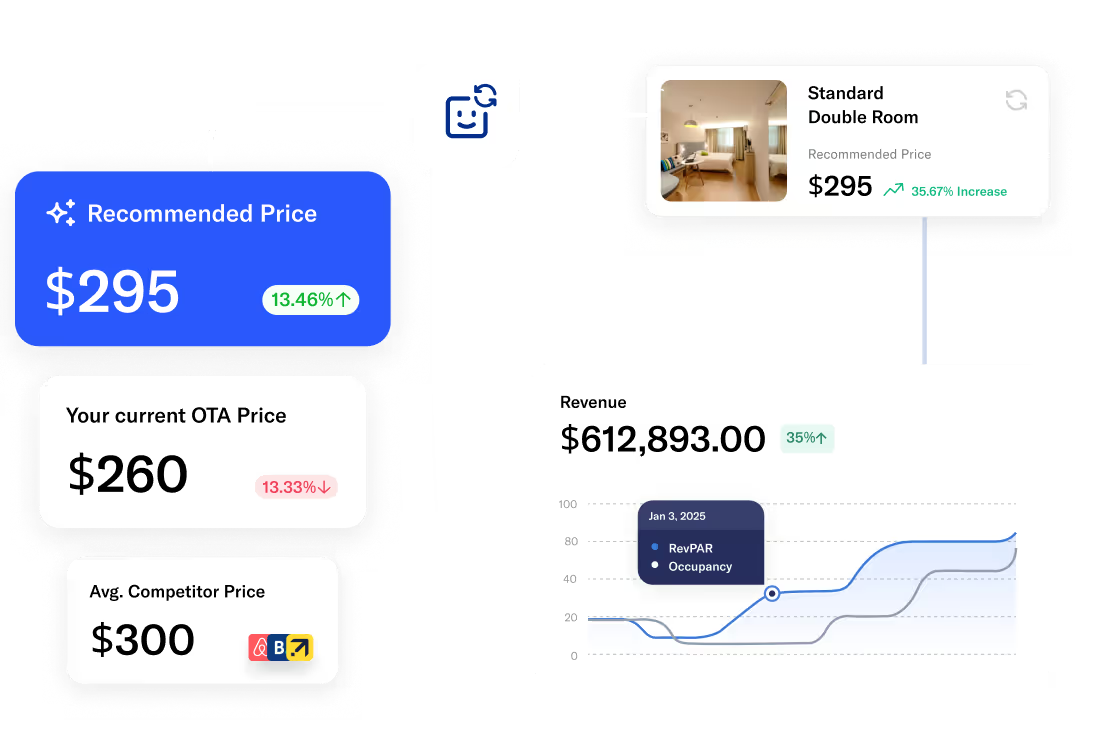
The rate falls, but so does your cost to serve. A monthly guest gets cleaned four times, not thirty, and books once instead of driving thirty separate reservations. That is why the segment can lift profit even as the nightly rate drops. Tie your tiers to real demand rather than a fixed table using dynamic pricing principles, so weekly and monthly rates flex with occupancy.
Revenue management and KPIs for long-stay inventory
Transient RevPAR alone will mislead you on extended stay, because it ignores the cost savings. Track these instead:
Average length of stay (ALOS): the core lever. A longer ALOS means fewer arrivals, lower labor and steadier occupancy.
Occupancy and RevPAR: long-stay blocks typically run higher, steadier occupancy than transient rooms, which cushions off-season and midweek troughs. Use a revpar calculator to compare a transient mix against a long-stay mix on the same rooms.
GOPPAR (gross operating profit per available room): the metric that actually settles the argument. Because housekeeping, turnover and distribution costs fall on long stays, a lower blended ADR can still produce a higher GOPPAR than a pure transient book.
Worked example on those same 40 rooms: a pure transient book at 68 percent occupancy and a $110 ADR earns roughly $75 RevPAR but carries daily cleaning and heavy OTA commission. A mixed book that runs the long-stay block at 88 percent occupancy pulls blended ADR down to about $92, yet weekly cleaning and direct corporate bookings cut cost per occupied room enough that GOPPAR comes out ahead. The top-line looks softer; the bottom line is stronger.
Direct-to-OTA mix: corporate and relocation demand should come direct or by contract, not through commission channels, which protects margin further.
Industry benchmark data for the segment comes from The Highland Group and STR/CoStar; use their published extended-stay occupancy and RevPAR indices to sanity-check your own numbers rather than guessing. Pull your own figures with hotel revenue management software so the comparison is live, not annual.
Operations and housekeeping for long-stay guests
The operating model, not the room, is where extended stay makes or loses money.
Housekeeping cadence: move to a weekly full clean with a mid-week linen and towel refresh. This is the largest cost saving in the model and the one guests expect, so publish it clearly at booking.
Staffing: long stays need fewer front-desk touches per room-night than transient, so you can run leaner. Manage the cleaning schedule and room-status board with housekeeping software rather than a spreadsheet, because the cadence is irregular.
Billing: recurring weekly or monthly charges with a card on file remove the biggest admin headache. Automate it through hotel payment processing so a month-long stay does not become thirty manual postings.
Legal, tax, and compliance: the 30-day rule
This is the part most guest-facing guides skip, and it is where operators get burned. In many US jurisdictions a stay that crosses 30 consecutive days becomes exempt from transient occupancy or hotel tax, and in some states a long-term guest can begin to acquire tenant rights that change how you can end the stay.
The practical implications for an operator:
- Your billing system has to stop charging occupancy tax at the local threshold automatically, or you overcharge the guest and create a refund mess.
- A written stay agreement, not just a reservation, protects you once a guest approaches tenant status.
- Thresholds and tenant rules vary by state and city, so confirm the exact rule with local counsel before you publish a monthly rate.
Handling this cleanly is a genuine competitive edge, because it is the question corporate bookers ask first.
How to win corporate and relocation extended stay business
The most profitable long-stay demand never touches an OTA. It comes from contracts:
- Corporate master agreements with local employers, hospital systems, engineering and infrastructure firms for a negotiated monthly rate.
- Relocation and insurance partners who place displaced residents and transferring staff and book in volume.
- Direct booking for repeat project crews, kept off commission channels so the margin stays yours.
Start with the two or three largest employers or hospitals in your catchment, offer a transparent monthly rate and a single point of contact, and you convert a handful of accounts into a stable occupancy base.
The technology behind extended stay operations
Extended stay is an automation problem more than a real-estate problem. The recurring billing, the shifting housekeeping cadence, the tax threshold and the corporate rates all break a system built only for nightly transient stays.
A hotel property management system built for mixed inventory ties them together, and pairing it with a hotel channel manager keeps your transient and long-stay availability in sync across every channel without overselling either. Reporting closes the loop, so you can watch ALOS, occupancy and GOPPAR on the long-stay block with hotel reporting software instead of rebuilding a spreadsheet each month.
{{channel-manager-one}}
Common extended stay mistakes to avoid
- Flat-discounting long stays instead of tiering by length of stay, which leaves rate on the table for weekly guests.
- Not fencing inventory, so a monthly guest blocks a room you could have sold at a high transient rate on a peak weekend.
- Over-housekeeping, which erases the model's core labor saving.
- Ignoring the 30-day tax and tenancy line, which turns into refunds and legal risk.
- Relying on OTAs for demand that should come direct or by corporate contract.
- Billing by hand, which is where long stays quietly consume front-desk hours.
The bottom line
Extended stay is not a niche room type. It is a distinct operating model that trades nightly rate for occupancy, low operating cost and demand that holds up when leisure travel softens. Win it by pricing in tiers, fencing inventory, handling the 30-day tax line cleanly, and chasing corporate and relocation contracts rather than OTA bookings. The properties that do this well run it on a system that automates the billing, housekeeping and tax logic instead of forcing a transient tool to fake it.
See how roommaster handles long-stay billing, housekeeping cadence and mixed inventory.
{{cta-strip}}
Frequently asked questions
1. What is an extended stay hotel?
An extended stay hotel rents furnished suites by the week or month to guests staying seven nights or longer. Rooms include a kitchen or kitchenette, a workspace and in-room laundry, with weekly rather than daily housekeeping.
2. What counts as an extended stay?
Most operators treat seven consecutive nights as the entry point for a weekly rate, and 30-plus nights as a monthly stay. The exact minimum is set by the property.
3. What does "fully equipped" mean at an extended stay?
Fully equipped usually means a full or partial kitchen with cookware and utensils, a fridge, a coffee maker, in-room or on-site laundry, a work area and Wi-Fi, so a guest can cook and work without leaving the suite.
4. How is extended stay pricing different from nightly rates?
Extended stay is priced in tiers by length of stay. The effective nightly rate falls as the commitment grows, because a longer stay cuts turnover, housekeeping and booking costs for the operator.
5. Do extended stay guests pay hotel tax after 30 days?
In many US jurisdictions a stay of 30 consecutive days or more is exempt from transient occupancy tax, and some states grant long-term guests tenant rights. Thresholds vary, so confirm the rule locally.
6. How often is housekeeping provided at extended stay hotels?
Typically a full clean once a week or every two weeks, with fresh linen and towels swapped in between, rather than daily service. This cadence is the model's biggest operating saving.
7. Is running extended stay more profitable than transient?
It can be. A lower nightly rate is offset by higher occupancy and far lower cost per occupied room, so long-stay inventory often produces a stronger GOPPAR than a pure transient book.



.png)
.png)
.png)