AI Phone Agent For Hotels: The Complete Guide 2026
"Everything is just so at your fingertips and quick, right from the call to the reservation to the check-in to the checkout. I would definitely recommend roommaster.” - Stacy Dadson, General Manager, Harrison Hall Hotel
An AI phone agent for hotels is a voice-based system that answers inbound guest calls, handles reservation inquiries, and books rooms directly into your PMS - 24/7, in any language.
The technology uses natural language processing to understand what the guest is saying, then checks your live inventory and confirms the booking in real time.
The critical difference between a useful AI phone agent and a useless one is PMS integration - without it, the agent can take a message but cannot actually book.
Standalone voice tools create a separate data silo. A PMS-native voice agent writes the booking directly into the system you already run your hotel on.
For independent hotels, the practical impact is captured after-hours bookings, reduced front desk call volume, and zero missed reservation calls.
An AI phone agent for hotels is a voice-based system that answers inbound guest calls, handles reservation inquiries, and books rooms directly into your PMS - 24/7, in any language.
This guide covers what the technology actually does, what separates a genuinely useful system from a glorified voicemail, and what to evaluate before choosing one for your property.
Every night, somewhere in your hotel, a call goes unanswered.
It's not always after hours. It happens at 3pm when both front desk agents are checking in a group. At 7pm when your one evening staffer is dealing with a billing dispute. At 11pm when there's nobody left to pick up at all.
That's not a staffing problem. It's a revenue problem. Every unanswered call that contains a reservation intent is revenue that leaves before it ever arrives.
Hotels run 24 hours. Phone inquiries don't schedule themselves around your shift patterns. And every unanswered call that contains a reservation intent is revenue that leaves before it ever arrives.
An AI phone agent for hotels is built to close that gap. Not as a gimmick, not as a chatbot dressed up in different packaging, but as a voice system that picks up the call, speaks naturally with the guest, checks live availability in your PMS, and confirms the booking - without any staff involvement.
What Is An AI Phone Agent For Hotels?
An AI phone agent for hotels is a voice-based software system that answers incoming guest phone calls, understands natural speech, and responds the way a trained front desk agent would - handling reservation inquiries, availability checks, booking confirmations, FAQs, and after-hours calls automatically.
It is not a chatbot. It does not handle web chat, text messages, or online forms. It picks up the phone.
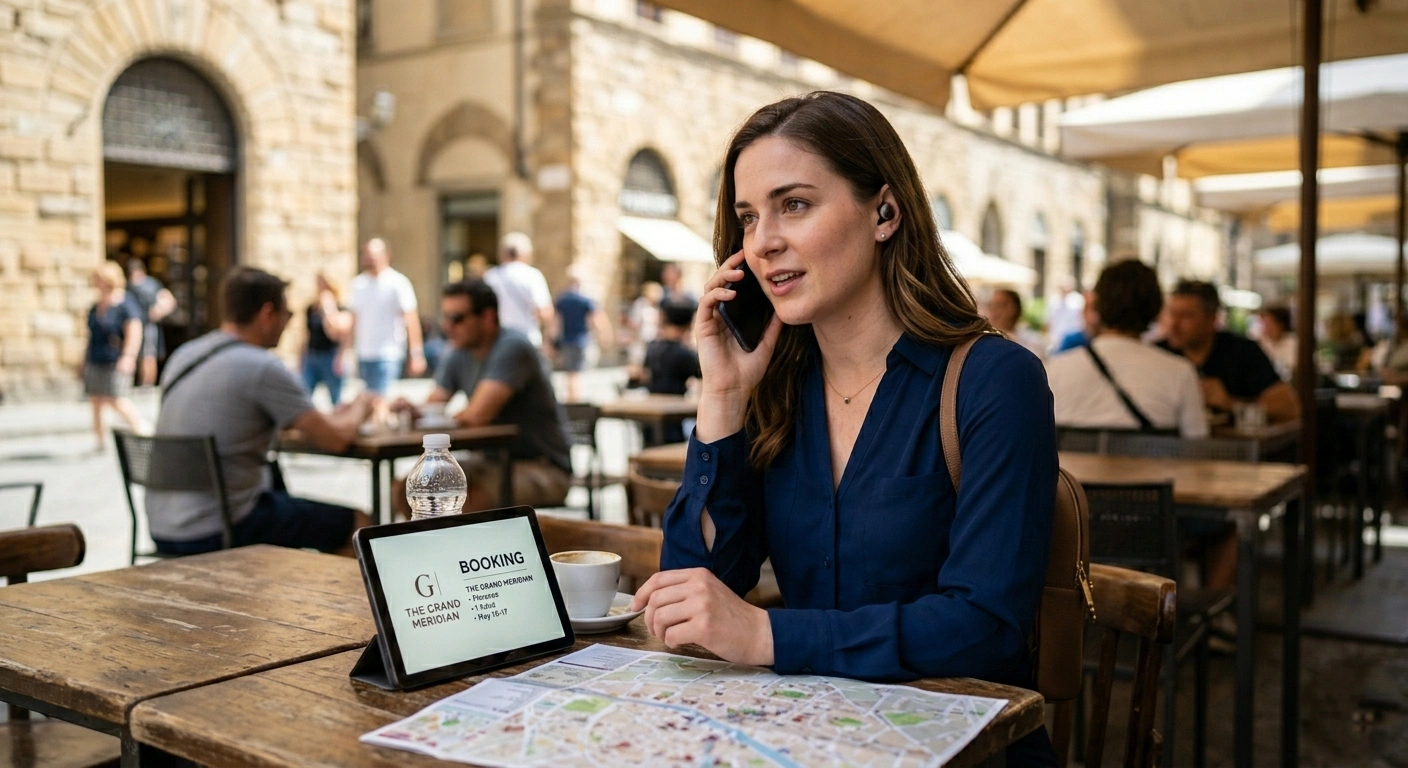
The distinction matters because the phone remains one of the highest-converting booking channels for independent hotels. Guests who call to book have already made most of their decision. They want confirmation, reassurance, and a rate. An AI phone agent delivers all three, instantly, every time the phone rings.
{{concierge-two}}
How Does An AI Phone Agent Actually Work?
The call flow is straightforward once you understand the four components involved.
Step 1: The Call Comes In
The guest dials your hotel's existing phone number. The AI phone agent picks up - typically within two rings. There is no hold music, no "press 1 for reservations" phone tree, no voicemail greeting. The agent answers with your hotel's name and a natural opening.
Step 2: Natural Language Processing Interprets The Request
The agent uses natural language processing (NLP) to understand what the guest is saying in real time. NLP is the technology that lets software recognise conversational speech rather than requiring the caller to use specific commands. The guest can say "I want to book a room for next Friday" or "do you have anything available the weekend of the 14th?" or "I'm looking for a king bed for two nights" - and the agent understands all of them.
Step 3: Live Inventory Is Checked
This is the step where integration with your PMS becomes decisive. A properly integrated AI phone agent queries your live inventory in real time - the same data your front desk sees when they pull up availability on screen. Room types, rates, and availability are accurate to the moment of the call.
A system without direct PMS integration has to rely on a separately maintained availability calendar or a one-way data feed. That creates lag. It creates the risk of confirming a booking for a room that's already taken. And it means the booking doesn't land in your PMS automatically - it generates a message or email that someone still has to process manually.
Step 4: The Booking Is Confirmed And Written To Your System
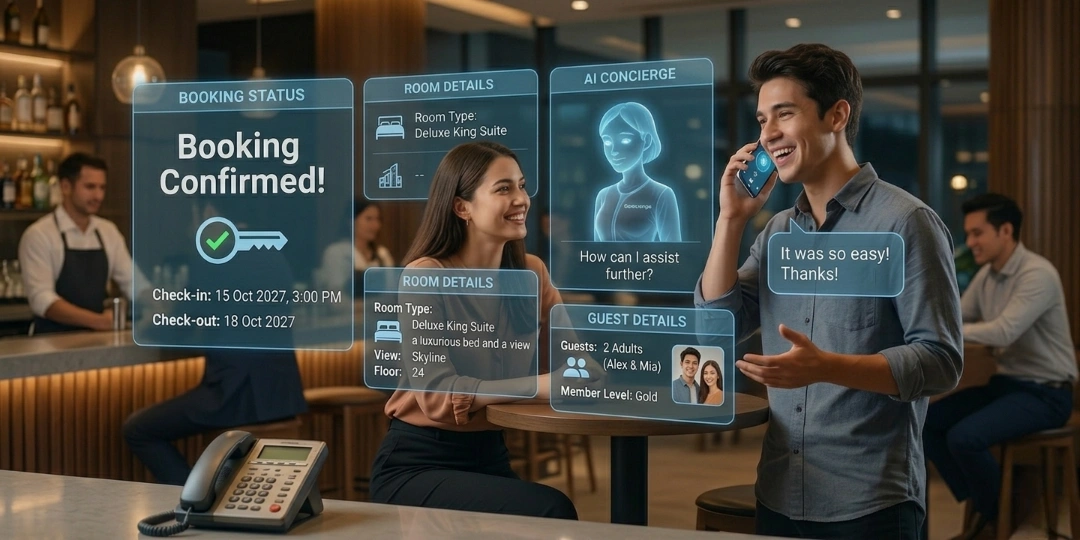
When the guest agrees to book, the AI phone agent creates the reservation record directly in your PMS. The guest receives a confirmation. Your front desk sees the booking appear. No manual data entry. No follow-up step. The same outcome as if a staff member had taken the call and typed it in themselves.
What An AI Phone Agent Handles And What It Doesn't
What it handles well:
Reservation inquiries - date availability, room types, rates, booking confirmations - make up the majority of inbound hotel calls. An AI phone agent handles these completely and accurately. Beyond reservations, it covers the high-volume, repetitive calls that consume front desk time without requiring complex judgement.
Common call types handled automatically:
Check-in and check-out time inquiries
Room availability and rate questions
Reservation creation and confirmation
Parking, amenities, and pet policy questions
Directions and location inquiries
Existing reservation lookups
Early check-in or late check-out requests
After-hours calls of every kind
What it escalates to staff:
Calls involving complaints, disputes, special circumstances, or anything that requires genuine human discretion get routed to a staff member or flagged for a callback. A well-configured AI phone agent knows the boundary between what it can resolve and what needs a person.
What it cannot replace:
An AI phone agent is not a substitute for human hospitality. It is a substitute for the phone ringing without answer. The relationship-building moments - the returning guest who wants to talk through options with someone they recognise, the couple planning a surprise anniversary stay - those still belong to your team. The AI handles the volume so your team has capacity for the moments that actually need them.
The Integration Question: Standalone Tool vs. Pms-Native Agent
This is the question most hotel operators don't think to ask until after they've signed up for something.
Standalone AI Phone Tools
are built as independent software products. They answer calls, interpret speech, and can be configured with information about your property. Some are well-built and capable. But they connect to your PMS through a third-party connection and that connection is only as reliable as the link between two separate systems built by two separate companies.
connects to your PMS through a third-party connection and that connection is only as reliable as the link between two separate systems
What this means in practice:
Availability data may be pulled on a scheduled sync rather than in real time
Bookings confirmed by the agent may arrive in your PMS as a task or email rather than a direct reservation record
You're managing two vendor relationships, two contracts, and two support lines when something breaks
Every booking touched by the agent adds a manual step somewhere in your operation
PMS Native AI Phone Agents
are built on top of the PMS itself. They read the same live inventory your front desk reads. They write the booking into the same reservation record your team manages. There is no middleware. There is no lag. There is no separate data silo to reconcile at the end of the day.
The difference isn't theoretical. Consider a 60-room independent hotel running at 75% occupancy on a Friday night. A guest calls at 10:47pm to book a king room for Saturday. A standalone tool checks its last sync from 9pm and tells the guest there's availability. Your PMS shows one king room left. That room was booked online at 10:30pm. The standalone tool didn't know. The guest gets confirmed. Saturday morning starts with an overbooking conversation.
A PMS-native agent queries the live inventory at 10:47pm, sees the one remaining king, and holds it against the booking in real time. The guest is confirmed accurately. Your front desk walks in the next morning with zero surprises.
Factor
Standalone AI Phone Tool
PMS-Native AI Phone Agent
Availability data
Synced periodically or via API
Live, real-time from PMS
Booking creation
Message/email to process manually
Direct reservation record in PMS
Guest data capture
Stored separately
Written to existing guest profile
Overbooking risk
Higher - sync lag creates exposure
Lower - live inventory checked
Vendor complexity
Two contracts, two support teams
One platform, one team
Setup complexity
Requires integration configuration
Configured within existing PMS
Data reconciliation
Required - two systems to align
Not required - single system
Six Things To Evaluate Before You Choose One
1. Does it have a direct, real-time connection to your PMS?
Not a scheduled sync. Not a delayed feed. A direct, live connection to the same inventory your front desk sees. Ask the vendor to explain exactly what happens between "guest agrees to book" and "reservation appears in your PMS." If there's a step that involves a human or a manual process, the integration is not complete.
2. Does it write the booking directly into your PMS, or create a task?
These are not the same thing. A booking written directly into your PMS is confirmed. A task or email generated for a staff member to process is a pending manual action. At peak periods, that's a missed booking waiting to happen.
3. Can it handle multilingual calls without a configuration change?
Your guests don't all call in English. A system that requires you to set up separate language instances for Spanish, French, or Mandarin is a configuration burden. The agent should detect the language the guest is speaking and switch automatically.
4. What happens when the call is outside the agent's capability?
Ask how the system handles escalation. Can it transfer to a live staff member during business hours? Does it capture a callback request after hours? Does it flag the call in your system so nothing falls through? Escalation handling separates professional tools from basic ones.
5. How is the agent configured to your property?
A generic AI phone agent that knows nothing about your hotel's room types, rate structure, policies, or brand will deliver a generic guest experience. The best systems are trained on your specific property data - your rooms, your rates, your language, your brand voice.
6. Who supports it when something breaks?
Hospitality support requirements don't follow business hours. If the AI phone agent develops a problem at 11pm on a Saturday, who do you call? What's the response time? Is support handled by the PMS team you already have a relationship with, or by a separate vendor you've never spoken to?
Real-World Scenario: How An Independent Hotel Changed Its Overnight Results
Picture an independently owned hotel. Two front desk agents on the day shift. One on evenings. The phone rings an average of 40 to 60 times per day. About a third of those calls are reservation inquiries. Another third are questions about parking, check-in times, and room policies. The rest are a mix.
Before an AI phone agent, the evening shift agent is splitting attention between the guests standing at the desk, the calls coming in, and any operational issues that need handling. Between 6pm and 11pm, some calls go to voicemail. After 11pm, almost all of them do.
After deploying a PMS-integrated AI phone agent:
Every call is answered within two rings, regardless of time
Reservation calls at 11pm are handled completely - availability checked live, booking confirmed, guest gets a confirmation
The morning front desk team arrives to find overnight reservations already in the system, no voicemails to return, no callbacks to make
The evening shift agent handles the guests in front of them properly instead of juggling the phone
The agent doesn't eliminate the need for staff. It eliminates the revenue leak that no amount of scheduling could fix and frees the team to focus on what they're actually good at.
{{concierge-one}}
How roommaster Concierge Recovers Lost Revenue from Missed Calls
roommaster Concierge is the AI phone agent built natively into the roommaster platform. It's powered by Sadie AI and purpose-built for independent hotels running on roommaster's property management system.
Because it's native to the PMS, it reads live inventory directly. Bookings confirmed through Concierge appear as reservation records in roommaster the same way a booking taken by a front desk agent would. There's no sync process, no manual reconciliation, and no separate vendor relationship to manage.
The setup is tailored to your property - your room types, your rates, your policies, your language. Harley Trudeau, Administrative Assistant at one of the hotels using roommaster Concierge, put it directly: "roommaster Concierge talks like one of us. It knows our room types, answers in different languages, and takes bookings without even sounding robotic. Guests even compliment 'our receptionist' - they don't realize it's AI."
Albert Gjoni, a hotel owner who adopted Concierge, described the initial hesitation plainly: "When we first introduced roommaster Concierge, we were a little hesitant. Would guests still book with us if an AI voice agent answered? But from day one, it proved its value. Direct bookings have increased, and guests often compliment the polite and helpful voice that assisted with their reservation."
Concierge is available 24/7, handles calls in multiple languages, and integrates with roommaster's guest communication tools for a connected guest experience from first call through post-stay follow-up.
If your team is spending too much time on phone calls at the expense of the guests standing in front of them, the pattern behind that is explored in detail in why hotel staff spend too much time on phones and how roommaster Concierge gives that time back.
Bottom Line
An AI phone agent for hotels solves a structural problem that staffing alone can't fix. Phones ring at times your team can't always answer. Guests who don't reach someone move on. That's not a failure of effort - it's a gap between how hotels operate and when guests decide to book.
The technology to close that gap exists. The evaluation question isn't whether to use an AI phone agent. It's which kind to use. A standalone tool adds another vendor, another integration, and another system to manage. A PMS-native agent writes directly into the system you already run on - no lag, no manual steps, no separate data to reconcile.
For independent hotels that want every call answered and every reservation captured without adding headcount, the case is clear.
If your front desk is routinely missing calls during busy periods or losing overnight bookings to voicemail, the problem compounds every night it goes unsolved. roommaster Concierge answers every call, confirms bookings directly into your PMS, and handles multilingual guests without configuration overhead. Hotels using it report guests complimenting the voice on the phone - not realising it's AI at all.
{{cta-strip}}
FAQs
What is an AI phone agent for hotels?
An AI phone agent for hotels is a voice-based system that answers inbound guest calls automatically, handles reservation inquiries and bookings, and responds in natural conversational speech - 24 hours a day, without staff involvement. It connects to your PMS to check live availability and confirm reservations in real time.
Can an AI phone agent actually complete a hotel booking, or just take a message?
A properly integrated AI phone agent completes the full booking - checking live availability, confirming the rate with the guest, and writing the reservation directly into the PMS. A system without real-time PMS integration can only collect guest details and generate a message for staff to process manually. The difference is significant: one creates a confirmed reservation, the other creates a task.
Will guests know they're speaking to an AI?
Modern AI phone agents use natural voice models trained on hospitality conversations. They're designed to sound warm and helpful, not robotic. Many hoteliers report that guests compliment the voice on the phone without realising it isn't a person. Disclosure rules vary by jurisdiction, and a well-configured agent handles identification requirements appropriately for each call.
Does an AI phone agent replace front desk staff?
No. An AI phone agent handles the high-volume, repetitive calls that currently compete for your team's attention - reservation inquiries, FAQs, after-hours calls. It frees your front desk team to focus on the guests standing in front of them, which is where the real hospitality happens. The agent supplements your staff, it doesn't replace them.
How long does it take to set up an AI phone agent for a hotel?
Setup time varies by vendor and depends on how much property-specific configuration is required. Simpler tools with limited PMS integration can be live quickly but deliver limited capability. A PMS-native agent with full inventory access and property-specific training requires a setup phase - typically a few days to a week - to configure room types, rates, policies, and escalation rules properly. The setup investment is front-loaded; after that, the system runs without ongoing maintenance.
concierge-one
Turn Missed Calls into Bookings with Hotel AI Agent
Mayela Lozano is a content strategist with a passion for hospitality and technology. She collaborates with roommaster on content creation, highlighting how technology can streamline hotel operations and enhance guest satisfaction. When she’s not creating content, Mayela loves to travel and spend time with her two little ones, discovering new adventures and making memories along the way.
Join Thousands of Hotels Thriving with roommaster
The transition to roommaster is straightforward and efficient. Our implementation team handles data migration including reservations, guest profiles, and historical information.
The transition to roommaster is straightforward and efficient. Our implementation team handles data migration including reservations, guest profiles, and historical information.
Cloud Computing In The Hospitality Industry: A Complete Guide For Hotels
October 1, 2026
AI
Hospitality Technology
10 Best Hotel Chatbots in 2026
July 30, 2026
AI
Online Bookings
10 Best Hotel Concierge Software 2026
July 22, 2026
AI
Hotel Management
10 Best Hotel Revenue Management Software (RMS) 2026
July 21, 2026
Hotel Management
AI
AI Phone Answering Service for Hotels: A Practical Buyer's Guide
May 17, 2026
AI
Online Bookings
AI Hotel Reservation Systems: Automate Bookings For Better Results
May 8, 2026
AI
Hospitality Trends
Best AI Tools For Customer Service In The Hospitality Industry (2026)
April 21, 2026
Hospitality Trends
AI
How Conversational AI Is Transforming Hotel Customer Service
April 17, 2026
AI
Data Management
Hotel Management
Hotel Profitability Analysis: Formulas, KPIs & Step-by-Step Guide (2026)
January 13, 2026
AI
Hospitality Technology
Top 10 Best AI Hotel Management Software
December 17, 2025
Join Thousands of Hotels Thriving with roommaster
See how roommaster's unified platform can work for your property. Our team will walk you through features tailored to your specific needs and operations.

.avif)
.png)
.png)
.png)