How Conversational AI Is Transforming Hotel Customer Service
“We’re no longer stuck behind our computers doing spreadsheets. With AI doing the heavy lifting, we can focus on our guests" - Susie Conway, General Manager, Flamingo Motel
Conversational AI in hotels uses natural language processing to enable context-aware, multi-turn conversations, a fundamental leap beyond rule-based chatbots.
This shift allows hotels to move from basic query handling to real-time, personalized guest interactions across booking, service, and support.
As a result, conversational AI now supports the entire guest journey, from pre-arrival planning to in-stay service and post-stay engagement, turning one-time stays into ongoing relationships.
The impact is measurable, with modern systems delivering up to 20% higher guest satisfaction and increasing revenue through always-on upselling and faster response times.
roommaster Concierge is purpose-built for hospitality, integrating across the full guest journey from first inquiry to post-stay follow-up.
Hilton’s Connie. Marriott’s ChatBotlr. The Cosmopolitan of Las Vegas’ Rose.
What do all of these have in common?
They’re all powered by conversational AI.
Unless you’ve been off the grid for a while, you’ve probably noticed the massive buzz around it.
Let’s say a guest messages your hotel at 11 PM asking about early check-in, local restaurant recommendations, and whether the pool is heated. In the past, that message either waited until morning or landed on an already stretched front-desk team.
Conversational AI in hotels changes that equation entirely.
Hotels that have deployed conversational AI are responding to guest inquiries instantly, across multiple languages, without adding headcount. The best part is that these interactions don’t feel robotic. Guests get answers that are relevant, contextual, and specific to their booking.
Here’s what conversational AI in hotels actually is, how it differs from the basic chatbots most properties have tried, and how it maps across the full guest journey.
What is Conversational AI?
Conversational AI is software that can understand, process, and respond to human language in a way that feels like a real exchange. It uses a combination of natural language processing (NLP), machine learning (ML), and large language models (LLMs). These are the same class of technology behind tools like ChatGPT, but trained and configured for specific domains.
In a hotel context, that domain is the guest relationship. The system learns how guests phrase requests and interprets intent even when the wording is informal or ambiguous. Plus, it responds in a way that reflects your property's voice and information.
Conversational AI vs. Traditional Chatbots: Key Differences
Most hotels that have experimented with chatbots have come away unimpressed. The reasons are consistent.
For example, the moment a guest asks anything outside a narrow script, the bot breaks. It loops and says, "I didn't understand that."
The guest gives up and calls the front desk anyway, which defeats the purpose.
The frustration is, more so, a problem with a rule-based system.
Traditional chatbots operate on decision trees. They pattern-match guest input against a list of pre-written triggers and respond with pre-written answers. They do not understand language. If a guest types, "Our baby keeps spitting up, and we're out of towels, can someone come up?", a rule-based bot cannot parse that. The right response requires reading intent, urgency, and context simultaneously.
Conversational AI, however, does that work differently:
Feature
Traditional Chatbot
Conversational AI
Language understanding
Keyword matching
NLP-driven intent recognition
Response flexibility
Scripted decision trees
Dynamic, context-aware responses
Multi-turn conversations
Limited or absent
Fully supported
Personalization
Generic
Adapts to guest profile and booking data
Handles unexpected input
Fails or loops
Interprets and responds
Learns over time
Static
Improves with use
PMS integration
Rare
Standard in hospitality-built platforms
Modern conversational AI systems deliver up to 20% higher guest satisfaction than rule-based bots, a gap that precisely reflects this architectural difference.
For example:
A traditional chatbot handles "What time does the restaurant open?"
A conversational AI agent handles, "We have a nut allergy in our group, and my partner just got upgraded. Is there anything the kitchen can do for dinner tonight?"
The former resolves a lookup. The latter requires comprehension, context, and coordination.
Only one of these technologies is capable of both. You guessed which one.
The most immediate application is always-on messaging. Guests ask questions at unpredictable hours, before booking, after midnight and from airports mid-journey. Conversational AI responds instantly across every channel, including your website, WhatsApp, SMS, email, and in-room tablets.
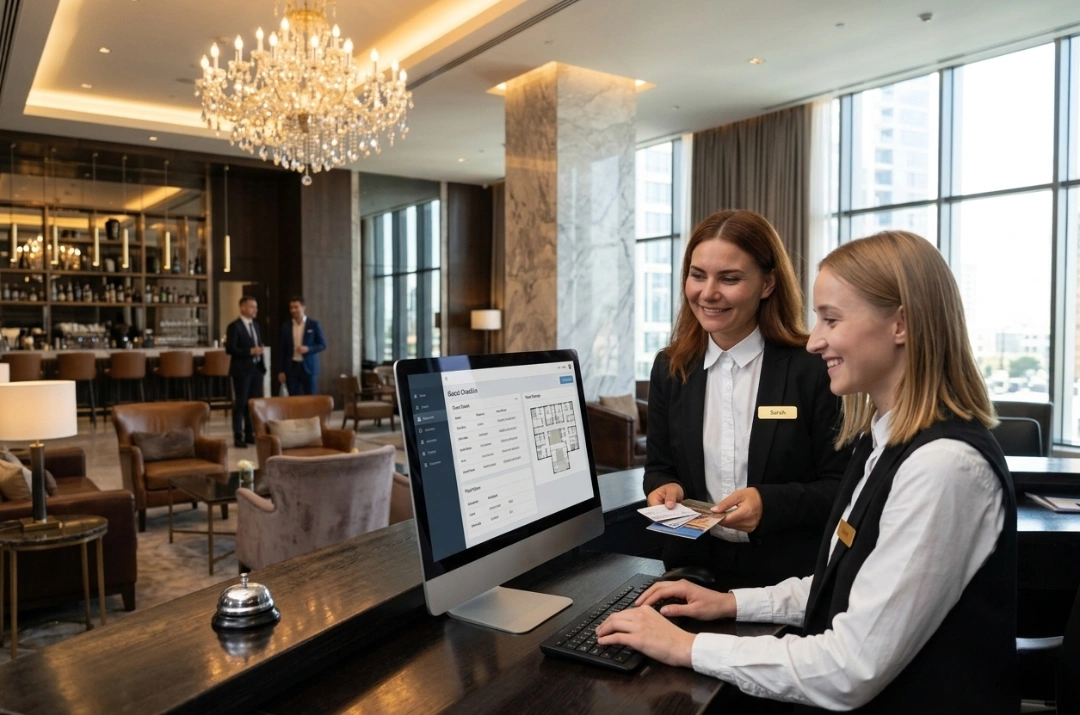
To support this, roommaster Concierge, powered by Sadie AI, acts as a 24/7 AI voice concierge that answers inbound phone calls, captures missed calls, and converts them into bookings in real time. Instead of missed calls or delayed replies, every guest gets an immediate response. As a result, hotels can convert more inquiries while keeping guest data and reservations in sync with their systems.
For guests, the experience is simple. They get quick answers to questions like check-in times, room details, or amenities without having to wait. Multilingual support also ensures international guests can communicate comfortably.
{{concierge-one}}
The 2025 State of Hotel Tech Report found that 70% of guests find AI tools helpful for simple requests like sharing the Wi-Fi password and placing room service orders.Handling that volume without a human in the loop frees your team to focus on the interactions that genuinely need them.
2. Reservation management
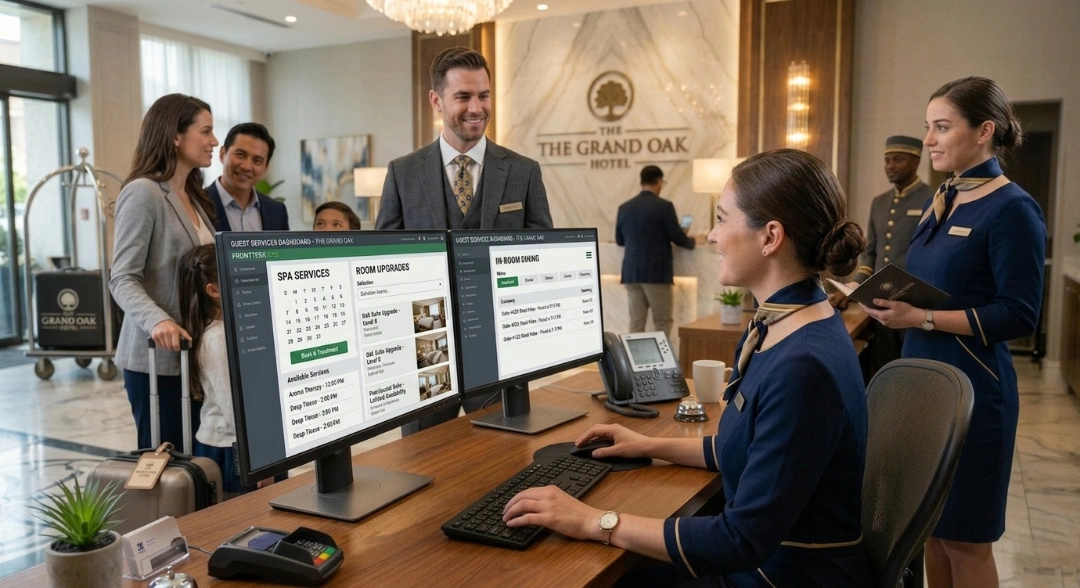
AI agents handle availability questions, rate comparisons, modification requests, and cancellation processing without routing through your reservations team for routine cases. With the roommaster Hotel Reservation Management Software, teams reduce front-desk clicks by up to 30% while keeping bookings, rates, and availability synchronized across all channels in real time.
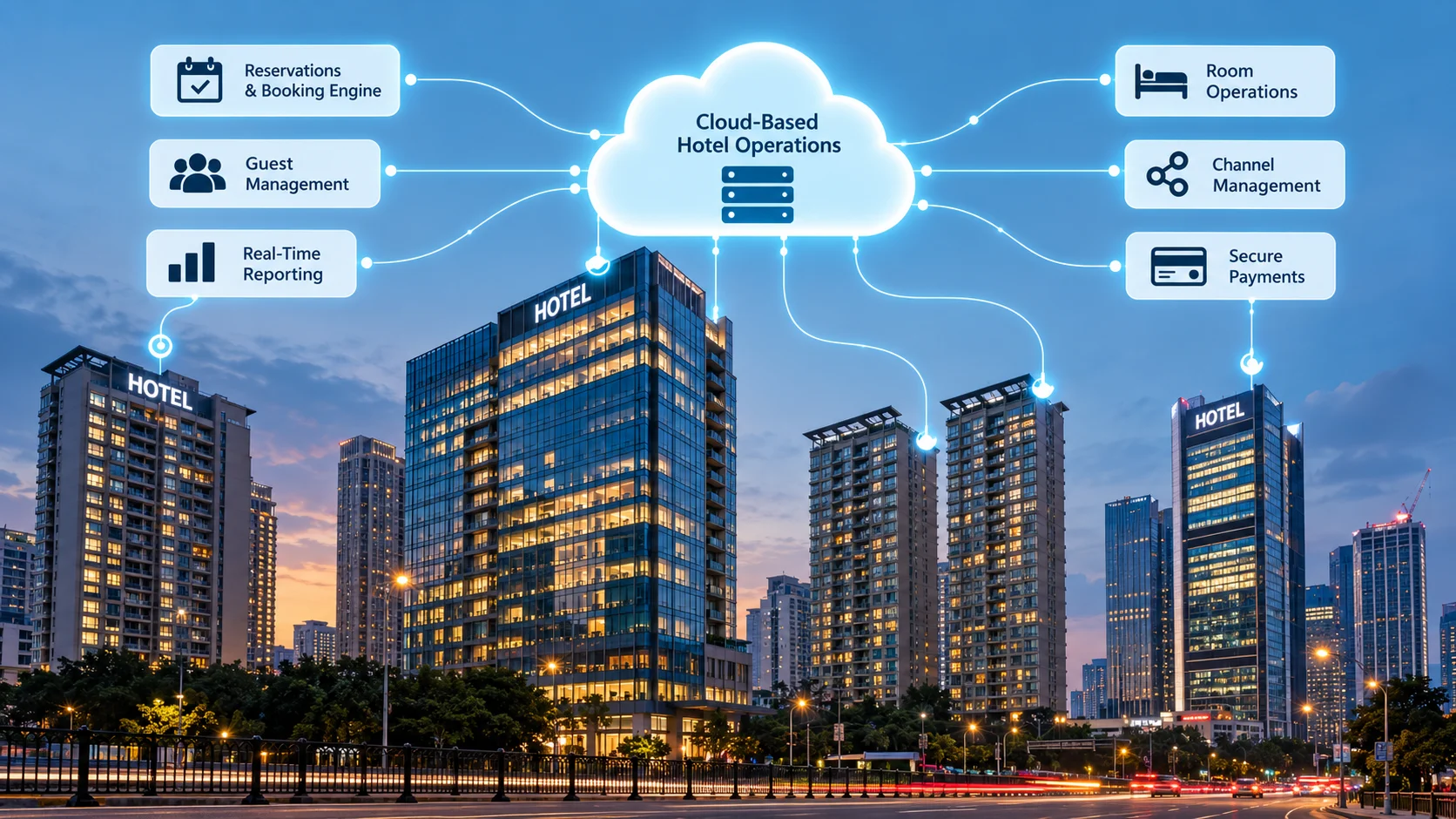
An intuitive calendar interface, drag-and-drop updates, and auto-filled guest details simplify daily tasks, while real-time syncing across the property management system (PMS), booking engine, and channel manager prevents overbookings and rate mismatches.
For properties handling groups and events, built-in tools support flexible billing, custom booking codes, and smart room allocation that keeps guests together while optimizing occupancy. This is where properties with lean staffing recapture the most time.
3. Pre-arrival upselling
Conversational AI acts as a digital concierge, surfacing relevant upgrades, dining reservations, spa bookings, and add-ons during the pre-arrival window based on guest context. For example, a couple on a weekend getaway may receive curated dining or spa suggestions, while a business traveler may see early check-in or transport options.
These offers are delivered naturally within the conversation, making it easy for guests to explore and add services without friction. This approach increases attachment rates while keeping the experience helpful, not salesy.
4. In-stay service routing
Guest message requests involve asking for extra towels, maintenance, room service, or a late checkout, via whatever channel they prefer.
The AI routes each request to the right department, confirms with the guest and creates a trackable record that your team can manage centrally.
5. Post-stay engagement
Most hotels stop engaging guests after checkout. That’s where revenue is lost.
AI-powered follow-up messages, review invitations, and loyalty prompts go out automatically through the same channels guests used during their stay. As a result, it drives significantly higher response rates than generic email campaigns.
Conversational AI Across the Guest Journey
One of the biggest advantages of chatbots is their versatility. They can adapt to a wide range of use cases.
In hospitality, that means supporting guests at every stage of their journey with your property. More importantly, it means turning what would otherwise be a simple transaction into an ongoing relationship through consistent, personalized engagement.
It starts even before they arrive, so let’s walk through the entire experience.
1. Pre-arrival
Pre-arrival is the highest-anxiety stage of the guest journey. Guests are confirming details, asking about logistics, flagging special needs, and building expectations about the stay ahead.
This is where conversational AI begins shaping the relationship from the very first interaction. roommaster’s Hotel Guest Engagement Software combines reservation support with personalized engagement, so guests can check availability, compare rates, and complete bookings in real time while receiving tailored welcome messages and relevant property information.
Beyond reservations, AI handles the steady flow of pre-arrival questions, such as parking, pet policies, or check-in details, through a 24/7 concierge experience. With multilingual support and the ability to resolve most common inquiries automatically, guests get instant answers without waiting on staff.
Simultaneously, properties can surface upgrades, packages, or offers based on guest preferences, turning early interactions into revenue opportunities.
2. In-stay
In-stay is where operational efficiency and hotel guest satisfaction intersect most directly. Every unanswered message is a service failure. Every request that bounces between departments is a source of friction. Conversational AI eliminates both by providing guests with a single, always-available channel and your team with a centralized view of every open request.
In fact, nearly 47.6% of respondents expressed “somewhat interest” in using automated messaging during their stay, while 29.3% say they are “very interested”. The appetite is already there. What most properties are still building is the infrastructure to meet it.
With roommaster’s AI-powered concierge capabilities, guests can request services, ask questions, and receive recommendations in real time. Meanwhile, all guest communication flows into a centralized system. Front desk teams always know the status of requests and rooms, which reduces confusion and speeds up service delivery. When needed, AI escalates conversations to staff with full context, offering a smooth transition without repeating information.
AI also enables proactive engagement. It can detect patterns in guest requests, flag dissatisfaction early, and prompt timely intervention. Similarly, in-stay communication workflows help guests receive the right message at the right moment, improving their experience without overwhelming them.
3. Post-stay
The post-stay window is one of the most valuable yet underused parts of the guest journey. By the time a guest checks out, their impression is already formed. What happens next determines whether they share that experience and whether they return.
Automated follow-up messages reach guests at the right moment, encouraging online reviews and collecting feedback when guest satisfaction is highest. AI can even suggest responses to reviews and help manage reputation across channels. With centralized reputation monitoring and multi-channel messaging through platforms like SMS and WhatsApp, communication stays consistent and accessible.
Additionally, guest profiles and behavioral data power targeted campaigns, special occasion recognition, and personalized offers that bring guests back. With integrations like Google Analytics and Tag Manager, hotels can track guest behavior and refine campaigns based on real interaction data.
What begins as a single stay evolves into a continuous relationship, increasing the likelihood of direct repeat bookings.
Key Benefits for Hotel Customer Service Teams
The guest-facing impact of conversational AI in hospitality is well-documented. The operational impact on hotel teams is equally significant and, in the current labor environment, arguably more urgent.
A direct response to staffing pressure: In North America, 65% of hotels reported staffing shortages in 2025, and labor costs rose 11.2% year-over-year, according to an analysis by BCG and NYU SPS.Conversational AI absorbs the volume of routine guest communication that would otherwise fall on an already-stretched front desk. In practice, chatbots now handle approximately 80% of routine guest inquiries, removing the repetitive load while freeing staff to focus on the complex, emotionally resonant interactions that define hospitality.
Consistent service quality, regardless of shift: Human teams vary by staffing levels, by time of day and by the cumulative weight of a long shift. Conversational AI delivers the same quality of response at 2 AM on a Wednesday as it does at noon on a Saturday, which directly affects your review scores.
Multilingual capability without multilingual headcount. International travel has recovered fully. Hospitality-built AI platforms like roommaster support multilingual conversations with automatic language detection,meaning a French-speaking guest, a Japanese-speaking guest, and an Arabic-speaking guest can all receive accurate, natural responses through the same system, without a multilingual human agent on duty.
Revenue data, not just operational data: Every conversation is a record. Over time, conversational AI identifies patterns in what guests ask, when they ask it, and which upsell offers convert, helping hotels increase bookings by 35%
The Human-AI Balance: When to Automate, When to Step In
In February 2026, the University of South Florida published one of the most practically useful studies on conversational AI in lodging to date. Published in the Journal of Hospitality and Tourism Technology, the study surveyed 145 participants, involving 44 hospitality industry practitioners and 101 hotel guests with recent stays, making it among the first to examine both perspectives on advanced conversational AI systems in lodging.
The headline finding was nuanced, and it matters for how hotels deploy this technology. Guests appreciate AI for quick, routine tasks and its 24/7 availability, but most still prefer human interaction for requests that involve emotional depth. A guest who is happy to get an instant AI response about pool hours will want a human agent when they're upset about a billing error or navigating a stressful situation.
81% of respondents said emotional authenticity was a critical challenge, and 76% expressed concerns about privacy and trust. Those concerns appeared in comments like “My voice could be hacked” and “AI cannot understand my feelings.”
The takeaway is not to limit AI, but to deploy it with clear boundaries. The hybrid approach, where AI starts the conversation and carries it until it's no longer appropriate for a human to be absent, is where the research points.
Detect escalation signals accurately: Complaint language, frustration indicators, and emotionally charged phrasing should trigger immediate routing to a human agent, with the full conversation history attached, so the guest never has to repeat themselves.
Make handoffs easier: A guest who has been speaking with an AI agent and then reaches a human should not experience a service gap. The staff member picks up with full context, and that continuity is what determines whether the escalation feels like good service or a system failure.
Give staff oversight: Your team should be able to see every active AI conversation, intervene with a single action, and set their own escalation thresholds. The AI manages volume. Humans manage judgment.
How to Get Started With Conversational AI at Your Hotel
Here’s how to bring conversational AI to your hotel and start improving guest engagement.
1. Audit your front desk and messaging volume first
Before selecting a platform, spend two weeks logging the categories of guest inquiries your team handles. In most properties, 70% of that volume falls into a short list of repeatable categories:
Check-in and checkout timing
Parking
Wi-Fi
Room features
Local recommendations
Service requests
Make that list your automation priority. Starting there delivers a fast, visible return and minimal disruption.
2. PMS integration is non-negotiable
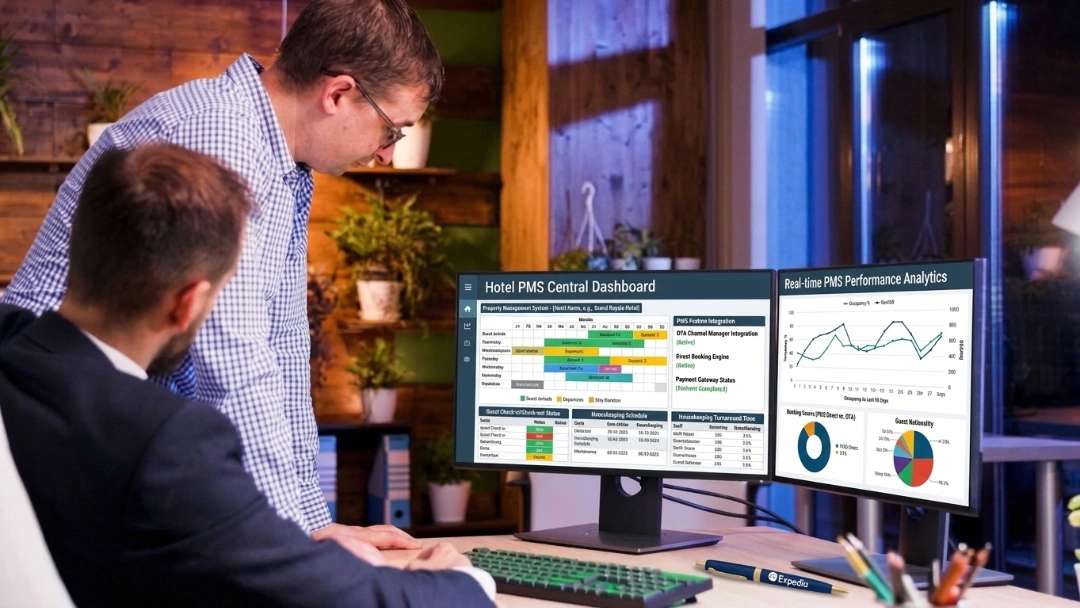
Conversational AI only delivers real value when it has live access to booking data, room availability, and guest profiles. A system that can't access your PMS can't confirm a reservation, check upgrade availability, or answer a specific question about a guest's stay.
roommaster Concierge integrates directly with your PMS to access real-time availability, bookings, and guest data, allowing the AI to confirm reservations, answer queries, and capture every inquiry without delays.
{{pms-four}}
As a result, it prevents missed calls, maintains consistent guest responses, and keeps the system fully synchronized across every interaction.
3. Choose hospitality-native over generic
A general-purpose AI tool requires months of configuration to understand hospitality workflows, including rate types, room categories, loyalty tiers, housekeeping language, and the specific patterns of guest communication across different phases of a stay.
A hospitality-built platform, such as roommaster, starts with all of that already in place.
4. Train your team on the handoff protocol, not the technology
The technology learning curve for staff is minimal.
The operational change that needs attention is knowing when and how to step into an AI-assisted conversation, and doing it in a way that feels smooth to the guest.
5. Track the metrics that reveal real performance
Response time, resolution rate without escalation, escalation rate by category, and guest satisfaction scores tied to AI-assisted interactions will tell you what's working.
Review failed conversations weekly, as these patterns reveal both platform gaps and opportunities to expand automation.
Transform Every Interaction Into a Guest Experience
In a successful conversational AI deployment, your brand’s personality shows up at every stage of the process. When designed thoughtfully, it communicates clearly, guides guests when questions are unclear, and connects them with a human when needed. Each interaction teaches the system more about your guests, allowing future stays to feel more personalized and seamless.
All of which brings us back to expectations. As these tools become more common, the convenience they provide will soon be a baseline expectation. There’s a reason the conversational AI market is projected to reach $41.39 billion by 2030. The technology is already making an impact. The question going forward won’t be whether to use it, but how to deploy it most effectively for your guests.
This is where all-in-one PMS, like roommaster bring everything together. From AI-powered concierge to automated guest communication and personalized engagement, it turns conversational AI into a system your team can actually rely on.
What is the difference between a chatbot and conversational AI?
A traditional chatbot follows scripted decision trees. It matches keywords to pre-written responses and fails the moment a guest asks something outside that script. In contrast, conversational AI uses NLP to understand intent and context, hold multi-turn conversations, and respond dynamically to real, unpredictable guest language.
Can conversational AI handle guest complaints?
Conversational AI can receive and acknowledge complaints, but the best practice is to escalate emotionally charged or complex complaints to a human agent. A well-configured hospitality AI system, such as the roommaster Concierge, can route these conversations to staff when needed, with conversation context carried forward so guests do not have to repeat themselves.
Does hotel conversational AI support multiple languages?
Yes, roommaster Concierge supports multiple languages and responds automatically in the guest's own language. This is particularly valuable for properties that serve international travelers but do not have multilingual staff available at all times. The response occurs in the correct language without manual routing.
How much does conversational AI cost for a hotel?
The pricing for conversational AI depends on the platform, property size, and the channels you deploy across. roommaster follows a similar approach, with pricing that scales to your property size and operational needs, so you only pay for what you use. Hotels typically receive a customized quote, and all-in-one platforms can reduce overall costs by replacing multiple vendors while providing 24/7 support.
concierge-one
Turn Missed Calls into Bookings with Hotel AI Agent
Mayela Lozano is a content strategist with a passion for hospitality and technology. She collaborates with roommaster on content creation, highlighting how technology can streamline hotel operations and enhance guest satisfaction. When she’s not creating content, Mayela loves to travel and spend time with her two little ones, discovering new adventures and making memories along the way.
Join Thousands of Hotels Thriving with roommaster
The transition to roommaster is straightforward and efficient. Our implementation team handles data migration including reservations, guest profiles, and historical information.
The transition to roommaster is straightforward and efficient. Our implementation team handles data migration including reservations, guest profiles, and historical information.
Hotel Check-In Kiosk: Enhance the Guest Experience
October 5, 2026
Hospitality Technology
Hotel Management
Hospitality Trends
Hotel Self Check-In: How It Works, Types, Benefits And Setup
October 1, 2026
Hotel Management
Hospitality Trends
Hotel Check-In & Check-Out Times Explained
October 1, 2026
Hospitality Trends
Hotel Management
Cloud-Based Property Management System: Hotel PMS
October 1, 2026
General
Cloud PMS
AI
Cloud Computing In The Hospitality Industry: A Complete Guide For Hotels
October 1, 2026
Hospitality Trends
Hotel PMS
Cloud PMS
Hotel PMS Integration: How It Works for Hotels
September 23, 2026
Hospitality Trends
Hospitality Technology
Hotel PMS
Hotel Management
Cloud PMS
How Hotel PMS Software Transforms Hospitality Management
September 23, 2026
Hospitality Trends
Best Hotels in New Orleans: A Complete Guide 2026
September 10, 2026
Hospitality Trends
Best Hotels in Philadelphia: A Complete Guide 2026
September 10, 2026
Hospitality Trends
Best Hotels in San Francisco: A Complete Guide 2026
September 10, 2026
Join Thousands of Hotels Thriving with roommaster
See how roommaster's unified platform can work for your property. Our team will walk you through features tailored to your specific needs and operations.



.avif)

.png)
.png)
.png)