Best AI Tools For Customer Service In The Hospitality Industry (2026)
“We’re no longer stuck behind our computers doing spreadsheets. With AI doing the heavy lifting, we can focus on our guests" - Susie Conway, General Manager, Flamingo Motel
Most hotel AI tools fail under real-world pressure, especially with complex or escalated queries
AI works best when applied across the full guest journey, not as a standalone chatbot
There are four key categories: guest communication, booking & reservations, revenue optimization, and post-stay engagement
The right tool depends on your biggest operational gap (not what’s trending). Implementation matters as much as the tool: training, integrations, and human handoff define success
Hotels using AI well are already pulling ahead in speed, revenue, and guest experience
So the other day, we decided to audit how customer service is handled across a few hospitality businesses we’ve been working with. You know… just to understand what the guest experience actually looks like and spot any gaps where things could be better.
We started testing a few touchpoints, including booking confirmations, guest messaging, and post-stay support. Everything seemed fine at first. Quick responses, decent automation… all good.
But then things got messy. Some systems couldn’t handle simple requests. Others kept looping the same responses. And when we tried to escalate to a human? Either it took forever… or it just didn’t happen.
Now, it was the weekend, and peak time in hospitality, and we needed answers fast. When we wanted to see how these AI systems really perform under pressure, it didn’t go well. Again.
For an industry that lives and dies by customer experience, it’s surprising how often this still goes wrong. Especially when we’ve seen just how good AI-powered support can be when it’s done right.
That’s the problem. Guests don’t wait. One bad interaction, and they move on. That’s exactly why choosing the right AI tools for hospitality customer service is critical.
That said, which tools actually deliver? And how do you pick the right one for your team?
Here’s what’s actually worth your time.
Why AI is Reshaping Customer Service in Hospitality
The hospitality industry has always run on service. But the definition of great service has shifted. Speed used to mean a quick response at the front desk. Today, it means a reply in seconds, on the channel a guest already uses, in their language, at any hour.
A recent study shows that organizations achieve significant productivity gains from generative AI. It includes a 14% increase in customer service effectiveness. In hospitality, that productivity gain matters enormously when you consider how much of a team's day is spent on repetitive, answerable questions.
72% of consumers say they are open to AI-powered interactions if they lead to faster, more efficient service. 54% of consumers are more likely to book a hotel that offers personalized recommendations based on past preferences. These numbers reflect an important point, that guests are not resistant to AI. They are resistant to poor service, and they will accept AI when it delivers a better experience than alternatives.
BCG's 2025 global analysis found that fewer than 10% of hospitality companies are “future built.” These firms already generate significant value from advanced AI. On the other hand, 25% had an AI strategy that was beginning to deliver real returns across multiple organizational activities. That leaves a significant majority of properties still in the early stages. The competitive gap between early movers and laggards is already visible in performance metrics.
The question the industry asked two years ago, "Should we use AI?", has been replaced by a more pressing one: How do we use it effectively without losing the human touch?
Types of AI Tools Hotels Are Using
Hotel AI tools generally fall into four operational categories:
Guest communication and support tools handle real-time messaging, voice calls, multilingual FAQs, digital check-in, and concierge-style requests across channels such as WhatsApp, web chat, and social media.
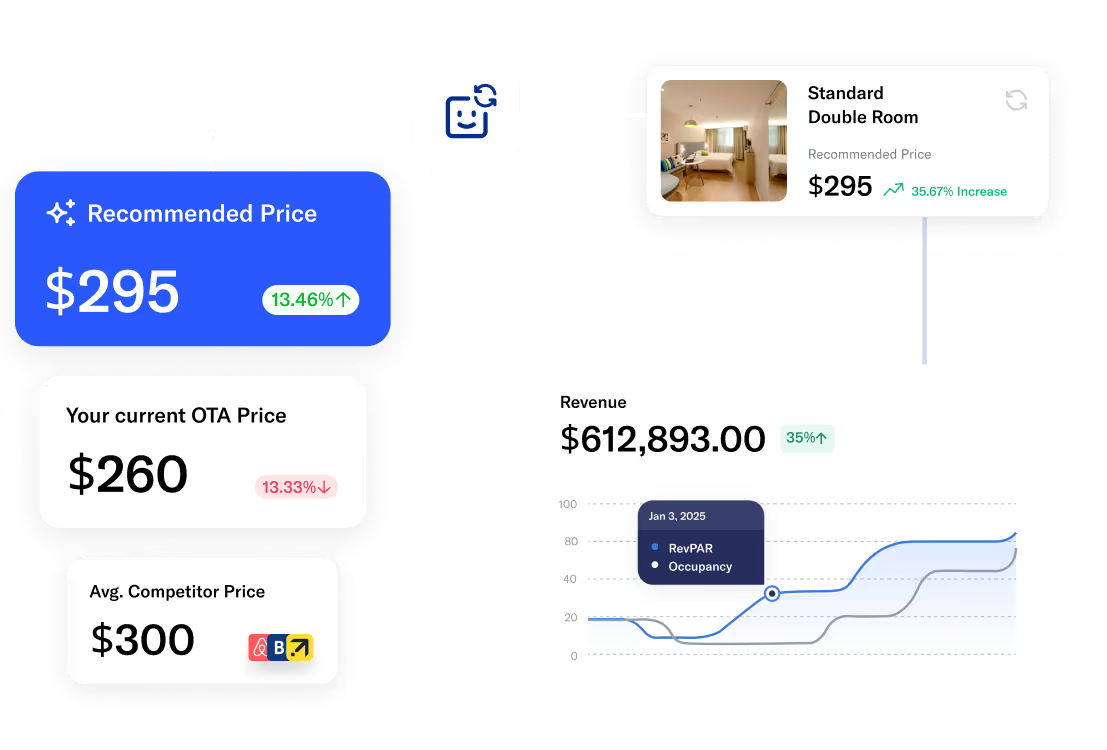
Reservation tools and booking engines use AI to manage pricing intelligence, channel distribution, and demand forecasting, helping hotels capture the right bookings at the right price, automatically.
Revenue management and pricing intelligence tools push personalized upgrade offers and add-on packages to guests at key moments in the journey, turning touchpoints into revenue opportunities.
Post-stay engagement and review management tools automate follow-up surveys, solicit reviews, and use sentiment analysis to surface operational insights from guest feedback.
{{revenue-management-one}}
There is an important distinction to consider here, as not every hotel needs all four categories at once. A boutique property might start with guest communication AI to handle after-hours calls. A large hotel group might prioritize revenue management automation first. Understanding the categories helps you match the tool to your actual problem.
A Quick Overview: AI Tools Comparison Table
Before we dive deeper into the hotel AI software for customer service, let’s take a quick look at how the top tools compare.
Tool
Best For
Key Features
Pros
Cons
G2 Rating
roommaster Concierge
Hotels looking to automate guest calls and improve booking capture
24/7 AI voice concierge that answers guest calls, handles reservations, responds to queries, supports multiple languages
Review management across 45+ sites, guest surveys, sentiment analysis, CRM segmentation and dashboards
Strong link between feedback and marketing; deep guest profiling; powerful segmentation for revenue growth
Manual translation required for reviews, no built-in end-to-end translation workflow
4.3
Top AI Tools for Guest Communication & Support
If guest messages are piling up across channels and your team is struggling to keep up, these AI chatbots for hotels can completely change how you handle communication and support.
1. roommaster Concierge
Best for: Hotels of all sizes that want to improve call handling, capture more direct bookings, and provide 24/7 multilingual guest support
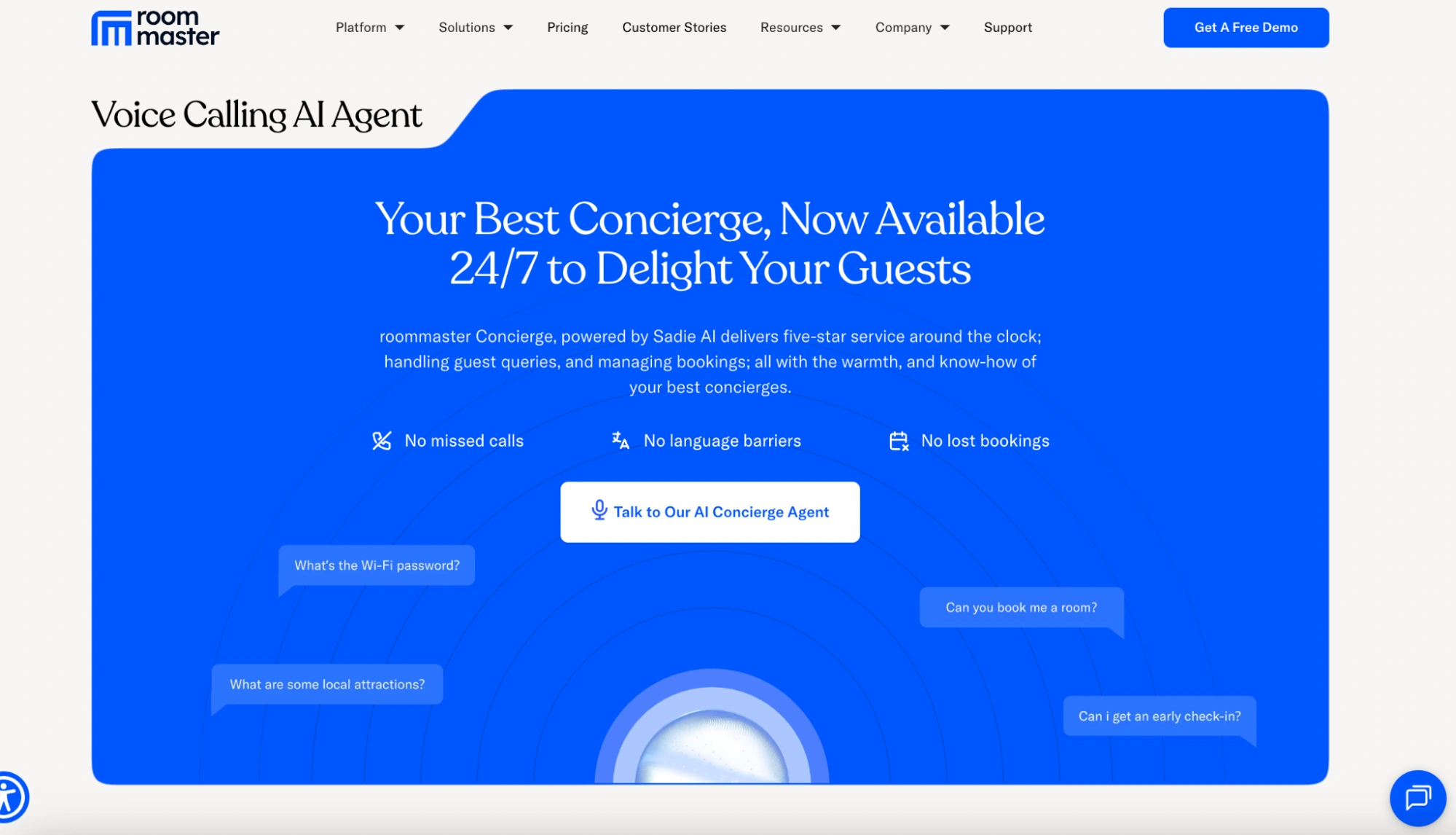
roommaster is one of the most established names in hotel property management software. Its AI Concierge, powered by Sadie technology, represents a significant step forward for independent hotels and boutique properties that need enterprise-level intelligence without enterprise-level complexity.
{{concierge-one}}
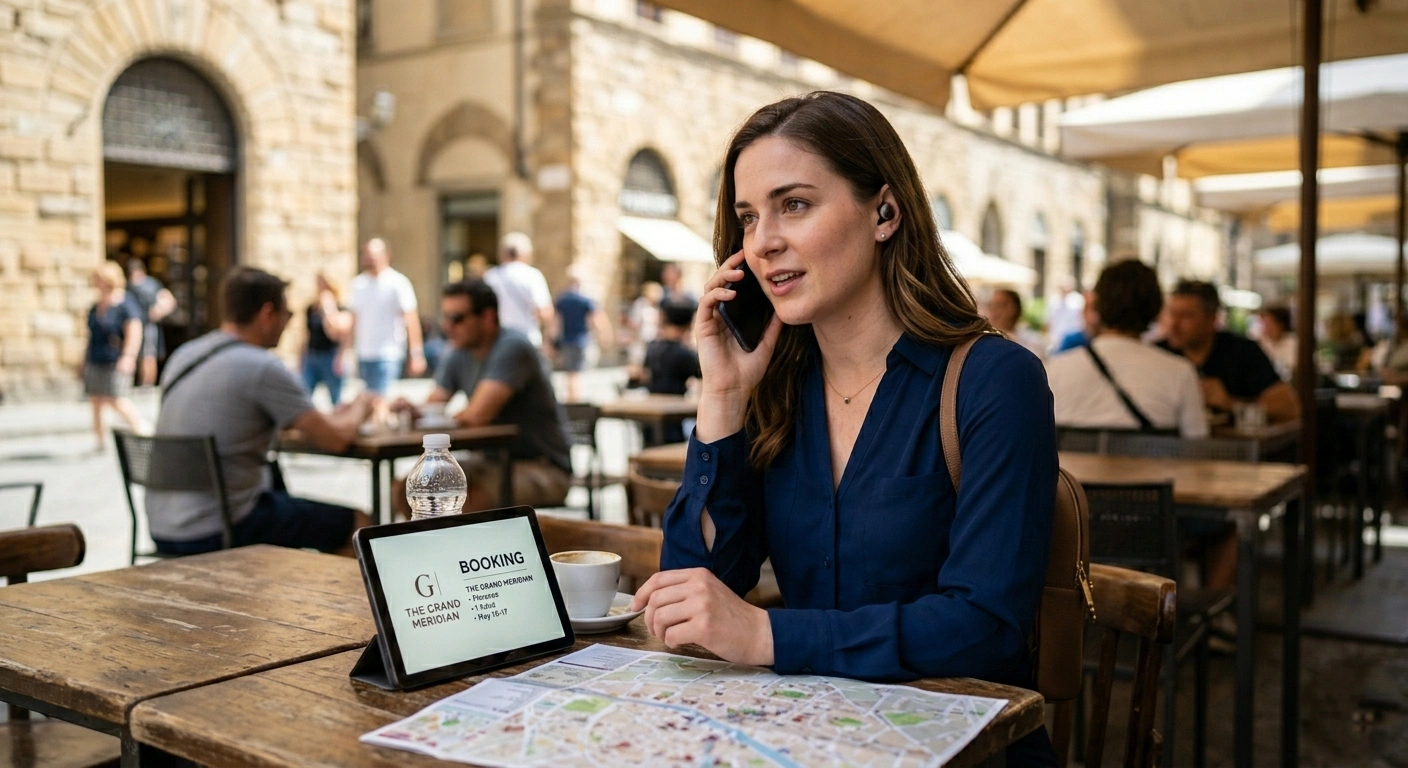
It handles approximately 95% of typical guest inquiries and bookings, allowing hotels to resolve most guest interactions automatically. When a request is complex or unusual, the system transfers the call to designated staff while preserving the full conversation context so guests can continue without repeating information.
Operating 24/7, the AI Concierge manages calls and bookings and integrates directly with the roommaster property management system (PMS) suite.
Key features
24/7 AI voice concierge that answers every call and handles guest queries instantly
Automated booking & confirmations directly during calls (no drop-offs)
PMS integration with real-time syncing of bookings, availability, and guest data
Multilingual support for handling international guests without friction
Smart call handling + human handoff for complex queries with full context transfer
Analytics & insights dashboard with call transcripts, booking data, and performance tracking
Pricing
Custom pricing
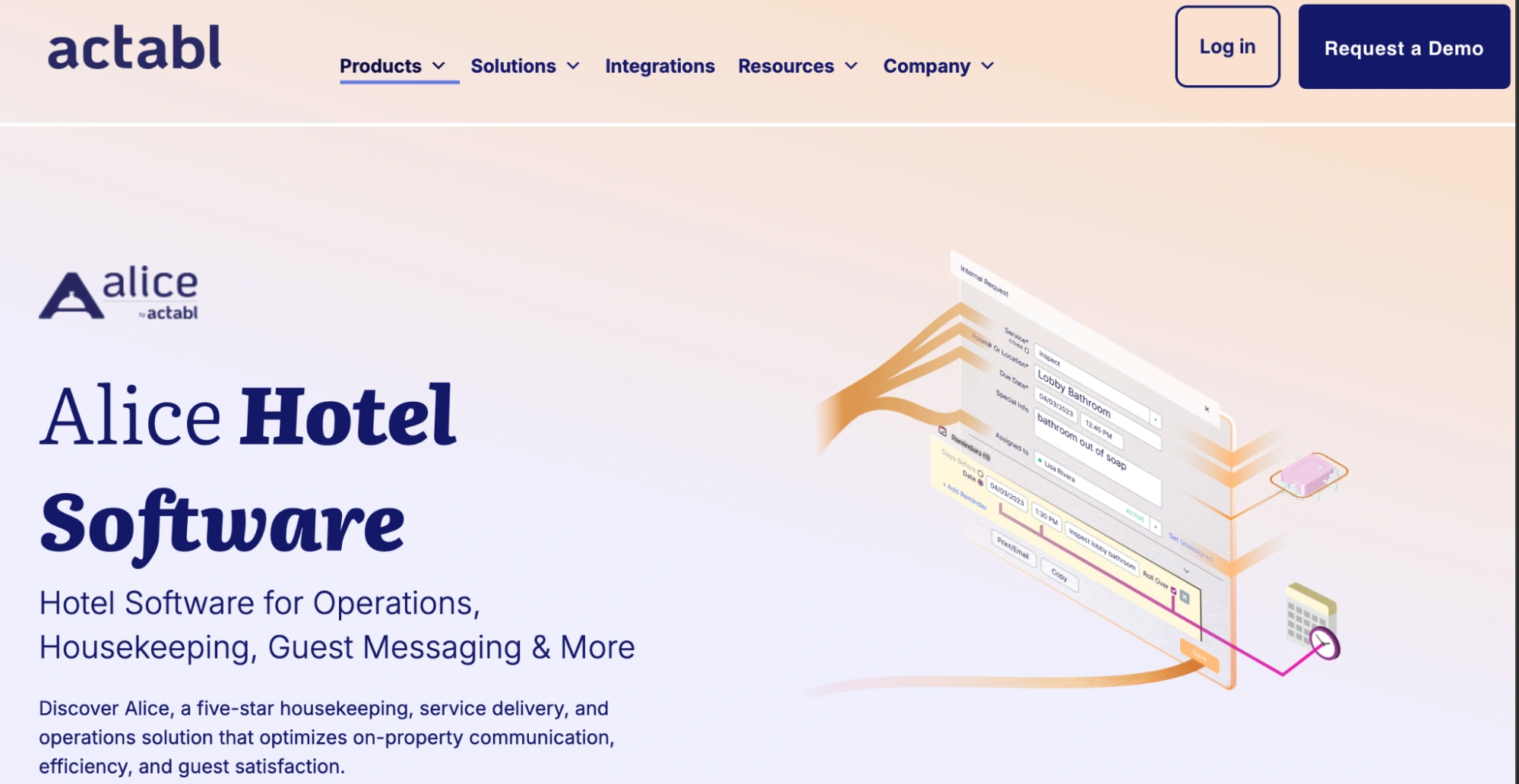
2. ALICE by Actabl
Best for: Luxury and upper-upscale hotels with complex multi-department operations.
Rather than leading with guest-facing AI, ALICE by Actabl leads with operational infrastructure, and it does that exceptionally well. One of its greatest strengths is real-time task management. Staff receive, track, and complete tasks instantly while managers maintain full visibility across operations.
In 2026, Actabl added digital itineraries to ALICE, replacing traditional paper-based workflows with a single live itinerary that updates in real time throughout a guest's stay. For luxury properties managing complex guest programs, this kind of operational precision matters.
Key features
Manage guest requests and housekeeping tasks with unified task tracking
Offer real‑time messaging with guests and staff on any device
Sync booking and room data with a connected property management system
Pricing
Custom pricing
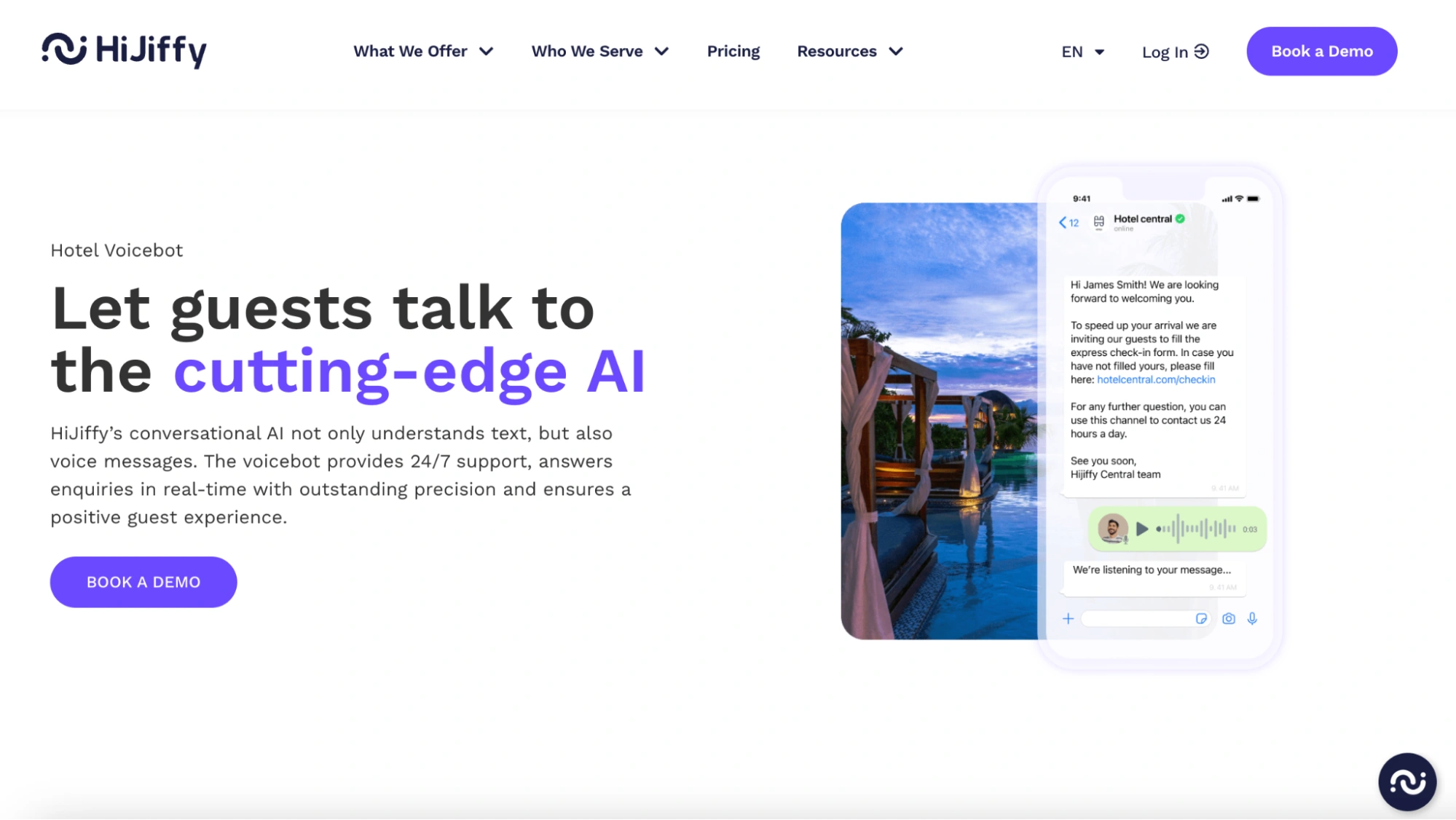
3. HiJiffy Voicebot
Best for: Hotel groups and international properties prioritizing direct booking conversion and OTA messaging.
HiJiffy built its reputation on one thing: automating guest communication at scale without making it feel robotic. Its proprietary Aplysia AI engine powers everything from pre-booking FAQs to in-stay requests to post-checkout review collection.
The platform’s voice product uses advanced Automatic Speech Recognition and Natural Language Understanding to create conversations that guests frequently mistake for a human. The omnichannel inbox is the feature hoteliers cite most. For properties receiving guest inquiries across five or six channels, that consolidation alone significantly reduces the workload.
Key features
Deliver 24/7 voice and text-based guest support across channels
Consolidate all guest messages into a single omnichannel inbox
Allow easy handover to human agents with full conversation context
Pricing
Basic: $115/month + $190 setup fee for each 5 properties
Pro: $190/month + $449 setup fee for each 5 properties
Premium: $390/month + $699 setup fee for each 5 properties
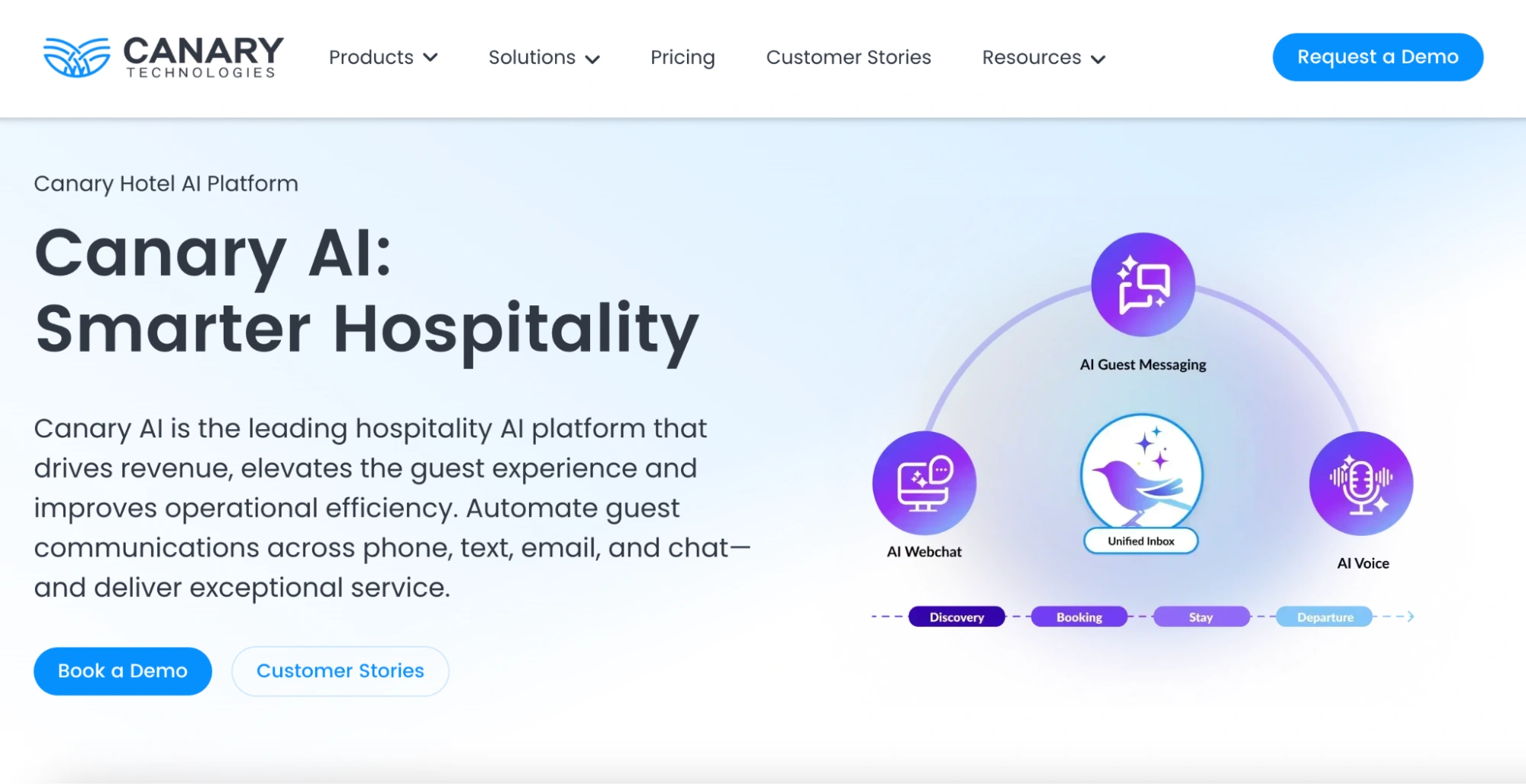
4. Canary AI
Best for: Mid-scale to luxury hotels and enterprise hotel groups needing a comprehensive, scalable guest management platform.
Trusted by over 20,000 hotels across Marriott, Four Seasons, Wyndham, and IHG, Canary has become the platform that large hotel groups turn to for AI across the full guest journey. The platform recently announced a global rollout of AI Voice technology with Wyndham Hotels and Resorts, the world's largest hotel franchisor, giving thousands of franchisees access to Canary's omnichannel AI ecosystem across calls, text, and web.
Starting with one or two modules, like Contactless Check-In or Upselling, allows hotels to realize ROI quickly before expanding into the broader suite. Guest experience improvements are measurable from deployment, not just on paper.
Key features
Leverage conversational AI to answer guest questions instantly
Streamline the arrival and departure experience
Secure payments and PCI-compliant authorizations
Pricing
Custom pricing
AI for Reservations & Booking Assistance
Designed for the exact moment a guest decides to book, these hospitality AI tools handle everything from inquiry to confirmation with contextual precision and zero delay.
5. Lighthouse
Best for: Independent and boutique hotels without a dedicated revenue management team.
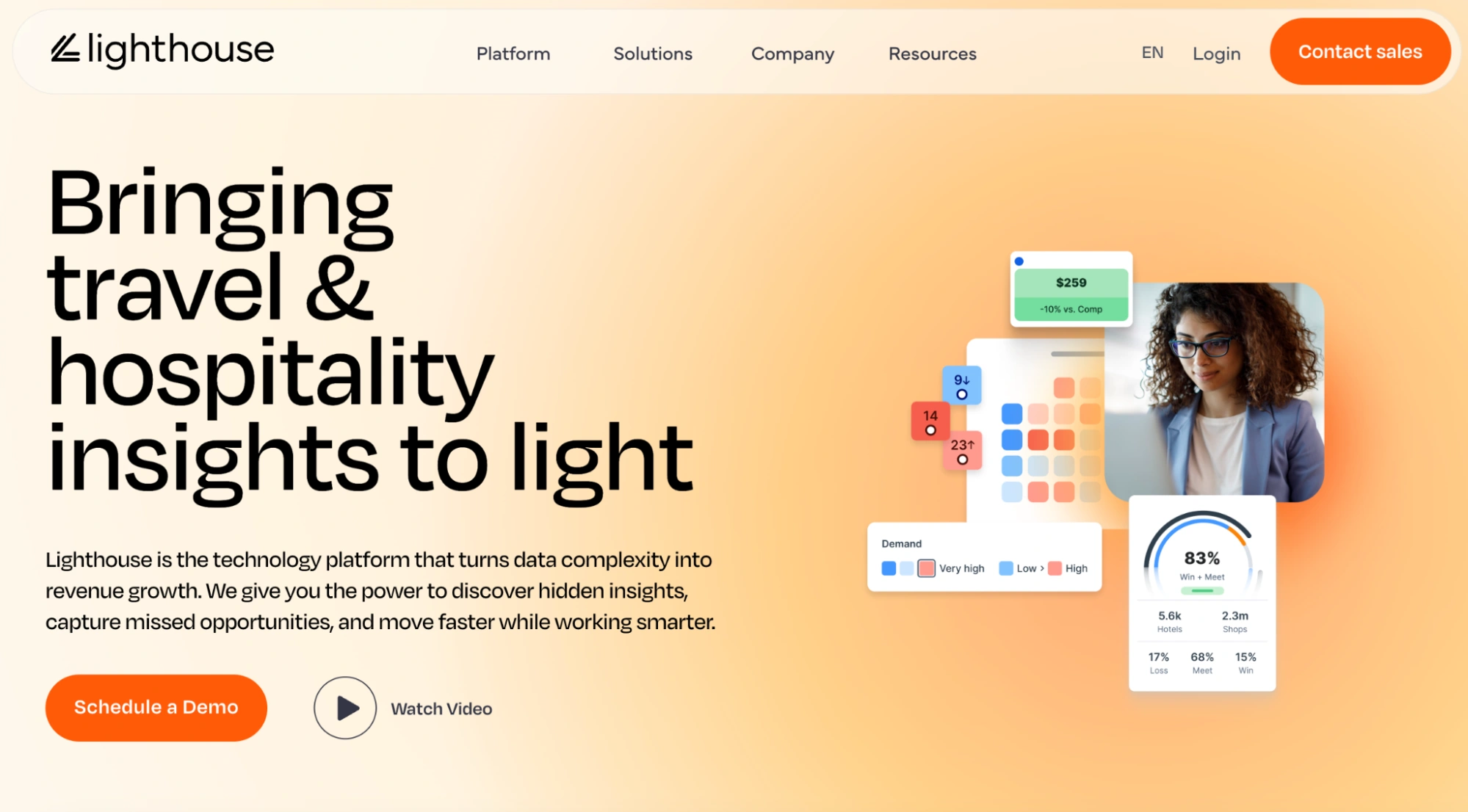
Lighthouse Intelligence (formerly OTA Insight) is what revenue management looks like when it is built for the real world, specifically for properties without a dedicated, full-time revenue manager to interpret complex dashboards.
In September 2025, Lighthouse launched Smart Distribution, an AI-powered feature that automatically optimizes pricing and distribution across booking channels for independent hotels. The product directly addresses one of the most common pain points in independent hotel operations: distribution management is too complex to do well manually, and most hotels either under-invest in it or outsource it at a premium.
Key features
Deliver real-time rate comparisons across various channels and competitors
Monitor competitor activities and demand trends in real-time
Get automated, daily performance insights on pickup, pace, and revenue
Pricing
Custom pricing
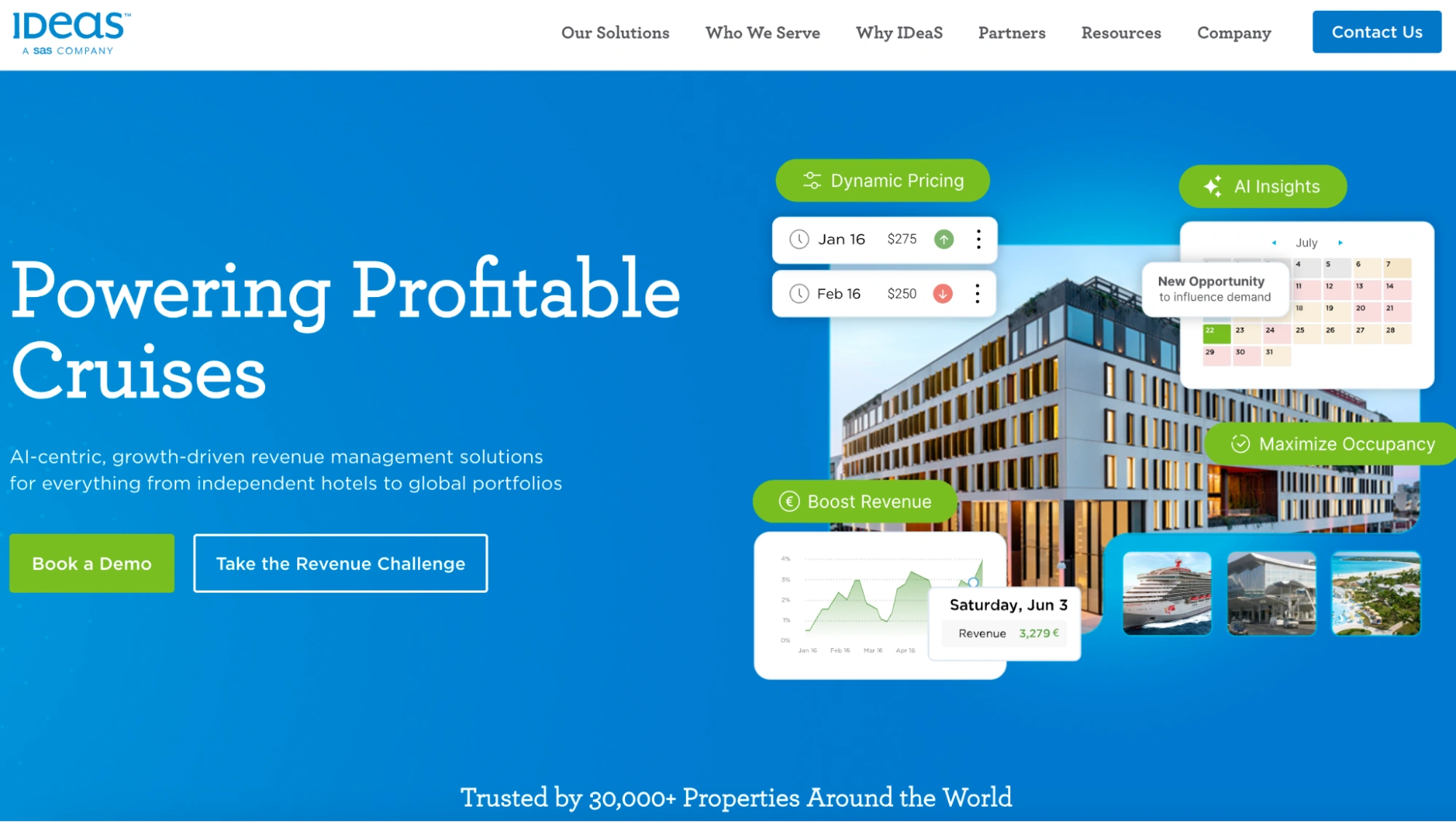
6. IDeaS
Best for: Large hotel groups, chains, and resort properties with complex revenue management needs.
Currently serving over 13,000 clients in 140 countries, IDeaS is a fully automated, AI-powered revenue management system (RMS) that makes pricing and inventory decisions at the room type and rate code level without requiring human input for every update
It applies AI across pricing, customer support, productivity, and reporting, and it has introduced IDeaS Spotlight, a demand intelligence solution that connects revenue management data directly with marketing teams. This enables teams to identify optimal campaign windows by channel and segment. Previously, aligning marketing and revenue strategies required manual coordination between two separate departments.
Key features
Automate room pricing based on demand, booking pace, and market trends
Analyze real-time data to make smarter revenue decisions
Reduce manual work through built-in automation
Pricing
Custom pricing
AI for Upselling & Revenue Optimization
If you have ever looked at missed upgrade opportunities or empty premium rooms and thought there should be a smarter way to convert demand into revenue, these AI tools are built exactly for that.
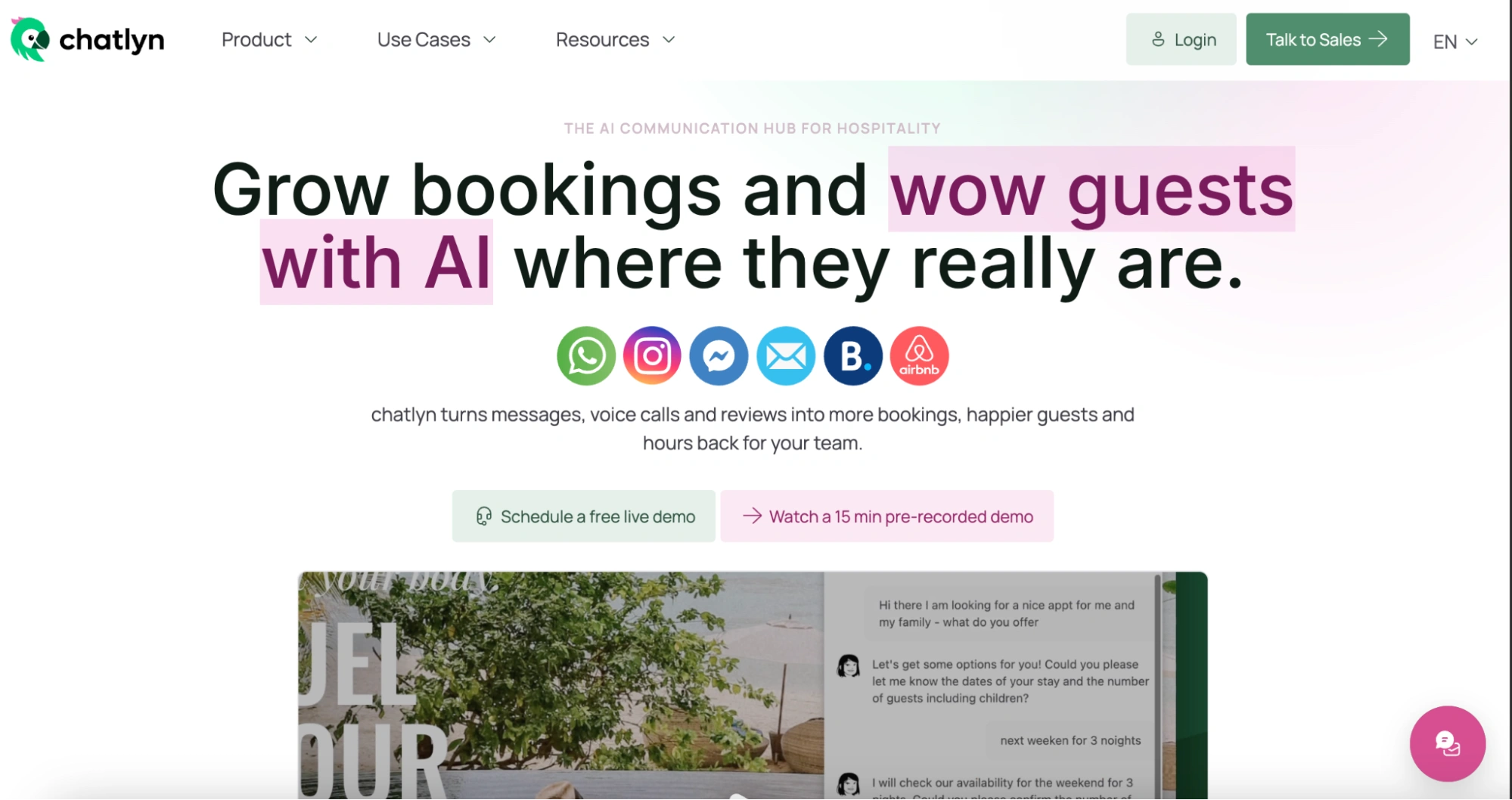
7. chatlyn
Best for: Independent and mid-scale hotels wanting to drive direct bookings and ancillary revenue via WhatsApp and multichannel automation.
chatlyn is an AI-powered guest communication platform that helps hotels manage conversations across WhatsApp, email, social media, and booking channels in one unified system. It turns guest interactions into more bookings and faster responses by centralizing messages into a single omnichannel inbox.
The platform supports instant multilingual replies, automated guest journeys, and targeted upsell messaging that reaches guests where they are most active. With built-in AI assistants and workflow automation, chatlyn reduces manual workload while improving response times, engagement, and overall guest experience across the full customer journey.
Key features
Centralize guest messages from email, WhatsApp, Booking.com, and social channels into one inbox
Automatically translate and respond to guest messages in over 35 languages
Run automated guest journeys for confirmations, upsells, and feedback collection
Pricing
Custom pricing
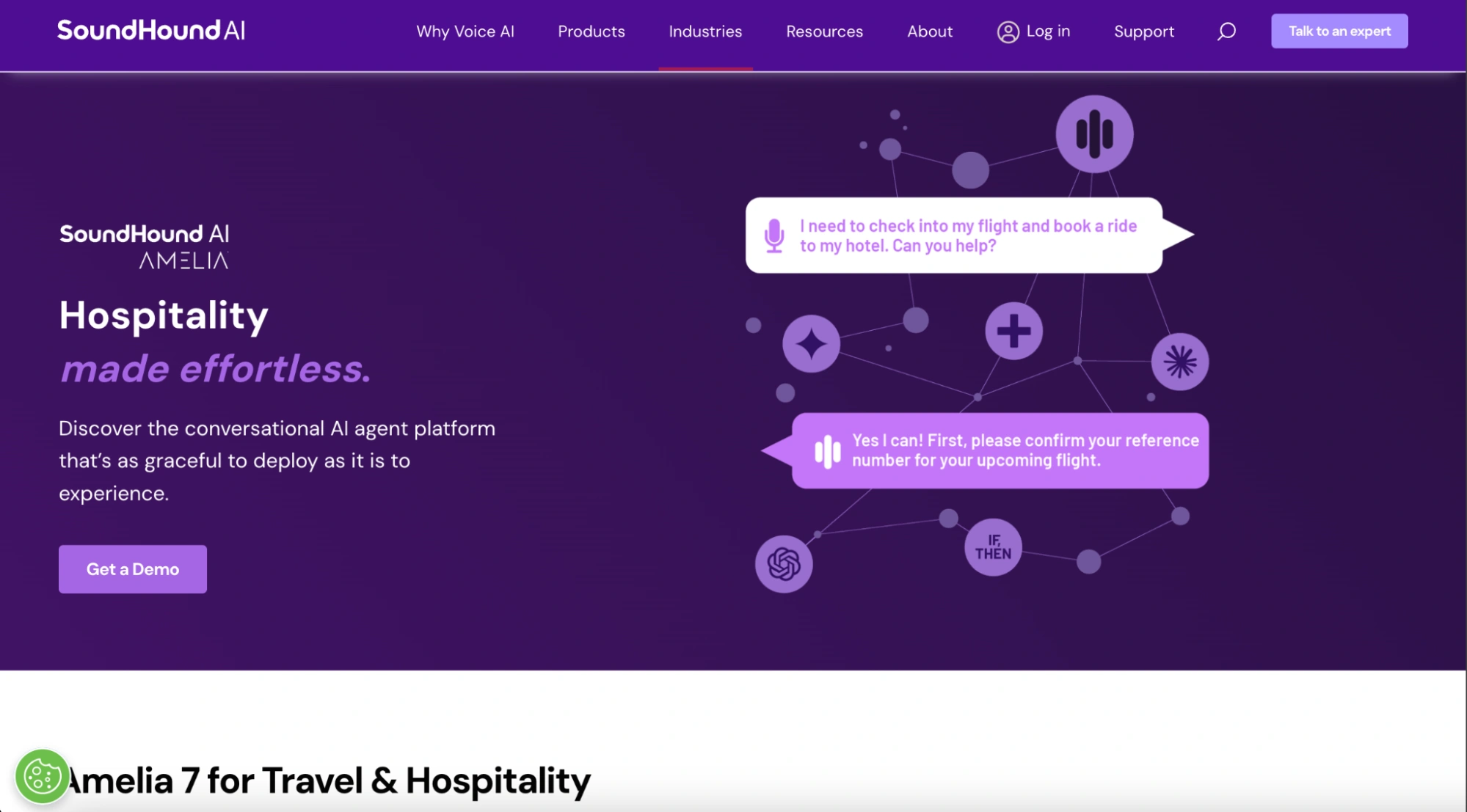
8. SoundHound AI
Best for: Travel and hospitality enterprises looking to deliver end-to-end guest journeys through voice and conversational AI.
SoundHound AI is a conversational AI platform built to power voice and text-based agent experiences for hospitality and travel. Its Amelia 7 solution is designed to deliver natural, human-like interactions that combine voice AI, generative AI, and agentic reasoning to support guests throughout their journey.
It enables guests to complete end-to-end tasks within a single conversation, including booking flights, arranging transport, and managing travel plans. Beyond reservations, it supports stay-related tasks such as exploring hotel amenities, making bookings, and coordinating activities based on guest preferences.
Key features
Voice-first guest interactions across hotels, airlines, and travel services
In-stay automation, including check-in and check-out via conversational AI
Track travel expenses and support payment management across services
Pricing
Custom pricing
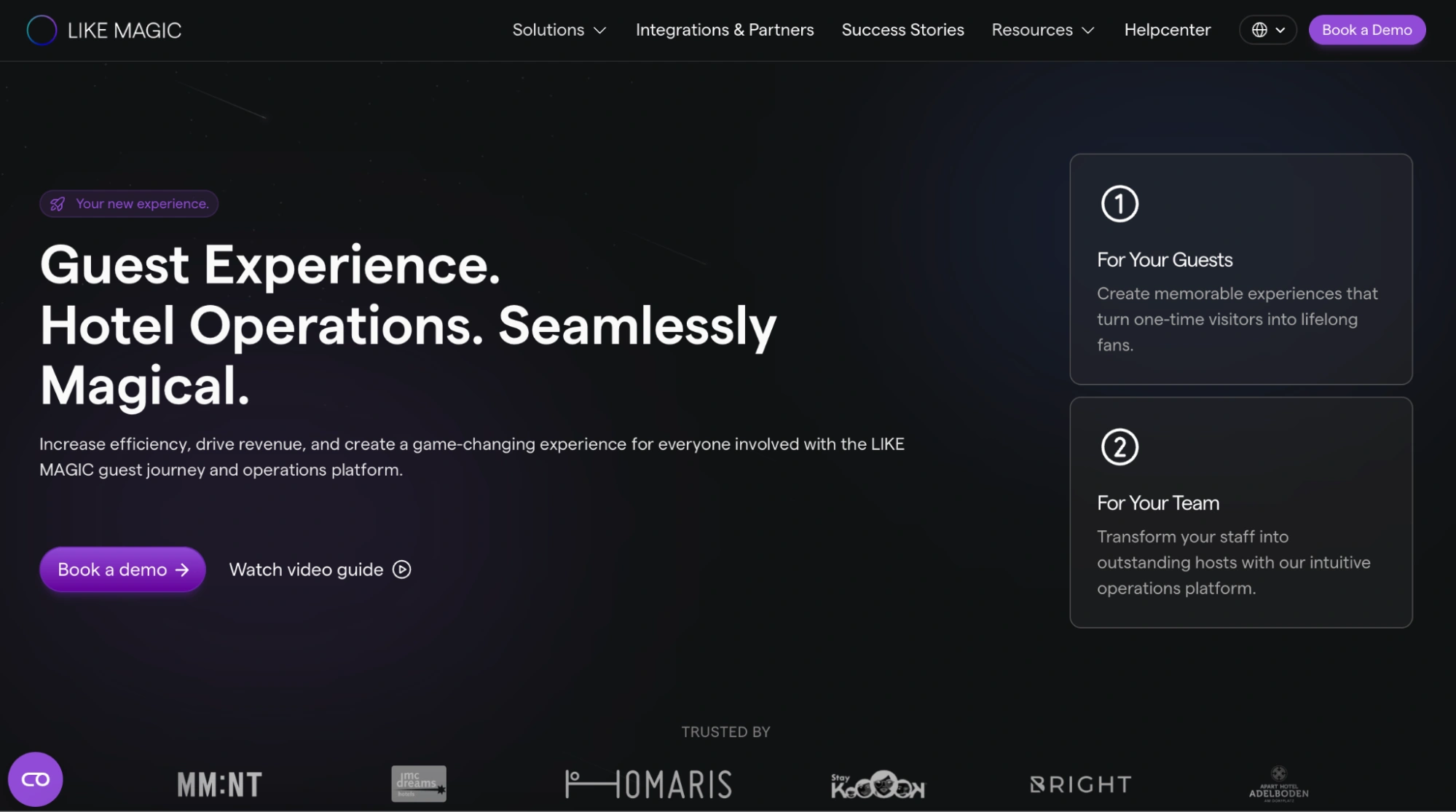
9. LIKE MAGIC
Best for: Independent and mid-scale hotels looking to digitize the guest journey, streamline operations, and increase ancillary revenue.
LIKE MAGIC is a guest experience and operations platform designed to make the entire hotel journey feel smooth, digital, and effortless. It combines guest-facing experiences with back-end operations to help hotels increase efficiency, drive revenue, and deliver a more connected stay from check-in to check-out.
The platform also helps hotels increase ancillary revenue by creating opportunities for upselling and cross-selling at different stages of the guest journey. With real-time communication and automated engagement, hotels can respond faster to guest needs while improving satisfaction and loyalty.
Key features
Centralize guest communication and interactions into a single connected hub
Support real-time, personalized guest communication throughout the stay
Integrate with PMS, payment systems, and access control systems
Pricing
Custom pricing
AI for Post-Stay Engagement & Review Management
After your guest checks out and returns the room key, the AI quietly continues the experience. This turns each stay into a timely, personalized follow-up that nudges authentic reviews and keeps your property top of mind long after departure.
Best for: Hotels looking to improve guest communication, increase upsell revenue, and digitize key touchpoints.
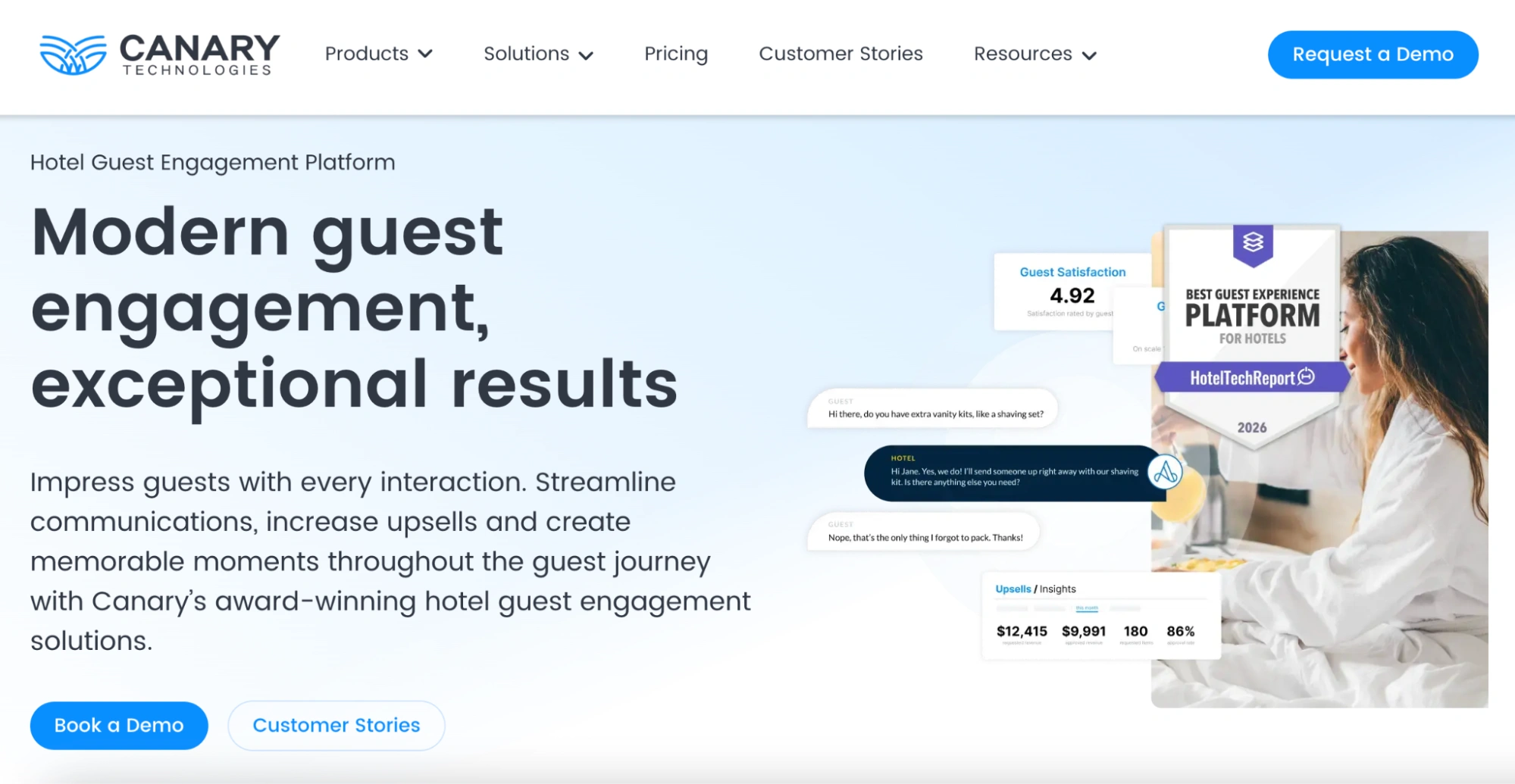
Canary Technologies’ hotel guest engagement platform is designed to help hotels modernize communication, increase revenue, and deliver better guest experiences across the entire journey. It centralizes guest interactions into mobile-first tools that make communication, upselling, and service delivery faster and more efficient for both guests and staff.
The platform enables hotels to communicate at scale through automated guest messaging, helping teams respond quickly while meeting the expectations of modern travelers. It also supports dynamic upsells, allowing guests to easily book room upgrades, amenities, and add-ons directly from their devices before or during their stay.
Key features
Automate guest messaging to enable fast, scalable communication across the guest journey
Enable mobile-based dynamic upsells for rooms, amenities, and add-on services
Provide a digital compendium for easy access to hotel information
Pricing
Custom pricing
11. Revinate
Best for: Mid-scale to large hotel groups and hospitality brands looking to centralize guest feedback, improve online reputation, and connect post-stay insights directly to marketing and revenue growth.
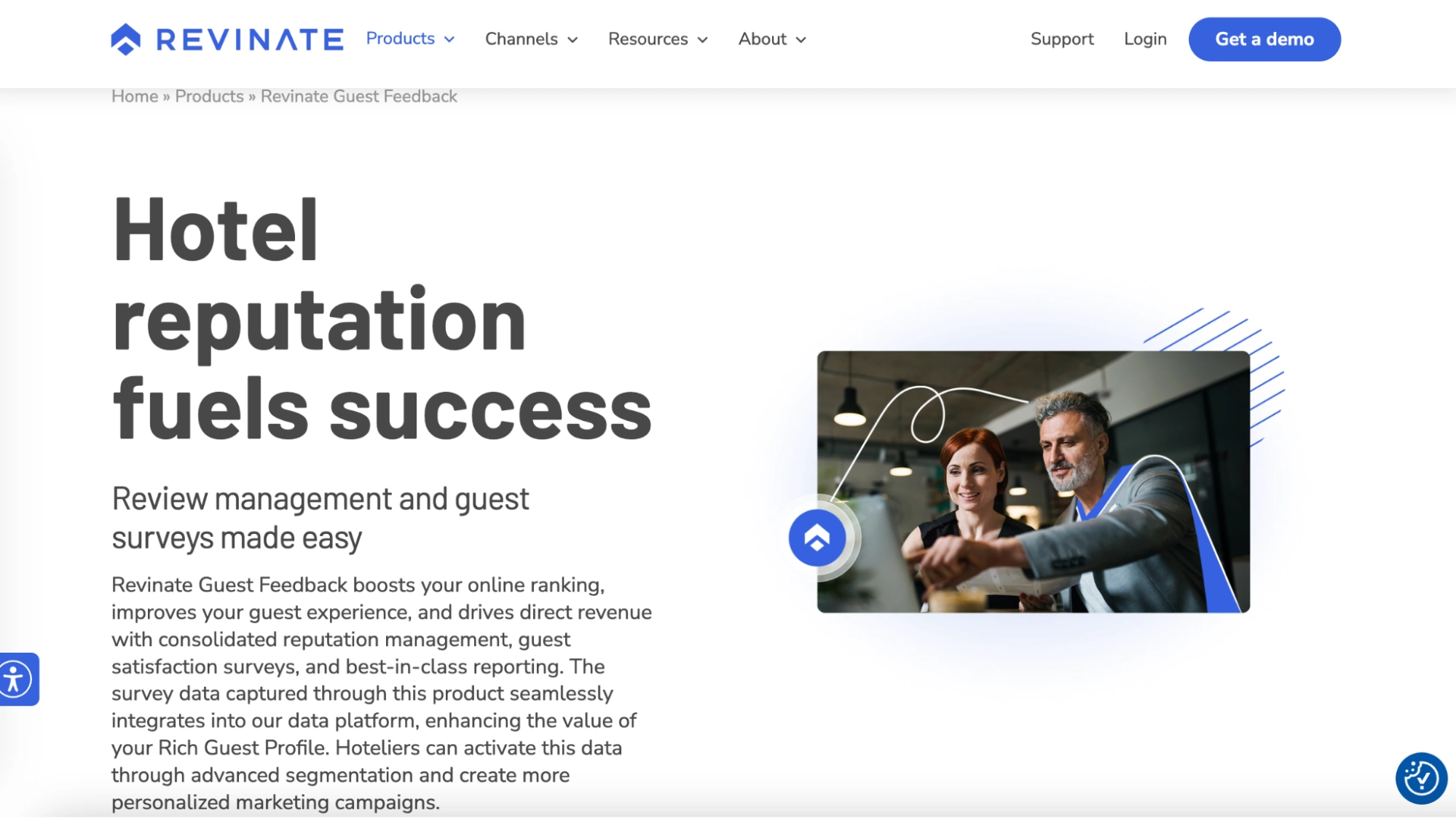
Revinate is a guest feedback and reputation management platform that helps hotels manage online reviews, collect guest surveys, and turn post-stay insights into revenue-driving actions. It centralizes feedback from multiple review sites into one dashboard and uses AI-powered analysis to help hotels understand sentiment, track performance trends, and identify areas for operational improvement.
Beyond review monitoring, Revinate connects post-stay data to its guest CRM, enabling hotels to build rich guest profiles and activate segmentation to deliver more personalized marketing campaigns. This helps properties not only improve their online reputation but also drive repeat bookings and direct revenue through targeted engagement.
Key features
Centralize guest reviews and feedback from ~45+ review sites into a single dashboard
Automate guest surveys for in-stay and post-stay feedback collection
Convert survey responses into publishable online reviews to boost visibility
Pricing
Custom pricing
How to Implement AI Without Losing the Human Touch
The most common mistake hotels make when deploying AI is treating it as a staffing solution, rather than a service tool. Even the best technology fails if implemented poorly. The key issue is assuming AI should fully replace human interaction.
Successful hotels take a balanced approach. They use AI to handle high-volume, repetitive queries and keep human staff focused on situations that require empathy. This has also given rise to a new role in hospitality, the conversation engineer, who designs, builds, and optimizes AI systems to maintain the brand’s voice. It requires ongoing training, review of conversations, and continuous improvement, rather than a one-time setup.
Practically speaking, implementation works best when it follows a phased approach:
Start with one use case: Pick the highest-friction point, usually after-hours call handling or repetitive FAQ management, and deploy AI there first. Measure the impact before expanding.
Train the system on your actual property: A generic AI trained on generic hospitality data will give generic answers. The hotels that achieve 90%+ automation rates are the ones that take time to upload accurate, detailed property information and refine the AI's responses based on real guest conversations.
Keep the human-in-the-loop design: Every AI guest tool worth considering should route complex or sensitive conversations to a staff member with full context. Guests who are transferred to a human and have to repeat themselves are more frustrated than those who wait on hold.
Communicate transparently with your team: Staff resistance to AI usually stems from fear of being replaced, not from resistance to technology. Position AI as the tool that handles the repetitive work so staff can focus on the interactions they actually enjoy.
What to Look for When Choosing a Hotel AI Tool
With dozens of platforms competing for your attention, the evaluation process matters. These are the criteria that separate tools that generate ROI from tools that generate reports about what could have been done better.
PMS integration: An AI concierge that cannot read your actual room availability in real time is dangerous. Verify that any tool you evaluate connects directly with your property management system and that the connection is bidirectional.
Automation rate: Some providers inflate automation rates by including draft responses requiring human review. Always verify that quoted rates refer to autopilot mode, not assisted drafts.
Multilingual capability: International guests are not a niche market for most hotels. A tool that handles English fluently but fumbles French or Mandarin creates inconsistent guest experiences. Check language support at the conversation level, not just the translation level.
Channel coverage: Guests do not all arrive through the same channel. Look for tools that cover your primary guest touchpoints, including WhatsApp, webchat, email, OTA messaging, and voice, without requiring separate products for each.
Onboarding and ongoing support: AI tools that take months to configure are never properly deployed. Ask vendors specifically about time-to-value, including how long it takes from sign-up to the first guest interaction. roommaster, for example, targets full operational deployment within three to five business days.
Total cost of ownership: Per-room pricing, commission structures on upsells, and integration fees all affect the real ROI of an AI investment. Model your expected outcomes before committing.
Why AI Is Now a Competitive Advantage in Hospitality
AI in hospitality customer service is no longer a future concept. It is a current operational reality, and the performance gap between hotels that use it well and those that use it poorly (or not at all) is already showing up in occupancy rates, review scores, and RevPAR. In this environment, the question is not whether hotels should adopt AI. It is whether they can afford to be invisible to the 91% of travelers already using AI tools to research and plan their stays.
The tools in this guide are not theoretical possibilities. They are already deployed across thousands of properties and are delivering measurable operational and revenue outcomes. The most important tools depend on your biggest operational pain points. You can solve them with multiple vendors or a single integrated platform.
roommaster sits at the intersection of those two realities. Built on 30+ years of hospitality software experience, it combines operational depth with modern AI capabilities.
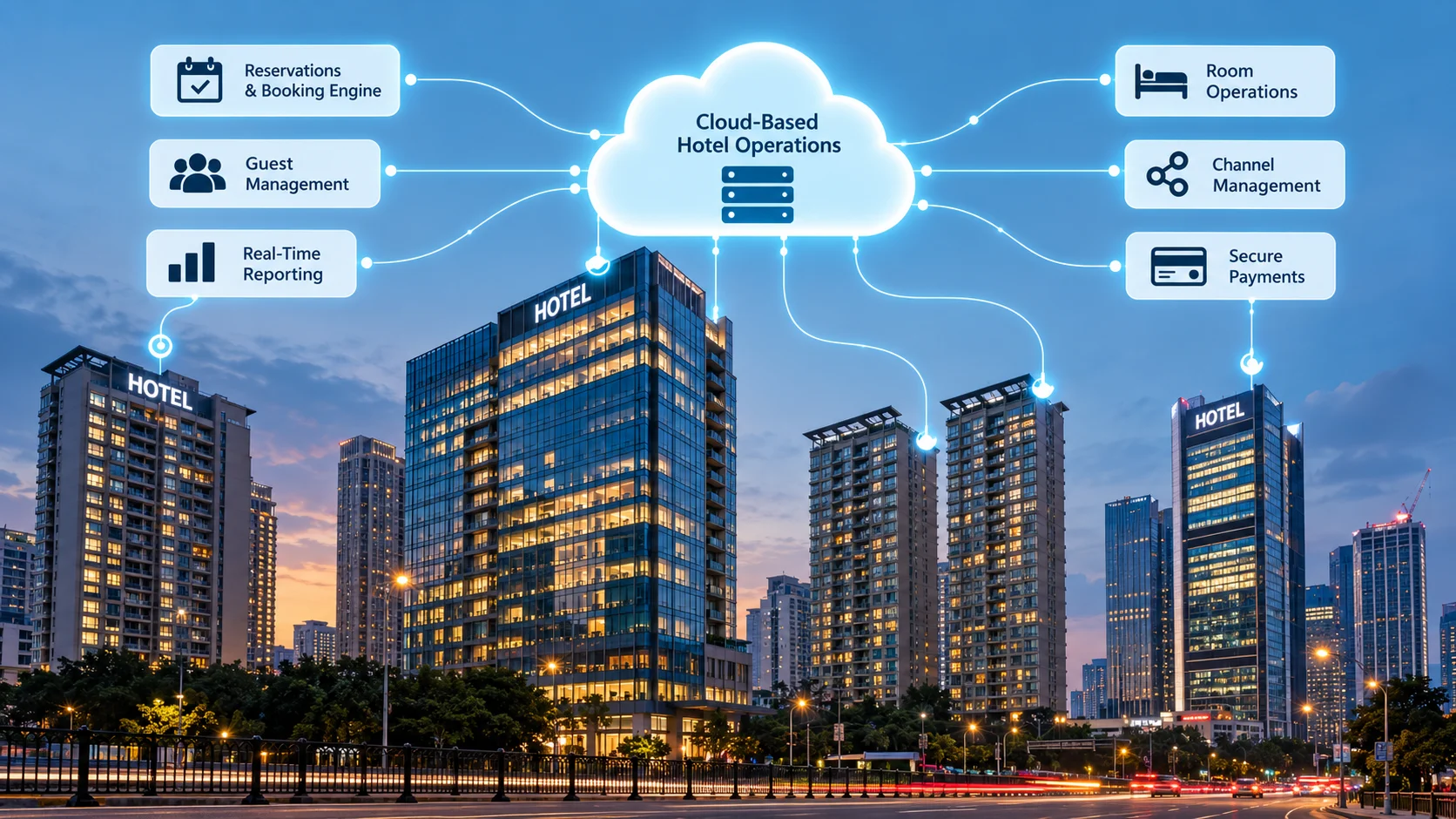
For independent hotels and growing hotel groups, the all-in-one structure matters practically. roommaster supports 270+ reports, hundreds of third-party integrations, open APIs, and a cloud-based infrastructure with 99.95% uptime. It is a platform you can grow into, not one you outgrow.
The technology is ready. The only remaining question is whether you are.
Hotels use AI chatbots, voice agents, and guest messaging platforms to handle reservations, FAQs, digital check-in, and upselling. Some of the popular tools include roommaster Concierge, Canary Technologies, and HiJiffy, all of which automate handling of high volumes of guest inquiries while integrating with existing property management systems.
Can AI replace hotel front desk staff?
AI handles routine inquiries very effectively, but it does not replace front desk staff. It redirects them. Tasks like booking confirmations, amenity questions, and check-in reminders run on autopilot, so staff can spend more time on high-value interactions that build guest loyalty and require genuine human judgment.
How does AI improve the guest experience?
AI improves guest experience by delivering faster, more consistent responses at any hour, in multiple languages, across the channels guests already use. It personalizes recommendations based on booking history and preferences, reduces wait times, and proactively addresses needs, such as sending a pre-arrival upgrade offer before guests think to ask.
What is the best AI chatbot for hotels in 2026?
The best AI tool depends on your property’s needs and use case, whether that’s chat-based support, voice interactions, or full guest journey automation.
For example, if you're looking for a chatbot, tools like HiJiffy or chatlyn are strong options. If you need a more comprehensive solution, roommaster Concierge stands out as an AI voice concierge that handles calls, bookings, and guest interactions end-to-end.
revenue-management-one
Put Your Hotel Pricing Optimization on Autopilot with AI
Mayela Lozano is a content strategist with a passion for hospitality and technology. She collaborates with roommaster on content creation, highlighting how technology can streamline hotel operations and enhance guest satisfaction. When she’s not creating content, Mayela loves to travel and spend time with her two little ones, discovering new adventures and making memories along the way.
Join Thousands of Hotels Thriving with roommaster
The transition to roommaster is straightforward and efficient. Our implementation team handles data migration including reservations, guest profiles, and historical information.
The transition to roommaster is straightforward and efficient. Our implementation team handles data migration including reservations, guest profiles, and historical information.
Hotel Check-In Kiosk: Enhance the Guest Experience
October 5, 2026
Hospitality Technology
Hotel Management
Hospitality Trends
Hotel Self Check-In: How It Works, Types, Benefits And Setup
October 1, 2026
Hotel Management
Hospitality Trends
Hotel Check-In & Check-Out Times Explained
October 1, 2026
Hospitality Trends
Hotel Management
Cloud-Based Property Management System: Hotel PMS
October 1, 2026
General
Cloud PMS
AI
Cloud Computing In The Hospitality Industry: A Complete Guide For Hotels
October 1, 2026
Hospitality Trends
Hotel PMS
Cloud PMS
Hotel PMS Integration: How It Works for Hotels
September 23, 2026
Hospitality Trends
Hospitality Technology
Hotel PMS
Hotel Management
Cloud PMS
How Hotel PMS Software Transforms Hospitality Management
September 23, 2026
Hospitality Trends
Best Hotels in New Orleans: A Complete Guide 2026
September 10, 2026
Hospitality Trends
Best Hotels in Philadelphia: A Complete Guide 2026
September 10, 2026
Hospitality Trends
Best Hotels in San Francisco: A Complete Guide 2026
September 10, 2026
Join Thousands of Hotels Thriving with roommaster
See how roommaster's unified platform can work for your property. Our team will walk you through features tailored to your specific needs and operations.

.avif)
.png)
.png)
.png)