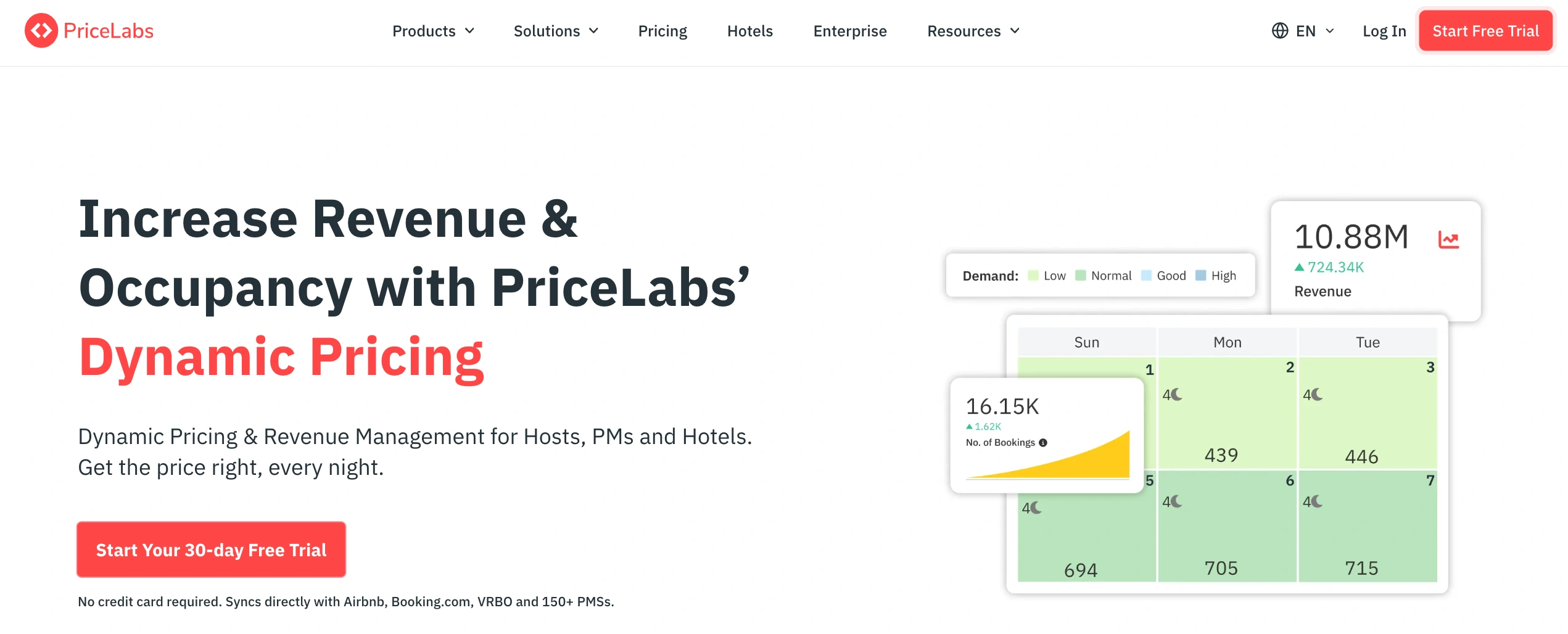
Looking for a PriceLabs alternative? Here are six pricing and revenue platforms worth comparing: 1. roommaster, 2. Beyond Pricing, 3. Wheelhouse, 4. DPGO, 5. RoomPriceGenie and 6. AirDNA. Each one fixes a different gap that PriceLabs leaves open, from a simpler pricing engine to a hotel PMS with revenue management built in. This guide sorts them by who they fit, pricing model, how deep the automation runs and the property type they serve best.
One honest thing up front: PriceLabs is a dynamic-pricing tool, and most people searching for it run short-term rentals on Airbnb and Vrbo. If that is you, a dedicated pricing app like Beyond, Wheelhouse or DPGO fits better than a hotel system. But if you run a small hotel, B&B or inn and are tired of bolting a separate pricing tool onto your property management system, the more useful move is a PMS with revenue management already inside it. That is where the roommaster earns a place, and we say clearly below when it is the wrong tool for you.
{{pms-two}}
Why users look for PriceLabs alternatives
PriceLabs is powerful and covers a huge range of markets, but a few recurring frustrations push people to compare options:
- It is complicated: the most common complaint across Reddit's r/airbnb_hosts and r/ShortTermRentals threads is a steep learning curve, with layered customization rules many hosts find hard to set up and trust.
- It is a separate tool, not part of the PMS: hotels have to integrate PriceLabs alongside their PMS, sync inventory and manage two logins, when many would rather price from one system.
- Airbnb-first design: PriceLabs grew up serving short-term rentals, so a small hotel or B&B that thinks in room types and rate plans can find the vacation-rental framing an awkward fit.
- Customization becomes a chore: the flexibility power users love means casual operators tune base prices, min-stay rules and seasonal profiles they would rather have handled automatically.
What operators say: Across Reddit's r/airbnb_hosts and r/ShortTermRentals, the recurring take is that PriceLabs is powerful but hard to master, with an overwhelming interface and a genuine learning curve. Capterra reviewers echo it, one describing a platform that took close to a year to feel confident with and formulas that get hard to interpret. In the same threads, hosts weighing a switch tend to name Beyond as the strongest set-and-forget algorithm, Wheelhouse as the better read on event-driven urban markets, and DPGO for its low usage-based fee, which lines up with the shortlist below.
Comparing the 6 best PriceLabs alternatives
Pricing models below reflect each vendor's published or commonly cited rate as of July 2026. Where a tool serves short-term rentals rather than hotels, we say so, since the right pick depends heavily on whether you run listings or a property.
| Tool |
Best for |
Pricing model |
Property/segment fit |
Standout capability |
| roommaster |
Small hotels and B&Bs wanting pricing inside the PMS |
Custom quote (contact sales) |
Independent, boutique, B&Bs, motels, groups |
Built-in revenue management inside a full hotel PMS |
| Beyond Pricing |
Airbnb/Vrbo hosts who want set-and-forget |
~1 to 1.25% of booking revenue |
Short-term rentals, small STR portfolios |
Revenue-aligned pricing with a trusted algorithm |
| Wheelhouse |
Boutique and event-heavy urban listings |
~$19.99 per listing/month (Pro Flat) |
Short-term rentals, boutique STR |
Control-friendly ML that prices peak events well |
| DPGO |
Cost-sensitive hosts wanting AI automation |
0.5% of booked price or $1 per booked night |
Short-term rentals, growing portfolios |
Low pay-per-booking option, AI-first engine |
| RoomPriceGenie |
Small independent hotels wanting simple RMS |
Flat fee from ~$150/month (under 50 rooms) |
Independent hotels, B&Bs, inns |
Hotel-native automated pricing, easy setup |
| AirDNA |
Market research and comp-set analysis |
Per-market subscription (varies) |
Short-term rentals, market analysts |
MarketMinder demand data and Rentalizer estimates |
A pricing model tells you more than a single number here. Beyond and DPGO scale with your revenue, Wheelhouse and PriceLabs charge a flat per-listing fee, RoomPriceGenie charges per property, and roommaster quotes for the whole PMS because pricing is one module inside it. So the smallest per-listing fee is not always the best value once you are running a real property with OTA distribution and a front desk.
A worked cost example: what a RevPAR uplift is worth
Software cost is the small number. What matters for a small hotel is the revenue a smarter pricing engine captures. Take a 25-room independent hotel at 68% occupancy and a $140 average daily rate:
- Current RevPAR: $140 x 0.68 = $95.20 per available room per night.
- Monthly room revenue: 25 rooms x $95.20 x 30 nights = about $71,400.
A 2025 study by Your.Rentals of 541 short-term-rental listings found properties using dynamic pricing earned 36% more than static-rate ones. Hotels usually see a more modest lift, so assume a conservative 8% RevPAR gain:
- 8% of $71,400 = about $5,700 a month in added room revenue, close to $68,000 a year.
That is why the pricing engine matters more than the sticker price. It also frames the real question for a hotel: do you want that engine inside the same system as your front desk and channel manager, or bolted on as a second tool you sync?
How we chose these PriceLabs alternatives
This list is built for small hotels, B&Bs and Airbnb hosts weighing a PriceLabs replacement, not enterprise revenue teams. Four criteria shaped it:
- Honest fit: we flag which tools are true short-term-rental pricing apps versus hotel systems, because the wrong category is the most common mismatch. For a broader hotel-side view, see the best hotel property management options.
- Automation depth: how well each tool prices without daily babysitting, since "too complicated" is the top PriceLabs complaint.
- Transparent evaluation: published pricing models and public review positioning, not marketing claims.
- Migration realism: setup, integrations and support, because a pricing switch fails on implementation as often as on the algorithm.
Top 6 PriceLabs alternatives
1. roommaster (best for small hotels wanting revenue management inside the PMS)
Best for: independent hotels, boutiques and B&Bs that would rather price from inside their property management system than sync a separate short-term-rental app.
roommaster (formerly innQuest) is a cloud hotel PMS that pairs core front-desk and reservation workflows with built-in revenue management, a channel manager that syncs rates across hundreds of OTAs, a commission-free booking engine and guest-facing tools. It has run hotel software for more than 25 years, with offices in the US, Canada, UK and Australia. It is not an Airbnb pricing app, so if you run pure short-term rentals it is the wrong tool. For a small hotel or B&B, though, it removes the reason to buy a standalone pricing engine at all.
Key features
- Built-in revenue management that adjusts rates automatically off demand and occupancy, in the same system as your inventory rather than a separate app you sync
- Channel manager with real-time OTA sync across Booking.com, Expedia, Airbnb, Vrbo and Agoda, so a rate change pushes everywhere without a second tool
- Commission-free booking engine that turns your own website into a zero-fee reservation channel, protecting the margin dynamic pricing wins
- Front desk, reservations, housekeeping and night audit in one cloud PMS, so the operation runs off a single system of record
- AI concierge, AI guest management and a hotel guest app with mobile check-in and digital keys for the guest-facing side a pricing tool cannot cover
- Integrated payments and 100+ integrations across accounting, POS and door locks
Pros
- Pricing sits inside the PMS, so rates, availability and OTA distribution stay in sync automatically, which removes the two-login, double-sync headache of running PriceLabs alongside a separate hotel system.
- One platform covers front desk, distribution, revenue and guest apps, so a small hotel is not stitching a pricing app, channel manager and booking engine from three vendors that each blame the other.
- 24/7 phone, chat and email support from offices in the US, Canada, UK and Australia means a front desk hitting a rate or sync problem at 2am reaches a human, not a help doc.
- The commission-free booking engine goes after OTA commission, the biggest cost line for most small hotels, so the platform can pay for itself beyond the pricing lift.
Cons
- It is a full hotel PMS, not a standalone pricing tool, so an Airbnb or Vrbo host who only wants a pricing engine is buying far more than they need. Beyond, Wheelhouse or DPGO fit better.
- Pricing is quote-based rather than published, so you need a short sales conversation to benchmark it against a flat per-listing tool.
- Its revenue management is tuned for hotel demand and occupancy, not the hyper-local comp-set data a tool like AirDNA surfaces for short-term rentals.
Verdict: the strongest fit if you run a small hotel or B&B and want pricing built into the PMS, not the pick if you run pure short-term rentals.
{{pms-three}}
2. Beyond Pricing (best for Airbnb hosts who want set-and-forget)
Best for: short-term-rental hosts on Airbnb and Vrbo who want a trusted algorithm with minimal tuning.
Beyond is one of the original dynamic-pricing tools for vacation rentals, and hosts consistently rate its algorithm as the most reliable out of the box. It charges a percentage of booking revenue, so its incentive lines up with yours.
Key features
- Automated daily pricing that recalculates every listing overnight off local demand, seasonality and booking pace, so rates move without you touching the calendar.
- An algorithm that blends completed-booking data with real-time consumer search signals, which is why comparison sites rate it the most data-driven of the major short-term-rental engines as of July 2026.
- Native connections to Airbnb and Vrbo plus OTA push through PMS integrations, so one price change reaches every channel you sell on.
- A Health Score and insights dashboard that flags listings priced below market or sitting unbooked, giving a one-look weekly gut-check on your portfolio.
- Direct-booking and website tools layered on the pricing core, so hosts can chase commission-free reservations alongside OTA demand.
- A revenue-aligned fee of roughly 1 to 1.25% of booking revenue as of July 2026, so the tool only costs more when your listing actually earns more.
Pros
- The algorithm earns repeated praise on host forums for pricing well without constant tuning, the direct answer to the "PriceLabs is too complicated" complaint.
- The revenue-based fee means Beyond only costs more when your listing earns more, so a slow month does not carry a fixed seat cost.
- Onboarding is quick and the defaults are sensible, so a host with one or two listings can be live and pricing the same day.
Cons
- At roughly 1 to 1.25% of revenue as of July 2026, a high-earning listing can cost more than a flat tool: a $5,000/month listing runs about $50 to $62 versus $19.99 on a flat plan.
- Power users sometimes find it less granular than PriceLabs for complex multi-unit rules, trading depth for simplicity.
- It is built for short-term rentals, so it does not replace a hotel PMS or channel manager if you run a property.
Verdict: the pick for an Airbnb host who wants a proven algorithm and will happily pay a share of revenue for less hands-on work.
3. Wheelhouse (best for boutique and event-heavy urban listings)
Best for: short-term-rental and boutique hosts who want control over the pricing logic and operate in event-driven markets.
Wheelhouse pairs a machine-learning pricing model with unusually deep user controls, and hosts in event-heavy cities like Nashville, Austin and Miami often report it prices peak demand better than rivals.
Key features
- A machine-learning pricing model with adjustable strategy dials, from conservative to aggressive, so you set how hard it chases peak nights instead of accepting one fixed curve.
- Real-time booking-pace tracking that compares your listing against the local market, which hosts in Nashville, Austin and Miami credit for reading event spikes better than rival tools.
- Custom pricing profiles for min-stay, orphan-gap nights and seasonal rules, so awkward one-night gaps in the calendar still get priced to fill.
- Connections to 40-plus platforms and the major OTAs, so a single strategy pushes across your whole channel mix.
- Built-in market data and comp-set views, giving you the benchmarking layer other pricing tools make you buy separately.
- A free plan plus a Pro Flat plan at about $19.99 per listing a month as of July 2026, so costs stay predictable no matter what a listing earns.
Pros
- The ML model reads local and event demand well, so hosts in volatile urban markets capture peaks that flatter algorithms miss.
- The control dials let a hands-on host shape strategy without the full rule-writing burden PriceLabs asks for, a middle ground many prefer.
- The flat per-listing option keeps costs predictable regardless of what a listing earns, unlike revenue-share tools.
Cons
- The flexibility still carries a learning curve, so a host who wants pure set-and-forget may find Beyond simpler.
- Integration breadth trails PriceLabs, so operators with an unusual PMS or channel stack should confirm the connection first.
- Like the other STR tools here, it prices listings and does not manage a hotel front desk or distribution.
Verdict: a strong middle option for hosts who want more control than Beyond but less complexity than PriceLabs.
4. DPGO (best for cost-sensitive hosts who want AI automation)
Best for: short-term-rental hosts who want AI-driven pricing with a low, usage-based fee.
DPGO is an AI-first pricing engine with a following among hosts who want automation without a fixed monthly seat cost.
Key features
- An AI pricing model that learns from each listing's own booking history, so recommendations sharpen on unusual or niche properties rather than defaulting to market averages.
- Two low, usage-based billing options, 0.5% of booked revenue or $1 per booked night as of July 2026, so a slow month never carries a fixed seat fee.
- Direct Airbnb and Vrbo connections plus PMS integrations, so rate moves reach your live channels automatically.
- Recommendation and analytics views that explain why the engine raised or dropped a given night, which helps a wary host trust the automation.
- Customizable pricing strategies and minimum-price floors, so the AI never pushes a night below your break-even rate.
- A 30-day free trial to test the algorithm against your current tool before you pay anything.
Pros
- The pay-per-booking options are among the most affordable here, so a host with seasonal or low-volume listings avoids paying for months with few bookings.
- The AI model adapts to your specific listing rather than only market averages, which can sharpen pricing on unusual properties.
- The free trial lowers switching risk, letting you compare its output against your current tool before you pay.
Cons
- It is a newer, smaller player than Beyond or PriceLabs, so its market-data depth and integration list are narrower.
- The AI needs booking history before it prices confidently, so brand-new listings may see a ramp-up period.
- Like the others in this group, it prices short-term rentals and is not a hotel revenue management system.
Verdict: the value pick for a cost-conscious short-term-rental host who wants AI pricing without a fixed monthly fee.
5. RoomPriceGenie (best hotel-native RMS for small independents)
Best for: small independent hotels, B&Bs and inns that want automated hotel pricing without complexity, kept separate from the PMS.
RoomPriceGenie is a revenue management system built for smaller hotels, and hoteliers voted it the number-one RMS in the 2026 HotelTechAwards. Unlike the vacation-rental tools above, it thinks in rooms, rate plans and OTA channels, which makes it the closest like-for-like hotel alternative to PriceLabs's hotels product.
Key features
- Automated room-level pricing that reacts to demand, local events and live occupancy, built around rooms and rate plans rather than vacation-rental listings.
- Independent proof of fit: hoteliers voted it the number-one overall RMS in the 2026 HotelTechAwards on 4,641 verified reviews across 109 countries.
- A price-explanation view that shows why each rate was set, so an owner without a revenue manager can trust and defend the number to their team.
- Direct integrations with common small-hotel PMS and channel managers, so it slots into an existing stack rather than forcing a rip-and-replace.
- Setup aimed at owners with no revenue team, which is why European independents adopt it and why it answers the "too complicated" objection PriceLabs raises.
- Recommendation and manual-override modes, so a hands-on operator keeps final control while the engine does the nightly repricing.
Pros
- It is designed for small hotels rather than listings, so the language, rate logic and channel handling map to how an independent property actually sells.
- Setup is genuinely simple, which is why European independents adopt it, and it removes the "too complicated" objection that pushes hoteliers away from PriceLabs.
- The flat per-property fee, from around $150 a month for smaller properties as of July 2026, keeps budgeting predictable.
Cons
- It is still a standalone tool, so a hotel runs and syncs it alongside a separate PMS and channel manager rather than pricing from one system.
- Depth is scoped for smaller independents, so a larger hotel or group may outgrow it and want an enterprise RMS. If so, compare roompricegenie alternatives and weigh roommaster vs roompricegenie directly.
- Its comp-set data is lighter than a dedicated market tool like AirDNA for deep competitor analysis.
Verdict: the best standalone RMS pick for a small hotel, and the natural comparison if you want pricing kept separate from the PMS.
6. AirDNA (best for market research, not standalone pricing)
Best for: short-term-rental hosts and analysts who need comp-set data and market intelligence to inform pricing.
AirDNA is a market-data platform rather than a pricing engine. Its MarketMinder and Rentalizer tools are the standard reference for short-term-rental demand, occupancy and revenue benchmarks, and hosts usually pair it with a pricing tool.
Key features
- MarketMinder demand, occupancy and ADR data down to the neighborhood level, the reference set most hosts use to benchmark a market before they price it.
- Rentalizer revenue estimates that project what a specific address could earn, so you can underwrite a purchase or new listing before committing capital.
- Smart Rates pricing suggestions included free for MarketMinder subscribers, giving a defensible starting rate without paying for a second tool.
- Comp-set and competitor tracking for a chosen area, so you see how rival listings price and perform against your own.
- Market-scoring and investment views that rank where demand is growing, useful for an operator scouting the next expansion market.
- A per-market subscription model, so a host pays only for the areas they actually operate in rather than a blanket fee.
Pros
- Its market data is the deepest here, so an operator researching a new property or repricing against local comps gets benchmarks no pricing engine matches.
- Rentalizer helps you underwrite a purchase or new listing before you commit, a different and useful job from day-to-day pricing.
- Smart Rates gives subscribers a pricing starting point without a second subscription.
Cons
- It is primarily a data tool, so most hosts still run a dedicated pricing engine for daily rate changes.
- The per-market model can add up for operators spread across several areas.
- Its focus is short-term-rental data, so it offers little to a hotel that prices on internal demand and OTA channels.
Verdict: the research layer, best paired with a pricing tool rather than used as your only pricing solution.
{{pms-one}}
How to choose between PriceLabs and these alternatives
Start with the category question, not the feature list, because the wrong type of tool is the most common mistake here:
- Do you run listings or a property? Pure Airbnb/Vrbo hosts should shortlist Beyond, Wheelhouse or DPGO. A small hotel or B&B should look at RoomPriceGenie or a PMS with pricing built in like roommaster.
- Do you want pricing inside your PMS or as a separate tool? roommaster keeps revenue management in the same system as front desk and distribution; RoomPriceGenie and the STR tools stay standalone and sync in.
- How hands-on do you want to be? Beyond leans set-and-forget, Wheelhouse gives control dials, PriceLabs and DPGO reward tuning, and a PMS-native engine handles it in the background.
- Do you need enterprise-grade RMS depth? Larger hotels and groups often outgrow small-property tools. If that is your path, look at duetto alternatives and ideas alternatives, or weigh roommaster vs duetto and roommaster vs ideas to see where a PMS-native engine lands against enterprise RMS.
Confirm the practical terms in writing before you sign: which integrations connect to your PMS and channel manager, the fee on your actual revenue, setup effort, and support hours when a rate pushes wrong on a sold-out night.
See how roommaster prices your rooms from inside the same system that runs your front desk and channel manager. Book a demo and bring your current PriceLabs setup to compare like for like.
Why roommaster is a strong PriceLabs alternative
Let us be honest about the fit. If you run short-term rentals, roommaster is not your tool, and Beyond, Wheelhouse or DPGO serve you better. Where roommaster wins is the small hotel, boutique or B&B that has been running PriceLabs bolted onto a separate PMS and is tired of the seams. For that operator, it closes the exact gaps that make a standalone pricing tool a chore:
- Revenue management lives inside the PMS, so rates, availability and OTA distribution stay in sync automatically instead of relying on a nightly push between two systems.
- A channel manager and commission-free booking engine ship in the same platform, so a rate change reaches every OTA and your own website without a third tool.
- 24/7 phone, chat and email support covers the overnight sync or rate emergency a self-serve pricing app leaves you to solve alone.
- Front desk, guest apps and payments run off the same system of record, so pricing is one part of the operation rather than an island.
That said, roommaster's revenue management is tuned for hotel demand and occupancy, not the hyper-local comp-set data a short-term-rental host relies on, and its pricing is quote-based. If you want pricing kept separate from the PMS, RoomPriceGenie is the cleaner standalone hotel RMS. For a small hotel that wants one system instead of two, moving pricing inside the PMS is the practical win.
Bottom line
PriceLabs is a capable pricing tool, but it is a separate app built first for short-term rentals, and "too complicated" is the complaint that sends people looking. If you run Airbnb or Vrbo listings, shortlist Beyond, Wheelhouse or DPGO, and pair AirDNA for market research. If you run a small hotel or B&B, the more useful question is whether you still want pricing living outside your PMS. RoomPriceGenie is the clean standalone hotel RMS; roommaster puts revenue management inside the same system as your front desk, channel manager and booking engine. Shortlist two, test them against your own occupancy and rate data, and let the revenue captured, not the sticker price, decide.
{{cta-strip}}
FAQs
What is the best PriceLabs alternative for small hotels and B&Bs?
For a small hotel or B&B that wants pricing inside the PMS, roommaster fits best. If you prefer a standalone hotel revenue system, RoomPriceGenie is the strongest like-for-like pick and was voted the top RMS in the 2026 HotelTechAwards.
What is the best PriceLabs alternative for Airbnb and Vrbo hosts?
For pure short-term rentals, Beyond Pricing, Wheelhouse and DPGO are the leading alternatives. Beyond is praised for a set-and-forget algorithm, Wheelhouse for control in event-heavy markets, and DPGO for low pay-per-booking pricing.
Why do people say PriceLabs is too complicated?
The most common complaint on host forums is PriceLabs's learning curve. Its deep customization rules give power users control but ask casual operators to tune base prices, min-stay rules and seasonal profiles they would rather automate. Beyond and RoomPriceGenie are simpler.
Is roommaster a direct PriceLabs competitor?
Not exactly. PriceLabs is a standalone pricing tool, while roommaster is a hotel PMS with revenue management built in. For a small hotel it removes the need for a separate pricing app; for a short-term-rental host it is the wrong category.
Are there cheaper alternatives to PriceLabs?
DPGO offers low usage-based pricing at 0.5% of booked price or $1 per booked night, and flat per-listing tools like Wheelhouse run about $19.99 a listing. Beyond charges a share of revenue, so cost depends on how much each listing earns.
Which PriceLabs alternative works best inside a hotel PMS?
roommaster prices rooms from inside the same system that runs the front desk, channel manager and booking engine, so nothing needs syncing. Standalone hotel tools like RoomPriceGenie integrate with a separate PMS instead.

.png)
.png)
.png)