Who This Guide Is For
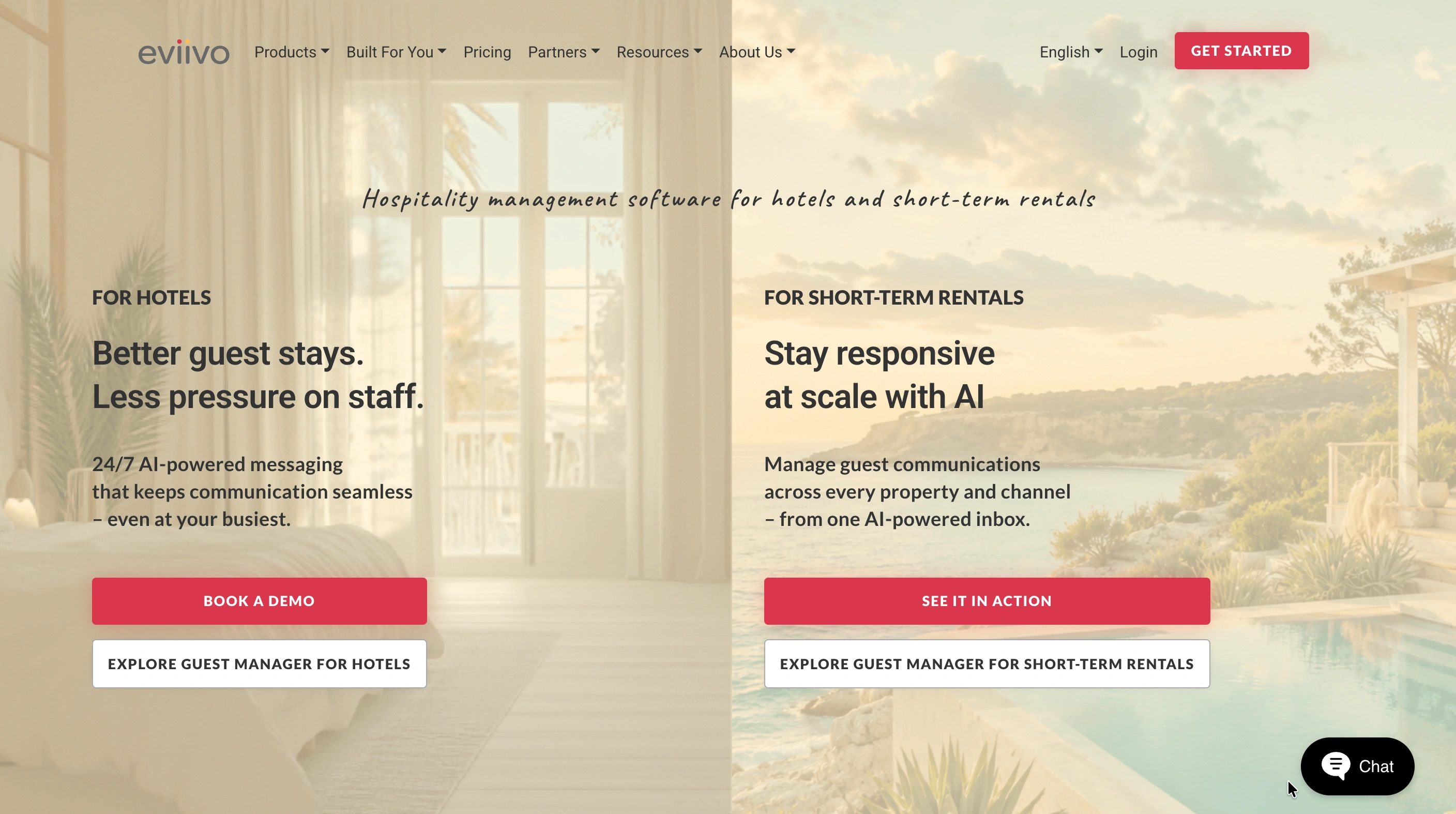
This guide is for independent hotels, guesthouses, and small hotel groups that started on eviivo at B&B scale and have grown past the booking volume its per-transaction pricing was built around.
eviivo does its actual job well for a small property. It serves 28,000-plus accommodations, and much of its review sentiment is positive. The friction shows up specifically once booking volume grows enough that a flat per-booking fee stacks into a real line item, and once support responsiveness matters more because there is more at stake in a delayed answer.
If you run 30 or more rooms and eviivo's per-booking fee has started showing up as a real number on your monthly costs, the sections below are built for you. If you run a small B&B under 20 rooms, eviivo is likely still the right tool. Stay where you are.
Why Are Hotels Actually Leaving eviivo?
Hotels leave eviivo for three recurring reasons: a fee model that scales against you, support that documented reviewers describe as slow to the point of unresponsive, and setup friction that becomes more costly as a property's complexity grows.
The per-booking fee compounds with volume. eviivo charges a flat $0.50 on every confirmed booking, on top of a $50 to $125 monthly subscription. At B&B volume, this is a rounding error. At independent-hotel volume, with hundreds of bookings a month across multiple channels, it becomes a real, unpredictable monthly cost that a flat-priced alternative does not carry.
Support responsiveness is a specific, documented complaint. Reviewers describe the support chat as passing issues to a team that takes months to respond, "if they respond at all," with one review noting "practically no customer support in the USA" during a period when eviivo was migrating customers from a prior product. This matters more at hotel scale, where a delayed rate or OTA sync fix has more revenue riding on it.
Setup and reconciliation friction. Reviewers describe onboarding as tedious, with difficulties navigating the interface, connecting OTAs, and compatibility problems across Mac, mobile, and certain browsers, alongside reports of delayed payouts and confusing invoices. None of this is universal, and eviivo's overall sentiment leans positive, but these are the specific, documented frictions that show up as a property scales.
What Staying Actually Costs You
eviivo's subscription itself is inexpensive relative to hotel-grade platforms. The real cost sits in two other places.
1. The per-booking fee at your actual volume. Take your average monthly booking count and multiply by fifty cents. At 50 rooms with reasonable occupancy, this adds up to a real monthly figure that a flat-priced platform simply does not charge. Run this number against your actual booking volume before comparing subscription prices alone.
2. Support-delay risk during a live OTA or rate issue. A support ticket that takes months to resolve is tolerable for a cosmetic bug. It is not tolerable for a rate mismatch actively overselling a room. Price this the same way you would price any channel-sync failure: a relocation, a refund, or a guest lost to a competitor.
Model your own booking volume against the per-booking fee using the roommaster ROI and pricing calculators before any sales conversation.
Before You Switch: The 5 Non-Negotiables
1. Re-establish OTA connections one at a time
eviivo's one-click OTA connections do not carry over to a new platform automatically. Configure your new channel manager fully, map every room type and rate plan, then reconnect one OTA at a time, verifying each before moving to the next.
2. Export your full reservation and guest history in writing
Confirm the export format and field list from eviivo before you sign with a new vendor. Given the documented onboarding friction eviivo itself carries, do not assume a clean export without checking it.
3. Confirm payment processing continuity
eviivo's automated payments add-on ties into its own processing. Confirm whether your new provider supports a direct handoff or whether guests need to re-enter stored payment details.
{{payments-cta}}
4. Plan for a support gap during the transition
Given eviivo's documented support-delay complaints, do not rely on eviivo's own support to help you migrate away cleanly. Build your export and verification plan assuming you are doing it yourself, with your new vendor's implementation team, not eviivo's help desk.
5. Freeze rate changes for 24 to 48 hours around cutover
This is the window where a channel mid-transition is most likely to show a stale rate or availability figure to a searching guest.
Realistic Timeline: The Staged Channel Cutover
Budget two to three weeks. One week to export and configure, one to two weeks moving OTA channels one at a time.
Week 1: Prepare. Export your full reservation history, guest profiles, and OTA mapping details. Configure your new system with matching room types and rate plans, but do not connect anything live yet.
Weeks 2 and 3: Staged cutover. Move channels one at a time, starting with your lowest-volume OTA. After each channel moves, push a full rate and availability update, then search your own property as a guest would to confirm it landed correctly.
When not to switch. Any period above roughly 70% occupancy, peak season or long weekends, a week with a group or event in-house, or any week you are short-staffed.
For the general version of this process, see the roommaster guide to migrating to a new property management system.
{{channel-manager-one}}
Evaluation Criteria: Pain Points and What the Switch Fixes
| Criteria | What eviivo users report | What roommaster users report | How roommaster solves it |
|---|
| Pricing model | Flat subscription plus a $0.50 fee on every confirmed booking, which compounds at scale, per eviivo's published pricing page | Flat, quote-based pricing scoped to the property | No per-transaction fee stacking on top of a subscription |
| Support responsiveness | Support chat "only passes issues to the support team, who take months to respond, if they respond at all" (Trustpilot) | Reviewers cite a "fantastic support team" that "answers the phone" | 24/7 phone, chat, and email support |
| Onboarding and OTA setup | Described as tedious, with interface and browser compatibility issues (Trustpilot) | "Straightforward and logical," with training done "in a couple of shifts rather than weeks" | Implementation team handles OTA reconnection directly, not left to self-service |
| Payment reconciliation | Reviewers report delayed payouts and confusing invoices (Trustpilot) | Payments run inside the same platform as reservations and folios | One system of record for payments and reservations, fewer manual reconciliation steps |
| Property complexity fit | Best suited to sub-20-room B&Bs and vacation rentals; feature set thins for properties with restaurant or spa operations (Hotel Tech Report) | Built for the 30-150 room independent hotel range specifically | Group and block booking, plus multi-folio billing, built in natively |
Top 3 eviivo Alternatives
1. roommaster
Quick verdict: choose roommaster if the per-booking fee has started showing up as a real cost, and you need hotel-grade operations eviivo's B&B design does not carry.
Best for: independent hotels, 30 to 150 rooms, that have outgrown eviivo's single-property, B&B-oriented design.
Why it fits eviivo switchers. Flat pricing with no per-booking fee stacking, 24/7 human support, and group and block booking handled natively, backed by over 30 years running hotel software.
Trade-off: pricing is quote-based, and a small B&B staying under twenty rooms may still be well served by eviivo's original design.
2. Cloudbeds
Quick verdict: choose Cloudbeds if you want a unified PMS and channel manager stack with strong marketplace breadth, and eviivo's per-booking fee is the primary complaint.
Best for: boutique and hybrid properties wanting a fast, single-vendor setup.
Why it fits eviivo switchers. Rated 4.3 out of 5 on G2 across 41 reviews, it is the most consistently cited eviivo alternative across independent sources, with broad OTA reach and a marketing suite built around direct bookings.
Trade-off: revenue management scores only 3.8 out of 5 on G2, and reporting depth narrows for properties with more complex needs.
3. RoomRaccoon
Quick verdict: choose RoomRaccoon if you want to stay close to eviivo's small-property simplicity but need stronger automation.
Best for: small independents and B&Bs crossing from vacation-rental-style tooling into hospitality operations, without wanting to jump straight to enterprise-grade software.
Why it fits eviivo switchers. It solves for automation depth, dynamic pricing and upselling included rather than configured, while staying close to the simplicity level eviivo customers are used to.
Trade-off: reporting depth is limited for finance work at scale, and it carries its own documented friction, an AI-chatbot-first support model with reported wait times, worth weighing against eviivo's own support gap rather than assuming it is automatically better.
How to Move From eviivo to roommaster in 3 Simple Steps
Step 1: Assess and plan
A roommaster implementation specialist reviews your current eviivo setup, room count, rate structure, and OTA connections. You agree on the export scope and the order channels will move in.
Step 2: Migrate and configure
Reservations, guest profiles, and rate plans transfer while eviivo continues running live. Your new system is configured with your actual room types and rates. Nothing is switched on yet.
Step 3: Cut over channel by channel
Your channel manager connects to one OTA at a time, lowest volume first. After each, a full rate and availability push goes out, verified by searching your own property as a guest would.
If eviivo's support delays are the actual reason you are reading this, the roommaster implementation team handles the OTA reconnection and data verification directly, not as a self-service afterthought.
{{pms-one}}
The Four Numbers That Prove Your Import Worked
- Reservation count. Arrivals, in-house, and future counts must match your final eviivo report exactly.
- Revenue on the books. Total future revenue must match. A mismatch usually traces back to a rate mapped incorrectly during OTA reconfiguration.
- Guest profile count. Totals must match, with several records spot-checked for missing details.
- Outstanding balances and deposits. Amounts held and owed must reconcile to the cent against your eviivo closing figure.
If any of the four diverge, hold the cutover and resolve the gap first.
Bottom Line
Migrating from eviivo is a fee-scaling and OTA-remapping problem, not a case against a bad platform. It works well for a small B&B. Confirm your actual per-booking cost at your real volume, re-establish OTA channels one at a time, and verify the four numbers before you close the account.
If the per-booking fee or support delays have become the real friction, the roommaster implementation team can map the switch against your specific booking volume on a call.
{{cta-strip}}
Frequently Asked Questions
1. Is eviivo a bad platform?
No. It serves 28,000-plus accommodations and works well for its actual target segment, small B&Bs and vacation rentals under twenty rooms. The friction in this article concerns fee scaling and support responsiveness at hotel volume, not overall product quality.
2. How long does migrating from eviivo take?
Two to three weeks is realistic, most of it spent sequencing OTA channels one at a time.
3. Will our OTA listings stay live during the switch?
Yes, if channels move one at a time with rate changes frozen for 24 to 48 hours around cutover, and you manually verify your top OTAs the morning after each channel moves.
4. Does eviivo's per-booking fee apply to every reservation?
Yes, per eviivo's own pricing page, a flat $0.50 charge applies to every confirmed booking regardless of channel, on top of the monthly subscription.
5. Does eviivo fit roommaster's typical customer?
Partially. eviivo's strongest fit is sub-20-room B&Bs and vacation rentals, UK and Europe-heavy. The overlap is real specifically for independent hotels in the 30 to 150 room range that have outgrown that design.


.png)
.png)
.png)