What Is a Hotel Phone System?
A hotel phone system (or PBX) connects guest rooms, the front desk and staff, handling internal and external calls, emergency services and outside lines, while also supporting hotel-specific needs like wake-up calls, do-not-disturb status, room-to-room dialing and multi-line handling at a busy front desk.
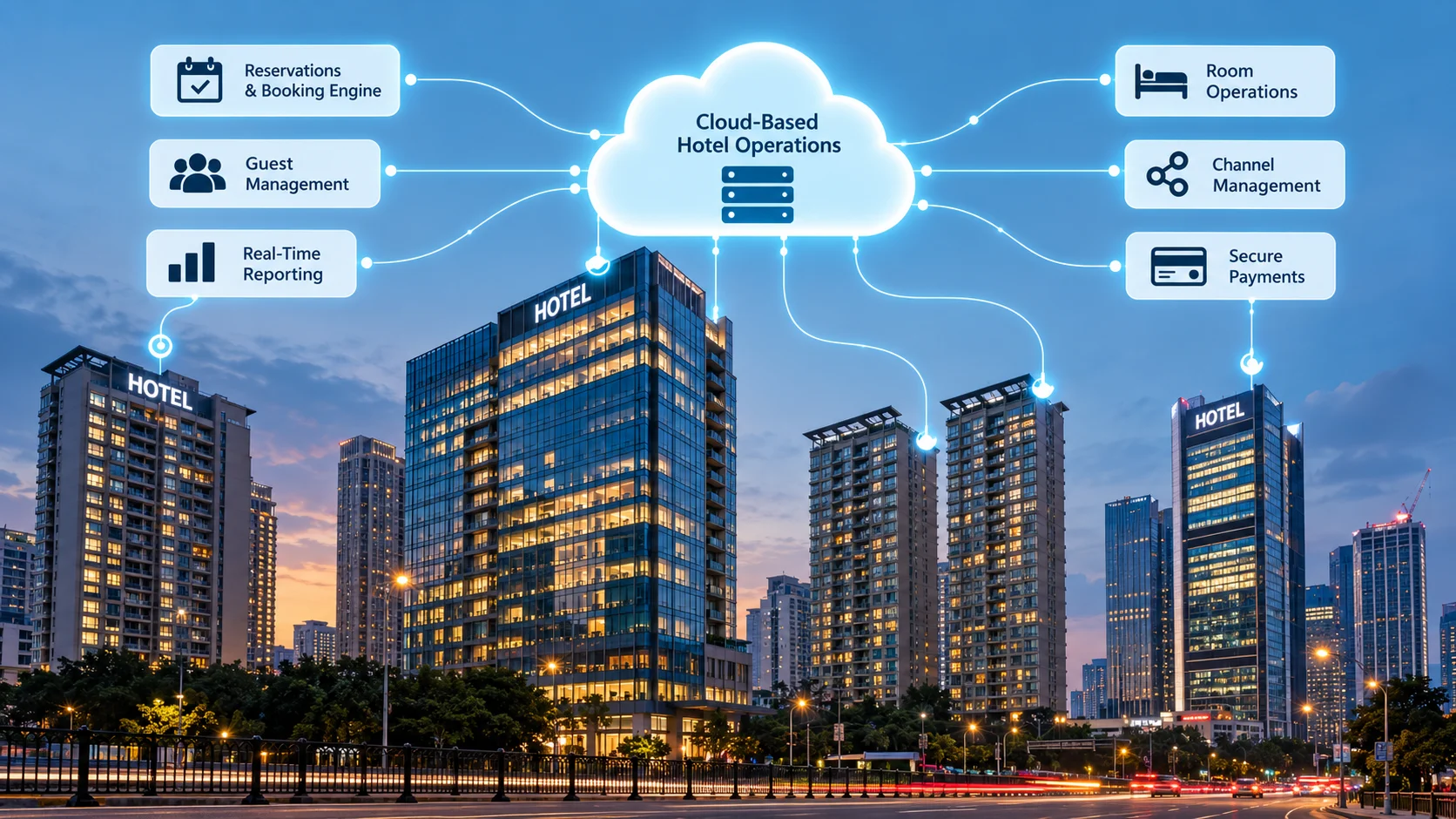
It's built on one of a few architectures, traditional on-premise PBX, hosted/cloud VoIP, or a hybrid setup that keeps existing in-room wiring while moving the back end to the cloud, and it has to handle hospitality-specific jobs that a standard office phone system doesn't: room-to-room dialing, automated wake-up calls, do-not-disturb status, and multi-line handling at a busy front desk.
Whichever architecture a property chooses, the system's value depends heavily on how well it connects to the property management system (PMS), since that integration is what turns a phone call into an automatic folio charge and a housekeeping status update into a real-time room-status change, instead of a manual entry someone has to remember to make.
{{concierge-one}}
How To Choose a Hotel Phone System
The right system depends on your property's size, existing wiring and how tightly you want phones tied into daily operations. Ask:
- What's your existing wiring? A property with analog jacks in every guest room has different, usually cheaper, upgrade paths than one wired for Ethernet.
- Cloud, on-premise, or hybrid? Cloud is the lowest-maintenance option for smaller independent hotels; hybrid keeps existing in-room phones while modernizing the back office; on-premise still suits larger properties with dedicated IT support.
- Does it integrate with your PMS? The single most important question on this list. See the dedicated section below on why "PMS compatible" and "PMS integrated" aren't the same thing.
- Is it compliant with 911 emergency-calling rules? Confirm the system supports direct 911 dialing with no prefix and can pass room-level location to dispatchers. Covered in detail below.
- How will staff use it day to day? Look at mobile/softphone access for housekeeping and maintenance, and failover if the internet goes down.
Matching a Phone System to Your Property Type
- Independent and boutique hotels (roughly 30 to 150 rooms): Hybrid systems tend to fit best, reusing existing wiring while gaining PMS integration and mobile staff access.
- Full-service hotels and resorts (roughly 150 to 400+ rooms): Higher call volume across departments (room service, spa, restaurant, valet) calls for solid multi-line and ring-group routing, and the larger footprint often justifies on-premise or hybrid setups with dedicated IT support.
- Limited-service and extended-stay properties: Fewer amenities to route calls to and smaller front-desk teams make cloud-hosted systems the more cost-effective default.
- Hotel groups managing multiple properties: Centralized hotel management software matters more than any one property's feature list, since a system that behaves consistently across locations avoids expensive re-platforming as the group grows.
Key Features of a Hotel Phone System
- PMS integration: Automated check-in/check-out line activation, wake-up calls, DND sync and call billing posted directly to the guest folio.
- Automated wake-up calls & do-not-disturb: Scheduled through the PMS or front desk console, not set manually room by room.
- Call accounting & folio billing: Calculates outside/long-distance call costs and posts them as a line item on the guest's bill.
- Multilingual auto-attendant / IVR: Routes routine questions without tying up front desk staff.
- Staff mobility: Mobile apps or softphones for housekeeping and maintenance.
- Failover for outages: Cellular (4G/5G) backup so the property can still make and receive calls, including 911, if the internet drops.
- E911 dispatchable location: The ability to pass exact room and floor information to emergency dispatchers, covered in detail below.
{{concierge-two}}
Cloud vs. Hybrid vs. On-Premise Phone Systems
Choosing a deployment model affects your upfront budget, who handles maintenance, and how the system behaves if the internet goes down.
| Feature |
Cloud-Hosted (VoIP/UCaaS) |
Hybrid |
On-Premise PBX |
| Upfront cost |
Low: subscription-based, minimal hardware |
Moderate: gateway hardware to reuse existing wiring |
High: servers, licenses, installation |
| Maintenance |
Handled remotely by the provider |
Local gateway plus cloud-managed back end |
Managed on-site, usually by your IT staff or a local vendor |
| Internet dependence |
Calls (including internal ones) rely on the connection, unless the vendor includes cellular/4G-5G failover |
Front-of-house cloud features depend on internet; basic room-to-room calling can still work locally depending on setup |
Low: internal and local extension-to-extension calls keep working even if the internet drops |
| Scalability |
Easy: add rooms or properties from a dashboard |
Moderate: limited by gateway port capacity |
Harder: limited by the physical server's capacity |
| Guest room wiring |
Requires Ethernet/Wi-Fi-capable phones |
Reuses existing analog wiring via FXS/VoIP gateways |
Flexible, but typically wired to the on-site server |
| Best for |
Smaller or newer properties with strong network infrastructure already in place |
Established independent hotels that don't want to rewire every room |
Larger properties with dedicated IT support or specific customization needs |
Many independent hotels land on hybrids as the middle path between cost and capability.
How Much Does a Hotel Phone System Cost?
Cost depends heavily on deployment type and property size. The table below breaks down typical ranges by cost component.
| Deployment / Cost Component |
Typical Range |
Notes |
| Cloud-hosted, per guest room |
$5 to $15 per room per month |
Subscription based, minimal hardware to buy |
| Cloud-hosted, per staff seat |
$10 to $35 per user per month |
Priced separately from guest room lines |
| On-premise PBX, upfront install |
$15,000 to $40,000 or more |
Varies by room count and hardware specified |
| On-premise PBX, ongoing maintenance |
A few thousand dollars per year |
Covers parts, support and technician visits |
No publisher quotes a standardized price for a guest-room system with full PMS integration and E911 setup, since that combination varies too much property to property, so treat these as planning ranges and get an actual quote scoped to your room count and existing wiring.
{{concierge-three}}
Hardware: Keeping Analog Phones vs. Replacing with IP Phones
The deployment model is one decision. A separate one is what happens at the handset: keep the phones already in your guest rooms, or replace them with modern IP hardware.
Keeping existing analog phones
- How it works: existing room phones connect through FXS/VoIP gateways, which translate the analog signal for a modern back end.
- Pros: saves significantly on hardware and avoids rewiring guest rooms.
- Cons: limited features, no advanced displays, and older handsets fail more often simply from age.
- Best for: budget-conscious properties, or historic buildings where rewiring isn't practical.
Replacing with new IP hardware
- How it works: Ethernet-based phones, typically powered over the network cable itself via Power over Ethernet (PoE).
- Pros: clearer HD audio, programmable guest-service keys, and easier centralized management.
- Cons: higher upfront cost, and requires modern Cat5e/Cat6 cabling to every room if not already in place.
- Best for: properties prioritizing a premium guest experience, new builds, or full renovations.
Does It Integrate With Your PMS? Why This Question Matters More Than Any Feature List
Most hotel phone system guides list "PMS integration" as one line in a feature checklist and move on. That's the wrong way to evaluate it. A phone system that's technically "PMS compatible" and one that's genuinely integrated can look identical on a spec sheet and behave completely differently at the front desk.
What a real integration should actually do:
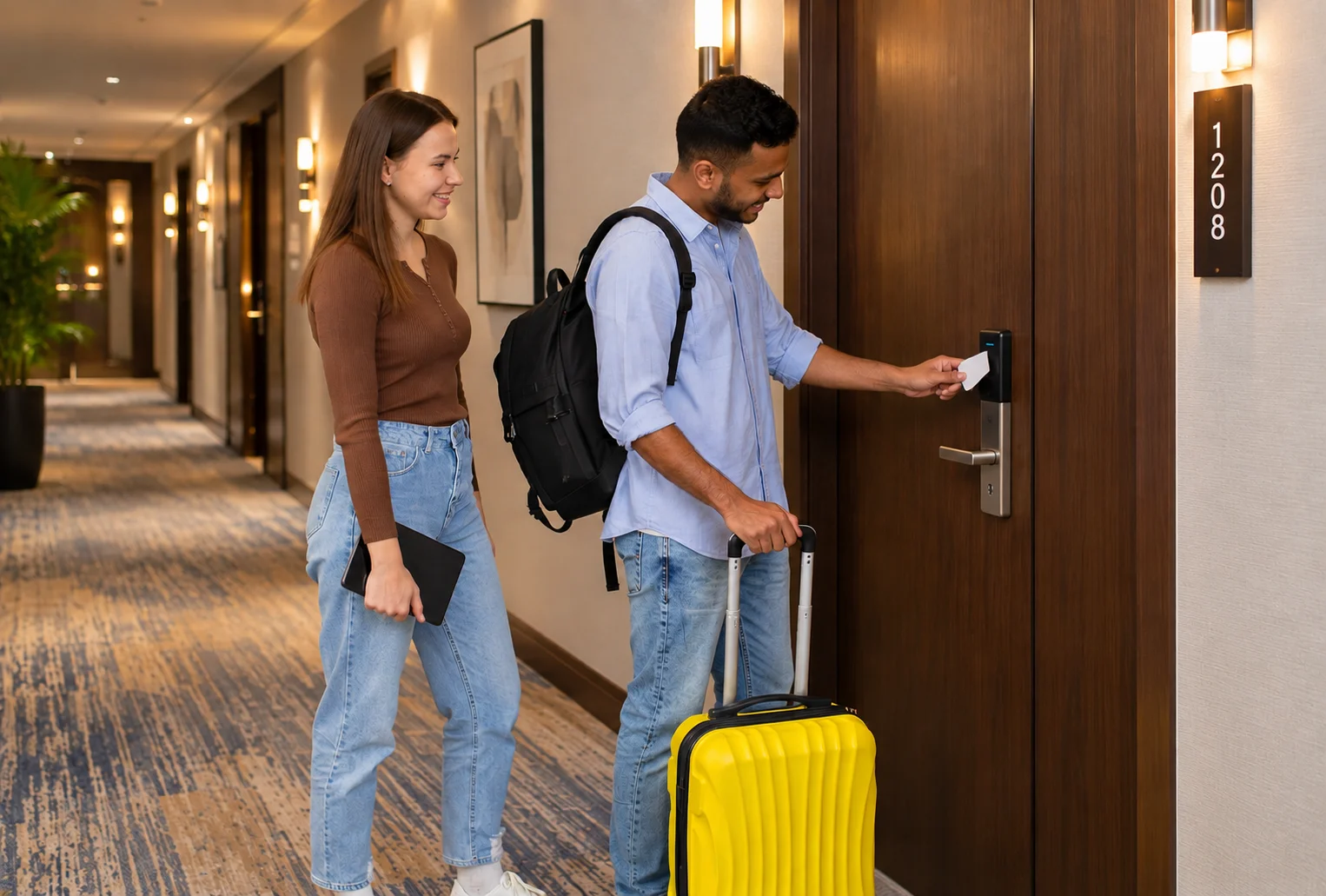
- Automatically activate a room's outside-line calling at check-in, and lock it back down at check-out, with no manual toggling by front desk staff.
- Let housekeeping dial a status code from the room phone (e.g., "clean," "dirty") that updates the room status inside the PMS in real time.
- Schedule and deliver wake-up calls set from the PMS or booking record.
- Sync do-not-disturb status between the phone system and the PMS in both directions.
- Post call charges directly to the guest folio as a line item, with the tariff calculated automatically.
- Display the guest's name on internal caller ID at the front desk, pulled from the reservation.
If a vendor's "integration" only covers one or two of these, ask directly which ones. Don't assume the rest come standard.
"Compatible" vs. "integrated": ask this exact question. Plenty of phone vendors describe themselves as "PMS compatible" when what they actually mean is a generic middleware layer requiring its own separate licensing and support contract, not a tested, direct integration with your specific hotel PMS software. Ask the vendor to name your PMS specifically and state, feature by feature, which of the six items above their integration handles today, not what's on a roadmap.
E911 and Compliance: What Every Hotelier Needs to Know
This is the section that gets skipped in most phone-system shopping, and it shouldn't be, because the rules aren't new, they're just widely ignored.
- Kari's Law (US): Since February 16, 2020, any multi-line telephone system (MLTS), which covers virtually every hotel phone system, must allow direct 911 dialing with no prefix (no "dial 9 first"), and must notify a central on-site or off-site location whenever a 911 call is placed.
- RAY BAUM'S Act (US): Requires that 911 calls from an MLTS convey a "dispatchable location": the specific room number and floor, not just the hotel's street address. A basic analog-to-VoIP gateway that maps the whole property to a single phone number won't meet this on its own; the system needs per-room location mapping (commonly via ELINs, short for Emergency Location Identification Numbers).
- Canada: There is no direct equivalent law. The CRTC's MLTS guidance is voluntary best practice, not a legal mandate, though the recommended practices mirror the US requirements closely.
If your current system doesn't already do this, it isn't a future deadline. For US properties, it's something you may already be out of compliance with.
Pros and Cons of a Modern Hotel Phone System
Pros:
- Reduces manual front-desk work through PMS integration.
- Lower ongoing costs than maintaining legacy analog lines and on-premise hardware.
- Brings the property into compliance with 911 direct-dial and location requirements.
- Scales more easily across multiple properties for hotel groups.
Cons:
- A full cloud/Ethernet switch can mean a costly rewire if guest rooms only have analog jacks; hybrid gateways avoid this but add hardware to manage.
- PMS integration quality varies significantly by vendor; a system that claims "PMS integration" may only offer basic connectivity.
- Any internet-dependent system needs a real failover plan, or an outage can take down calling, including 911, unless cellular backup is in place.
Is a New Phone System Right for Your Hotel?
The technology decision is usually simpler than it looks: cloud, hybrid or on-premise. The harder decisions are operational: how deeply the system integrates with your PMS, whether it meets 911 requirements today, and how much manual front-desk work you want automated. Match those to your property's size and existing wiring, and you'll have a clear view of whether it's time to upgrade.
{{cta-strip}}
Frequently Asked Questions
1. What is a hotel phone system?
A hotel phone system (or PBX) connects guest rooms, the front desk and staff, handling internal and external calls, emergency services and outside lines, while also supporting hotel-specific needs like wake-up calls, do-not-disturb status, room-to-room dialing and multi-line handling at a busy front desk.
2. What phone systems do hotels use?
Most hotels run a central PBX connecting the front desk to guest room phones. Corded analog handsets are still widely deployed, and many properties layer newer VoIP/SIP-based systems on top, so legacy and modern technology often run side by side in the same building.
3. Is a hotel phone system the same thing as a PBX?
Not exactly. PBX refers specifically to the on-premise hardware and switching technology that routes calls between extensions. Hotel phone system is the broader term for the whole setup, which can run on a traditional PBX, a hosted or cloud VoIP platform, or a hybrid of both, so a modern cloud-hosted system still counts as a hotel phone system even though it isn't a PBX in the traditional sense.
4. How do you call another room from a hotel phone?
Pick up the receiver and dial the other room's number directly, no area code or outside-line prefix needed, since the system routes it internally.
5. Do hotels charge for phone calls made from guest rooms?
Local and room-to-room calls are typically free. Long-distance and international calls are usually billed, and rates vary a lot by property, domestic long-distance can average around $1.50 per minute and international calls $5 or more per minute at some hotels. A PMS-integrated phone system calculates and posts these charges automatically instead of a staff member doing it by hand.
6. How much does a PBX system cost?
It depends heavily on deployment type. Cloud-hosted PBX plans commonly run $8 to $90 per user per month with no hardware to buy, while a full on-premise PBX typically requires $50,000 to $62,000 upfront for hardware and installation, plus a few hundred to over a thousand dollars a month in recurring fees. These are general business PBX ranges, not hotel-specific per-room pricing, since guest-room-and-PMS-integrated installs vary too much by property to quote generically, so get an actual quote based on your room count and existing wiring.
7. What is Kari's Law and does it apply to my hotel?
A US federal law requires multi-line telephone systems, which covers virtually all hotel phone systems, to allow direct 911 dialing without a prefix and to notify staff when a 911 call is made. In effect since February 16, 2020.
8. Can a hotel keep its existing analog room phones and still modernize?
Yes, via gateway hardware that connects existing analog wiring to a modern, cloud-managed back end.
.avif)
.png)
.png)
.png)