Hotel Group Management Software: How Multi-Property Hotels Stay In Control
"We’ve trusted roommaster for over 25 years. It keeps our entire hotel group running smoothly with everything we need in one easy-to-use system" - Jorge Venegas, General Manager, NUVO Suites
Hotel group management software connects multiple properties into one unified system - covering reservations, rates, housekeeping, reporting, and payments.
Without it, multi-property groups manage through disconnected tools, which creates rate inconsistencies, reporting gaps, and staff inefficiency at scale.
The core capabilities that matter are centralized reservations, a two-way connected channel manager, consolidated reporting, and role-based access control.
Groups that outgrow a single-property PMS often discover the signs gradually - through manual workarounds, overbooking errors, or time lost reconciling data across properties.
roommaster is built to scale from independent properties to multi-property groups without requiring a platform change.
Managing two or more properties on disconnected systems costs hotel groups more than they realise - in staff hours, missed revenue, and avoidable errors. This guide covers what hotel group management software actually does, which capabilities matter most, and how to evaluate platforms built for multi-property operations.
Running a hotel group without the right software is a bit like managing a fleet of vehicles from separate offices, using different maps, with no shared radio. Each property has its own data. Rate changes at one location don't automatically update at another. Your VP of Operations is logging into four systems before 9am just to get a read on last night's occupancy.
That's not a staffing problem. It's a software problem.
Hotel group management software solves it by giving your entire portfolio a single operational spine.
What Is Hotel Group Management Software?
Hotel group management software is a property management system (PMS) built to run multiple properties from a single platform. It handles reservations, front desk operations, housekeeping, rate management, OTA distribution, reporting, and payments across every location in your portfolio - under one login, one database, and one set of operational rules.
It's different from a single-property PMS in one important way: the system is designed from the ground up to keep data synchronized across properties. Availability updates at one hotel immediately reflect group-wide. A guest profile built at one location carries forward when that guest books another property in your collection. A rate change pushed from head office rolls out across every connected OTA at every property simultaneously.
The result is visibility and control that simply isn't possible when each location runs on its own disconnected system.
{{pms-one}}
Why Single-Property Pms Tools Break At Scale
A single-property PMS is built for one context: one front desk, one room inventory, one set of rates. It works well for that. But when a group adds a second property - and especially a third, fourth, or fifth - the cracks appear fast.
Here's how it typically plays out.
The group adds a new property and either buys another license of the same PMS or signs with a different vendor. Now the front desk teams are in different systems. Rates are updated manually at each property. Someone has to log in and out of each platform to check occupancy. Night audit reports from three locations arrive in three different formats and someone spends Monday morning merging spreadsheets.
Then an OTA reports an overbooking at Property B because availability wasn't synced after a run of walk-ins at Property A. A guest who stayed last summer calls to make a reservation and your agent has no record of them at the sister property.
None of these are edge cases. They're predictable failure points that appear as portfolio size grows. The functions of a property management system are well understood at the single-property level - the challenge is maintaining those functions consistently when the same operations need to run across multiple locations simultaneously.
What Features Does Hotel Group Management Software Need?
Not every feature on a hotel group software spec sheet carries equal weight. These are the ones that actually determine whether a multi-property operation runs smoothly or spends its days firefighting.
1. How Do Multi-Property Hotels Manage Centralized Reservations?
The reservation engine needs to sit above the property level. That means a single database showing real-time availability across your entire portfolio - so your central reservations team can make, modify, or move a booking across properties without switching platforms.
For groups with a mix of property types or sizes, this also means handling different room configurations, rate plans, and booking rules for each property, while still managing them from the same interface. An inter-property room move - when a guest needs to be shifted from one property to another - should take minutes, not involve phone calls between two separate systems.
Riley Hotel Group runs 17 properties on roommaster. Lisa Zifer, their VP of Operations, has noted that the level of support and the collaborative relationship with the development team has been central to how the platform has grown with them. That kind of operational depth - across 17 locations - only works with a PMS designed to handle that footprint.
2. How Does Rate Management Work Across Multiple Properties And Otas?
Rate parity across OTAs becomes genuinely difficult at scale. When you're managing three or more properties, each with their own room categories, seasonal rates, and corporate contracts, the risk of rate inconsistencies multiplies. A standard rate might get updated at one property but not pushed to another. A special offer goes live on Booking.com for Property A but not for Property C because someone missed it.
Hotel group management software solves this with a channel manager that operates at the portfolio level. Rate changes pushed from the PMS sync in real time to every connected OTA across every property simultaneously. Availability updates flow back the same way - two-way sync, not a one-directional push.
This matters because a two-way sync means the OTA's reservation count and your PMS inventory stay in permanent alignment. When Booking.com takes a reservation at 2am, your PMS knows about it immediately. No manual reconciliation at check-in, no overbooking surprises. Groups using a properly integrated channel manager typically see an 85% reduction in distribution management time.
3. What Does Group-Wide Hotel Reporting Look Like?
A general manager needs property-level data. A VP of Operations or owner needs a group-level view. A good hotel group management system gives you both - and lets you switch between them without exporting to a spreadsheet.
That means consolidated occupancy, ADR, and RevPAR across all properties in one report. It also means the ability to drill down: compare Property A's occupancy against Property B's for the same period. Identify which property is underperforming on direct bookings. See which room type is generating the highest booking value group-wide.
Finance teams need this too. Multi-folio billing, group event invoicing, inter-property accounting - these aren't niche requirements for hotel groups. They're daily operations. A PMS with finance-grade reporting means your accounts team isn't building manual reconciliations every month-end.
Seaboard Hotels, a four-property family-owned group, has been running on roommaster for 25 years. Alex Moore, their President and CEO, cites yield management and consistent reporting as central to their ability to achieve at least 7% revenue growth annually pre-COVID. That kind of performance visibility comes from having reliable, comparable data across properties - not from four separate reporting tools.
4. How Do Hotel Groups Manage Staff Access And Permissions Across Properties?
When you have multiple properties and multiple teams, access control isn't optional. A front desk agent at Property B shouldn't be able to modify rate plans at Property A. A revenue manager might need read access to data across all properties but write access only to their own.
A well-designed hotel group PMS handles this with role-based permissions scoped at the property level, the portfolio level, or any combination. Staff can be granted cross-property access where needed - for example, a housekeeping supervisor who covers two sites - without opening the full system to everyone.
This is also where cloud architecture matters. Because the platform is cloud-based, regional managers or ownership groups can access data across the portfolio from anywhere, without being physically present at a property or connected to a local server.
5. How Does Payment Processing Work For Hotel Groups?
Multi-property groups carry more payment complexity than single properties. Group bookings often bill to a master folio. Corporate accounts span multiple locations. Chargebacks from one property need to be handled without affecting the billing records of another.
Integrated payments at the group level means all transactions run through the same gateway, the same reconciliation workflows, and the same reporting dashboard - regardless of which property processed the charge. This removes the manual reconciliation burden and reduces the risk of billing errors that erode margins quietly.
How Do Hotel Groups Use This Software Day To Day?
The operational reality of a multi-property group changes significantly once the right software is in place. Here's what that looks like in practice.
1. Monday Morning Performance Review
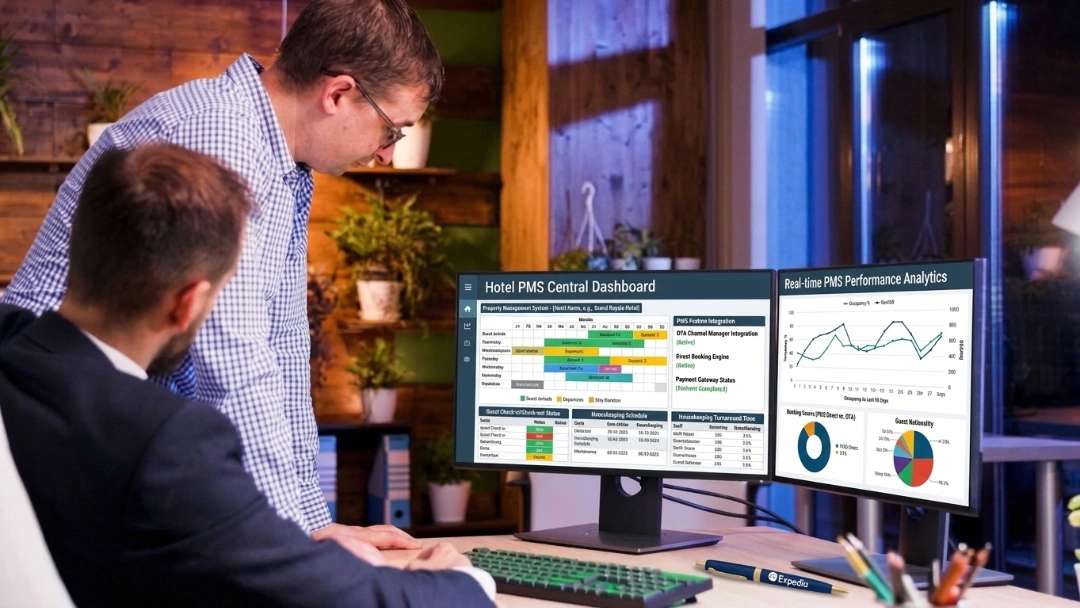
A VP of Operations opens a single dashboard showing the prior week's occupancy, ADR, and RevPAR for every property in the group. One report. No spreadsheet consolidation. Any property that underperformed against forecast is immediately visible, and the data is granular enough to identify whether the issue was low occupancy, low rates, or high OTA commission.
2. A Walk-In Arrives At A Fully Booked Property
The front desk agent can see in real time that Property B, 4 miles away, has availability. They can book the guest into that property from the same interface they're already working in - without calling the other property, without logging into a second system. The guest's profile is created once and shared across the portfolio.
3. OTA Rate Update
The revenue manager needs to adjust the weekend rates at two properties ahead of a local event. They make the change once in the PMS. The channel manager pushes it to every connected OTA for both properties in real time. No double-entry, no risk of one property going out of parity.
4. New Property Onboarded
The group acquires a fifth property. Because the PMS is built to scale, onboarding the new site doesn't require a new platform, a new vendor contract, or a separate integration project. The property is added to the existing portfolio, staff are granted appropriate access levels, and rate plans are configured from a central template. Training time is reduced because the system is already familiar to the group's wider team typically by up to 50%.
This is the operational difference between a platform built for one property and one built for groups. It's not about feature lists - it's about whether daily operations actually work at the scale you're running. Scaling with a cloud-based PMS is a fundamentally different experience than trying to bolt together multiple single-property tools.
How Does Revenue Management Work Across A Hotel Portfolio?
Revenue management gets meaningfully more complex at the group level. Each property has its own demand profile, competitive set, and seasonal pattern. A rate decision made in isolation at one property can affect the others - especially if two properties in your portfolio draw from the same booking audience.
Group-level revenue management means having the data to make pricing decisions that optimise across the portfolio, not just within a single property. That might mean intentionally positioning one property at a higher ADR to push demand toward another with higher margins. It might mean applying event-based pricing to all properties simultaneously when a major conference hits a market where three of your hotels compete.
roommaster's revenue management includes AI-powered dynamic pricing that works at scale. The system uses real-time competitor rate data and demand signals to recommend pricing adjustments, which can be pushed directly from the PMS and distributed across OTAs automatically.
This distinction matters for hotel groups specifically. A standalone revenue manager handling three or four properties manually - checking competitor rates, updating price plans by hand, reconciling OTA reports - can spend the majority of their week on administrative tasks rather than analysis. Integration between the PMS and a revenue management layer removes that overhead. You can see how revenue managers at independent hotel groups approach this in practice.
{{pms-two}}
What Should You Look For When Choosing Hotel Group Software?
Hotel groups often make one of two mistakes when evaluating software. They either buy what works for their current size - then outgrow it in 18 months when they add a property - or they buy enterprise software that's overpowered and overpriced for an independent group of three to eight properties.
These are the practical criteria that separate platforms designed for genuine multi-property operations from single-property tools with a "groups" checkbox.
1. Single Login With Property Switching
Can your team access all properties from one login and move between them without re-authenticating? Any platform that requires separate logins per property creates unnecessary friction and starts to look like a workaround, not a feature.
2. Group-Level Reporting With Property-Level Drill-Down
The platform should produce consolidated reports across all properties as a standard output - not as a custom export request. Check whether RevPAR, occupancy, ADR, and revenue data can be viewed at the portfolio level and by individual property in the same report.
3. Real-Time Two-Way Channel Manager Sync
Confirm specifically that availability flows back from OTAs to the PMS in real time, not on a scheduled update cycle. Groups cannot afford a 15-minute lag between a booking on Expedia and an inventory update in the PMS when occupancy is high.
4. Role-Based Permissions Scoped To Property
Can you set a staff member's access to read-only across all properties but write access only at their home property? This level of granularity is standard in a properly designed group PMS and absent in most single-property tools.
5. Multi-Folio And Group Billing
If your group handles corporate accounts, group blocks, or event billing, the PMS needs native support for multi-folio management - not a workaround involving notes fields and manual tracking.
6. Support That Understands Group Operations
When a rate parity issue hits two of your properties simultaneously at 11pm on a Friday, you need a support team that understands what that means and can resolve it. Look at support response times, support hours, and whether the team has hands-on hotel operations experience. roommaster's support team is available 24/7 and has 125+ years of combined hotel management experience in-house and with a 97% client retention rate, it shows up in the numbers.
You can also review how general managers at independent hotel groups use roommaster across these exact operational scenarios.
What Does Migrating A Hotel Group To A New Pms Actually Involve?
The single biggest reason hotel groups delay moving to a unified platform isn't cost - it's fear of disruption. Moving three or four properties to a new PMS simultaneously sounds like a recipe for overbooking chaos and staff meltdowns.
The practical answer is phased migration. Move the first property, run the team through the system, iron out any configuration issues, then roll out to the next. Because roommaster is cloud-based, each new property can be added to the same account and configured against existing templates rather than built from scratch. Rate plans, room categories, staff permissions - these carry forward rather than being rebuilt.
Training time is reduced significantly because staff at Properties 2, 3, and 4 are learning the same system that Properties 1 and 2 already know. By the time the fourth property goes live, the group has an in-house team that can onboard new staff without external help.
The Harrison Group - 14 properties managed by Harrison Hall Hotel's team. Made the transition to roommaster's cloud platform and found the workload cut roughly in half. Stacy Dadson, their GM, put it simply: I really just can't say how good it is because everything is just so at your fingertips and quick, right from the call to the reservation to the check-in to the checkout. That's the operational reality of a platform designed to serve groups, not just scale to them. For more on handling group bookings within the platform, the detail is covered separately.
The Bottom Line
Hotel group management software isn't a luxury for growing portfolios - it's what makes the difference between a group that scales cleanly and one that layers on operational debt with every new property. Disconnected systems, manual rate updates, and spreadsheet reconciliations are manageable at one property. At three or four, they start costing real money in staff time, missed revenue, and avoidable errors.
The platform you choose needs to be built for group operations from the start - not a single-property tool with a multi-property bolt-on. Centralized reservations, real-time OTA distribution, portfolio-level reporting, and payments reconciliation across properties are table stakes. Everything else is secondary.
If you're managing two or more properties and spending meaningful time reconciling data, updating rates manually across OTAs, or logging into separate systems for a morning performance check, it's worth examining whether your current setup was designed for a group - or whether you've outgrown it. The roommaster hotel group PMS covers exactly how independent groups of this size typically structure their technology.
If you're running a multi-property group and your current PMS requires a different login per property, roommaster's group platform consolidates everything into one system. Thousands of hotels worldwide, including groups running 17 or more properties, manage their full portfolio - reservations, rates, reporting, and payments from a single roommaster account. You can see how it works for your specific group setup by booking a demo.
{{cta-strip}}
FAQs
What is hotel group management software?
Hotel group management software is a PMS that allows multi-property hotels to manage reservations, rates, housekeeping, reporting, and payments across all locations from one platform. It replaces separate PMS tools at each property and keeps inventory, guest data, and financials synchronized in real time.
How does a multi-property PMS handle rate parity across OTAs?
A multi-property PMS connects to a channel manager that distributes rates and availability to all connected OTAs in real time. When a rate is updated in the PMS, the channel manager pushes that change to every OTA simultaneously across all properties, so rates stay consistent without manual updates at each platform.
Can hotel groups use one PMS across properties with different configurations?
Yes. A properly designed group PMS supports individual room categories, rate plans, and operational rules at the property level, while still allowing group-level management of what's shared across the portfolio. Each property retains its own setup while the group maintains centralized visibility and control.
What's the difference between a hotel group PMS and an enterprise hotel system?
Enterprise systems are built for large chains with dedicated IT teams and complex customization requirements. Hotel group PMS platforms are designed for independent groups - typically two to 30 properties - where the owner or VP of Operations needs group-level control without enterprise-level cost or complexity. They're operationally deep but built for teams without dedicated IT infrastructure.
How long does it take to migrate a hotel group to a new PMS?
Most multi-property groups complete a phased rollout over 4-12 weeks depending on portfolio size and configuration complexity. Cloud-based platforms reduce migration time significantly because there's no on-premise hardware to install. roommaster typically onboards new properties within 3-5 business days per site using a phased approach with role-specific training.
Mayela Lozano is a content strategist with a passion for hospitality and technology. She collaborates with roommaster on content creation, highlighting how technology can streamline hotel operations and enhance guest satisfaction. When she’s not creating content, Mayela loves to travel and spend time with her two little ones, discovering new adventures and making memories along the way.
Join Thousands of Hotels Thriving with roommaster
The transition to roommaster is straightforward and efficient. Our implementation team handles data migration including reservations, guest profiles, and historical information.
The transition to roommaster is straightforward and efficient. Our implementation team handles data migration including reservations, guest profiles, and historical information.
Hotel Check-In Kiosk: Enhance the Guest Experience
October 5, 2026
Hospitality Technology
Hotel Management
Hospitality Trends
Hotel Self Check-In: How It Works, Types, Benefits And Setup
October 1, 2026
Hotel Management
Hospitality Trends
Hotel Check-In & Check-Out Times Explained
October 1, 2026
Hospitality Trends
Hotel Management
Cloud-Based Property Management System: Hotel PMS
October 1, 2026
Hotel Management
Cloud PMS
Hotel Management System (HMS): A Complete Guide
September 23, 2026
Hospitality Trends
Hotel PMS
Cloud PMS
Hotel PMS Integration: How It Works for Hotels
September 23, 2026
Hospitality Trends
Hospitality Technology
Hotel PMS
Hotel Management
Cloud PMS
How Hotel PMS Software Transforms Hospitality Management
September 23, 2026
Hotel Management
Marketing
Pet-Friendly Hotel Amenities & Package Ideas That Drive Revenue
September 22, 2026
Hotel Management
Hotel PMS
Hotel Food And Beverage (F&B): The Complete Guide
September 22, 2026
Hotel Management
Marketing
Hotel Pet Fees: How Much Should You Charge?
September 22, 2026
Join Thousands of Hotels Thriving with roommaster
See how roommaster's unified platform can work for your property. Our team will walk you through features tailored to your specific needs and operations.



.png)
.png)
.png)