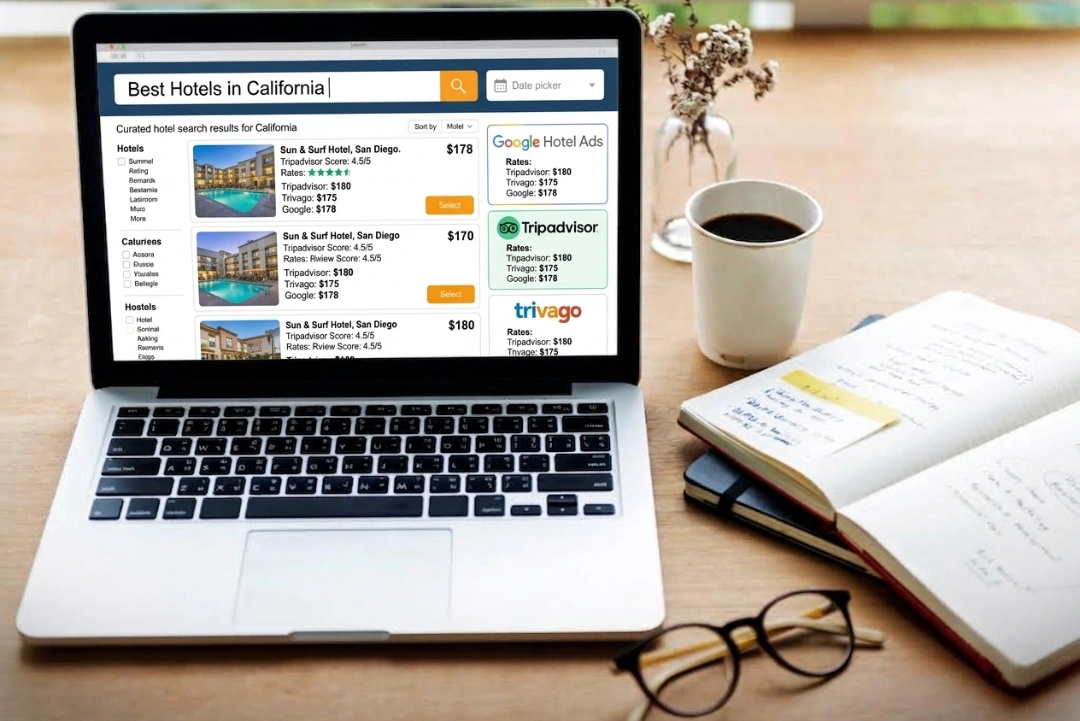
Hotel metasearch puts your direct rate next to the OTAs so guests compare and book with you. Here is how it works, the top platforms and cost models, and how to win more direct bookings in 2026.
What it is: hotel metasearch aggregates room rates and availability from OTAs, wholesalers, and direct hotel sites into one comparison view, then redirects the traveler to book with the provider they choose.
How it works: three moves, aggregate the rates, compare them on one screen, and redirect the guest to complete the booking.
Why it matters for hotels: it puts your direct rate next to the OTAs, so you win more direct bookings, usually at a lower cost than the 10% to 30% an OTA charges, and you keep the guest relationship.
Top platforms: Google Hotel Ads, Trivago, Tripadvisor, Kayak, Skyscanner, HotelsCombined, and Wego, each with different reach.
Cost models: pay-per-click (PPC), commission or pay-per-stay (CPA), and sponsored placements, all needing careful budget management.
Watch-outs: high competition, PPC costs that do not always convert, and rate parity issues across channels.
What Is Hotel Metasearch?
Hotel metasearch is a platform that aggregates hotel rates and availability from multiple sources in one place, so travelers can compare prices and book with the provider they choose. It gathers room rates from OTAs like Expedia and Booking.com, from wholesalers, and from a hotel's own direct booking pages, then displays them side by side on comparison sites like Google Hotels, Tripadvisor, and Kayak.
For hotels, hotel metasearch is also a place to compete. It displays your property's direct rate alongside the OTA and wholesaler rates, so the platform functions as a digital marketplace where hotels bid for visibility to capture the guest. Hotel metasearch is where travelers compare hotel rates before booking, and where hotels compete directly with OTAs for the click.
How Hotel Metasearch Works
A traveler enters a destination and travel dates, and the metasearch engine returns rates from many sources in a single ranked list. The process comes down to three moves.
Aggregation: it pulls live pricing, availability, and reviews from online travel agent (OTAs), wholesalers, and the hotel's own booking system into one list.
Comparison: it displays the choices on one screen, so travelers find the best deal without opening a dozen tabs.
Redirection: it does not take bookings directly. It sends the user straight to the chosen OTA or hotel website to complete the reservation.
When travelers choose a hotel, they are directed to the OTA or hotel website to complete the booking. Hotels can also bid for top ad placements on specific search terms. For instance, a hotel may bid on a term like "Los Angeles hotel" to appear at the top when people search for it. A higher bid may secure better placement but could increase guest acquisition costs, while bidding too low might mean your hotel does not show up high enough. It is worth remembering that metasearch engines differ from bidding sites, where guests place bids for rooms and hotels decide whether to accept them.
How Hotel Metasearch Makes Money
Hotel Metasearch platforms make money differently from OTAs, and usually more cheaply for the hotel. Both main models are typically far lower than the high commission an OTA charges for the same booking, and the guest becomes your direct customer.
1. Pay-per-click (PPC) model
Hotels and OTAs compete for visibility by bidding on specific search terms. When a user clicks a listing, the bidder pays for that click. The cost per click fluctuates with competition, so bidding on a high-volume term like "New York City hotel" costs more than a niche term like "upstate New York boutique hotels." Hotels must weigh the cost per click against the likelihood of converting clicks into bookings. If you pay $5 per click but conversion is low, the return can go negative, so the key is evaluating whether the traffic is worth the cost.
2. Commission or pay-per-stay (CPA) model
Some platforms take a percentage of confirmed bookings, so they get paid only when a traveler completes the booking. Rates commonly range from 10% to 15% per booking. For example, if a hotel earns $300 from a booking and the platform takes 12%, the hotel pays $36. There is no upfront cost, but the commission should align with your profit margins and average room rates. This model suits hotels that prefer to pay only after a booking, provided they keep pricing competitive and conversion high.
3. Advertising and sponsorships
Metasearch engines also sell premium placements or featured ads, usually labeled "sponsored" or "promoted," at the top of results. This boosts visibility during peak periods or promotions, for example featuring a summer special for terms like "NY summer hotel deals." Pricing depends on demand, competition, and timing, so track clicks and conversions to confirm the placement is cost-effective.
{{booking-engine-one}}
Why Hotel Metasearch Matters For Hotels
Hotel Metasearch gives hotels a way to stand out in a crowded online space. Here is how.
1. Higher visibility
Your hotel appears directly in price comparisons alongside OTAs like Expedia or Booking.com, which increases exposure among travelers who compare options before deciding. Without visibility here, hotels lose out to OTAs that dominate search results.
2. More direct bookings
When travelers use metasearch, they can be redirected to your hotel's website to book, which helps you avoid OTA commissions. Studies indicate that 65% of bookings through metasearch come from Google Hotel Ads. Capturing the guest directly means more bookings and higher profit margins.
3. Better rate control
With metasearch, you can monitor and adjust rates in real time. A flash sale or promotion can be reflected immediately across platforms, and hotels that align pricing with high-demand periods like holidays or events can optimize revenue quickly. Integrating metasearch with advanced hotel management software keeps rate and inventory updates flowing smoothly across every connected platform.
4. Build credibility
Travelers trust transparent pricing. Listing on metasearch lets guests view a range of pricing options and amenities, which builds trust in your property and encourages confident booking.
Hotel Metasearch vs OTAs: What's The Difference?
Metasearch engines aggregate rates from multiple sources, including online travel agent (OTAs) and the hotel's own booking engine, and display them side by side, then redirect the traveler to book on the provider's site. OTAs, in contrast, sell rooms directly on their own platforms and control the whole booking process, often charging commissions of 10% to 30% depending on your property's size and volume.
Category
Hotel Metasearch Engines
OTAs
How they work
Aggregate rates from multiple sources (OTAs + hotel website) and display them side by side
Sell rooms directly through their own booking platform
Booking flow
User is redirected to the hotel website or an OTA to complete the booking
User completes the booking on the OTA's site
Cost to hotel
Pay-per-click or commission hybrid, generally lower than OTA commissions
High commissions (typically 10 to 30%), varying by property size and volume
Control over guest data
Higher, as guests book on the hotel's site, giving direct access to data
Lower, as OTAs retain guest data and limit hotel access
Role in marketing
Price comparison plus traffic driver to the hotel website
End-to-end distribution channel with strong marketing power
Impact on direct bookings
Supports and grows direct bookings
Competes with direct bookings and increases dependency
Visibility
Broad exposure on comparison platforms
Strong visibility through the OTA marketplace and advertising
{{booking-engine-two}}
Top Hotel Metasearch Platforms
A few platforms dominate, each reaching a slightly different traveler.
Google Hotel Ads: the largest by far, integrated with Google Search and Maps.
Trivago: a dedicated hotel comparison platform, strong in Europe.
Tripadvisor: comparison paired with the reviews that influence decisions.
Kayak: travel metasearch that bundles hotels with flights.
Others: Skyscanner, HotelsCombined, and Wego round out the field.
To compare the tools that help you manage bidding across these platforms, see our guide to the best hotel metasearch software.
Benefits Of Hotel Metasearch For Hotels
Hotel metasearch is a platform that aggregates hotel rates and availability from multiple sources, OTAs, wholesalers, and a hotel's own booking pages, and displays them side by side so travelers can compare prices in one place. It does not take the booking itself. It redirects the traveler to the chosen provider to complete the reservation. For hotels, hotel metasearch is where you place your direct rate next to the OTAs and compete for the click, usually at a far lower cost than OTA commission.
Hotel metasearch gives your property a noticeable boost in revenue. Here is why it works so well.
1. Optimised pricing strategy
Hotel metasearch lets you control rates across comparison platforms, adjust pricing instantly, test promotions, and adapt bids as demand shifts. Real-time updates keep rates competitive and listings accurate, so travelers see transparent pricing and genuine value.
2. Compete with OTAs
Metasearch puts hotels directly alongside OTAs in a competitive space. By appearing there, properties capture travel planners, draw bookings away from OTAs, and generate more profitable direct reservations.
3. Better relationship with the customers
Every direct booking gives you contact details and guest reviews you can use to personalise the stay, create loyalty perks, and build repeat business. Guests feel seen, and you can see your efforts working.
4. Flexibility of payment models
CPC (Cost Per Click): you pay for each visitor who clicks your listing.
CPA (Cost Per Acquisition): you pay only when someone completes a booking.
Sales commission: an OTA-style model with generally lower fees to generate bookings without overspending.
5. Upsell and cross-sell
Driving travelers to your website gives you full control of the booking experience, so you can highlight premium room types, packages, and amenities not on OTAs, and showcase on-property services like dining, spa, retail, and activities.
Disadvantages Of Hotel Metasearch For Hotels
Now that we have covered the benefits, here are the challenges hotels may face.
1. High competition
You compete with multiple OTAs for visibility, and they often bid higher to secure top positions, which can push your rates down the list. Even with better deals or service, standing out against larger, better-funded competitors can be hard without sacrificing profitability.
2. Pay-per-click costs
You pay for each click even if the user does not book, and those costs add up fast if traffic does not convert. If your listing does not capture interest quickly, you can pay for exposure without a return.
3. Rate parity issues
Maintaining rate parity across platforms is crucial. Metasearch can expose gaps between your direct rates and OTA rates, and if OTAs show lower prices, travelers book with them. That can force you to lower direct rates to compete, hurting margins.
{{booking-engine-three}}
Common Challenges In Hotel Metasearch
Below are the common challenges hoteliers face with hotel metasearch.
Managing budgets and bids: metasearch needs constant monitoring and adjustment. Without strategic bidding, costs rise quickly or visibility drops. The average cost-per-click more than doubled from about US$0.21 to US$0.48 in 2023, so effective budget allocation is a continuous balancing act.
Tracking performance accurately: attribution is hard, since hotels struggle to identify which campaigns, devices, or touchpoints drive conversions. With direct bookings dropping slightly from 39% to 38% in 2023, measuring true ROI matters more than ever.
Converting website traffic: even with strong clicks, conversions suffer when booking engines load slowly, lack mobile optimization, or add checkout friction. The average hotel website conversion rate is only about 1.5% to 2.5%, and mobile can be lower.
Handling technical complexity: success depends on seamless integrations between booking engines, channel managers, and connectivity partners. Sync issues, delayed updates, or missing inventory cause outdated pricing, reduced visibility, and wasted spend.
Search Engines vs Metasearch Engines: What's The Difference?
Search engines like Google or Bing index vast amounts of content from across the web and return links to many websites based on the user's keywords. Metasearch engines like Google Hotels, Trivago, or Kayak do not host original content. Instead, they pull pricing and availability from multiple OTAs and platforms to give users a consolidated view in one place.
If you have optimized your SEO, search engines lead to your website, while metasearch engines direct travelers to third-party sites or your hotel's booking page. Metasearch lets you appear across multiple platforms and compete directly with OTAs, which is crucial for direct bookings. On search engines you rely on organic rankings or paid ads, while metasearch attracts guests actively comparing rates and drives them toward your website, avoiding OTA commissions.
How roommaster Powers Hotel Metasearch
Hotel metasearch only pays off when your direct rate and booking experience are ready to win the click. roommaster provides a hotel channel manager that centralizes and automates your booking process, with real-time rate and inventory updates across OTAs and metasearch-connected booking engines. It also integrates with Google Hotel Finder to drive direct bookings through the hotel booking engine.
Here is how roommaster helps you maximize metasearch performance:
Prevents overbookings: automatically syncs inventory across all channels to minimize overbooking risk.
Maintains rate parity: keeps pricing consistent across OTAs and metasearch platforms, preserving revenue.
Seamless integration with roommaster PMS: front-desk operations, reservations, and housekeeping sync automatically with metasearch and OTA data through a fully connected property management system, eliminating manual errors.
Saves time: reduces manual rate adjustments and human error.
Automates pricing updates: reflects the best available pricing on metasearch engines in real time.
With the roommaster hotel channel manager, you manage your presence across OTAs like Booking.com, Expedia, Ctrip, and Airbnb from one platform, close channels when full, apply rate restrictions, and track your most profitable channels, all while every booking posts back to the guest and reservation.
How To Measure Metasearch Success
To measure success, track performance across all metasearch engines, focusing on metrics that show how effectively clicks convert into bookings and revenue.
Impressions: how often your hotel appears in results, and which channels generate the most visibility.
Click-through rate (CTR): how many travelers click versus how many see your listing.
Cost-per-click (CPC) and total spend: what you pay for clicks and whether spend delivers profitable bookings.
Bookings and revenue: direct bookings from each channel against acquisition cost.
Conversion rate: how many clicks turn into reservations, and where users drop off.
Return on ad spend (ROAS): revenue generated per dollar spent.
Monitoring these over time helps you spot trends, respond to market changes, and make data-driven decisions that maximize direct bookings.
Take Control Of Your Direct Bookings
Hotel metasearch is a must-have in a modern hotel's distribution strategy. When you understand how it works, get listed properly, and optimize performance, you can drive more bookings and boost revenue. While many platforms exist, Google and Tripadvisor remain the most important, and investing there helps you balance visibility, direct bookings, and revenue growth. roommaster Hotel Metasearch simplifies this by connecting your property to top channels, displaying real-time rates, and providing actionable insights to maximize performance.
{{cta-strip}}
Frequently Asked Questions
1. What is hotel metasearch?
Hotel metasearch is a platform that aggregates hotel rates and availability from multiple sources, including OTAs, wholesalers, and direct hotel sites, and displays them side by side so travelers can compare prices in one place. It redirects the traveler to the chosen provider to complete the booking.
2. How does hotel metasearch work?
It aggregates live rates and availability from many booking channels, shows them on one comparison screen, and redirects the traveler to the selected OTA or hotel site to book. Platforms charge hotels on a cost-per-click or commission basis rather than a high OTA commission.
3. What is the difference between hotel metasearch and an OTA?
An OTA sells the room and takes the booking on its own site, charging a commission of roughly 10% to 30%. Hotel metasearch only compares rates and redirects the traveler to book elsewhere, usually at a lower cost, which supports direct bookings rather than competing with them.
4. What are the top hotel metasearch platforms?
The leading platforms are Google Hotel Ads, Trivago, Tripadvisor, and Kayak, with Skyscanner, HotelsCombined, and Wego also in the mix. Google Hotel Ads has the largest reach and is where most hotels start.
5. Is hotel metasearch cheaper than OTAs?
Usually, yes. Metasearch runs on cost-per-click or commission models that are typically lower than the 10% to 30% an OTA charges, and a metasearch booking made directly captures the guest as your own customer for future stays.
booking-engine-one
Capture more direct bookings with a fast, reliable booking engine.
Mayela Lozano is a content strategist with a passion for hospitality and technology. She collaborates with roommaster on content creation, highlighting how technology can streamline hotel operations and enhance guest satisfaction. When she’s not creating content, Mayela loves to travel and spend time with her two little ones, discovering new adventures and making memories along the way.
Join Thousands of Hotels Thriving with roommaster
The transition to roommaster is straightforward and efficient. Our implementation team handles data migration including reservations, guest profiles, and historical information.
The transition to roommaster is straightforward and efficient. Our implementation team handles data migration including reservations, guest profiles, and historical information.
Hotel Metasearch Strategy: 8 Tactics That Drive Direct Bookings
September 22, 2026
Hotel Management
Marketing
Pet-Friendly Hotel Amenities & Package Ideas That Drive Revenue
September 22, 2026
Hotel Management
Marketing
Hotel Pet Fees: How Much Should You Charge?
September 22, 2026
Hotel Management
Marketing
Pet-Friendly Hotel Guide: Policy, Fees & Amenities
September 22, 2026
Hotel Management
Online Bookings
Hotel SEO Agency vs. Consultant vs. In-House
September 13, 2026
Marketing
SEO Strategies For Hospitality Websites 2026
September 13, 2026
Hotel Management
Online Bookings
Hotel SEO: Boost Your Visibility in AI Search Results
September 13, 2026
Marketing
Hotel Management
Christmas Vacation Packages: How to Design and Promote It
September 1, 2026
Online Bookings
Hotel Management
Unsold Hotel Room Inventory: A Complete Guide For Owners 2026
August 25, 2026
Online Bookings
Hotel Management
Bed Bank: A Complete Guide For Hoteliers 2026
August 25, 2026
Join Thousands of Hotels Thriving with roommaster
See how roommaster's unified platform can work for your property. Our team will walk you through features tailored to your specific needs and operations.


.png)
.png)
.png)