What Is Hotel Price Optimization? A Practical Guide for Independent Hotels
Hotel price optimization is the practice of setting the best room rate for every date, room type, and channel. It uses demand, competitor rates, and booking pace to grow revenue while keeping rooms full.
Price optimization means charging the right rate at the right time, not a fixed rate.
It reads demand, seasonality, events, and competitor rates to guide each price.
Price optimization, dynamic pricing, and revenue management are related but not the same.
The goal is higher RevPAR, not just high occupancy or high ADR.
Common strategies include dynamic, demand based, and competitor based pricing.
Manual pricing misses signals. Software tracks the market for you.
What Is Hotel Price Optimization?
Hotel price optimization is the practice of setting the best possible room rate for each date, room type, and channel. The aim is to sell every room at the highest price a guest will pay, without losing the booking.
It replaces fixed rates with data driven ones. Prices move as demand moves.
Some hoteliers call it hotel rate optimization. Same idea, different word. Both mean finding the ideal number for each room and date.
The best price is rarely the highest price. It is the one that earns the most total revenue across all your rooms.
Price Optimization vs Dynamic Pricing vs Revenue Management
Revenue management is the overall strategy. Price optimization is finding the ideal rate. Dynamic pricing is changing that rate as conditions shift. They work together but are not the same.
Term
What it is
Revenue Management
The full strategy. Selling the right room to the right guest at the right price.
Price Optimization
Finding the ideal rate for each date and room type.
Dynamic Pricing
Changing that rate as demand and competition shift.
The simple way to hold it: revenue management is the goal, price optimization is the math, dynamic pricing is the lever.
How Does Hotel Pricing Work?
Hotel pricing works by adjusting room rates to match supply, demand, and timing for each date. Traditional pricing sets fixed rates by season. Optimized pricing adjusts continuously.
Three levers sit at the center of it:
Rate: The price you charge per room.
Occupancy: How full the hotel is.
Timing: How far ahead guests book.
Balance the three and revenue rises. Manage one in isolation and it usually falls.
The Metrics That Measure Success: RevPAR, ADA, and Occupancy
Three metrics measure pricing success: RevPAR, ADR, and occupancy.
RevPAR (Revenue Per Available Room): Room revenue divided by all available rooms. It blends rate and occupancy into one score. This is the number to grow.
ADR (Average Daily Rate): Room revenue divided by rooms sold. Your average selling price.
Occupancy: Rooms sold divided by rooms available. How full you are.
Do not chase one alone. Full rooms at a low rate can starve RevPAR. A high ADR with empty rooms does the same. Price optimization lifts RevPAR by managing all three at once.
Understanding Room Pricing At Your Hotel
Room pricing should vary by room type, date, length of stay, and channel. Each room is a separate product with its own demand.
A suite and a standard king sell differently. A weekend behaves differently from a Tuesday. A last minute booking is worth a different rate than one made months out.
Good pricing accounts for all of it:
Room type and view
Day of week and season
Length of stay
Booking lead time
Channel the guest books through
The more granular your pricing, the more revenue you capture.
Core Drivers Of Price Optimization
Price optimization is driven by demand, seasonality, events, competitor rates, booking pace, lead time, and length of stay. These signals shift daily.
Market Demand: How many travelers want your area right now.
Seasonality: Peak, shoulder, and low season patterns.
Local Events: Concerts, sports, conferences, and festivals.
Competitor Rates: What comparable hotels charge today.
Booking Pace: How fast rooms are selling for a future date.
Lead Time: How far ahead guests are reserving.
Length of Stay: Longer stays can justify different rates.
Hotel price intelligence is the market data behind these decisions. It shows competitor rates, demand trends, and events before they hit your occupancy. Optimization is the decision. Price intelligence is the evidence.
Popular Hotel Pricing Optimization Strategies
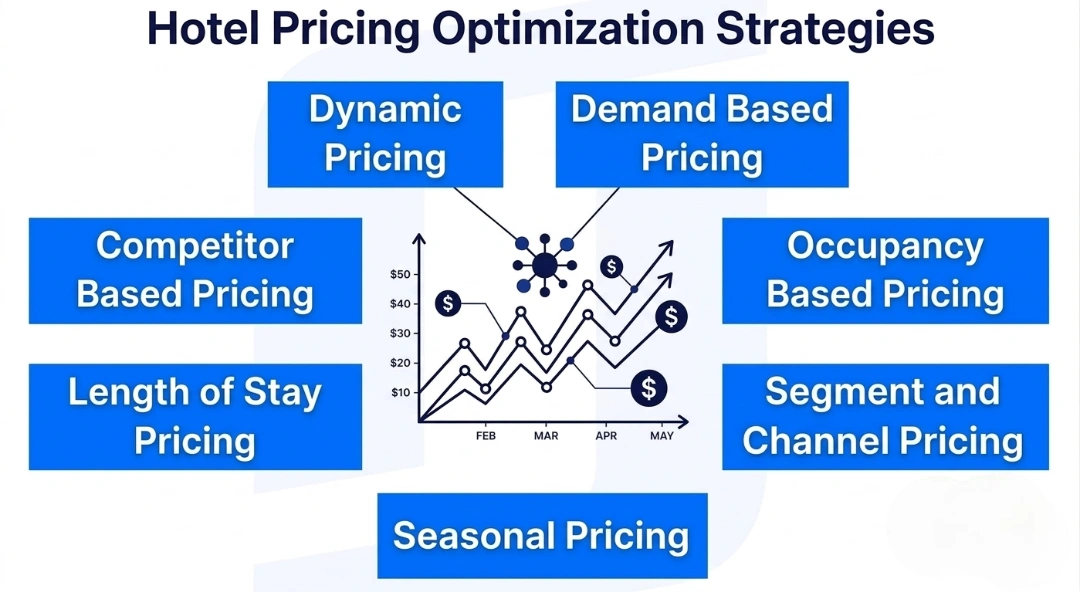
The most popular strategies are dynamic, demand based, competitor based, occupancy based, length of stay, segment, and seasonal pricing. Most hotels blend several.
Dynamic Pricing: Rates shift automatically as demand and competition change.
Demand Based Pricing: Prices rise on high demand dates and drop on soft ones.
Competitor Based Pricing: Rates track a chosen set of nearby hotels.
Occupancy Based Pricing: Prices climb as the hotel fills.
Length of Stay Pricing: Rates reward or require longer bookings.
Segment and Channel Pricing: Different rates for different guest types or platforms.
Seasonal Pricing: Baseline rates set for peak, shoulder, and low seasons.
The strongest results come from combining strategies, not picking one.
Benefits Of Hotel Price Optimization
Hotel price optimization increases revenue, lifts RevPAR, fills more rooms, and cuts manual work.
More Revenue On Busy Dates. You capture peak demand instead of underselling.
Fewer Empty Rooms On Slow Dates: You lower rates early to drive bookings.
Higher RevPAR: You balance rate and occupancy instead of chasing one.
Less Manual Work: Rates update without daily spreadsheet edits.
Fewer Missed Opportunities: No more forgetting a sold out event nearby.
Stronger Direct Revenue: Sharper rates reduce reliance on OTAs.
These gains come from rooms you already have. No renovation required.
How Price Optimization Supports Your Hotel Operations
Price optimization supports operations by giving the front desk confidence, freeing management time, and improving forecasting.
The front desk sells without second guessing the rate. Reservations trusts the number. Revenue holds without constant meetings.
It also returns time to owners and managers. They stop pricing by gut feel. That time goes back to guests and staff.
Clean pricing data sharpens forecasting too. You plan staffing and inventory around demand you can see.
Key Considerations For Hotel Pricing Optimization
Before optimizing rates, address data quality, rate limits, parity, guest perception, human oversight, and system integration.
Data Quality: Good rates need accurate, current data.
Rate Floors and Ceilings: Set limits so prices never go too low or too high.
Rate Parity: Keep pricing consistent across channels.
Guest Perception: Frequent swings can confuse loyal guests. Use rules to smooth them.
Human Oversight: Automation should follow your strategy, not replace it.
System Integration: Your pricing tool should connect to your PMS and channels.
Handle these and pricing becomes an asset, not a risk.
Common Hotel Pricing Mistakes To Avoid
The most common mistakes are chasing occupancy, copying competitors, and leaving rates static.
Chasing Occupancy Alone. A full hotel at a weak rate loses revenue.
Copying Competitors Blindly. Their costs and demand are not yours.
Setting Rates and Forgetting Them. Demand moves. Your price should too.
Ignoring Local Events. A sold out event nearby is money you can capture.
No Rate Floor. Prices should never fall below a level you choose.
Racing To The Bottom. Undercutting everyone trains guests to wait for lower prices.
One Rate For Every Channel. Each channel carries a different cost to serve.
Avoid these and your pricing stays profitable, not just busy.
How Price Optimization Software Streamlines Your Room Rates
Price optimization software streamlines pricing by tracking the market, recommending rates, and updating channels automatically. It removes the daily manual work.
A typical tool follows five steps:
Collect demand, competitor, and booking data.
Forecast occupancy and rate potential.
Recommend the best rate per date and room type.
Update your booking engine and OTAs automatically.
Learn from results and refine over time.
Choose tools that connect directly to your property management system. That is what turns pricing insight into action. A connected revenue management platform handles this end to end. {{cta-strip}}
Frequently Asked Questions
How Do I Optimize My Room Rates?
Track RevPAR, ADR, and occupancy for the past year. Map your seasons. Pick a competitor set. Set your rate floors and ceilings. Then add software that adjusts rates using live demand and market data.
What Are The Benefits Of Optimized Prices?
More revenue on high demand dates. Fewer empty rooms on slow ones. Higher RevPAR overall. Less time spent pricing by hand. And less dependence on OTA bookings.
Will Low Rates Hurt My Hotel?
No, when they follow rules. Lower rates fill rooms during soft periods. Set a floor rate you never drop below. Use length of stay rules and rate fences to protect value.
What Do You Need For Price Optimization?
Three things. Clean data on demand and competitors. Clear rate rules and limits. And a tool that connects to your PMS to push rates automatically.
What Is Hotel Price Intelligence?
It is the market data behind pricing. Competitor rates, demand trends, and event signals that inform your rate decisions.
Does Every Hotel Need Price Optimization?
Almost. Any property that sells on more than one channel benefits. Smaller independent hotels often gain the most, since owners rarely have time to price by hand.
What Is The Difference Between Price Optimization And Yield Management?
Yield management is the older, broader idea of adjusting price and availability together. Price optimization is the modern, data driven core of it, focused on the rate itself.
How Often Should Room Rates Change?
As often as demand moves, which can be daily. Automated tools adjust rates continuously with no manual work.
Mayela Lozano is a content strategist with a passion for hospitality and technology. She collaborates with roommaster on content creation, highlighting how technology can streamline hotel operations and enhance guest satisfaction. When she’s not creating content, Mayela loves to travel and spend time with her two little ones, discovering new adventures and making memories along the way.
Join Thousands of Hotels Thriving with roommaster
The transition to roommaster is straightforward and efficient. Our implementation team handles data migration including reservations, guest profiles, and historical information.
The transition to roommaster is straightforward and efficient. Our implementation team handles data migration including reservations, guest profiles, and historical information.
Hotel Check-In Kiosk: Enhance the Guest Experience
October 5, 2026
Hospitality Technology
Hotel Management
Hospitality Trends
Hotel Self Check-In: How It Works, Types, Benefits And Setup
October 1, 2026
Hotel Management
Hospitality Trends
Hotel Check-In & Check-Out Times Explained
October 1, 2026
Hospitality Trends
Hotel Management
Cloud-Based Property Management System: Hotel PMS
October 1, 2026
General
Cloud PMS
AI
Cloud Computing In The Hospitality Industry: A Complete Guide For Hotels
October 1, 2026
General
Best Hotels in Montreal: A Complete Guide
September 25, 2026
General
Best Hotels in Edmonton: A Complete Guide
September 25, 2026
General
Best Hotels in Banff: A Complete Guide
September 25, 2026
General
Best Hotels in Calgary: A Complete Guide
September 25, 2026
General
Best Hotels in Whistler: A Complete Guide
September 25, 2026
Join Thousands of Hotels Thriving with roommaster
See how roommaster's unified platform can work for your property. Our team will walk you through features tailored to your specific needs and operations.


.png)
.png)
.png)