Channel Manager vs PMS vs CRS: What Hotels Really Need
“roommaster is very easy with our channel management, our OTAs, the availability is updated right away. So there’s no delay, doesn’t cause any overbookings.” - Stacy Dadson, General Manager, Harrison Hall Hotel
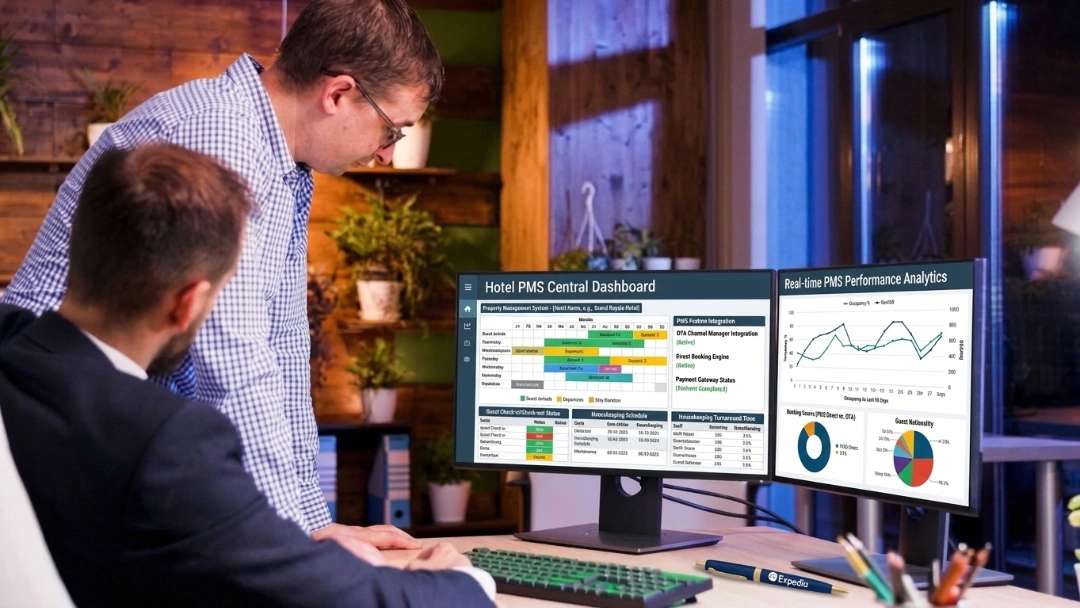
A PMS (Property Management System) is your operational core. It manages reservations, front desk, housekeeping, billing, and guest data inside your property.
A channel manager connects your inventory to OTAs and syncs rates and availability in real time across every distribution channel.
A CRS (Central Reservation System) centralises inventory and rate management across multiple properties or distribution networks. It is built for hotel chains and groups, not single-property independents.
Most independent hotels, boutique properties, motels, B&Bs, and resorts need a PMS and a channel manager. They do not need a standalone CRS.
When your PMS and channel manager are fully integrated in one platform, the distribution function of a CRS is already built in.
A channel manager, a PMS, and a CRS are three different hotel technology systems. Each does a distinct job. Confusing them leads to buying software you don't need or missing tools that would actually move the needle.
Most hotel owners and general managers have heard all three terms. Fewer know exactly what separates them. And almost nobody gets a straight answer on which combination their property actually needs without sitting through a sales pitch first.
What Is A PMS, Channel Manager And CRS?
Channel manager vs PMS vs CRS refers to three distinct hotel technology systems that manage different parts of how a hotel runs and sells rooms.
A PMS (Property Management System) is the software that runs your hotel's daily operations. Think of it as the system your front desk lives in every day: check-ins, reservations, housekeeping assignments, guest billing, and reporting all happen inside the PMS.
A channel manager is the distribution engine. It connects your hotel to OTAs like Booking.com, Expedia, and Airbnb and keeps your rates and availability in sync across all of them simultaneously. When a room is booked on one platform, every other platform updates instantly.
A CRS (Central Reservation System) is a centralised hub for managing room inventory, rates, and reservations across multiple properties or distribution networks at once. It was built for hotel chains and groups that need to coordinate rate strategy across dozens or hundreds of properties from a single platform.
Each system does a different job. They are not interchangeable. And for most independent properties, only two of the three are actually needed.
{{pms-two}}
Compare: Channel Manager vs PMS vs CRS
Feature
PMS
Channel Manager
CRS
Primary function
Manages daily hotel operations
Distributes inventory to OTAs and booking channels
Centralises inventory and rates across multiple properties
PMS systems at individual properties, GDS networks, OTAs
Who typically needs it
Independent hotels, Hotel chains, hotel management groups
Every hotel with OTA listings
Hotel chains, hotel management groups
Cost and complexity
Low to high depending on platform
Low to moderate
High, enterprise-level
Independent hotel verdict
Essential
Essential
Not required for single-property operators
What Does A Channel Manager, PMS And CRS Actually Do?
What Is PMS And How Does It Work?
A PMS manages everything that happens inside your hotel. Every interaction between your staff and the property runs through it.
When a guest calls to book, the PMS records the reservation. When they arrive, your front desk uses the PMS to check them in and assign a room. When housekeeping clears a room after checkout, the PMS updates its status to clean and available. When the guest settles their bill, the PMS processes the folio.
The PMS also holds your guest profiles, tracks stay history, generates occupancy and revenue reports, and connects with every other tool in your tech stack.
Without a PMS, all of this is manual. That means spreadsheets for availability, separate tools for billing, no automatic communication between systems. Errors compound. Overbookings happen. Staff spend hours on admin that should take minutes.
A modern cloud-based PMS eliminates that entirely. Hotels using roommaster's hotel property management system report 50% faster check-ins and 40% fewer admin tasks compared to their previous setups.
Stacie Dodson, General Manager at Harrison Hall Hotel, has run her 97-room property on roommaster for 25 years: "We evaluated a dozen systems, and nothing came close to how easy roommaster is to use. From managing bookings and rates to payments and guest communication, it's transformed how we run our entire operation."
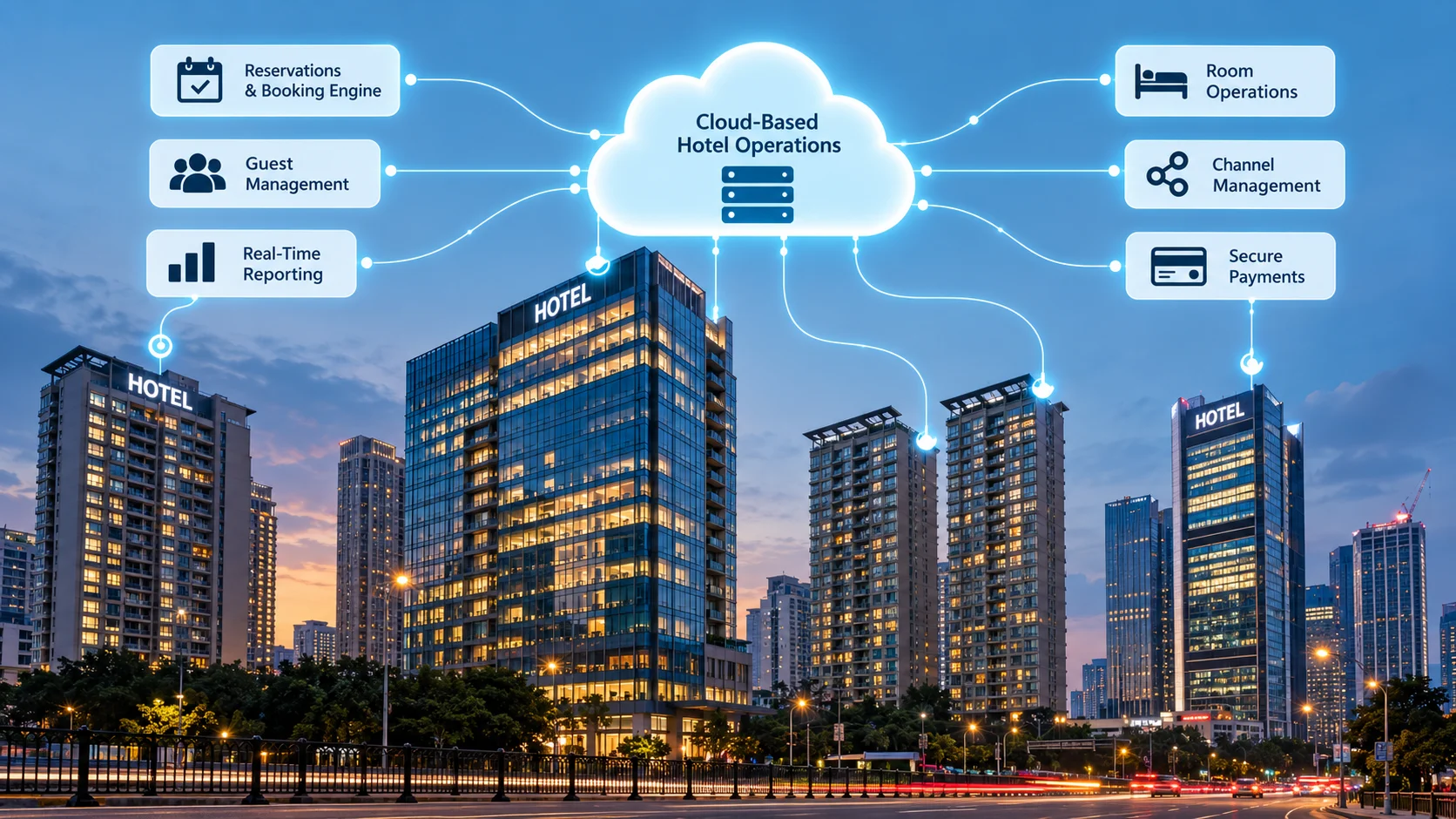
A channel manager connects your hotel's live inventory to every OTA you're listed on and keeps everything in sync, automatically, in real time.
Here's what happens without one. You list your property on Booking.com, Expedia, Airbnb, Hotels.com, and four other platforms. A booking comes in on Booking.com. You now need to manually log into each other platform and reduce availability. If you're a second too slow on one of them, another booking comes in for the same room on a different channel. You now have two reservations for one room and an overbooking problem.
A channel manager stops this entirely. It sits between your PMS and your OTA accounts. Rates and availability push out in real time from your PMS to every channel simultaneously. Incoming reservations from every OTA flow back into your PMS automatically.
This is what two-way sync means in practice: inventory and rates push out, reservations come back in, with no manual step required.
roommaster's channel manager connects to hundreds of OTAs and metasearch platforms including Booking.com, Expedia, Airbnb, Agoda, CTrip, Google Free Booking Links, and Trivago. Hotels using it report an 85% reduction in distribution management time. That is the difference between managing OTA updates manually across multiple logins and having the whole thing run automatically in the background.
One important distinction: a channel manager distributes your rooms to third-party OTAs. A booking engine takes direct bookings on your own website, commission-free. They are different tools serving different purposes. You need both to reduce OTA dependence while maintaining distribution breadth. The channel manager vs booking engine article covers how they work together.
What Is CRS And How Does It Work?
A CRS manages room inventory, rates, and reservations across multiple properties or large distribution networks from a single centralised platform.
The CRS originated with airline reservation systems and was adopted by hotel chains in the 1980s as a way to manage bookings across a large portfolio from one place. A chain with 50 properties across five countries needs a central hub where corporate revenue teams can update rates, push promotions, and manage distribution across the entire estate in one action. That is what a CRS does.
The CRS typically connects to GDS networks (Amadeus, Sabre, Travelport), which are the global distribution systems used by travel agents, corporate travel buyers, and airline loyalty programs. For chains that rely on corporate and travel agent bookings, GDS connectivity matters. For most independent hotels, those channels contribute a small fraction of total reservations.
Key CRS functions:
Centralised inventory and rate management across multiple properties
GDS connectivity for corporate and travel agent bookings
Group-level rate strategy and promotions applied across a portfolio
Brand website and loyalty platform integration for chain-level direct bookings
Multi-property reporting and demand forecasting at a corporate level
For a single independent hotel, none of these functions require a dedicated CRS. A properly integrated PMS and channel manager handles the same distribution job at the property level, without the enterprise cost or implementation complexity.
Channel Manager vs PMS vs CRS: Where Hotels Get Confused
The confusion between channel manager vs PMS vs CRS comes from three sources: overlapping marketing language, vendors selling products that replicate each other's functions, and jargon that sounds similar even when the systems do entirely different things.
Confusion 1: "PMS Channel Manager" Is A Single Term Some Vendors Use
Some providers market an integrated product as a "PMS channel manager," meaning a PMS with a built-in channel manager. This is actually the right setup for independent hotels. The confusion arises because other vendors sell a PMS and a channel manager as separate products requiring separate integrations. When the terminology shifts between providers, it's hard to know which combination you're actually buying.
Confusion 2: CRS And Channel Manager Both Involve "Distribution"
A CRS manages distribution strategy across a portfolio. A channel manager manages distribution to OTAs for a single property. Both deal with rates and availability across multiple channels, which is why the terms blur. But the scope is different. A channel manager is an operational tool your property uses daily. A CRS is a corporate layer that sits above individual properties.
Confusion 3: Some CRS Platforms Include A Channel Manager Module
Certain CRS providers bundle a channel manager into their product. When a hotel buys such a platform, they may believe they've purchased a standalone CRS when they've actually purchased a PMS-adjacent distribution tool. Reading beyond the label to understand which specific functions each component handles avoids this.
The Practical Test
one property, updating OTAs manually? You need a channel manager. Ten properties, applying rate strategy across all of them from one screen? You need a CRS.
One property, and someone is selling you a CRS? Ask them exactly what it does that a PMS and channel manager don't already handle. Nine times out of ten, the honest answer is: nothing you actually need.
A PMS with an integrated channel manager is the complete solution for most independent hotels. That's not a compromise. It's the right tool for the job.
Channel Manager vs PMS vs CRS: The Core Difference
Channel manager vs PMS vs CRS maps clearly onto three different layers of how a hotel operates.
1. The PMS Is Internal
It runs what happens inside your property. Reservations, front desk, housekeeping, payments, and reporting are all internal operations. Your guests never interact with your PMS directly. Your staff do, constantly.
2. The Channel Manager Is External Distribution At The Property Level
It connects your internal inventory to the external booking world. It's the bridge between what your PMS knows about your availability and what every OTA shows to potential guests. It operates at the property level.
3. The CRS Is External Distribution At The Group Level
It does the same job the channel manager does for a single property, but across a portfolio of properties and across distribution networks that go beyond OTAs, into GDS and brand platforms. It operates at the chain level.
Put simply:
PMS: inside the hotel
Channel manager: hotel to OTAs, single property
CRS: hotel group to all distribution networks, multiple properties
For a single-property independent hotel, the PMS and channel manager together cover everything the CRS would add. The CRS becomes a justified investment when the multi-property coordination problem actually exists.
The hotel reservation management software page shows how roommaster handles reservation control across both property operations and distribution from a single platform.
{{booking-engine-one}}
Do Independent Hotels Need A CRS?
Most independent hotels do not need a standalone CRS.
A CRS was built to solve a specific problem at scale: coordinating rate strategy and inventory distribution across many properties at once. When you're managing 100 hotels in 20 countries, you cannot handle each property's distribution manually. A CRS gives your corporate revenue team one place to push rate changes, promotions, and restrictions across the entire estate. That's the problem it solves.
A 60-room independent hotel in one location doesn't have that problem. It has one set of rooms, one set of rates, and one property to manage. The PMS holds the live inventory. The channel manager distributes it to OTAs in real time. The booking engine captures direct bookings commission-free. That combination handles everything a CRS would provide at the property level, without the complexity or the enterprise cost.
The scenario where an independent hotel genuinely benefits from a CRS is specific: if the property works heavily with corporate travel buyers via GDS and wants to manage GDS connectivity, rate loading, and corporate contract management separately from their OTA distribution, a CRS built for that function adds value. That is a minority use case.
For the vast majority of independent hotels, boutique properties, motels, B&Bs, and resorts, the question isn't whether to buy a CRS. The question is whether the PMS and channel manager they already have are properly integrated and whether their booking engine is capturing direct bookings at a meaningful rate. Those are the gaps that actually affect revenue.
For hotel groups managing multiple properties, the calculation changes. roommaster's hotel groups platform covers how multi-property management works in practice, including centralised rate control across properties without requiring a separate CRS investment.
What Hotel Tech Stack Does Your Property Actually Need?
The right combination depends on your property type and the problems you're actually trying to solve.
1. Single Independent Hotel, Motel, B&B, Boutique Resort
You need three tools working as one integrated system:
A cloud PMS to manage reservations, front desk, housekeeping, payments, and reporting. This is the non-negotiable foundation. Everything else connects to it.
A channel manager to distribute your inventory to OTAs in real time and pull incoming bookings back automatically. If you're listed on more than two OTAs and updating them manually, you're already overdue for a channel manager.
A booking engine on your own website to take commission-free direct bookings. Every booking that goes through an OTA costs you a commission of typically 15 to 25 percent. A booking engine is how you capture the same guest directly.
These three together give you operational control, full distribution reach, and a direct booking channel. No CRS needed.
2. Hotel Group Or Multi-Property Operator
Everything above at each individual property, plus a way to manage rates, inventory, and reporting across all properties from one place. For groups of 5 to 20 properties, a PMS with multi-property capabilities handles this without a separate CRS layer. The group management function is built into how the PMS handles portfolio-wide rate control.
3. Revenue Focused Properties
If RevPAR and ADR optimisation are priorities beyond what manual rate management can deliver, adding AI-powered revenue management on top of your PMS and channel manager allows you to automate rate decisions based on occupancy patterns, competitor pricing, and demand signals in real time. This is a different function from a CRS and a more impactful investment for most independent hotels. The best hotel revenue management software guide covers what that looks like in practice.
Independent Hotels That Don't Need Right Now
You don't need a CRS if you operate a single property, regardless of size. You don't need a CRS if all your bookings come through OTAs, direct, and your own website. You don't need a CRS if you have a PMS with a native integrated channel manager. Adding a CRS in any of those situations adds cost, complexity, and a third vendor to coordinate without adding anything your existing stack doesn't already handle.
roommaster Does All Of This In One Platform
If you're managing a hotel manually across multiple OTA logins, or running a PMS and channel manager from two different vendors that don't always talk to each other cleanly, that's the problem roommaster was built to fix.
roommaster gives independent hotels and hotel groups a single platform that includes the PMS, channel manager, booking engine, and payments all built together with native integration from day one. No middleware. No separate logins. No API maintenance costs.
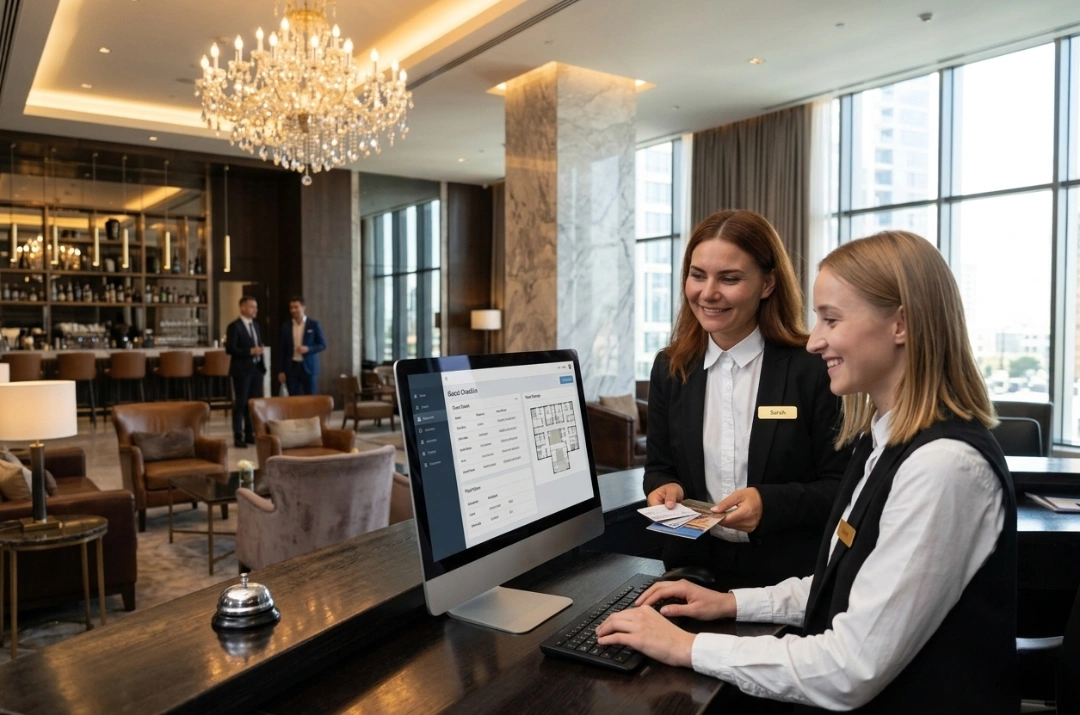
When a booking arrives on Expedia, it's in your PMS in seconds. When you update a rate in your PMS, it's live on every connected OTA immediately. Your front desk sees what's live on every channel in real time, from the same screen they use to check guests in.
The channel manager connects to hundreds of OTAs and metasearch platforms including Booking.com, Expedia, Airbnb, Agoda, Google Free Booking Links, TripAdvisor, TripConnect, and Trivago. Hotels running roommaster report an 85% reduction in distribution management time. That is not a theoretical benefit. It's the difference between managing OTA availability manually across a dozen platforms and not having to think about it at all.
Ryan Allison, owner of Wood River Inn, saw a 57% increase in direct bookings and saves four hours every day through the platform: "I don't have to worry about back-office stuff. We can worry about selling hotel rooms."
For single properties patching together separate tools for reservations, distribution, and direct bookings, roommaster's independent hotel software brings all of that into one platform.
For groups that need centralised rate and inventory control across multiple properties, roommaster's hotel groups platform handles that from a single login.
When you're ready to see it running on a property like yours, a personalised demo is the fastest way to get there.
{{cta-strip}}
FAQs
What is the difference between a channel manager and a PMS?
A PMS manages your hotel's internal operations: reservations, check-in, housekeeping, billing, and guest data. A channel manager manages external distribution, connecting your inventory to OTAs and syncing rates and availability in real time across every channel. They serve different functions and most hotels need both.
Do small and independent hotels need a CRS?
No. A CRS is designed for hotel chains and groups managing inventory across multiple properties. A single-property hotel with a PMS and an integrated channel manager already has the distribution capability a CRS would add, without the enterprise cost or complexity.
Is a channel manager the same as a CRS?
No. A channel manager connects one property to OTAs and keeps rates and availability in sync. A CRS manages inventory, rates, and reservations across multiple properties and distribution networks including GDS. Both deal with distribution, but they operate at different scales and for different types of operators.
What does a CRS do in a hotel?
A CRS centralises room inventory, rate management, and reservations across multiple properties or distribution networks. It's primarily used by hotel chains and management groups to coordinate rate strategy and distribution across a portfolio from one hub. Individual properties within the group still each run their own PMS for daily operations.
Can a PMS replace both a channel manager and a CRS?
A PMS with a built-in channel manager replaces the need for a separate channel manager. For a single-property independent hotel, that combination also replaces the need for a standalone CRS. For a hotel chain or group that needs multi-property rate coordination across GDS networks and brand platforms, a CRS still serves a purpose that a property-level PMS and channel manager don't fully cover.
pms-two
Hotel Operations Made Simple and Effective with roommaster
Mayela Lozano is a content strategist with a passion for hospitality and technology. She collaborates with roommaster on content creation, highlighting how technology can streamline hotel operations and enhance guest satisfaction. When she’s not creating content, Mayela loves to travel and spend time with her two little ones, discovering new adventures and making memories along the way.
Join Thousands of Hotels Thriving with roommaster
The transition to roommaster is straightforward and efficient. Our implementation team handles data migration including reservations, guest profiles, and historical information.
The transition to roommaster is straightforward and efficient. Our implementation team handles data migration including reservations, guest profiles, and historical information.
Hotel Check-In Kiosk: Enhance the Guest Experience
October 5, 2026
Hospitality Technology
Hotel Management
Hospitality Trends
Hotel Self Check-In: How It Works, Types, Benefits And Setup
October 1, 2026
Hotel Management
Hospitality Trends
Hotel Check-In & Check-Out Times Explained
October 1, 2026
Cloud PMS
Cloud PMS vs On-Premise PMS: A Complete Comparison For Hotels
October 1, 2026
Hospitality Trends
Hotel Management
Cloud-Based Property Management System: Hotel PMS
October 1, 2026
General
Cloud PMS
AI
Cloud Computing In The Hospitality Industry: A Complete Guide For Hotels
October 1, 2026
Hotel Management
Cloud PMS
Hotel Management System (HMS): A Complete Guide
September 23, 2026
Hospitality Trends
Hotel PMS
Cloud PMS
Hotel PMS Integration: How It Works for Hotels
September 23, 2026
Hospitality Trends
Hospitality Technology
Hotel PMS
Hotel Management
Cloud PMS
How Hotel PMS Software Transforms Hospitality Management
September 23, 2026
Hotel Management
Marketing
Pet-Friendly Hotel Amenities & Package Ideas That Drive Revenue
September 22, 2026
Join Thousands of Hotels Thriving with roommaster
See how roommaster's unified platform can work for your property. Our team will walk you through features tailored to your specific needs and operations.





.png)
.png)
.png)