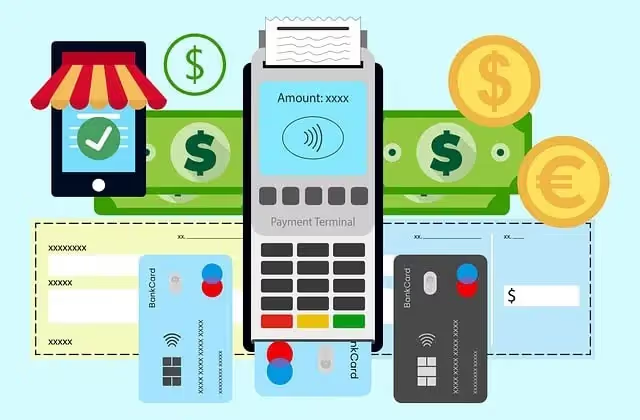
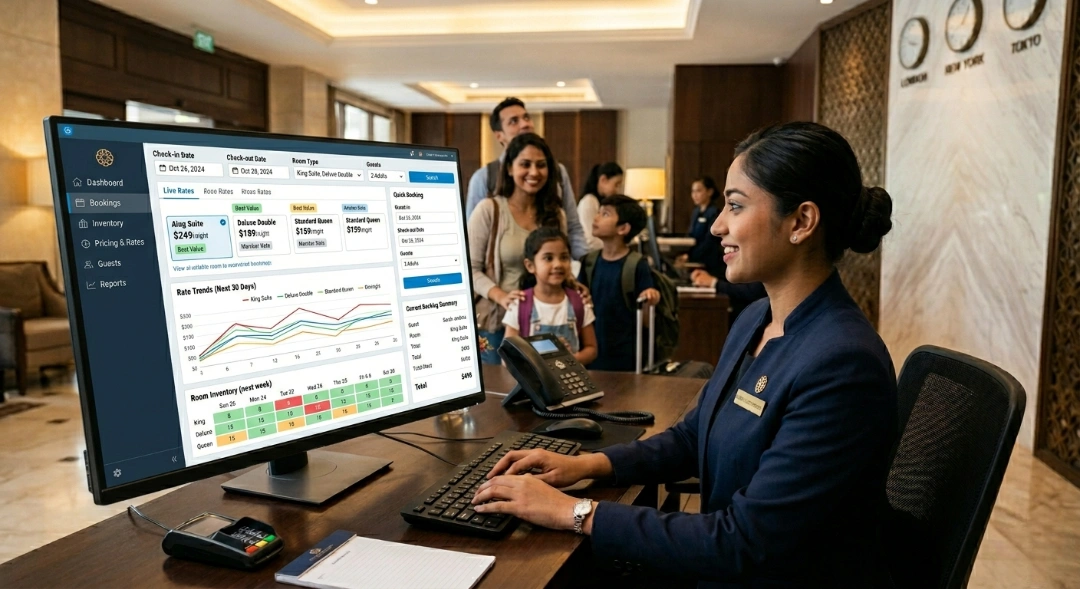
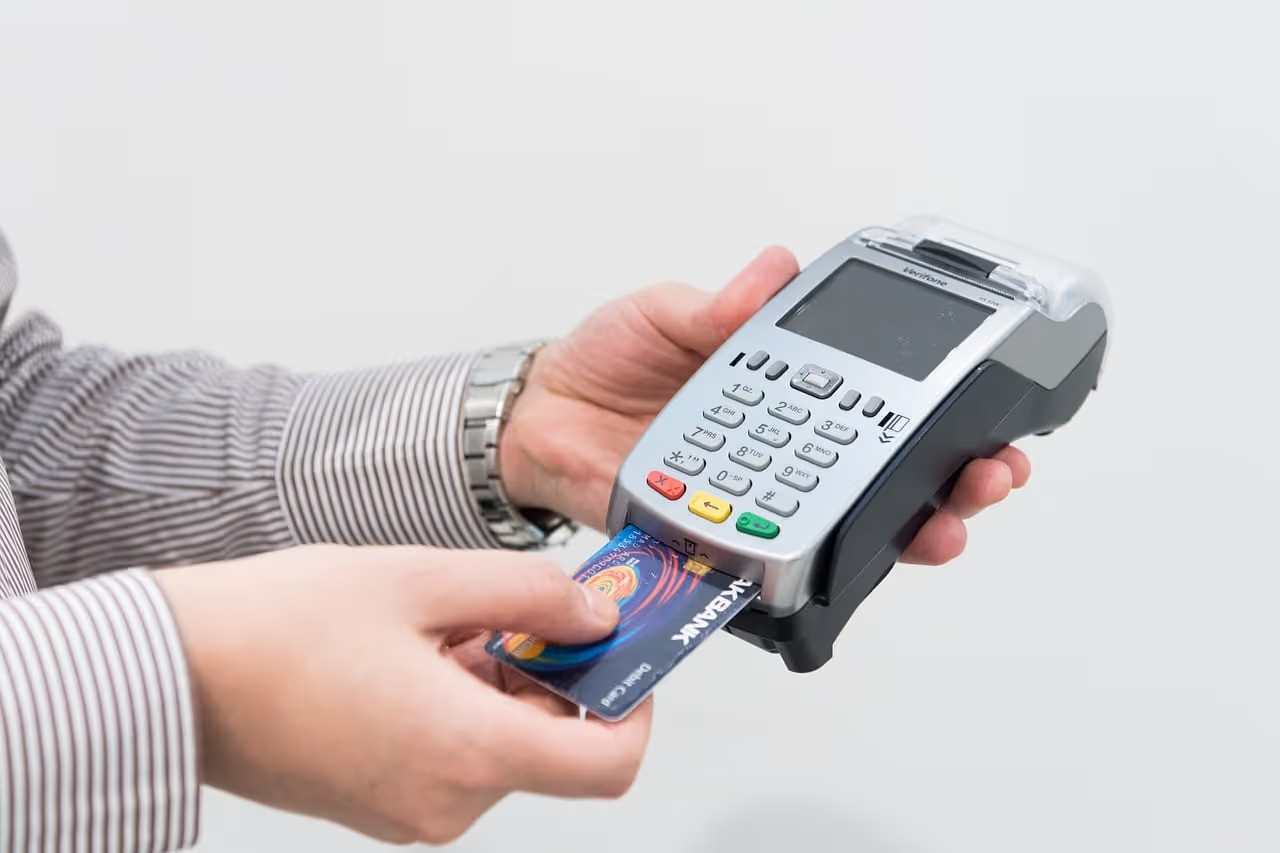
Everything hoteliers need to know about hotel payment gateways in 2026: how they work, the types and fees, the payment methods guests expect, and how to choose a secure, PMS-ready gateway for your property.
What it is: a hotel payment gateway is the secure layer that authorizes, encrypts, and processes every guest transaction in real time.
How it works: capture and encrypt card data, authorize with the network and bank, then sync the paid amount to the folio and reservation.
What guests expect in 2026: cards, digital wallets like Apple Pay and Google Pay, contactless, buy now pay later, and multi-currency options.
What it costs: processing fees generally run 1.5% to 3.5% per card transaction, and chargebacks carry real cost on top, so total cost matters more than the headline rate.
What keeps it safe: PCI-DSS compliance, tokenization, 3D Secure, and PSD2 support.
How to choose: prioritize PMS integration, transparent pricing, security, and the payment methods your guests use.
What Is A Hotel Payment Gateway?
A hotel payment gateway is a secure technology tool that connects a hotel's booking engine or property management system to payment networks to authorize and process guest transactions in real time. When a guest books online, they enter their payment details, and the payment gateway facilitates the transaction instantly.
Think of the gateway as the secure messenger. It captures and encrypts card and digital wallet data, sends payment instructions to the card network and issuing bank, returns the approval status, and links the paid amount directly to the guest folio and reservation record. The strongest hotel payment gateways are embedded in the PMS, so the entire cycle runs with a single click at any point in the guest journey.
Hotel Payment Gateway Vs Payment Processor Vs Acquirer
These three terms get used interchangeably, but they do different jobs. Getting them straight makes it far easier to compare a hotel payment gateway against a full hotel payment processing setup.
Payment gateway: the technology that securely captures and transmits card data and requests authorization. This is the guest-facing and PMS-facing layer.
Payment processor: the service that routes the transaction between the card networks and banks and moves the money.
Acquiring bank: the bank that holds your merchant account and deposits settled funds into your business account.
Some providers do only one of these. Others, including roommaster hotel payment gateway software, bundle the gateway and processing into one experience, so you deal with a single partner instead of stitching several vendors together.
How A Hotel Payment Gateway Works
Every hotel transaction runs through the same core steps, whether the guest is booking online at midnight or checking out at the front desk.
Data transmission: the gateway securely captures and encrypts the credit card or digital wallet data during the online booking or on-site checkout.
Authorization: it sends the payment instructions to the card network and issuing bank, which approves or declines, then returns the status to the hotel.
Pre-authorization and deposits: for future stays, the gateway can place a hold or schedule a deposit according to your cancellation policy, then capture the balance at the right time.
PMS syncing: it automatically links the paid amount to the guest folio and reservation record, so there is no manual re-keying.
Settlement: the acquiring bank moves the funds into your account, typically within one to three business days, minus processing fees.
When the payment gateway lives inside the hotel PMS system, these steps are automatic. When it does not, staff often re-enter card details by hand, which is slower and riskier.
{{payments-cta}}
How Does Hotel Credit Card Processing Actually Work?
Hotel credit card processing is the same authorization-to-settlement flow above, viewed from the money's point of view. At booking or checkout, the guest's card is authorized. Charges are then scheduled and collected according to your cancellation and deposit policy. At each step, the payment gateway handles the secure transmission of card details to the bank for approval, and the acquiring bank settles the approved funds into your account. Card-present payments at the desk and card-not-present payments online follow the same path, though card-not-present transactions carry slightly higher fees and fraud risk.
The Hotel Payment Methods Guests Expect In 2026
Guests now decide where to book partly on how they can pay. Offer too few options and you lose bookings to friction. The methods that matter most in 2026 are:
Credit and debit cards: still the backbone, including Visa, Mastercard, Discover, and American Express.
Digital wallets: Apple Pay, Google Pay, and Samsung Pay remove the need to type card details and lift direct-booking conversion.
Contactless and mobile payments: tap-to-pay at the front desk and across outlets.
Buy now, pay later: installment options are growing fast, especially for higher-value and longer-lead bookings.
Multi-currency and regional methods: let international guests pay in their own currency with transparent conversion.
Virtual credit cards: for OTA and travel-agent bookings that settle by VCC.
The pattern is clear: guests expect choice, and a hotel payment gateway that supports the methods their guests already use captures more direct revenue.
{{pms-one}}
What Are The Main Types Of Hotel Payment Gateway Systems?
Not all gateways are set up the same way. Most fall into a few models, and the right one depends on how much you want to manage yourself.
Embedded (PMS-integrated) gateways: built directly into the property management system, so payments, folios, and reservations share one platform. This is the lowest-friction option for hotels.
Third-party (standalone) gateways: a separate payment provider connected to your PMS or booking engine through an integration. Flexible, but you manage two relationships.
Hosted gateways: the provider hosts the payment page and handles card data, which reduces your PCI scope.
On-site and online acceptance: terminal and card-present acceptance at the desk, plus online and pay-by-link acceptance for remote payments. The best systems cover both under one provider.
Who Are The Key Players In Hotel Payment Processing?
The hotel payments market ranges from embedded PMS payments to global enterprise processors. The main categories you will encounter are hospitality-native embedded payment gateways and dedicated hospitality processors (such as roommaster Payments)
For a side-by-side comparison of these providers with verified ratings, pricing models, and who each one fits, see our guide to the best hotel payment gateway for 2026.
A hotel payment gateway is secure technology that connects your booking engine or property management system to card networks so guest transactions can be authorized and processed in real time. It captures and encrypts card or wallet data, sends it to the card network and bank for approval, and posts the result to the guest folio.
The best hotel payment gateway is embedded in your PMS, so deposits, pre-authorizations, and postings happen automatically with a single click, which is the heart of smooth hotel payment processing.
Key Benefits Of A Hotel Payment Gateway
A well-chosen hotel payment gateway pays for itself in saved time and fewer failed transactions.
Faster operations: automates deposits, speeds up check-in and check-out, and reduces front desk workload.
Enhanced security: protects sensitive financial data using tokenization and maintains PCI-DSS compliance.
Flexible payments: supports credit cards, contactless mobile wallets, and regional payment methods.
Better guest experience: guests pay the way they want, in their own currency, at any point in their stay.
Cleaner reporting: every charge ties back to a reservation, which makes revenue tracking and audits simpler.
{{pms-two}}
Hotel Payment Gateway Fees And Chargebacks
Fees are where hotels quietly lose margin, so it helps to know the parts.
Interchange fees: the base cost set by card networks, generally between 1.5% and 3.5% per transaction depending on card type and how the payment is taken.
Pricing models: flat-rate pricing is simple but often costs more, while interchange-plus pricing is more transparent and can save higher-volume properties meaningfully over a year.
Chargebacks: when a guest disputes a charge, the hotel usually loses without clear records. Itemized receipts and documented authorizations are your best defense, and industry estimates put the all-in cost of a single chargeback in the hundreds of dollars once fees and lost revenue are counted.
Cross-border and currency markups: international cards and conversions add cost, so factor them into any comparison.
Compare the full cost of hotel payment processing, including chargebacks and currency markups, not just the headline rate.
What Are The Biggest Security Considerations For Hotel Payment Processing?
Hotels store card data across bookings, deposits, and long stays, which makes them a target. A few controls do most of the protecting.
PCI-DSS compliance: the standard that governs how card data is stored, processed, and transmitted. A hotel payment gateway that handles card data for you reduces your compliance burden.
Tokenization: replaces stored card numbers with secure tokens that have no value if stolen, using either vault or network tokenization.
Encryption: protects card data in transit from the moment it is captured.
3D Secure and PSD2: strong customer authentication that verifies the cardholder and shifts liability on many disputes.
Reduced PCI scope: hosted payment pages and embedded gateways keep raw card numbers off your own systems.
How To Choose The Right Hotel Payment Gateway
Weigh providers on what actually affects your operation, not just the rate.
PMS and booking engine integration: does it embed in your systems so deposits and folios post automatically?
Total cost of processing: transaction fees, pricing model, cross-border markups, and chargeback handling.
Security and compliance: PCI-DSS, tokenization, 3D Secure, and PSD2 support.
Guest payment experience: the cards, wallets, and currencies your guests expect.
Support and reliability: hospitality-aware support and uptime, since a payment outage stops check-ins.
Scale: whether it fits your property size today and as you add rooms or properties.
When you are ready to compare named options, our best hotel payment gateway guide ranks the leading providers for 2026.
Run Every Payment Inside Your PMS
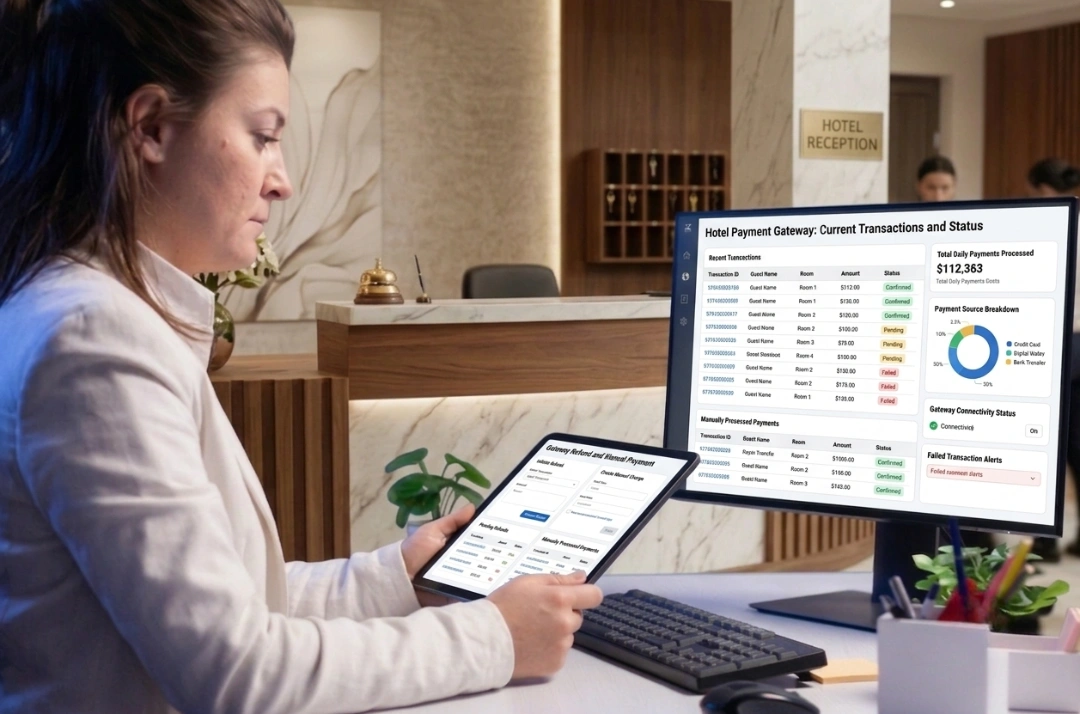
The simplest way to remove payment friction is to stop treating payments as a separate system. Because roommaster Payments is a hotel payment gateway embedded in the roommaster hotel PMS system, deposits, pre-authorizations, and folio postings happen automatically, so your team can focus on guests instead of reconciling cards. It brings secure, PCI-DSS-compliant processing, tokenization, multi-currency, and chargeback management into the same platform you already run the property on.
{{cta-strip}}
Frequently Asked Questions
1. What is a hotel payment gateway?
A hotel payment gateway is a secure technology tool that connects a hotel's booking engine or property management system to payment networks so guest transactions can be authorized and processed in real time. It captures and encrypts card and wallet data, gets approval from the bank, and links the payment to the reservation.
2. What is hotel payment processing?
Hotel payment processing is the end-to-end journey that moves a guest's payment from their card into the hotel's bank account. It involves the payment gateway, the processor, and the acquiring bank working together to authorize the payment, secure the data, and settle the funds, usually within one to three business days.
3. What is the difference between a payment gateway and a payment processor?
The gateway is the technology that securely captures card data and requests authorization, while the processor routes the transaction between card networks and banks and moves the money. Some providers, including roommaster Payments, combine both so you work with a single partner.
4. How much does a hotel payment gateway cost?
Costs depend on your card mix, transaction volume, and pricing model. Interchange fees generally run 1.5% to 3.5% per transaction, and providers use flat-rate, interchange-plus, or quote-based models. The lowest total cost comes from comparing full processing costs, including chargebacks and currency markups.
5. Is hotel payment processing secure?
Yes, when you use a reputable hotel payment gateway. Secure processing relies on PCI-DSS compliance, tokenization of stored cards, encryption in transit, and strong customer authentication such as 3D Secure and PSD2, which together keep sensitive card data protected.
6. Which hotel payment gateway is best?
The best gateway is the one that integrates most deeply with your systems and supports the payment methods your guests use. For properties on roommaster, roommaster Payments is the most integrated option. For a full comparison, see our guide to the best hotel payment gateway for 2026.
Mayela Lozano is a content strategist with a passion for hospitality and technology. She collaborates with roommaster on content creation, highlighting how technology can streamline hotel operations and enhance guest satisfaction. When she’s not creating content, Mayela loves to travel and spend time with her two little ones, discovering new adventures and making memories along the way.
Join Thousands of Hotels Thriving with roommaster
The transition to roommaster is straightforward and efficient. Our implementation team handles data migration including reservations, guest profiles, and historical information.
The transition to roommaster is straightforward and efficient. Our implementation team handles data migration including reservations, guest profiles, and historical information.
Best Hotel Billing Software: Streamlining Financial Operations
August 17, 2026
Hotel Management
Payment Processing
Hotel Folio Explained: Meaning & Invoice Differences
February 26, 2026
Hotel Management
Payment Processing
11 Best Dynamic Pricing Software for Hotels in 2026 (AI & RMS Compared)
November 10, 2025
Hotel Management
Payment Processing
Top 11 Best Practices For Hotels To Avoid Chargebacks Disputes
March 18, 2025
Hospitality Trends
Hospitality Technology
Hotel Management
Online Bookings
Payment Processing
roommaster PMS Software: Features & Pricing & Reviews (2026)
August 11, 2022
Payment Processing
What is EMV?
December 15, 2020
Hospitality Trends
Data Management
Payment Processing
What Does The EMV Liability Shift Mean For Your Property?
January 24, 2019
Join Thousands of Hotels Thriving with roommaster
See how roommaster's unified platform can work for your property. Our team will walk you through features tailored to your specific needs and operations.


.png)
.png)
.png)