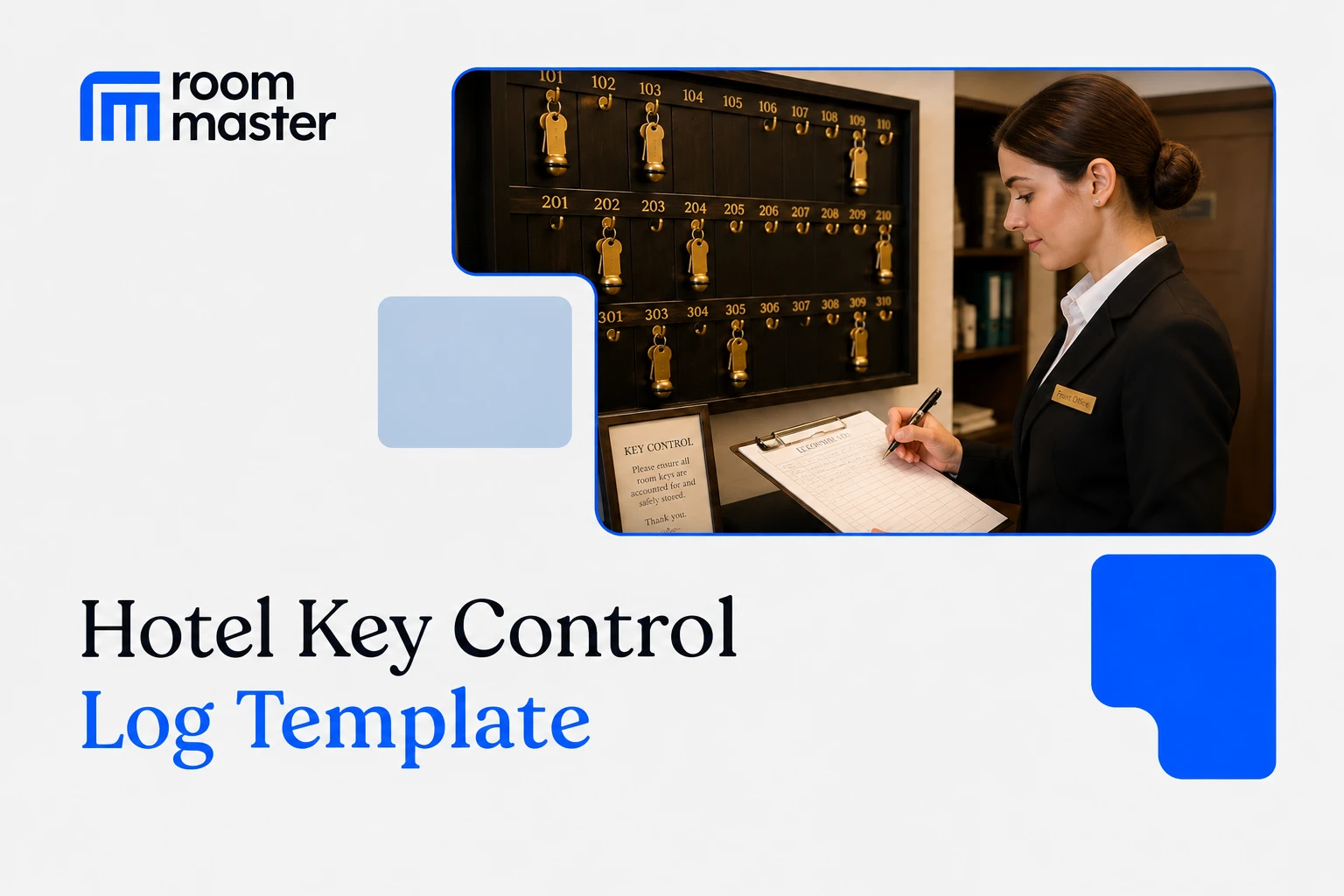
Who this is for: front office managers, housekeeping leads, security, and duty managers at independent hotels, hotel groups, motels, resorts, parks, and hostels that control physical keys and electronic key cards.
Key control is about one thing: knowing who holds every key and getting it back. This template gives you a key-type legend, a sign-out log, a daily housekeeping sign-out, a contractor loaner process, and the steps for a lost key and a key audit. Copy the log, set who can hold each key type, and run the audit on a schedule.
What You Get
- A key-type legend from grand master down to a single room key or card
- A key sign-out and return log with signatures at issue and return
- A daily housekeeping key sign-out and end-of-shift reconciliation
- A contractor and vendor loaner process with a return time
- Lost-key steps and a periodic key audit, plus downloadable PDF and Word files
The Key-Type Legend
Control access by key type. The higher the key sits, the fewer people should ever hold it.
| Key type | What it opens and who holds it |
|---|---|
| Grand master | Every guest room and most back-of-house doors; issue only to senior management |
| Master | A block of rooms, such as a floor or section, for supervisors |
| Submaster or section | One housekeeper's or one section's assigned rooms |
| Room key or key card | A single guest room; issued to the guest at check-in |
| Emergency or double-lock | Overrides the deadbolt for emergencies; control tightly and log every use |
| Back-of-house and equipment | Storerooms, offices, safes, and equipment; sign out by role |
The Key Control Log
Every key that leaves the board gets a row. Sign it out, sign it in, and never pass a key hand to hand.
| Column | What to record |
|---|---|
| Key ID and type | The key number or tag and its type from the legend |
| Door or area | The room, zone, or area the key opens |
| Issued to and department | The name and department of the person taking the key |
| Date and time out | When the key was issued, with the recipient's signature |
| Date and time in | When the key was returned, with a sign-in and any note |
Daily Housekeeping Key Sign-Out
- Issue by name: sign out each housekeeping master to a named attendant and record the exact key number.
- Check condition: confirm the key and any clip or lanyard are intact at issue.
- Return before clock-out: require every master back before the attendant leaves.
- Reconcile the board: confirm all issued keys are back at shift end, and escalate any no-return immediately.
Contractor and Vendor Loaners
- Verify and authorize: confirm the vendor, the work order, and manager authorization before issuing.
- Record the details: log the company, technician name, and a contact number.
- Limit access: issue only the keys the job needs, not a master, where possible.
- Set a return time: note the expected return, collect and sign the key back in, and flag any overdue loaner.
Lost Keys and the Key Audit
- Record the loss: log the key ID, who held it, and when and where it went missing.
- Act without delay: rekey the affected locks or deactivate the key card, and notify security and management.
- Count the board: check every key against the master key list, and reconcile each signed-out key by name.
- Log and sign the audit: record the result, the date, and the auditor's signature.
Common Mistakes to Avoid
- Passing keys between staff. Every key should return to the board, not move hand to hand off the log.
- Issuing a master when a room key would do. Give the least access the job needs.
- No signature at return. Without a sign-in, you cannot prove a key came back.
- Delaying a rekey or deactivation. A lost key is a live security risk until the lock is changed or the card is killed.
- Never auditing the board. Keys drift without a periodic count against the master list.
Stop Tracking Keys on a Clipboard
A key control log keeps physical keys accountable, but a clipboard on a hook only works if everyone signs it. With roommaster working alongside your electronic lock system, guest key cards are encoded from the reservation and can be deactivated the moment a card is reported lost, so room access stays tied to the right guest without rekeying a floor. The log handles your physical keys, and roommaster keeps guest access under control. See how it works on the roommaster platform.
Frequently Asked Questions
1. What is key control in a hotel?
Key control is the system for issuing, tracking, and recovering every key and key card, from the grand master down to a single room. It records who holds each key, requires a signature at issue and return, and includes lost-key steps and a regular audit.
2. What should a key control log record?
The key ID and type, the door or area it opens, who took it and from which department, the date and time out with a signature, and the date and time in with a sign-in. Every key that leaves the board gets a row.
3. What happens when a master key is lost?
Record the loss, then rekey the affected locks or deactivate the card without delay, and notify security and management. A lost master is a live risk to every room it opens until the locks are changed.
4. How often should you audit hotel keys?
Count the board against the master key list on a set schedule, often weekly for masters and at every shift change for housekeeping keys. Reconcile each signed-out key by name and sign off the audit.


