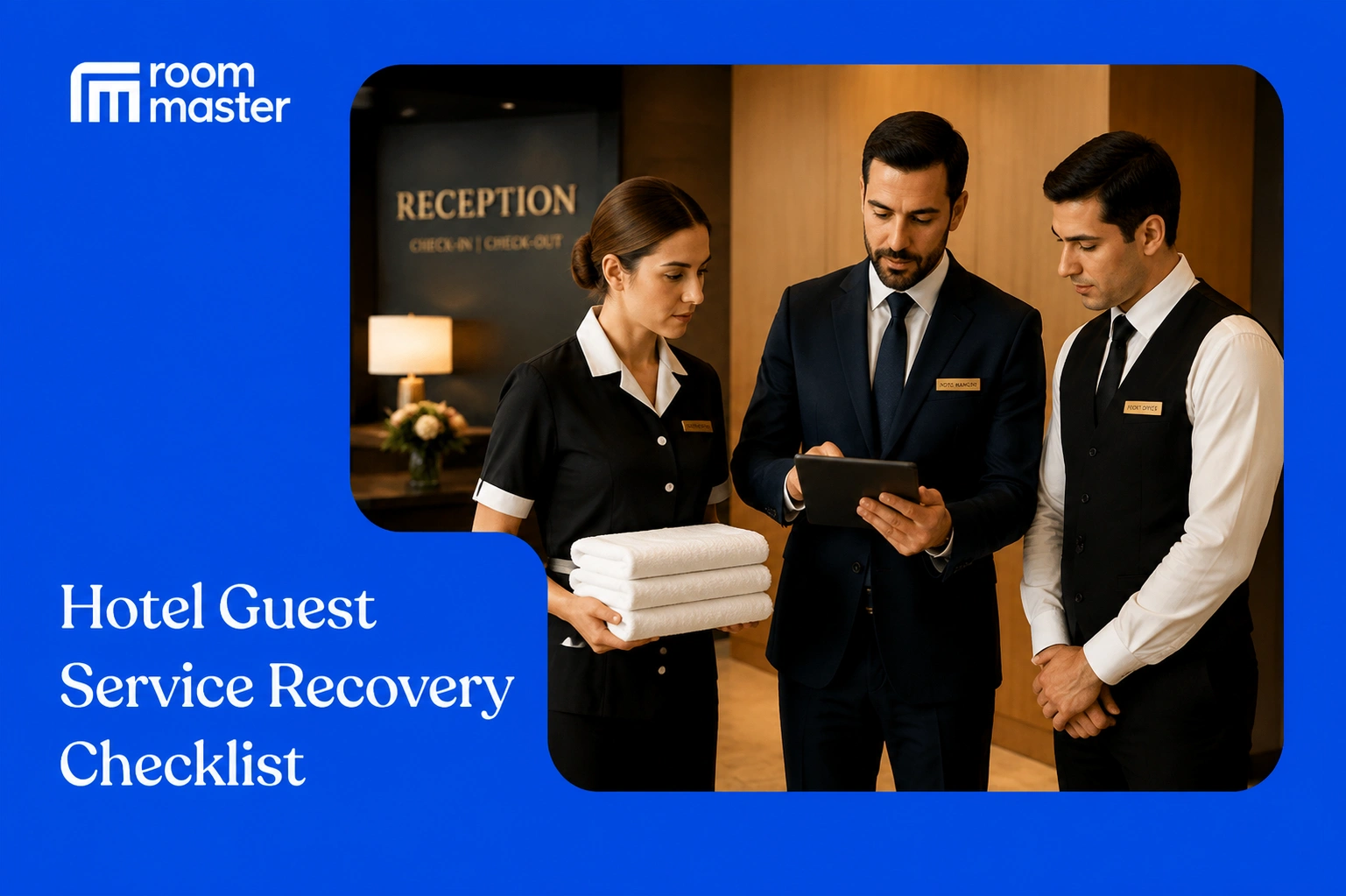
Who this is for: front desk agents, guest relations staff, and shift managers at independent hotels, hotel groups, motels, resorts, B&Bs, parks, and hostels who need a consistent way to turn a guest complaint into a resolved, documented case.
A service recovery checklist walks staff through a complaint from the moment a guest raises it to the moment the case is closed. This one follows the LEARN model: Listen, Empathize, Log details in the intake phase; Apologize, Respond, Notify to act on it; then Verify, Compensate, and Close to follow up properly. Working the three phases in order keeps recovery consistent no matter who is on shift.
The Short Version: What's In This Checklist
- A 3-phase, 9-step workflow: Intake and Triage, Action and Resolution, Follow-Up and Closure
- Exact fields to log for every complaint: room number, problem, time, staff member involved
- A clear response time target to quote the guest during resolution
- A compensation log so vouchers, discounts, and amenities are tracked, not handed out ad hoc
- A satisfaction check-back step before the case is marked closed
- A shift handover step so the next team is not caught off guard by an open case
Phase 1: Intake and Triage
The first three steps set up everything that follows. Get these right and the rest of the recovery is straightforward.
| Step | Action |
|---|
| 1 | Listen: let the guest explain the full problem without interrupting; keep calm body language and eye contact |
| 2 | Empathize: acknowledge the frustration sincerely and use the guest's name |
| 3 | Log details: record the room number, exact problem, time, and staff member involved in the complaint log |
Phase 2: Action and Resolution
This is where the complaint actually gets fixed, not just acknowledged.
| Step | Action |
|---|
| 4 | Apologize: give a clear, professional apology for the breakdown in service without making excuses |
| 5 | Respond: take ownership, fix the physical issue or coordinate with maintenance/housekeeping, and quote a clear time target (for example, resolve within 10 to 20 minutes) |
| 6 | Notify: update the department head or manager on duty if compensation or escalation is required |
Phase 3: Follow-Up and Closure
Skipping this phase is the single most common reason guests feel a complaint was never really resolved.
| Step | Action |
|---|
| 7 | Verify satisfaction: call or visit the guest within 30 minutes of the fix to ensure the issue is completely resolved |
| 8 | Compensate: document any vouchers, discounts, or amenities provided in the compensation log |
| 9 | Close case: update the guest profile history and brief the next shift during handover |
Where Recovery Efforts Go Wrong
- Apologizing without fixing the actual problem, which reads as empty and often re-escalates the complaint
- Skipping the log-details step, so there is no record if the same guest or same room has a repeat issue
- Offering compensation on the spot without logging it, which makes it impossible to track how often comps are given
- Closing the case without a satisfaction check-back, leaving the guest unsure if the issue is actually resolved
- Not briefing the next shift, so an unresolved case gets rediscovered by a guest complaint instead of a handover note
See It In Action
A guest calls the front desk at 9 PM to report the air conditioning is not working in Room 312. The agent listens without interrupting, apologizes for the inconvenience, and tells the guest maintenance will be up within 15 minutes. Maintenance fixes a tripped breaker in 10 minutes. The agent calls the room 20 minutes after the initial report to confirm the unit is now cooling properly, offers a $20 dining credit for the trouble, logs the credit and the resolution in the guest's profile, and notes the case as closed at shift handover.
Adapting the Checklist by Property Type
Guest complaints happen at every property type roommaster serves, so all seven get their own version below. The three phases stay the same everywhere; what changes is who handles each step and what gets logged.
Hotel Groups
Adds property-level identification to the log and routes brand-affecting issues to group guest relations, so compensation history follows the guest across every property in the group, not just the one where the issue happened.
| Step | Action |
|---|
| 1 | Listen: let the guest explain the full problem without interrupting, noting which property in the group is involved |
| 2 | Empathize: acknowledge the frustration sincerely and use the guest's name |
| 3 | Log details: record the property name, room number, exact problem, time, and staff member in the shared group complaint log |
| 4 | Apologize: give a clear, professional apology consistent with the group's brand service standard |
| 5 | Respond: take ownership at the property level, fix the issue, and quote a clear time target per that property's protocol |
| 6 | Notify: escalate to the property GM and, for anything brand-affecting, to group guest relations |
| 7 | Verify satisfaction: call or visit the guest within 30 minutes of the fix to confirm resolution |
| 8 | Compensate: apply compensation within the group's standard authorization limits and log it centrally so any future stay at another property in the group reflects the history |
| 9 | Close case: update the guest profile in the shared group system and brief the next shift, flagging repeat issues for group-level review |
Motels
Keeps the workflow lean for properties without a separate maintenance shift, since the front desk agent often fixes the issue directly or moves the guest to another room.
| Step | Action |
|---|
| 1 | Listen: let the guest explain the full problem without interrupting |
| 2 | Empathize: acknowledge the frustration sincerely and use the guest's name |
| 3 | Log details: record the room number, exact problem, and time in the complaint log, even a simple notebook if that is what the property uses |
| 4 | Apologize: give a clear, professional apology without making excuses |
| 5 | Respond: fix the issue directly or move the guest to another room, since motels rarely have a separate maintenance team on shift |
| 6 | Notify: loop in the owner or manager on duty only if compensation is needed, since front desk staff often handle recovery solo |
| 7 | Verify satisfaction: check back with the guest once the fix or room change is complete |
| 8 | Compensate: offer a rate adjustment or discount on a future stay, logged for the owner's records |
| 9 | Close case: note the resolution on the guest's folio and mention it at shift handover |
Resorts
Routes the complaint to the specific outlet involved (F&B, spa, activities), since resort issues rarely stop at the room, and compensation often includes resort credit or activity upgrades.
| Step | Action |
|---|
| 1 | Listen: let the guest explain the full problem without interrupting, noting whether it involves the room, F&B, spa, or an activity |
| 2 | Empathize: acknowledge the frustration sincerely and use the guest's name |
| 3 | Log details: record the room number, department involved, exact problem, time, and staff member in the complaint log |
| 4 | Apologize: give a clear, professional apology for the specific department's breakdown in service |
| 5 | Respond: coordinate with the relevant department (housekeeping, F&B, spa, activities desk) and quote a clear time target |
| 6 | Notify: update the department head involved and management if compensation across outlets is required |
| 7 | Verify satisfaction: call or visit the guest within 30 minutes of the fix, checking the specific outlet involved |
| 8 | Compensate: document vouchers, resort credit, spa treatments, or activity upgrades in the compensation log |
| 9 | Close case: update the guest profile history across all outlets and brief the next shift and relevant department |
Bed & Breakfast
The innkeeper typically handles every step personally, from the initial apology through compensation, since there is rarely a separate department to escalate to.
| Step | Action |
|---|
| 1 | Listen: let the guest explain the full problem without interrupting |
| 2 | Empathize: acknowledge the frustration sincerely and use the guest's name |
| 3 | Log details: record the room or suite name, exact problem, and time, usually handled personally by the innkeeper |
| 4 | Apologize: give a clear, personal apology, since guests expect a direct relationship with the owner or innkeeper |
| 5 | Respond: fix the issue directly, whether it is a room concern or something tied to breakfast or shared spaces |
| 6 | Notify: there is rarely a separate department to escalate to, so the innkeeper typically handles resolution end to end |
| 7 | Verify satisfaction: check in personally with the guest once the fix is complete |
| 8 | Compensate: offer a complimentary breakfast add-on, late checkout, or discount on a future stay |
| 9 | Close case: note the resolution in the guest's history so it is remembered on their next visit |
Parks (RV & Campground)
Replaces room-based fields with site-based ones and routes hookup or utility issues to the camp host, with site relocation as a common fix.
| Step | Action |
|---|
| 1 | Listen: let the guest explain the full problem without interrupting, noting the site number and issue type |
| 2 | Empathize: acknowledge the frustration sincerely and use the guest's name |
| 3 | Log details: record the site/campsite number, exact problem (hookup, utility, site condition), and time in the complaint log |
| 4 | Apologize: give a clear, professional apology without making excuses |
| 5 | Respond: coordinate with the camp host or maintenance to fix a hookup, utility, or site issue, or relocate the guest to another site |
| 6 | Notify: update the camp host or park manager if compensation or a site change is required |
| 7 | Verify satisfaction: check back with the guest once the fix or site relocation is complete |
| 8 | Compensate: offer a site rate adjustment, a free night, or a discount on a future stay |
| 9 | Close case: note the resolution in the guest's record and brief the next shift or camp host |
Hostels
Covers shared-space and dorm disputes between guests in addition to facilities issues, with a bed or dorm reassignment as a common resolution.
| Step | Action |
|---|
| 1 | Listen: let the guest explain the full problem without interrupting, noting whether it involves a shared dorm, another guest, or facilities |
| 2 | Empathize: acknowledge the frustration sincerely and use the guest's name |
| 3 | Log details: record the bed/dorm number, exact problem, time, and staff member in the complaint log |
| 4 | Apologize: give a clear, professional apology without making excuses |
| 5 | Respond: resolve noise, cleanliness, or shared-space disputes directly, or move the guest to a different bed or dorm if needed |
| 6 | Notify: update the hostel manager on duty if a bed reassignment or compensation is required |
| 7 | Verify satisfaction: check back with the guest once the fix or bed change is complete |
| 8 | Compensate: offer a locker upgrade, linen credit, or discount on the next night's bed rate |
| 9 | Close case: note the resolution in the guest's record and brief the next shift |
Bottom Line
A consistent recovery process is what turns a service failure into a guest who still trusts the property, and an inconsistent one is what turns a minor issue into a bad review. If your front desk is still logging complaints on paper or in a spreadsheet that the next shift never sees, roommaster keeps the guest profile, folio, and case notes in one place, so the next agent on shift sees exactly what happened and what has already been promised.
Frequently Asked Questions
1. What is the LEARN model in hotel service recovery?
It is a 5-step framework: Listen, Empathize, Apologize, Respond, Notify. Paired with logging and closing steps, it becomes the 9-step checklist on this page.
2. How fast should a hotel respond to a guest complaint?
Quote a specific time target when you take ownership of the issue, commonly 10 to 20 minutes for an in-room fix, and follow up within 30 minutes of completing it.
3. Should every guest complaint get compensation?
No. Compensation should match the severity of the issue and be logged consistently, not handed out by default for every complaint regardless of impact.
4. What's the difference between a guest request and a service recovery case?
A request (extra towels, a late checkout) is routine. A service recovery case starts once something has already gone wrong for the guest and needs to be made right.
5. Who should be notified when a guest complaint requires compensation?
The department head or manager on duty at minimum; at a hotel group, anything brand-affecting should also reach group guest relations.
.png)