Hotel Metasearch Strategy: 8 Tactics That Drive Direct Bookings
A strong hotel metasearch strategy puts your direct rate next to the OTAs and wins the click. Here are the core tactics, rate parity, smart bidding, a fast booking engine, and the right tech stack, to drive commission-free bookings.
The goal: win the click on metasearch and convert it into a direct, commission-free booking, not just buy reach.
The foundation: rate parity. If your direct rate is higher than the OTA, you pay for the click and lose the booking.
Start free, then scale: use free organic booking links before paid CPC or commission bidding.
Bid smart: adjust by device, season, and length of stay, and choose the CPC or commission model that fits your risk.
Win beyond price: add direct-only perks and a fast booking engine so guests choose direct even at the same rate.
Connect the stack: integrate your PMS with metasearch through a channel manager so rates and inventory stay live.
What Is A Hotel Metasearch Strategy?
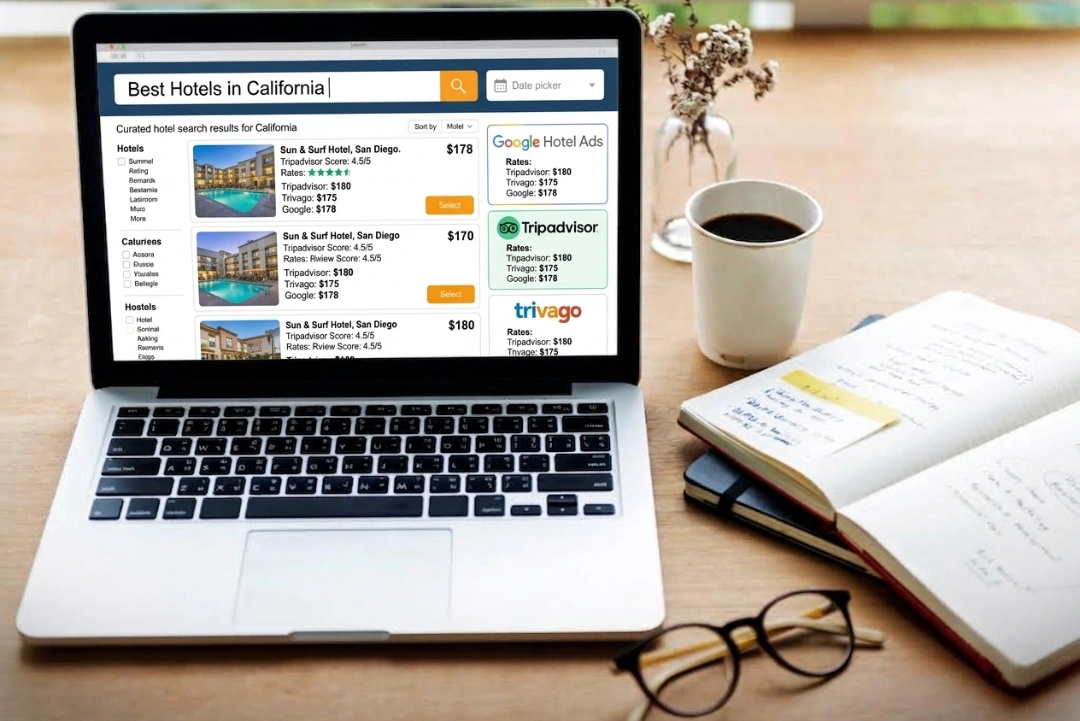
A hotel metasearch strategy is your plan for competing on comparison platforms where travelers see your direct rate next to the OTAs and wholesalers. An effective strategy displays your direct rates side by side with OTAs on platforms like Google Hotel Ads, Tripadvisor, and Trivago to capture high-intent travelers and drive direct, commission-free bookings.
It matters because metasearch is a conversion channel, not an awareness channel. A traveler on Google Hotel Ads has already chosen a destination and often a property, so the only question is which listed rate and seller wins the click. Metasearch drives a large share of ad-driven direct bookings, which is why a deliberate strategy beats simply switching a channel on. If you are new to the fundamentals, start with our guide to hotel metasearch, then use the tactics below to compete.
Why You Need A Deliberate Metasearch Strategy
Without a strategy, metasearch quietly drains the budget. You can pay for clicks that never convert, advertise a direct rate that is higher than the OTA sitting right beside it, or send expensive traffic to a slow booking page. A strategy fixes the leaks and focuses on booking yield.
The payoff is direct bookings at a lower cost than OTA commission, plus ownership of the guest relationship for future stays. The hotels that win treat metasearch as a system: pricing, bidding, conversion, and technology all working together. Miss one and the others underperform.
The 8 Core Hotel Metasearch Strategies
1. Maintain Rate Parity
Rate parity is the foundation of everything else. Ensure your direct website price matches or beats the OTA rate. If your direct rate is higher, travelers will click the OTA option, and you will have paid for a click that sends the booking to a commissioned channel. Before you advertise, check that the price in your metasearch listing matches the price in your own booking tool, and that your rates are competitive against online travel agent (OTAs) for the exact dates.
Google and other platforms also enforce strict parity and reward accuracy, so avoid frequent, erratic rate changes that make your listing show stale or inconsistent prices. Consistent, live rates protect both your ad performance and your credibility with the platform.
2. Win Beyond Price With Direct-Only Value
Parity governs the number on the screen, not the experience behind the click, so use that to your advantage. Highlight perks exclusive to direct bookings, such as free breakfast, Wi-Fi, parking, a room upgrade, or flexible cancellation, to win the click even when the price is identical or only slightly different. Member-only rates and loyalty perks are especially effective, because OTAs increasingly compete through fenced discounts rather than openly published rates. Make the direct option the obviously better deal, not just the same deal.
3. Start With Free Booking Links, Then Scale Into Paid
You do not have to buy your way in from day one. Start with free organic booking links, such as those Google offers, to capture direct clicks at no media cost, then scale into paid cost-per-click or commission-based bidding once you see which dates and platforms convert. This lowers your risk, builds a performance baseline, and ensures your first paid dollars go toward proven demand rather than guesswork.
{{booking-engine-three}}
4. Choose The Right Bidding Model
Your bidding model shapes your risk. Cost-per-click (CPC) means you pay for every click whether or not it converts, which gives control but needs active management. Commission or cost-per-acquisition (CPA) means you pay only on a completed booking, which lowers risk but offers less control over click cost.
The landscape shifted recently: Google retired commission-based bidding for Hotel Ads in February 2025, so Google now runs on CPC and smart bidding like Target ROAS or Enhanced CPC. Many third-party metasearch providers still offer performance-based, pay-after-stay arrangements. For most independents starting out, a commission or managed CPA model reduces exposure, while higher-volume properties often move to CPC for tighter cost control once they have data.
5. Optimize Bids And Budgets By Demand
A flat bid across everything wastes money. Adjust bids by device type, seasonality, and length of stay, and shift budget toward high-converting mobile traffic or high-demand dates. Push harder on the dates and segments that book, and pull back where clicks do not convert. This disciplined allocation is what separates a profitable program from one that burns budget on low-intent traffic.
6. Streamline Your Booking Engine
A slow or clunky landing page after an expensive metasearch click destroys conversion. Make sure your mobile checkout is fast, secure, and simple, because most metasearch traffic is mobile and impatient. Every extra step, slow load, or form field between the click and the confirmation is a chance to lose a booking you already paid for. A fast, frictionless hotel booking engine is one of the highest-return investments in your whole metasearch strategy.
7. Connect Your Tech Stack
Metasearch only works when your rates and inventory are live and accurate everywhere. Integrate your property management system or central reservation system directly with metasearch providers through a hotel channel manager, so prices and availability update in real time. This prevents the parity errors, overbookings, and stale rates that quietly kill performance, and it removes the manual work of updating each platform by hand.
8. Pick The Right Channels And Tailor Each One
You cannot treat every platform the same. Focus first on aggregators that specialize in accommodations, such as Google Hotel Ads, which has the largest reach and the strongest booking intent, rather than spreading thin across every option. Then tailor your approach per platform: Google Hotel Ads converts well but costs more, while Tripadvisor draws heavy traffic with lower immediate booking intent, so a lower bid and testing suit it better. To compare the tools that help you manage this across platforms, see our guide to the best hotel metasearch software.
How To Measure And Optimize Your Strategy
Metasearch should be funded as a conversion channel measured on booking yield, not an awareness channel measured on reach. Track the metrics that show whether clicks turn into profitable bookings.
Impressions and click-through rate (CTR): visibility and how compelling your listing is.
Cost-per-click (CPC) and total spend: what you pay for traffic.
Bookings, revenue, and conversion rate: how much of that traffic actually books.
Return on ad spend (ROAS) and cost of acquisition: the true profitability versus OTA commission.
Then optimize continuously. You cannot reach the top simply by lowering rates or bidding too low to stay visible, so experiment over time, adjust CPC within budget, and double down on the rates, dates, and platforms that generate the most bookings. Reaching more direct bookings is a process of steady refinement, not a one-time setup.
{{booking-engine-one}}
Common Metasearch Strategy Mistakes To Avoid
A hotel metasearch strategy is the plan for how you display your direct rate on comparison platforms like Google Hotel Ads, Trivago, and Tripadvisor, and win the click over the OTAs. The core tactics are simple: keep rate parity so your direct price is never higher than the OTAs, start with free booking links before paid bids, optimize bids by device and demand, make the direct option more attractive with perks, run a fast booking engine, and connect your hotel PMS system to metasearch through a channel manager. Done together, these turn high-intent comparison shoppers into direct, commission-free bookings.
Advertising a direct rate higher than the OTA: you pay for the click and lose the booking.
Sending traffic to a slow mobile checkout: expensive clicks that never convert.
Bidding flat across all dates and devices: budget wasted on low-intent traffic.
Skipping free booking links: paying for clicks you could have earned organically.
Manual rate updates: stale prices and parity errors that hurt visibility.
How roommaster Powers Your Metasearch Strategy
A strategy is only as good as the systems behind it. roommaster Metasearch connects your property to top metasearch channels, displays real-time rates, and can secure the "Official Site" tag to boost visibility. You can automate CPC and CPA bidding, manage budgets efficiently, and track impressions, bookings, and conversion across every channel to see which platforms earn their spend.
Because it runs on one platform, the roommaster channel manager keeps rates and inventory consistent across OTAs and metasearch, the fast direct booking engine converts the traffic you pay for, and everything syncs with the property management system so parity errors and overbookings do not undo your bids. That is the infrastructure a winning metasearch strategy needs.
Turn Your Strategy Into Direct Bookings
A hotel metasearch strategy is not about outspending the OTAs. It is about showing an accurate, competitive direct rate, making the direct option more attractive, and converting the click on a fast booking engine, all kept in sync by the right technology. Get those pieces working together and metasearch becomes one of your most cost-effective direct-booking channels.
{{cta-strip}}
Frequently Asked Questions
1. What is a hotel metasearch strategy?
A hotel metasearch strategy is your plan for displaying your direct rate on comparison platforms like Google Hotel Ads, Trivago, and Tripadvisor and winning the click over the OTAs. It covers rate parity, bidding, budget allocation, conversion, and the technology that keeps rates and inventory accurate.
2. What is the most important metasearch strategy?
Rate parity. If your direct rate is higher than the OTA rate shown beside it, travelers click the OTA and you pay for a click that becomes a commissioned booking. Getting parity right, then adding direct-only perks, is the foundation everything else builds on.
3. Should hotels use CPC or commission bidding?
It depends on volume and risk appetite. Commission or CPA models charge only on a completed booking, which suits many independents. CPC gives more control and often lower cost at scale. Note that Google retired commission bidding for Hotel Ads in 2025, so Google now uses CPC and smart bidding, while many third-party providers still offer pay-after-stay commission models.
4. How do free booking links fit into a metasearch strategy?
Free organic booking links, such as those Google offers, let you capture direct clicks at no media cost. Start there to build a performance baseline, then scale into paid CPC or commission bidding on the dates and platforms that prove they convert, so your paid budget targets real demand.
5. How do you measure a hotel metasearch strategy?
Measure it on booking yield, not reach. Track impressions, click-through rate, CPC and total spend, bookings and revenue, conversion rate, and return on ad spend. Compare the cost of acquisition against OTA commission to confirm metasearch is winning bookings more cheaply.
6. How much should a hotel spend on metasearch?
There is no fixed number, since it depends on your market, rates, and demand. Start small with free links and a modest paid budget, measure conversion and ROAS, then scale spend toward the platforms, dates, and devices that deliver profitable direct bookings.
booking-engine-one
Capture more direct bookings with a fast, reliable booking engine.
Mayela Lozano is a content strategist with a passion for hospitality and technology. She collaborates with roommaster on content creation, highlighting how technology can streamline hotel operations and enhance guest satisfaction. When she’s not creating content, Mayela loves to travel and spend time with her two little ones, discovering new adventures and making memories along the way.
Join Thousands of Hotels Thriving with roommaster
The transition to roommaster is straightforward and efficient. Our implementation team handles data migration including reservations, guest profiles, and historical information.
The transition to roommaster is straightforward and efficient. Our implementation team handles data migration including reservations, guest profiles, and historical information.
Pet-Friendly Hotel Amenities & Package Ideas That Drive Revenue
September 22, 2026
Hotel Management
Marketing
Hotel Pet Fees: How Much Should You Charge?
September 22, 2026
Hotel Management
Marketing
Pet-Friendly Hotel Guide: Policy, Fees & Amenities
September 22, 2026
Marketing
Online Bookings
Hotel Metasearch: The Complete Guide For Hotels
September 22, 2026
Hotel Management
Online Bookings
Hotel SEO Agency vs. Consultant vs. In-House
September 13, 2026
Marketing
SEO Strategies For Hospitality Websites 2026
September 13, 2026
Hotel Management
Online Bookings
Hotel SEO: Boost Your Visibility in AI Search Results
September 13, 2026
Marketing
Hotel Management
Christmas Vacation Packages: How to Design and Promote It
September 1, 2026
Online Bookings
Hotel Management
Unsold Hotel Room Inventory: A Complete Guide For Owners 2026
August 25, 2026
Online Bookings
Hotel Management
Bed Bank: A Complete Guide For Hoteliers 2026
August 25, 2026
Join Thousands of Hotels Thriving with roommaster
See how roommaster's unified platform can work for your property. Our team will walk you through features tailored to your specific needs and operations.


.png)
.png)
.png)